Sit-ups for strength
- What you see
- A PD patient does daily sit-ups.
- What is likely going on
- High intra-abdominal pressure.
- What to do
- Switch to gentle core control; ask the PD team about timing.
- Why it matters
- Straining raises hernia and leak risk.
Pressure inside a full abdomen, protecting the catheter and exit site, timing activity around dwells, and lifting, work and sport at home.

Study material for licensed occupational therapists (RA 11241) and physical therapists (RA 5680) working with people who have kidney disease. It explains the reasoning behind renal rehabilitation; it is not a hospital protocol. It never authorizes changes to dialysis settings, handling of a needled access or catheter, medicine decisions or benefit promises. Exercise parameters come from the referring physician and your unit’s agreed sheet: per unit protocol, but always ask the attending nephrologist’s guidance. Every case, name and number in the cases is fictional and illustrative.
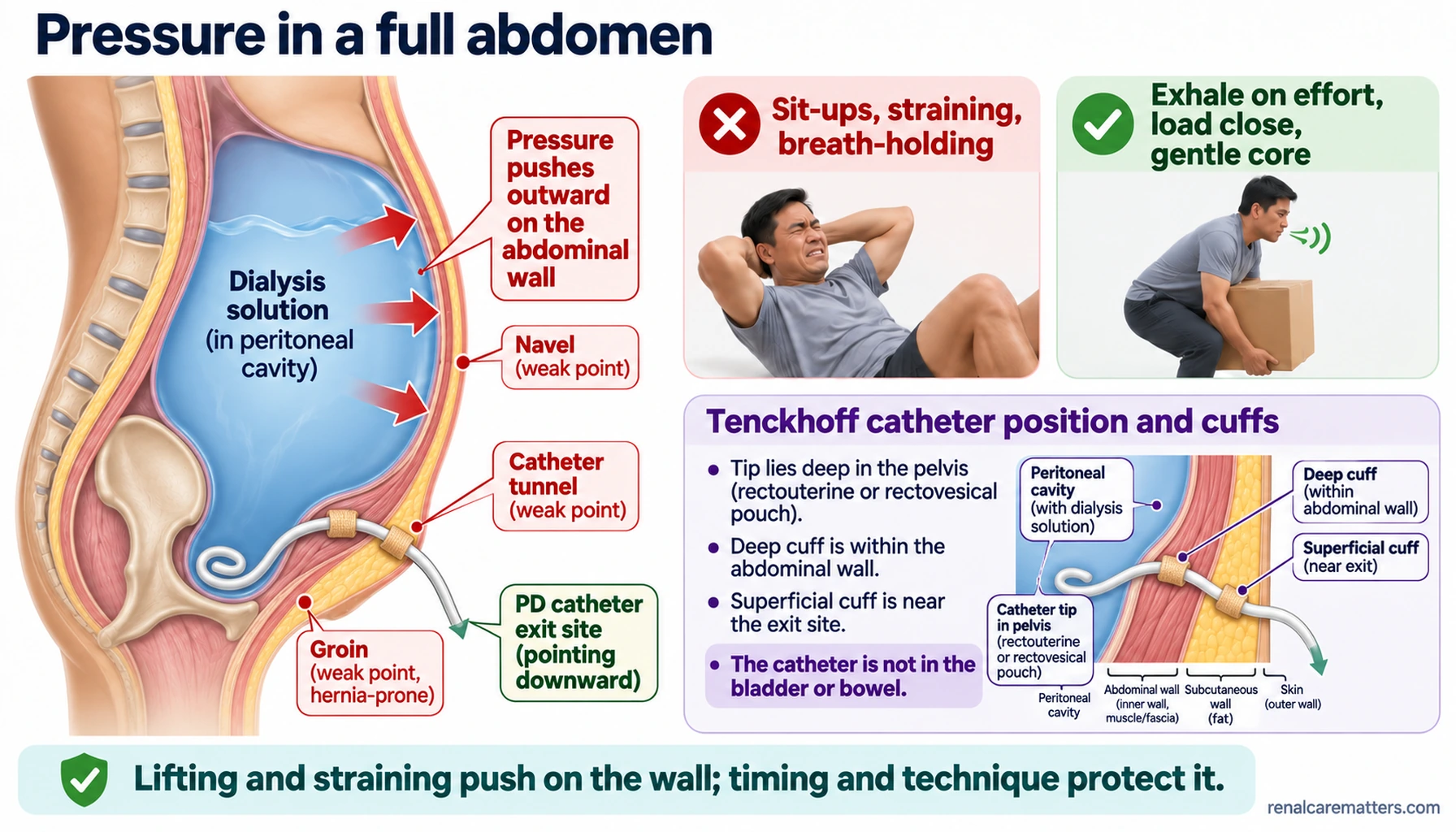
The picture has a limit. A filter sits still. The abdomen does not: it is a pressurized container with muscular walls, and anything that tightens those walls (lifting, straining, coughing, sit-ups) raises the pressure inside. With two liters of fluid on board, that pressure is higher still. Over time, high pressure can push fluid or bowel through weak spots in the wall, causing a hernia or a leak around the catheter. So the question for you is not whether a person on PD can be active (they should be) but how to time and shape activity so the abdominal wall is protected.
The International Society for Peritoneal Dialysis (ISPD) and the Global Renal Exercise Network (GREX) published practice recommendations on physical activity in PD. They cover timing after catheter insertion, exercising with the abdomen empty or full, work, sex, swimming and core exercise, exit-site care, perspiration, fatigue and intra-abdominal pressure. The authors are explicit that quality evidence is sparse, so most points rest on expert and patient consensus.1
Figure 2 · Key terms for this module
Friday, 1:00 p.m. Mr. Ronaldo “Nonoy” Bautista, 45, drives a tricycle in Bulacan and helps load 25-kilogram sacks of rice at his brother’s store. His PD catheter was inserted eight weeks ago and he started continuous ambulatory PD four weeks ago, with four exchanges a day. He asks occupational therapist (OT) Bea Santiago and physical therapist (PT) Carlo Dizon: “When can I go back to driving and lifting? I need the money.”
His PD nurse mentions that his exit site was red last week and is now healing. He has been doing sit-ups “to make my stomach strong.” He showers in a bathroom where the water often splashes his dressing.
Before reading on, decide:
Keep your answers in mind. The lesson gives you what you need, and the case review near the end shows one sound response.
Intra-abdominal pressure rises whenever the abdominal muscles contract against a closed throat: lifting heavy objects, straining at stool, coughing hard, and full sit-ups or crunches. Lying flat with a full dwell also raises it more than standing or walking. Repeated high pressure stresses the abdominal wall at its weak points (the navel, the groin, old incisions, the catheter tunnel), which is where hernias and fluid leaks occur.
The practical rules follow from the mechanism: lift close to the body, breathe out during the effort rather than holding the breath, avoid straining, prefer gentle core activation (drawing in the lower abdomen, pelvic tilts) over sit-ups and crunches, and plan heavier work with the abdomen drained or carrying a smaller volume if the PD team agrees.
The exit site is a permanent opening in the skin. Infection there can track along the catheter into the abdomen and cause peritonitis, a serious and sometimes catheter-ending complication. Your precautions are simple and constant:
Ask the PD team three questions first: How long after catheter insertion before heavier lifting and core work? Should heavier tasks be done with the abdomen drained or with a smaller fill? Are there swimming or contact-sport restrictions for this person?
Occupational therapy also looks at the exchange routine itself: where it is done, light, cleanliness, a table at the right height, a place for supplies, and how the day’s work fits around four exchanges or an overnight machine. The PD nurse teaches and signs off the exchange technique; you shape the setting and the schedule around it.
These are fictional but typical. For each one, cover the answer, decide what you would do, then compare. Where a step depends on local rules, your unit’s procedure and your supervisor’s direction come first.
The physiology. Sit-ups and heavy lifting raise intra-abdominal pressure, more so with a full dwell, stressing the abdominal wall and the catheter tunnel and raising the risk of hernia and leak. His sit-ups are well meant but the wrong exercise.
Questions for the PD team. When heavier lifting and core work are allowed after his catheter insertion; whether to lift drained or at a lower fill; the showering and swimming rule; and whether the healing exit site changes anything. The splashed dressing goes to the PD nurse now.
A staged return. Walking and gentle core control now, driving when he can do it comfortably and the PD team agrees, graded lifting when cleared, and a redesigned loading job (platform, trolley, two-person carry for 25-kilogram sacks, loading after a drain).
Plan activity and work with a simulated PD patient, with the PD nurse role played by a colleague. Your preceptor rates each step as satisfactory, needs practice, or not observed. Steps marked Critical must all be satisfactory before sign-off. This checklist supports supervised learning; your unit’s own procedure and competency form are the authority. A printable version of every checklist is on the trainer page.
Each visit draws 5 questions at random from this module’s 10-question bank. Choose the single best answer for each, then select Check answers; an explanation appears under the best answer. Select New set of questions for a different mix. A good target is 4 of 5 on two different sets. Nothing you select is sent anywhere; scoring happens in your browser.

Internal Medicine · Nephrology · Nutrition · Philippines · PRC 0105184
Educational material for licensed occupational and physical therapists. Completing it is an Academy learning record only. It is not a PRC, DOH, PhilHealth or PSN credential, not CPD units, and not a workplace privilege. Your license, your referral or prescription, your employer’s privileges and the renal team’s plan govern what you may do.

Scan and save