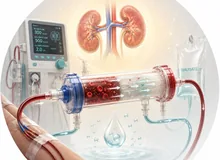
When and how to exercise in the chair, what DiaTT and PEDAL each showed, and how to build a program patients actually keep.
PublishedNailathalaGipatikPepalwal:ReferencesMga SanggunianMga TinubdanReng Reperensya:3Audience: Philippine-registered occupational therapists and physical therapists who see people with kidney disease · rehabilitation leads, physiatrists and renal teams who refer to them · students on an observer pathwayRead timeOras ng pagbasaOras sa pagbasaOras ning pamamasa:
Renal rehabilitation track for licensed occupational and physical therapists
Study material for licensed occupational therapists (RA 11241) and physical therapists (RA 5680) working with people who have kidney disease. It explains the reasoning behind renal rehabilitation; it is not a hospital protocol. It never authorizes changes to dialysis settings, handling of a needled access or catheter, medicine decisions or benefit promises. Exercise parameters come from the referring physician and your unit’s agreed sheet: per unit protocol, but always ask the attending nephrologist’s guidance. Every case, name and number in the cases is fictional and illustrative.
Learning objectives
After this module you should be able to
Explain why exercise during dialysis is attractive and what hemodynamic risks it must respect.
Summarize the three largest trials of exercise during hemodialysis (HD), Dialysis Training Therapy (DiaTT), PrEscription of intraDialytic exercise to improve quAlity of Life (PEDAL) and CYCLE-HD, including what each did and did not show.
Explain why the trials disagreed, and use that to design a program patients will keep.
Set up intradialytic exercise safely with the nurse: timing, position, access protection and stop rules.
Measure the program with a sit-to-stand test and track adherence.
Classroom 2 hSkills lab 2 hSupervised placement 1 h
Pre-testBefore you read, answer the 5 self-assessment questions and note your score. After the module, select New set of questions and compare. The difference is what you learned; the questions you still miss are what to reread.
Start here
The big picture, in plain words
In plain wordsTwelve hours a week in a dialysis chair is like a long bus ride three times a week. You cannot get off, but you can stretch your legs. Intradialytic exercise turns dead time into training time, without asking the patient for an extra trip or an extra hour.
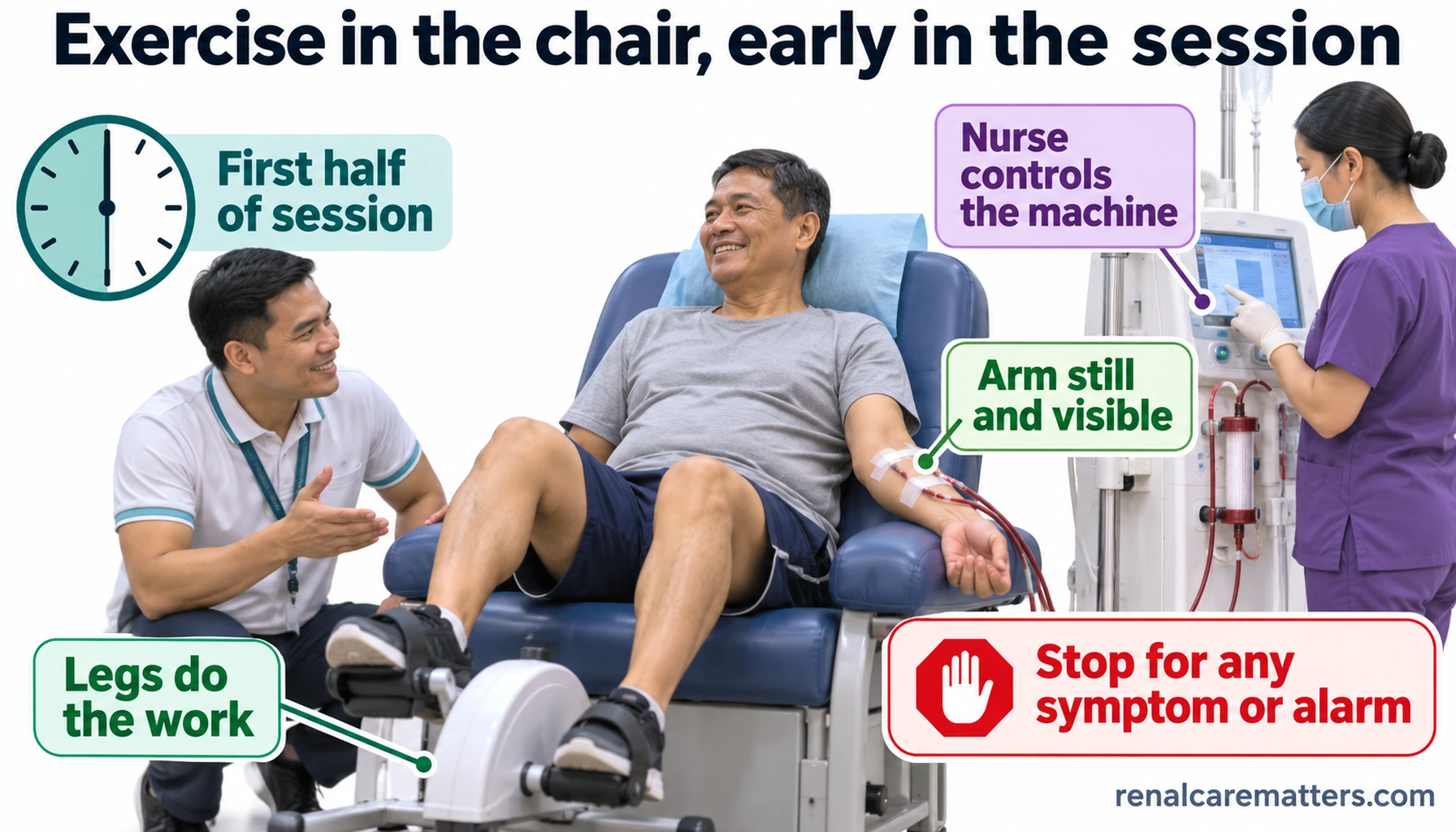
The picture has a limit. On a bus, nothing is being taken out of your blood. During hemodialysis, two to three liters of fluid may be removed, the blood is outside the body in the circuit, and blood pressure can fall. Exercise also sends blood to working muscles. So timing and position matter: most programs exercise in the first half of the session, before much fluid has been removed and before pressure is likely to fall, with the legs doing the work and the access arm still.
Figure 1. Exercise in the chair, early in the session, with the nurse and the plan.
This module is shared between occupational therapist (OT) and physical therapist (PT), with the PT leading the exercise prescription. The nurse controls the session and the machine; nothing you do changes either.
Figure 2 · Key terms for this module
Intradialytic exerciseExercise performed during the dialysis session.
Bed or pedal cycleA small cycle ergometer fixed to the foot of the chair.
AdherenceDoing the prescribed amount; not the same as attending.
60-second sit-to-stand test (STS60)Full chair rises in 60 seconds; the main outcome of the DiaTT trial.
Surrogate outcomeA measurement (such as heart mass) used in place of an outcome patients feel.
Opening case · fictional
Case: Twelve chairs and one bike
Monday, 7:30 a.m. The Santa Maria Kidney Center has received two donated pedal cycles. Dr. Ramon Uy asks PT Carlo Dizon to “start an exercise program on the morning shift: 12 chairs.” The head nurse is supportive but worried: “Last time a patient fainted on a bike. And who will set them up? My nurses have their hands full at the start of the shift.”
Carlo has read about a British trial in which patients cycled during dialysis for six months and quality of life did not improve, and a German trial in which a year of exercise during dialysis improved function. A patient, Mrs. Carmen Velasco, 61, asks him: “Will this make me live longer?”
Before reading on, decide:
What did each trial show, and why might they disagree?
How would you design the program so patients keep doing it?
What do you say to Mrs. Velasco?
Keep your answers in mind. The lesson gives you what you need, and the case review near the end shows one sound response.
Lesson · part 1
What the major trials showed
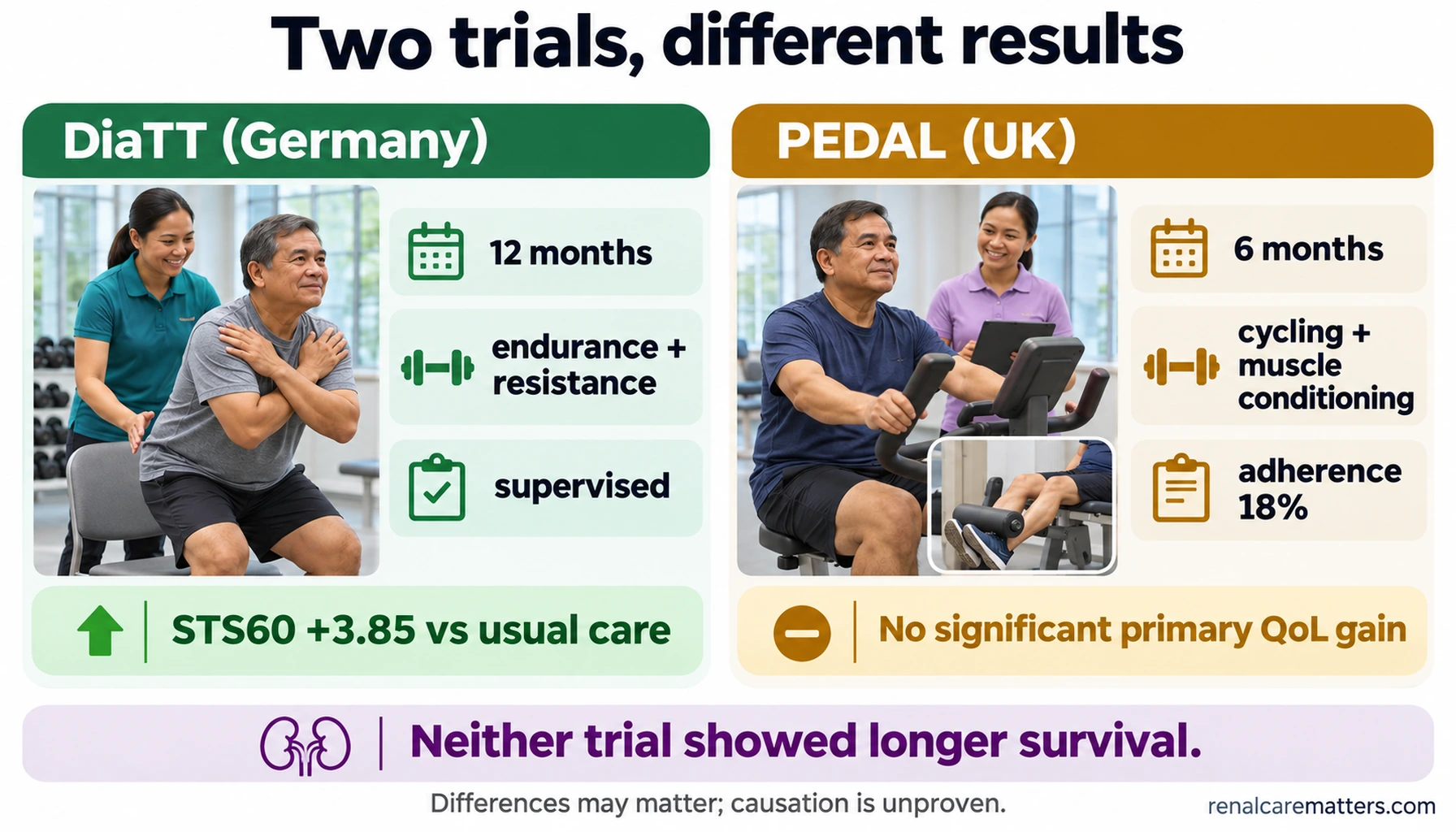
DiaTT (Germany). In a cluster-randomized trial across dialysis units, 1,211 patients were randomized and 917 analyzed (mean age 66). The intervention was 12 months of combined endurance and resistance training during dialysis, supervised by trained staff. The STS60 improved from 16.2 to 19.2 repetitions with exercise and fell from 16.2 to 14.7 with usual care: a difference of 3.85 repetitions (95 percent confidence interval 2.22 to 5.48). The Timed Up and Go improved by 1.1 seconds and the six-minute walk by 37.5 meters, and the physical summary and vitality scores of a quality-of-life questionnaire improved. Adverse events during sessions were similar in both groups. Median hospital days per year were 2 with exercise and 5 with usual care, a secondary outcome. Mortality was not affected.1
PEDAL (United Kingdom). In a randomized trial of 379 patients on hemodialysis for more than a year, six months of intradialytic cycling did not significantly improve the physical component of a kidney-specific quality-of-life questionnaire (difference 2.4 units, 95 percent confidence interval −0.1 to 4.8; P = 0.055), and peak oxygen uptake and other secondary outcomes did not improve. Compliance was 47 percent and adherence to the prescription only 18 percent. Harms were similar between groups.2
CYCLE-HD (United Kingdom). In a cluster-randomized trial (130 recruited, 101 completed), six months of intradialytic cycling reduced left ventricular mass on cardiac magnetic resonance imaging (MRI) by 11.1 grams versus control and reduced measures of myocardial fibrosis and aortic stiffness, without increasing arrhythmias. Physical function and quality of life did not change.3 Heart mass is a surrogate: a plausible marker of cardiac risk, not a demonstrated reduction in heart attacks or deaths.
Figure 3. Why two trials disagreed. Duration, resistance training and adherence made the difference.
RememberSupervised, combined, year-long training improved function. Short, cycling-only programs with poor adherence did not. Neither has shown longer survival.
Lesson · part 2
Why the trials disagreed, and what that means for your program
When good trials disagree, the differences between them teach more than either result alone.
Feature
DiaTT (positive for function)
PEDAL (null for quality of life)
Duration
12 months
6 months
Type
Endurance plus resistance
Cycling (aerobic) only
Primary outcome
STS60 (physical function)
Kidney quality-of-life physical score
Delivery
Supervised by trained exercise staff
Prescribed; adherence 18 percent
The lessons for your unit follow directly. Include resistance work, not only cycling. Plan for a year, not a few weeks. Supervise and coach: an exercise that nobody sets up does not happen. Measure what exercise most directly changes (function) as well as what patients value most (how they feel), and do not promise more than the evidence shows.
RememberDesign for adherence. A perfect prescription done 18 percent of the time is a weak prescription.
Lesson · part 3
Setting up intradialytic exercise safely
Figure 4 · Chairside set-up with the nurse
SelectWith the nephrologist and head nurse, agree who is eligible (stable sessions, no recent hypotension in the chair) and who is not, per unit protocol.
ScreenBefore each session, the nurse confirms stability; you run your screen (Module 3).
TimeStart after the nurse has connected and the session is running smoothly; exercise in the first half; stop well before the end.
PositionLegs do the work; the access arm stays still and visible, needles taped, lines free of the pedals.
DoseWarm up 2 to 5 minutes; cycle at rating of perceived exertion (RPE) 11 to 13 progressing toward 30 minutes; add leg resistance (ankle weights, bands, straight-leg raises) on alternate sessions.
StopAny symptom, alarm, needle movement, or the nurse’s request; nurse checks pressure.
CleanWipe the cycle and bands with the approved disinfectant between patients (Module 4).
Nurses are busiest at connection and disconnection. A program that relies on nurses to set up bikes during those minutes will fail. Agree a time slot (for example, 30 to 90 minutes into the session) and who does the set-up: you, a trained exercise assistant, or the patient themselves after training.
Stop and reportStop pedaling and call the nurse at once for dizziness, yawning, nausea, cramps, chest discomfort, breathlessness, a machine alarm, any movement of a needle or blood on the dressing, or if the nurse asks. You never silence an alarm or touch the machine or lines.
Lesson · part 4
Measuring the program and keeping it going
Use the STS60 or the five-times sit-to-stand at baseline and every three months, on a non-dialysis day or before a session, under standard conditions. The sit-to-stand change tracker shows each patient’s change, with the DiaTT between-group difference (3.85 repetitions over 12 months) as context, not as an individual target. Track adherence too: sessions offered, sessions done, minutes done. A unit run chart (Module 19) shows whether the program is working at scale.
Illustrative 3-month report, morning shift (12 eligible patients). Sessions offered 432; sessions with any exercise 302 (70 percent); median minutes per session 18. Median STS60 13 at baseline, 15 at 3 months. Two sessions stopped for dizziness, both resolved with the nurse. Plan: add resistance on alternate days; patient champions for the afternoon shift.
RememberReport adherence beside outcomes. Low adherence explains a weak result better than any other variable.
On the floor
Real situations: problems and solutions
These are fictional but typical. For each one, cover the answer, decide what you would do, then compare. Where a step depends on local rules, your unit’s procedure and your supervisor’s direction come first.
The bike nobody sets up
What you see
Donated cycles sit unused because nurses are busy at connection.
What is likely going on
A delivery problem, not an evidence problem.
What to do
Agree a time slot and who sets up; train patients.
Why it matters
Adherence decides results.
Yawning on the bike
What you see
A patient yawns and feels nauseated 2 hours into the session while cycling.
What is likely going on
Possible falling blood pressure.
What to do
Stop and call the nurse.
Why it matters
Hypotension during dialysis can escalate quickly.
“Will I live longer?”
What you see
A patient asks if chair exercise prolongs life.
What is likely going on
A fair question.
What to do
Say what trials show (function, fewer hospital days in one trial) and what they do not (survival).
Why it matters
Honest answers build trust.
Field notes
Exercise in the first half of the session.
Keep pedals clear of the lines.
Track sessions offered and done.
Include leg resistance, not only cycling.
Case review
Back to the case: Twelve chairs and one bike
The trials. DiaTT (12 months, supervised, endurance plus resistance) improved STS60 by 3.85 repetitions versus usual care, with fewer hospital days as a secondary finding and no effect on mortality. PEDAL (6 months, cycling only, 18 percent adherence) did not improve quality of life. CYCLE-HD reduced heart mass, a surrogate, without changing function. They differ in duration, exercise type, supervision and outcome.
Designing for adherence. Carlo proposes a fixed time slot after connection, set-up by him or a trained assistant rather than the nurses, a combined cycling and leg-resistance program, patient champions, and a plan for at least a year. He agrees eligibility and stop rules with Dr. Uy and the head nurse, and adds cleaning of the cycles between patients.
Mrs. Velasco’s question. “The best studies show that exercise during dialysis helps people get stronger, stand up more easily and walk further, and in one large study people spent fewer days in hospital. We don’t yet have proof that it makes people live longer. Most people who stay with it say they feel better.”
Skills lab · with your preceptor
Skills checklist: Intradialytic exercise set-up
Set up and supervise simulated intradialytic exercise with a dialysis nurse playing the nurse role. Your preceptor rates each step as satisfactory, needs practice, or not observed. Steps marked Critical must all be satisfactory before sign-off. This checklist supports supervised learning; your unit’s own procedure and competency form are the authority. A printable version of every checklist is on the trainer page.
CriticalConfirms eligibility and the nurse’s go-ahead for this session.
CriticalPositions the cycle so pedals and lines do not touch, and the access arm stays still and visible.
Times the exercise in the first half of the session and states why.
Delivers warm-up and dose by RPE, and adds leg resistance work.
CriticalStates and applies the stop rules; never touches the machine, alarms or lines.
CriticalCleans the equipment between patients.
Records minutes, RPE, any stop and the reason.
Placement activity. Run or observe a two-week pilot on one shift; report sessions offered, sessions done, minutes, stops and reasons.
Self-assessment
Check your understanding
Each visit draws 5 questions at random from this module’s 10-question bank. Choose the single best answer for each, then select Check answers; an explanation appears under the best answer. Select New set of questions for a different mix. A good target is 4 of 5 on two different sets. Nothing you select is sent anywhere; scoring happens in your browser.
Anding-Rost, K., von Gersdorff, G., von Korn, P., Ihorst, G., Josef, A., Kaufmann, M., Huber, M., Bär, T., Zeißler, S., Höfling, S., Breuer, C., Gärtner, N., Haykowsky, M. J., Degenhardt, S., Wanner, C., & Halle, M. (2023). Exercise during hemodialysis in patients with chronic kidney failure. NEJM Evidence, 2(9), EVIDoa2300057. https://doi.org/10.1056/EVIDoa2300057
Greenwood, S. A., Koufaki, P., Macdonald, J. H., Bhandari, S., Burton, J. O., Dasgupta, I., Farrington, K., Ford, I., Kalra, P. A., Kean, S., Kumwenda, M., Macdougall, I. C., Messow, C.-M., Mitra, S., Reid, C., Smith, A. C., Taal, M. W., Thomson, P. C., Wheeler, D. C., White, C., Yaqoob, M., & Mercer, T. H. (2021). Randomized trial—PrEscription of intraDialytic exercise to improve quAlity of Life in patients receiving hemodialysis. Kidney International Reports, 6(8), 2159–2170. https://doi.org/10.1016/j.ekir.2021.05.034
Graham-Brown, M. P. M., March, D. S., Young, R., Highton, P. J., Young, H. M. L., Churchward, D. R., Dungey, M., Stensel, D. J., Bishop, N. C., Brunskill, N. J., Smith, A. C., McCann, G. P., McConnachie, A., & Burton, J. O. (2021). A randomized controlled trial to investigate the effects of intra-dialytic cycling on left ventricular mass. Kidney International, 99(6), 1478–1486. https://doi.org/10.1016/j.kint.2021.02.027
Educational material for licensed occupational and physical therapists. Completing it is an Academy learning record only. It is not a PRC, DOH, PhilHealth or PSN credential, not CPD units, and not a workplace privilege. Your license, your referral or prescription, your employer’s privileges and the renal team’s plan govern what you may do.