AKI Hospitalization and Recovery After Critical Illness
Intensive care unit-acquired weakness, early mobility with lines in place, and why recovery from AKI and critical illness takes months.
PublishedNailathalaGipatikPepalwal:ReferencesMga SanggunianMga TinubdanReng Reperensya:2Audience: Philippine-registered occupational therapists and physical therapists who see people with kidney disease · rehabilitation leads, physiatrists and renal teams who refer to them · students on an observer pathwayRead timeOras ng pagbasaOras sa pagbasaOras ning pamamasa:
Renal rehabilitation track for licensed occupational and physical therapists
Study material for licensed occupational therapists (RA 11241) and physical therapists (RA 5680) working with people who have kidney disease. It explains the reasoning behind renal rehabilitation; it is not a hospital protocol. It never authorizes changes to dialysis settings, handling of a needled access or catheter, medicine decisions or benefit promises. Exercise parameters come from the referring physician and your unit’s agreed sheet: per unit protocol, but always ask the attending nephrologist’s guidance. Every case, name and number in the cases is fictional and illustrative.
Learning objectives
After this module you should be able to
Explain intensive care unit-acquired weakness and post-intensive care syndrome, and why recovery takes months.
Summarize the evidence for early physical and occupational therapy in critical illness.
Progress early mobility safely with dialysis catheters and continuous kidney replacement therapy lines in place, with the team.
Plan discharge function after acute kidney injury (AKI), including home, follow-up and the possibility of ongoing dialysis.
Recognize when to stop and call during acute-care rehabilitation.
Classroom 2 hSkills lab 2 hSupervised placement 1 h
Pre-testBefore you read, answer the 5 self-assessment questions and note your score. After the module, select New set of questions and compare. The difference is what you learned; the questions you still miss are what to reread.
Start here
The big picture, in plain words
In plain wordsCritical illness is like a storm that strips a house to the frame. The patient survives, but muscle, strength, memory and confidence have been torn away in days. Rebuilding takes months, and it starts before the storm is fully over.
The picture has a limit. A house does not lose more of itself while it waits to be rebuilt. A critically ill patient does: in bed, under sedation, with inflammation driving muscle breakdown, a person loses muscle within days, and the loss is fastest early. Acute kidney injury (AKI) adds its own catabolism, fluid overload and sometimes dialysis. That is why rehabilitation starts in the intensive care unit (ICU), not after discharge.
The evidence for starting early is among the strongest in rehabilitation. In a randomized trial of 104 sedated, mechanically ventilated adults, early physical and occupational therapy during daily sedation breaks increased the share who returned to independent function at hospital discharge from 35 to 59 percent (odds ratio 2.7), shortened delirium and increased ventilator-free days. There was one serious adverse event in 498 sessions.1 The trial was small and not specific to AKI, but its message is clear: early, structured mobility is safe and helps function.
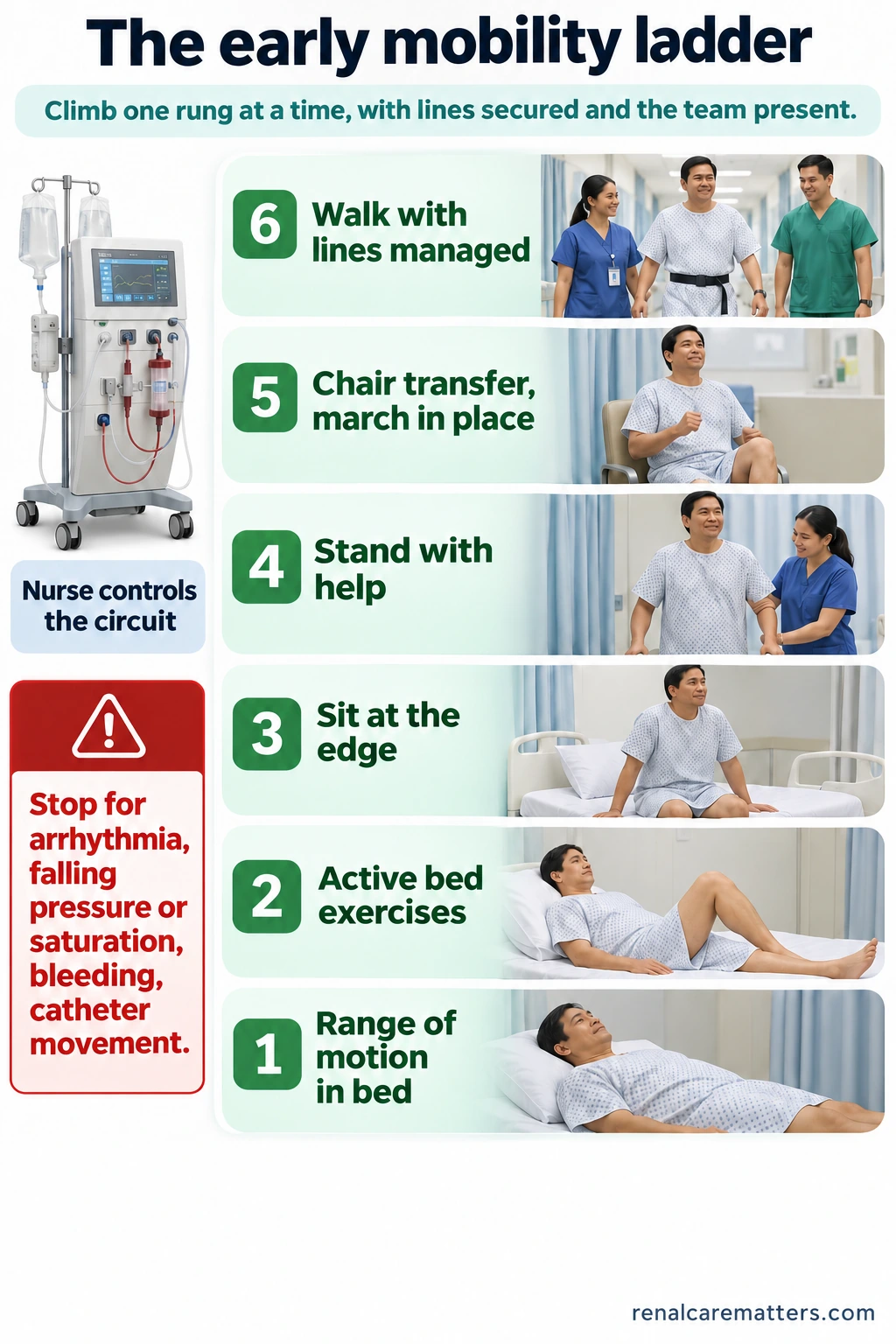
Figure 1. The early mobility ladder. Climb one rung at a time, with lines secured and the team present.
Figure 2 · Key terms for this module
ICU-acquired weaknessSymmetric limb weakness from critical illness affecting muscle and nerve.
Post-intensive care syndrome (PICS)New or worse physical, cognitive or mental-health problems after critical illness.
continuous renal replacement therapy (CRRT)Continuous kidney replacement therapy: slow, round-the-clock dialysis in the ICU.
Early mobilityStructured, progressive activity started as soon as the patient is stable enough.
AKI recoveryPartial or full return of kidney function after acute injury; some patients remain on dialysis.
Opening case · fictional
Case: Bed to chair with lines in place
Day 9 in the ICU, 10:00 a.m. Mr. Arnel Domingo, 49, a delivery rider, was admitted with severe dengue complicated by shock and AKI. He was ventilated for five days and is now extubated and awake but very weak. He is on continuous kidney replacement therapy through a right internal jugular dialysis catheter. He can lift his arms against gravity but not his legs, and he is frightened: “Will I walk again? Will I need dialysis forever?”
The ICU team has asked physical therapist (PT) Carlo Dizon and occupational therapist (OT) Bea Santiago to start mobility. The nurse says the CRRT circuit “keeps clotting when he moves.”
Before reading on, decide:
What causes his weakness, and how long might recovery take?
How do you progress mobility with a neck catheter and CRRT running?
How do you answer his two questions honestly?
Keep your answers in mind. The lesson gives you what you need, and the case review near the end shows one sound response.
Lesson · part 1
Why critical illness strips muscle and mind
Several processes work together. Inflammation and stress hormones drive rapid muscle protein breakdown. Immobility removes the main signal that maintains muscle. Critical illness also damages nerves and muscle directly (critical illness polyneuropathy and myopathy). Sedatives and delirium cloud the brain; some patients leave with lasting memory or attention problems, anxiety or depression. Together these make up post-intensive care syndrome.
Recovery is slow. In survivors of acute respiratory distress syndrome followed for five years, median six-minute walk distance was still only 76 percent of predicted and the physical quality-of-life score remained below normal, even though lung function had returned to near normal.2 That cohort was not an AKI cohort, but many of your AKI patients share its pathway through the ICU.
RememberWeakness after critical illness is common and slow to recover. Start early, plan for months, and say so to the family.
Lesson · part 2
Early mobility with catheters and CRRT
Early mobility is a team procedure. The ICU nurse controls the CRRT machine and the lines; you control the movement. Agree before each session:
Stability: the ICU team confirms the patient is stable enough today and what to watch.
Lines: who secures the dialysis catheter and the CRRT lines, and how much slack there is. Femoral catheters limit hip flexion; internal jugular catheters limit neck movement. Clotting of the circuit with movement is a known problem; the nurse may pause or adjust the machine, never you.
Roles: one person leads the count; one watches the lines; one watches the monitor.
Progression: the mobility ladder below, one rung at a time.
Figure 3 · The early mobility ladder
1Passive and active-assisted range of motion in bed; positioning.
2Active exercises in bed; sitting up in bed.
3Sitting at the edge of the bed with support; sitting balance.
4Standing with assistance or a standing aid.
5Transfer to a chair; marching in place.
6Walking with assistance and the lines managed.
Stop and callStop and call the ICU team for new arrhythmia, chest pain, a sharp fall in blood pressure or oxygen saturation, new confusion or agitation, bleeding at the catheter site, catheter dislodgement, or a circuit alarm that the nurse asks you to stop for. Never disconnect, clamp or reposition a line yourself.
Lesson · part 3
From ward to home: planning function after AKI
Recovery continues on the ward and at home. The OT focuses on self-care, cognition (many patients have attention and memory problems after ICU), energy and the home; the PT on strength, walking, stairs and endurance. Some patients recover kidney function; some remain dependent on dialysis for weeks or permanently. Your plan must work for both: a patient who will attend outpatient dialysis three times a week needs a different week (Module 6) and transport plan from one who will not.
Illustrative discharge plan for Mr. Domingo. Function at discharge: walks 40 meters with a walker, Short Physical Performance Battery (SPPB) 4, needs help with bathing, short attention span. Kidney status: still dialysis-dependent at discharge; outpatient hemodialysis three times a week pending recovery. Plan: walker and shower chair; home exercise program 15 minutes twice daily; family taught safe transfers; OT routine with written cues; outpatient PT and OT, scheduled on non-dialysis days; reassessment at 4 and 12 weeks; no return to motorcycle riding until strength, balance, cognition and the physician allow.
RememberWrite the discharge plan for both possibilities: kidneys recover, or dialysis continues.
On the floor
Real situations: problems and solutions
These are fictional but typical. For each one, cover the answer, decide what you would do, then compare. Where a step depends on local rules, your unit’s procedure and your supervisor’s direction come first.
The circuit clots
What you see
The CRRT circuit alarms when the patient sits up.
What is likely going on
Catheter position and flow change with movement.
What to do
Stop; the ICU nurse manages the circuit; agree a different position or time.
Why it matters
Only the nurse touches the machine.
“Too sick for therapy”
What you see
A stable, extubated patient has had no mobility for a week.
What is likely going on
Missed early mobility.
What to do
Ask the team for a mobility plan today.
Why it matters
Early mobility improves function at discharge.
Home on dialysis
What you see
A patient is discharged still dialysis-dependent after AKI.
What is likely going on
Uncertain kidney recovery.
What to do
Plan the week around outpatient dialysis and arrange follow-up therapy.
Why it matters
Plans must fit both possible futures.
Field notes
Assign a line watcher at every ICU session.
Climb the mobility ladder one rung at a time.
Tell families recovery takes months.
Write discharge plans for recovery and for continued dialysis.
Case review
Back to the case: Bed to chair with lines in place
His weakness. ICU-acquired weakness from inflammation-driven muscle breakdown, immobility and possible critical illness nerve and muscle injury, worsened by shock and AKI. Recovery takes months; some deficits may persist.
Mobility with lines. With the ICU nurse controlling the CRRT and securing the right internal jugular catheter, Carlo and Bea work up the ladder: bed exercises, then sitting at the edge with neck movement limited and lines slack, then standing when he can. The nurse may pause or adjust the circuit around movement; they never touch the lines or the machine.
His questions. “Most people your age who get this weak in the ICU walk again, but it takes weeks to months, and we will start today.” On dialysis: “Many people recover kidney function after dengue-related AKI, but not all, and not always quickly. Your kidney doctors will check regularly. We will plan for both.” The kidney prognosis itself belongs to the nephrologist; Carlo and Bea make sure he asks.
Skills lab · with your preceptor
Skills checklist: Early mobility with kidney replacement therapy
Lead a simulated early mobility session with a mannequin and a colleague playing the ICU nurse. Your preceptor rates each step as satisfactory, needs practice, or not observed. Steps marked Critical must all be satisfactory before sign-off. This checklist supports supervised learning; your unit’s own procedure and competency form are the authority. A printable version of every checklist is on the trainer page.
CriticalConfirms stability and the plan with the ICU team before starting.
CriticalAssigns roles: lead, line watcher, monitor watcher.
Identifies catheter site and the movement limits it imposes.
Progresses one rung of the mobility ladder with clear counts and cues.
CriticalStates the stop-and-call triggers; never touches the CRRT circuit or lines.
Explains post-intensive care syndrome and expected recovery time to the patient or family.
Drafts a discharge plan covering both kidney recovery and continued dialysis.
Placement activity. Observe or join two ICU mobility sessions with patients on kidney replacement therapy, and write a reflective note on line management.
Self-assessment
Check your understanding
Each visit draws 5 questions at random from this module’s 10-question bank. Choose the single best answer for each, then select Check answers; an explanation appears under the best answer. Select New set of questions for a different mix. A good target is 4 of 5 on two different sets. Nothing you select is sent anywhere; scoring happens in your browser.
Schweickert, W. D., Pohlman, M. C., Pohlman, A. S., Nigos, C., Pawlik, A. J., Esbrook, C. L., Spears, L., Miller, M., Franczyk, M., Deprizio, D., Schmidt, G. A., Bowman, A., Barr, R., McCallister, K. E., Hall, J. B., & Kress, J. P. (2009). Early physical and occupational therapy in mechanically ventilated, critically ill patients: A randomised controlled trial. The Lancet, 373(9678), 1874–1882. https://doi.org/10.1016/S0140-6736(09)60658-9
Herridge, M. S., Tansey, C. M., Matté, A., Tomlinson, G., Diaz-Granados, N., Cooper, A., Guest, C. B., Mazer, C. D., Mehta, S., Stewart, T. E., Kudlow, P., Cook, D., Slutsky, A. S., Cheung, A. M., & Canadian Critical Care Trials Group. (2011). Functional disability 5 years after acute respiratory distress syndrome. The New England Journal of Medicine, 364(14), 1293–1304. https://doi.org/10.1056/NEJMoa1011802
Educational material for licensed occupational and physical therapists. Completing it is an Academy learning record only. It is not a PRC, DOH, PhilHealth or PSN credential, not CPD units, and not a workplace privilege. Your license, your referral or prescription, your employer’s privileges and the renal team’s plan govern what you may do.