Why dialysis days drain people, recovery time after a session, the deconditioning spiral, and energy budgeting that protects what matters most.
PublishedNailathalaGipatikPepalwal:ReferencesMga SanggunianMga TinubdanReng Reperensya:4Audience: Philippine-registered occupational therapists and physical therapists who see people with kidney disease · rehabilitation leads, physiatrists and renal teams who refer to them · students on an observer pathwayRead timeOras ng pagbasaOras sa pagbasaOras ning pamamasa:
Renal rehabilitation track for licensed occupational and physical therapists
Study material for licensed occupational therapists (RA 11241) and physical therapists (RA 5680) working with people who have kidney disease. It explains the reasoning behind renal rehabilitation; it is not a hospital protocol. It never authorizes changes to dialysis settings, handling of a needled access or catheter, medicine decisions or benefit promises. Exercise parameters come from the referring physician and your unit’s agreed sheet: per unit protocol, but always ask the attending nephrologist’s guidance. Every case, name and number in the cases is fictional and illustrative.
Learning objectives
After this module you should be able to
Explain the main contributors to fatigue in kidney failure and why it worsens after dialysis sessions.
Ask about and record post-dialysis recovery time, and explain what it is associated with.
Describe the deconditioning spiral and how pacing and graded activity interrupt it.
Build an energy budget for a dialysis week that protects the activities the person values most.
Recognize fatigue patterns that need medical review rather than a pacing plan.
Classroom 2 hSkills lab 2 hSupervised placement 1 h
Pre-testBefore you read, answer the 5 self-assessment questions and note your score. After the module, select New set of questions and compare. The difference is what you learned; the questions you still miss are what to reread.
Start here
The big picture, in plain words
In plain wordsThink of energy as a phone battery. A healthy person starts the day at 100 percent and charges overnight. A person on hemodialysis starts at 60 percent, loses a large chunk during a session, and charges slowly. If they spend the morning’s charge on chores, there is nothing left for the evening with the grandchildren.
The picture has a limit. A phone battery only drains. Human energy also grows with use: muscles that work become more efficient, and a heart that is trained delivers oxygen better. Resting all the time keeps the battery small. So the answer to fatigue is not simply rest; it is planned rest and planned activity, spent on what matters, with capacity built up over weeks.
Fatigue is the most common symptom in dialysis. A systematic review of 59 studies found a weighted average prevalence of 71 percent for fatigue, ahead of itch, pain and sleep problems.1 It is also what patients most want addressed. The occupational therapist (OT) leads this module, but the physical therapist (PT) shapes the capacity side of the plan.
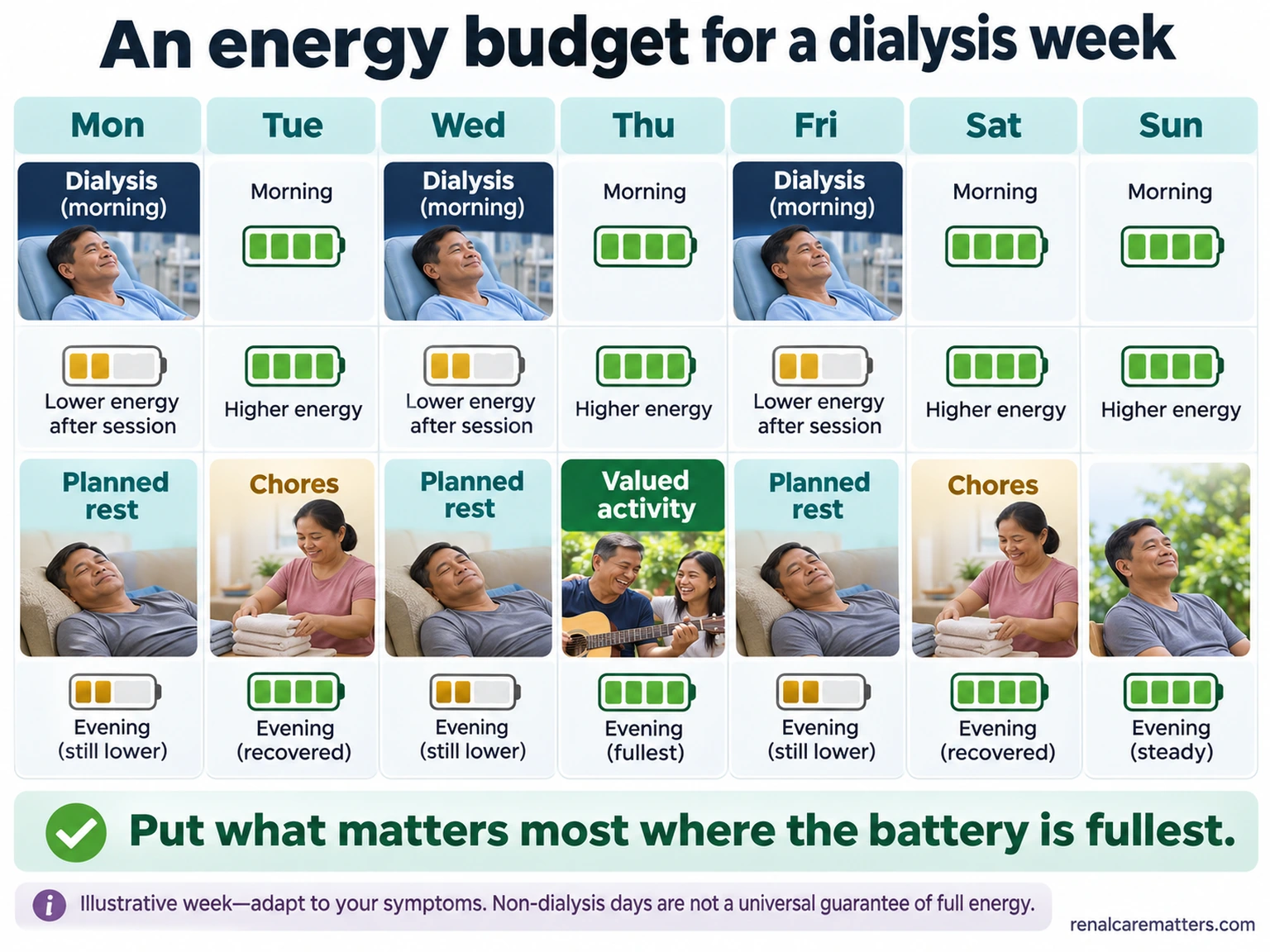
Figure 1. An energy budget for a dialysis week. Put the valued activity where the battery is fullest.
Figure 2 · Key terms for this module
Recovery timeHow long after a dialysis session the person feels back to their usual self.
Deconditioning spiralFatigue leads to rest, rest to weakness, weakness to more fatigue.
PacingSpreading effort through the day and week, with planned rests before exhaustion.
Energy budgetA plan that places valued activities where energy is highest.
Graded activityA slow, planned increase in activity over weeks.
Opening case · fictional
Case: Aling Rosa’s Mondays
Friday, 3:00 p.m. Aling Rosa Mendoza, 57, a former market vendor, has been on hemodialysis Monday, Wednesday and Friday mornings for three years. She tells OT Bea Santiago: “On dialysis days I am useless. I sleep all afternoon. On the other days I try to do everything: laundry, the market, cooking for the week. By Sunday I am exhausted, and Monday is the worst.”
She looks after two grandchildren after school. She used to sing in her parish choir on Thursday evenings and stopped a year ago. She says it takes her “until night” to recover after a session.
Before reading on, decide:
What is driving her fatigue, and which parts need a medical review?
What does her recovery time tell you?
Sketch an energy budget for her week that brings back one valued activity.
Keep your answers in mind. The lesson gives you what you need, and the case review near the end shows one sound response.
Lesson · part 1
The physiology of fatigue in kidney failure
Fatigue in kidney failure has many sources, and most patients have several at once.
Source
How it causes fatigue
Whose job
Anemia
Less oxygen to muscle and brain
Renal team
Uremia and underdialysis
Retained toxins affect muscle and brain
Renal team
The session itself
Rapid fluid and solute shifts, falls in blood pressure, a long sitting period
Renal team; you report patterns
Depression and poor sleep
Low energy and motivation; broken nights
Shared; screen and refer (Module 16)
Deconditioning
Weaker muscles and heart need more effort for each task
Rehabilitation
Inefficient routines
Tasks done standing, in heat, all at once, at the wrong time
Rehabilitation (OT)
The last two are where you make the difference. But a pacing plan that ignores untreated anemia or depression will fail, so share what you find with the renal team.
RememberAsk what else could be causing the fatigue before you plan around it. Rehabilitation treats the part that is deconditioning and routine.
Lesson · part 2
Recovery time: a question with outcome data
Ask every patient: “After a dialysis session, how long does it take you to feel like yourself again?” In the international Dialysis Outcomes and Practice Patterns Study (DOPPS), about one patient in ten needed more than 12 hours to recover after a session. Longer recovery was associated with greater weight loss during dialysis, with hospital admission and with death.2 The study was observational, so recovery time is a marker of risk, not proof of cause. But a long or lengthening recovery time is worth reporting to the nephrologist, because fluid removal and session length can sometimes be adjusted.
Recovery time also tells you where energy is in the week. For Aling Rosa, “until night” means dialysis days are lost after noon, so the plan must use non-dialysis days well rather than cram them.
RememberRecord recovery time at baseline and review. A change is information for the whole team.
Lesson · part 3
Breaking the spiral
The deconditioning spiral runs like this: fatigue leads to rest; rest leads to weaker muscles; weaker muscles make every task cost more; tasks feel harder, so the person rests more. Breaking it needs two moves at once. The OT reduces the cost of tasks so the person has energy left; the PT builds capacity slowly so the same task costs less over time.
The OT’s pacing tools are simple and powerful:
Prioritize: which activities matter most? Protect those first.
Plan: spread heavy tasks across the week instead of one exhausting day.
Position: sit for tasks that can be done sitting (preparing vegetables, ironing, bathing).
Pace: rest before exhaustion, not after; break tasks into parts.
Simplify: fewer steps, tools within reach, help for the heaviest part.
On the capacity side, structured exercise improves fitness in chronic kidney disease (CKD). A Cochrane review of 45 randomized trials found that regular exercise improved aerobic capacity, walking capacity and health-related quality of life, although many trials were small and half had a high risk of bias.3 In the Exercise Introduction to Enhance Performance in Dialysis (EXCITE) trial, a simple home walking program managed by dialysis staff improved the six-minute walk (328 to 367 meters versus no change in controls) and improved the cognitive function and social interaction scores of a kidney-specific quality-of-life questionnaire.4
RememberRest that is planned restores. Rest that is the only activity shrinks the battery.
Lesson · part 4
Worked example: an energy budget for a dialysis week
Illustrative energy budget for Aling Rosa (agreed with her). Monday, Wednesday, Friday (dialysis mornings): light lunch, then a planned 1-hour rest; no chores; grandchildren for homework only, seated; early night. Tuesday: laundry split in two loads (morning and late afternoon), seated sorting; 10-minute walk with Carlo’s plan. Thursday: light morning; rest after lunch; choir practice in the evening, with a chair available. Saturday: market with her daughter carrying the bags; cooking two dishes, seated preparation. Sunday: Mass, family, rest; no batch cooking. Review in four weeks: recovery time, number of exhausted days, and whether she went to choir.
The choir goes on Thursday because it follows a non-dialysis day and precedes another, the point in her week when the battery is fullest. The heavy cooking is spread across Saturday and helped by her daughter. Dialysis days are protected rather than wasted: a planned rest, then a valued, light role with the grandchildren.
The weekly activity tool in the toolkit helps you track minutes of planned activity alongside the budget, so you can see capacity work growing week by week.
RememberPut the activity the person values most where their energy is highest, and protect it.
On the floor
Real situations: problems and solutions
These are fictional but typical. For each one, cover the answer, decide what you would do, then compare. Where a step depends on local rules, your unit’s procedure and your supervisor’s direction come first.
Boom and bust
What you see
A patient does all chores on one non-dialysis day and is exhausted for two.
What is likely going on
Poor pacing.
What to do
Spread tasks; plan rests; protect one valued activity.
Why it matters
Pacing gives back energy for what matters.
The 14-hour recovery
What you see
A patient says she needs until the next morning to recover after each session.
What is likely going on
Long recovery time, associated with worse outcomes.
What to do
Report it with recent fluid removal data to the nephrologist.
Why it matters
The session may be adjustable.
Rest as treatment
What you see
A family keeps a patient in bed “to save his strength.”
What is likely going on
The deconditioning spiral.
What to do
Explain the spiral; agree small, regular activity.
Why it matters
Too much rest shrinks capacity.
Field notes
Ask about recovery time at every review.
Put valued activities where energy is highest.
Sit for tasks that can be done sitting.
Report possible medical causes of fatigue.
Case review
Back to the case: Aling Rosa’s Mondays
What drives her fatigue. Likely contributors include the sessions themselves (a long recovery time), the boom-and-bust pattern on non-dialysis days, deconditioning, and possibly anemia, poor sleep or low mood after stopping choir. Bea shares the recovery time and the mood change with the nurse and nephrologist, and asks whether her anemia and dialysis adequacy have been reviewed recently; a depression screen may be appropriate (Module 16).
Her recovery time. Recovering “until night” places her in the group with long recovery, which in DOPPS was associated with worse outcomes. It is worth reporting, and it tells Bea that dialysis afternoons should hold no demanding tasks.
An energy budget. As above: spread the chores, sit for preparation, protect dialysis afternoons for rest, and place choir on Thursday evening. Carlo adds a short walking program on non-dialysis days. They review recovery time, exhausted days and choir attendance in four weeks.
Skills lab · with your preceptor
Skills checklist: Fatigue assessment and energy budget
Interview a simulated patient about fatigue and build an energy budget with them while your preceptor observes. Your preceptor rates each step as satisfactory, needs practice, or not observed. Steps marked Critical must all be satisfactory before sign-off. This checklist supports supervised learning; your unit’s own procedure and competency form are the authority. A printable version of every checklist is on the trainer page.
Asks about recovery time after dialysis, daily pattern of fatigue, sleep, mood and valued activities.
CriticalIdentifies possible medical contributors and reports them to the renal team instead of treating them.
Identifies the boom-and-bust pattern and explains the deconditioning spiral in plain language.
Builds a weekly energy budget that places a valued activity at a high-energy point.
Applies at least three pacing strategies to the person’s actual tasks.
Agrees a review date and two measures (for example, recovery time and number of exhausted days).
Placement activity. For two patients, record recovery time and a one-week activity diary, then build and review an energy budget with each.
Self-assessment
Check your understanding
Each visit draws 5 questions at random from this module’s 10-question bank. Choose the single best answer for each, then select Check answers; an explanation appears under the best answer. Select New set of questions for a different mix. A good target is 4 of 5 on two different sets. Nothing you select is sent anywhere; scoring happens in your browser.
Murtagh, F. E., Addington-Hall, J., & Higginson, I. J. (2007). The prevalence of symptoms in end-stage renal disease: A systematic review. Advances in Chronic Kidney Disease, 14(1), 82–99. https://doi.org/10.1053/j.ackd.2006.10.001
Rayner, H. C., Zepel, L., Fuller, D. S., Morgenstern, H., Karaboyas, A., Culleton, B. F., Mapes, D. L., Lopes, A. A., Gillespie, B. W., Hasegawa, T., Saran, R., Tentori, F., Hecking, M., Pisoni, R. L., & Robinson, B. M. (2014). Recovery time, quality of life, and mortality in hemodialysis patients: the dialysis outcomes and Practice patterns study (DOPPS). American Journal of Kidney Diseases, 64(1), 86–94. https://doi.org/10.1053/j.ajkd.2014.01.014
Heiwe, S., & Jacobson, S. H. (2011). Exercise training for adults with chronic kidney disease. Cochrane Database of Systematic Reviews, 2011(10), CD003236. https://doi.org/10.1002/14651858.CD003236.pub2
Manfredini, F., Mallamaci, F., D’Arrigo, G., Baggetta, R., Bolignano, D., Torino, C., Lamberti, N., Bertoli, S., Ciurlino, D., Rocca-Rey, L., Barillà, A., Battaglia, Y., Rapanà, R. M., Zuccalà, A., Bonanno, G., Fatuzzo, P., Rapisarda, F., Rastelli, S., Fabrizi, F., … Zoccali, C. (2017). Exercise in patients on dialysis: A multicenter, randomized clinical trial. Journal of the American Society of Nephrology, 28(4), 1259–1268. https://doi.org/10.1681/ASN.2016030378
Educational material for licensed occupational and physical therapists. Completing it is an Academy learning record only. It is not a PRC, DOH, PhilHealth or PSN credential, not CPD units, and not a workplace privilege. Your license, your referral or prescription, your employer’s privileges and the renal team’s plan govern what you may do.