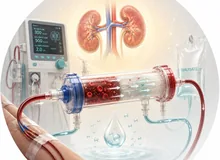
Gait speed, sit-to-stand, the Short Physical Performance Battery, the six-minute walk and occupational performance, turned into goals the patient chose.
PublishedNailathalaGipatikPepalwal:ReferencesMga SanggunianMga TinubdanReng Reperensya:4Audience: Philippine-registered occupational therapists and physical therapists who see people with kidney disease · rehabilitation leads, physiatrists and renal teams who refer to them · students on an observer pathwayRead timeOras ng pagbasaOras sa pagbasaOras ning pamamasa:
Renal rehabilitation track for licensed occupational and physical therapists
Study material for licensed occupational therapists (RA 11241) and physical therapists (RA 5680) working with people who have kidney disease. It explains the reasoning behind renal rehabilitation; it is not a hospital protocol. It never authorizes changes to dialysis settings, handling of a needled access or catheter, medicine decisions or benefit promises. Exercise parameters come from the referring physician and your unit’s agreed sheet: per unit protocol, but always ask the attending nephrologist’s guidance. Every case, name and number in the cases is fictional and illustrative.
Learning objectives
After this module you should be able to
Explain why performance measures add information that self-report and laboratory tests do not.
Administer and score gait speed, the five-times sit-to-stand, the Short Physical Performance Battery and the six-minute walk test in a standard way.
Calculate percent-predicted six-minute walk distance and interpret it with its limits.
Combine performance results with an occupational interview to build a functional problem list.
Write shared, measurable goals in the patient’s own words, with a review date.
Classroom 2 hSkills lab 2 hSupervised placement 1 h
Pre-testBefore you read, answer the 5 self-assessment questions and note your score. After the module, select New set of questions and compare. The difference is what you learned; the questions you still miss are what to reread.
Start here
The big picture, in plain words
In plain wordsA bathroom scale only helps if you stand on the same scale, at the same time of day, in the same clothes. Change any of those and the number moves for reasons that have nothing to do with your weight.
The picture has a limit. A scale measures one thing. Function has many parts, and a person can improve in one and decline in another. So you choose a small battery that covers the parts that matter for this person, and you run it the same way every time: same chair height, same course length, same instructions, same point in the dialysis week. Without standard conditions, a change in the number means nothing.
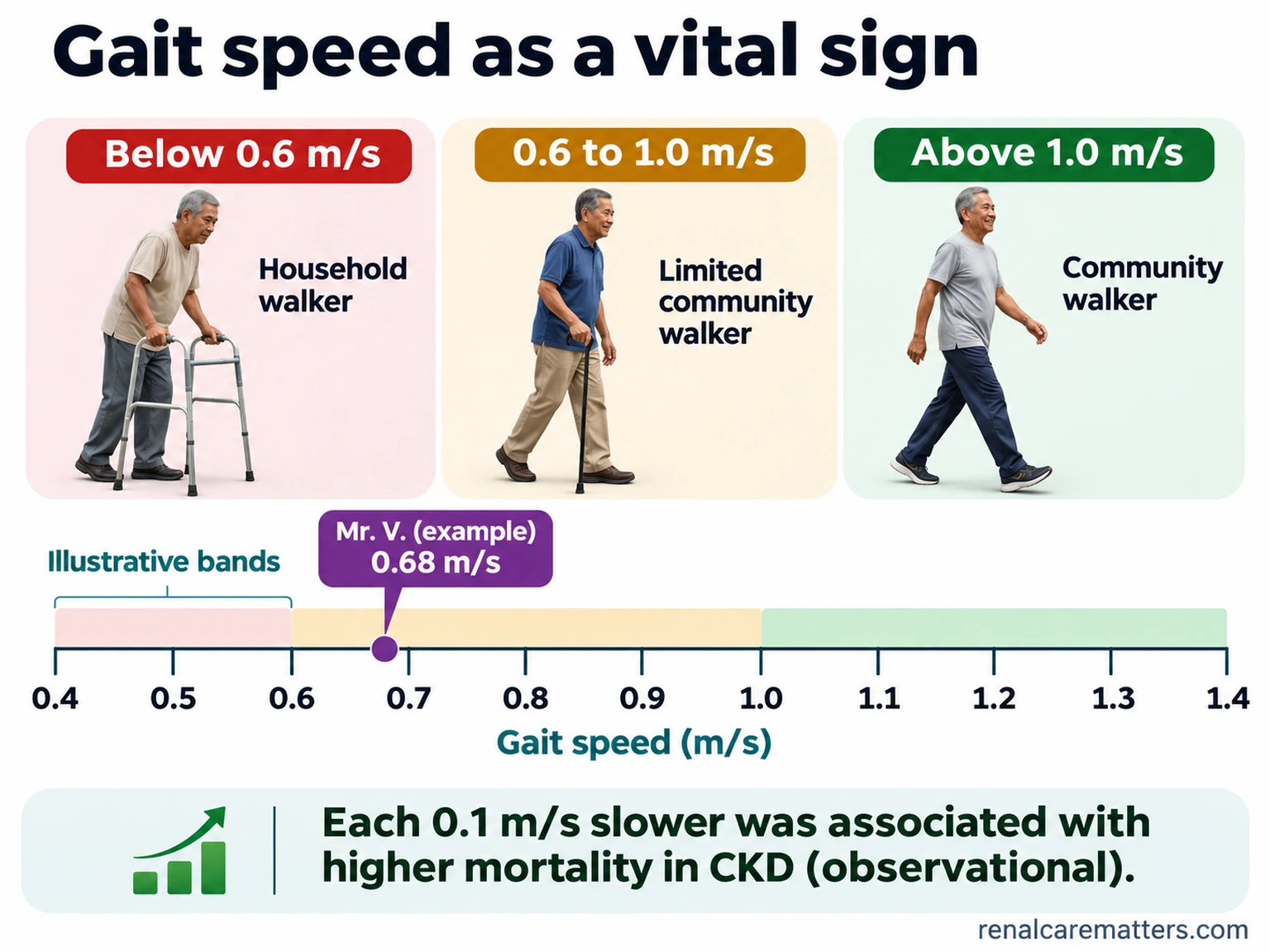
Why bother measuring at all, when you can see that a patient is weak? Because performance tests carry information that neither the patient’s report nor the chart gives. In the study that built the Short Physical Performance Battery (SPPB), performance scores still separated people by later risk of death and nursing-home admission even among those who reported almost no disability.1 In a pooled analysis of 34,485 older adults, each 0.1 meter per second of gait speed was associated with lower mortality (hazard ratio 0.88).2 In chronic kidney disease (CKD), gait speed predicted three-year mortality better than kidney function did.3 These are associations; they tell you what to watch, not that raising the number will change survival.
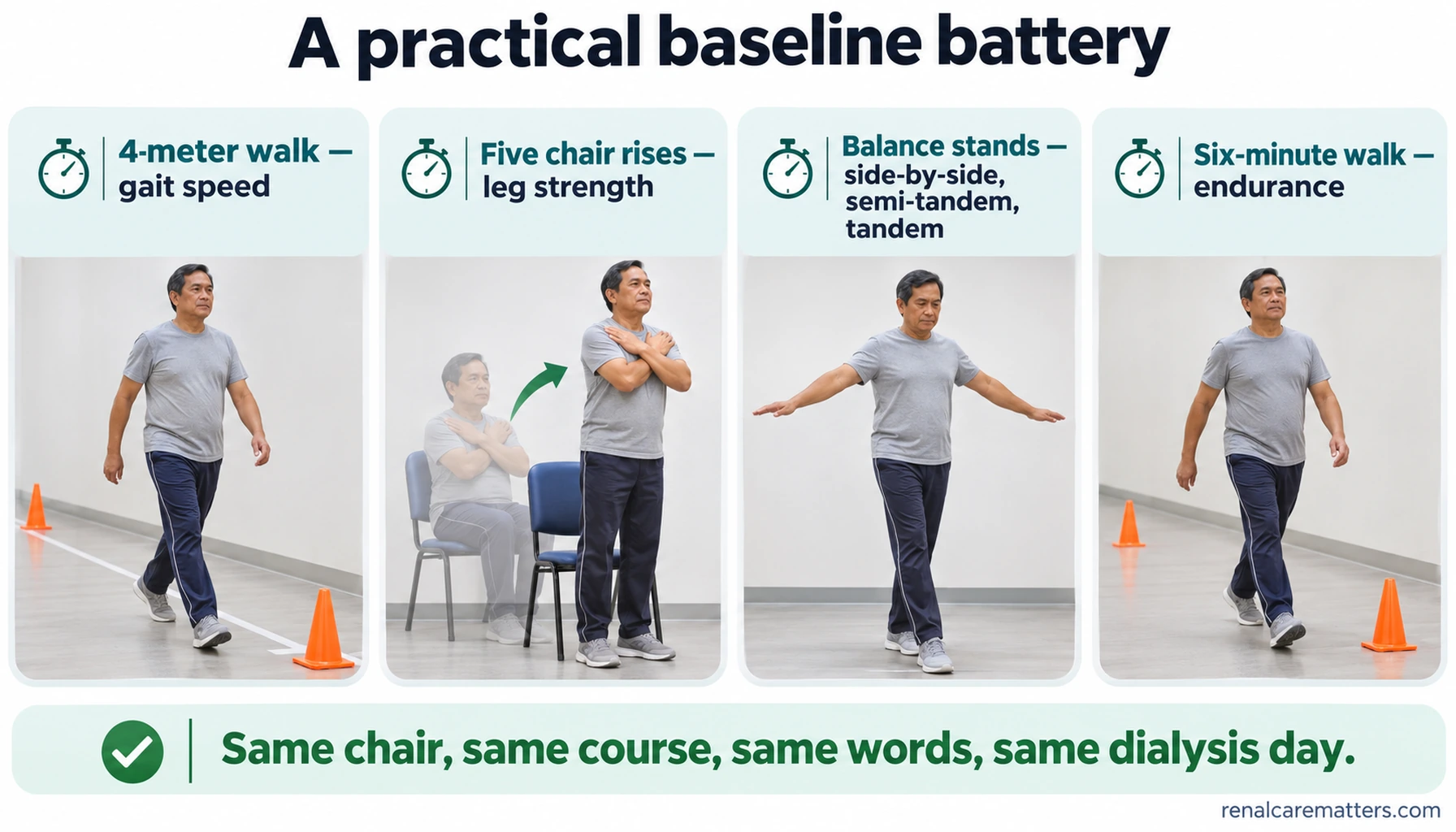
Figure 1. A practical baseline battery. Same chair, same course, same words, every time.
Figure 2 · Key terms for this module
Performance measureA timed or counted test the person does in front of you.
Self-reportWhat the person says they can do; useful, but different.
Standard conditionsThe same equipment, instructions and timing every time.
Percent predictedA result compared with healthy people of the same age, sex and size.
Shared goalA change the person wants, written so you both can tell when it is met.
Opening case · fictional
Case: A baseline for Mr. Villanueva
Thursday, 9:00 a.m., a non-dialysis day. With parameters from Dr. Uy in the chart, physical therapist (PT) Carlo Dizon and occupational therapist (OT) Bea Santiago assess Mr. Ernesto Villanueva, 64, height 165 centimeters, dry weight 68 kilograms.
Carlo’s results: 4-meter usual walk 5.9 seconds; side-by-side and semi-tandem stands held 10 seconds each, tandem held 4 seconds; five chair rises (arms crossed, standard 46-centimeter chair) 17.5 seconds; six-minute walk 290 meters with one standing rest. Bea’s interview: he wants to watch his grandson’s weekend basketball games at the barangay court, about 250 meters from home, and to bathe himself again.
Before reading on, decide:
What are his gait speed, SPPB score and percent-predicted six-minute walk distance?
What do these numbers mean for the goals he named?
Write two shared goals, one led by each profession.
Keep your answers in mind. The lesson gives you what you need, and the case review near the end shows one sound response.
Lesson · part 1
A practical baseline battery
Choose tests that fit the person, the space you have, and the question. For most adults on dialysis who can walk, four tests cover the main accounts.
Test
How
What it reflects
Gait speed
Usual pace over 4 meters, timed from a standing start (or with a short run-in, but always the same way)
Overall mobility; a strong prognostic signal
Five-times sit-to-stand
Five full rises from a standard chair, arms crossed, timed
Leg strength and power
SPPB
Three balance stands, the 4-meter walk, and five chair rises, each scored 0 to 4; total 0 to 12
Lower-limb function across balance, gait and strength
Six-minute walk test (6MWT)
Walk as far as possible in 6 minutes on a flat measured course with standard encouragement; rests allowed, clock keeps running
Functional endurance
60-second sit-to-stand (STS60)
Full rises in one minute
Leg endurance and strength; the main outcome of the largest dialysis exercise trial
If the person cannot walk, use transfers, sitting balance and a task observation instead. Never test in the hours after a session with a large fluid removal unless the purpose is to measure that.
RememberSame chair, same course, same words, same day of the dialysis week. Write the conditions next to the number.
Lesson · part 2
Worked example: turning times into meaning
Here is how Carlo turns Mr. Villanueva’s times into results he can track and explain.
Gait speed. 4 meters ÷ 5.9 seconds = 0.68 m/s. SPPB (widely used 4-meter scoring). Balance: side-by-side 10 s (1) + semi-tandem 10 s (1) + tandem 4 s (1) = 3. Gait: 5.9 s = 3 points (4.82 to 6.20 s). Chair stands: 17.5 s = 1 point (16.70 s or longer). Total 7 of 12. Six-minute walk, percent predicted. The Enright–Sherrill equation for men: (7.57 × height cm) − (5.02 × age) − (1.76 × weight kg) − 309.4 = (7.57 × 165) − (5.02 × 64) − (1.76 × 68) − 309 = 1,249 − 321 − 120 − 309 ≈ 499 m predicted. He walked 290 m: 290 ÷ 499 ≈ 58 percent of predicted.
The Renal Rehabilitation Toolkit does these calculations. Use the numbers with their limits. The Enright–Sherrill equations came from healthy American adults aged 40 to 80; they are a reference point, not a Filipino norm, so the most useful comparison is with the person’s own baseline. The SPPB cut points come from older community-dwelling adults.
Figure 3. Gait speed as a vital sign. Each 0.1 m/s matters; the association is observational.
What do the numbers mean for his goals? A gait speed of 0.68 m/s and 290 meters in six minutes with a rest suggest that walking 250 meters to the court, then standing or sitting on bleachers, is near the edge of what he can do now. The chair-stand time tells Carlo that leg strength, not only endurance, is limiting; that matters for rising from bleachers and from a low toilet.
RememberEvery number earns its place by answering a question about a goal the person cares about.
Lesson · part 3
Adding the occupational picture
Performance tests describe the body. They do not tell you which tasks matter, how the person does them now, or what the setting demands. The OT adds that picture through an interview about roles and routines and through observing a real task.
For Mr. Villanueva, Bea asks him to talk through a bathing day: where the bathroom is, whether there is a step, whether he sits or stands, how warm the water is, how long it takes, and when in the dialysis week he bathes. She learns that he bathes standing, with a tabo and pail, in a bathroom with a 15-centimeter step and no rail, usually right after he comes home from dialysis. That one interview reveals three targets: the timing (after fluid removal), the posture (standing, with dizziness), and the environment (a step without a rail).
RememberAsk the person to walk you through the task, step by step, in their own setting. The problem is often in the sequence, not the muscles.
Lesson · part 4
Goals the person chose, written so you can tell when they are met
A useful goal states what the person will do, in what setting, with what help, by when, in words they would recognize as their own. specific, measurable, achievable, relevant and time-bound (SMART) goals (specific, measurable, achievable, relevant and time-bound) are one format; the essentials are that the patient chose it and that you will both know when it is met.
Illustrative shared goals for Mr. Villanueva (review in 8 weeks). PT-led: “Walk to the barangay court (250 m) with no more than one short rest, and rise from the bleachers without help, in time for the league finals.” Measures: 6MWT, five-times sit-to-stand, gait speed. OT-led: “Bathe myself seated, on non-dialysis evenings, with my wife nearby but not helping.” Measures: observed bathing task, assistance level, dizziness episodes logged.
Agree the goals with the patient and family, share them with the renal team, and record the review date. Goals are reassessed, not abandoned, when a bad week or a hospital stay interrupts progress.
RememberA goal that the patient did not choose is your goal, not theirs. Ask what they want back.
On the floor
Real situations: problems and solutions
These are fictional but typical. For each one, cover the answer, decide what you would do, then compare. Where a step depends on local rules, your unit’s procedure and your supervisor’s direction come first.
The different chair
What you see
A reassessment shows a big improvement in sit-to-stand, but you used a higher chair.
What is likely going on
Changed test conditions.
What to do
Repeat with the original chair height before reporting progress.
Why it matters
Unequal conditions create false gains.
“Just tell me what to do”
What you see
A patient says he has no goals.
What is likely going on
Low engagement or low mood.
What to do
Ask what he used to enjoy and what he misses; screen mood if indicated.
Why it matters
Goals the patient chose drive adherence.
Testing after dialysis
What you see
A colleague tests the six-minute walk an hour after a 3-kilogram session.
What is likely going on
Post-dialysis fatigue and hypotension distort the result.
What to do
Reschedule to a non-dialysis day; record conditions.
Why it matters
The test measured the session, not the person.
Field notes
Write chair height and course length on your test form.
Use the same words of encouragement every time.
Compare with the person’s own baseline first.
Put the goal in the patient’s words.
Case review
Back to the case: A baseline for Mr. Villanueva
The numbers. Gait speed 0.68 m/s; SPPB 7 of 12 (balance 3, gait 3, chair stands 1); predicted six-minute walk about 499 meters, so 290 meters is about 58 percent of predicted.
What they mean. He has moderate lower-limb impairment, with leg strength the weakest component and endurance limited. Walking 250 meters and rising from bleachers are realistic but currently near his limit. Because of his neuropathy and earlier fracture, the tandem stand needed close guarding.
Two shared goals. As written above: a PT-led walking and bleacher-rise goal, and an OT-led seated bathing goal timed for non-dialysis evenings. Both are reviewed in eight weeks using the same tests under the same conditions.
Skills lab · with your preceptor
Skills checklist: Baseline battery and goal setting
Administer a baseline battery to a colleague or a consenting patient, then agree two goals while your preceptor observes. Your preceptor rates each step as satisfactory, needs practice, or not observed. Steps marked Critical must all be satisfactory before sign-off. This checklist supports supervised learning; your unit’s own procedure and competency form are the authority. A printable version of every checklist is on the trainer page.
CriticalCompletes the pre-session screen and confirms the test day and timing relative to dialysis.
Sets up standard conditions: chair height, measured course, standard instructions.
CriticalGuards closely during balance and walking tests, protecting the access arm.
Scores gait speed, five-times sit-to-stand and SPPB correctly.
Calculates percent-predicted six-minute walk distance and states the equation’s limits.
Obtains the occupational picture through interview or task observation (OT) or reviews the OT findings (PT).
Writes two shared, measurable goals with the patient, with a review date.
Placement activity. Complete baselines for three patients and repeat one test on two separate days under the same conditions to see how much the result varies without any real change.
Self-assessment
Check your understanding
Each visit draws 5 questions at random from this module’s 10-question bank. Choose the single best answer for each, then select Check answers; an explanation appears under the best answer. Select New set of questions for a different mix. A good target is 4 of 5 on two different sets. Nothing you select is sent anywhere; scoring happens in your browser.
Guralnik, J. M., Simonsick, E. M., Ferrucci, L., Glynn, R. J., Berkman, L. F., Blazer, D. G., Scherr, P. A., & Wallace, R. B. (1994). A short physical performance battery assessing lower extremity function: Association with self-reported disability and prediction of mortality and nursing home admission. Journal of Gerontology, 49(2), M85–M94. https://doi.org/10.1093/geronj/49.2.m85
Studenski, S., Perera, S., Patel, K., Rosano, C., Faulkner, K., Inzitari, M., Brach, J., Chandler, J., Cawthon, P., Connor, E. B., Nevitt, M., Visser, M., Kritchevsky, S., Badinelli, S., Harris, T., Newman, A. B., Cauley, J., Ferrucci, L., & Guralnik, J. (2011). Gait speed and survival in older adults. JAMA, 305(1), 50–58. https://doi.org/10.1001/jama.2010.1923
Roshanravan, B., Robinson-Cohen, C., Patel, K. V., Ayers, E., Littman, A. J., de Boer, I. H., Ikizler, T. A., Himmelfarb, J., Katzel, L. I., Kestenbaum, B., & Seliger, S. (2013). Association between physical performance and all-cause mortality in CKD. Journal of the American Society of Nephrology, 24(5), 822–830. https://doi.org/10.1681/ASN.2012070702
Enright, P. L., & Sherrill, D. L. (1998). Reference equations for the six-minute walk in healthy adults. American Journal of Respiratory and Critical Care Medicine, 158(5 Pt 1), 1384–1387. https://doi.org/10.1164/ajrccm.158.5.9710086
Educational material for licensed occupational and physical therapists. Completing it is an Academy learning record only. It is not a PRC, DOH, PhilHealth or PSN credential, not CPD units, and not a workplace privilege. Your license, your referral or prescription, your employer’s privileges and the renal team’s plan govern what you may do.