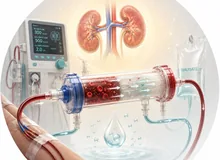
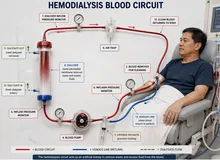
How a fistula works and why pressure clots it, catheter rules, what exercise can and cannot do for a new fistula, and infection control for shared equipment.
PublishedNailathalaGipatikPepalwal:ReferencesMga SanggunianMga TinubdanReng Reperensya:3Audience: Philippine-registered occupational therapists and physical therapists who see people with kidney disease · rehabilitation leads, physiatrists and renal teams who refer to them · students on an observer pathwayRead timeOras ng pagbasaOras sa pagbasaOras ning pamamasa:
Renal rehabilitation track for licensed occupational and physical therapists
Study material for licensed occupational therapists (RA 11241) and physical therapists (RA 5680) working with people who have kidney disease. It explains the reasoning behind renal rehabilitation; it is not a hospital protocol. It never authorizes changes to dialysis settings, handling of a needled access or catheter, medicine decisions or benefit promises. Exercise parameters come from the referring physician and your unit’s agreed sheet: per unit protocol, but always ask the attending nephrologist’s guidance. Every case, name and number in the cases is fictional and illustrative.
Learning objectives
After this module you should be able to
Explain how an arteriovenous fistula works and why compression can clot it.
Apply access precautions for fistulas, grafts and central venous catheters during every assessment and activity.
Summarize what the evidence shows about hand and forearm exercise before and after fistula creation.
Recognize access emergencies (bleeding, loss of thrill, catheter dislodgement) and respond within your role.
Clean and turn over shared rehabilitation equipment to dialysis infection-prevention standards.
Classroom 2 hSkills lab 2 hSupervised placement 1 h
Pre-testBefore you read, answer the 5 self-assessment questions and note your score. After the module, select New set of questions and compare. The difference is what you learned; the questions you still miss are what to reread.
Start here
The big picture, in plain words
In plain wordsA fistula is a short circuit in the arm. The surgeon joins an artery straight to a vein, so high-pressure blood rushes into the vein and makes it wide and thick enough to take two needles three times a week. You can feel the rush as a buzz under the skin, the thrill.
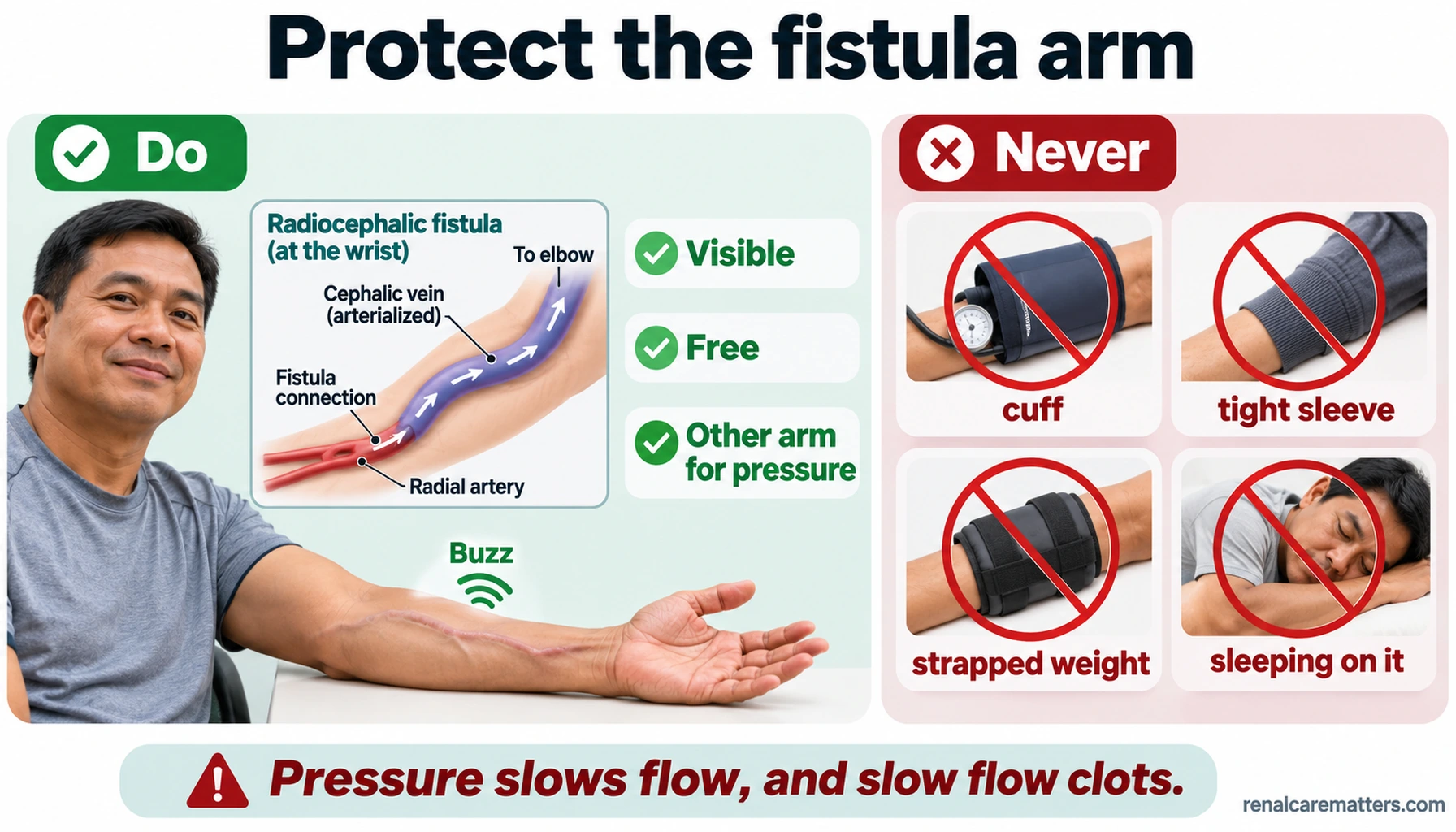
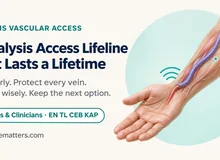
The picture has a limit. A short circuit in a house is a fault. This one is the patient’s lifeline, and it is fragile in a particular way: it depends on fast flow. Anything that slows the flow—a blood pressure cuff, a tight sleeve, a weight strapped to the wrist, sleeping on the arm, a long fall in blood pressure—lets blood sit still in a vein that has been injured by needles, and still blood clots. A clotted fistula can mean an emergency procedure, a catheter in the neck, missed dialysis and weeks of risk.
Figure 1. Protect the fistula arm. Pressure slows flow, and slow flow clots.
Your job is not to examine or manage the access. That is the nurse’s and the nephrologist’s. Your job is to make sure nothing you do harms it, to notice when something is wrong, and to keep shared equipment from carrying infection from one chair to the next.
Figure 2 · Key terms for this module
Arteriovenous fistula (AVF)An artery joined directly to a vein.
Arteriovenous graft (AVG)A synthetic tube joining artery to vein.
Thrill and bruitThe buzz you feel and the whoosh you hear over a working fistula.
Central venous catheterA tube in a large neck or chest vein; a direct route for infection into the blood.
MaturationThe weeks in which a new fistula widens and thickens before it can be used.
Opening case · fictional
Case: The weight on the wrist
Wednesday, 10:15 a.m. Mr. Danilo Cruz, 58, has diabetes and chronic kidney disease (CKD) stage 5 and is not yet on dialysis. Vein mapping two weeks ago showed a left cephalic vein of 2.4 millimeters at the wrist. His surgeon has scheduled a left radiocephalic fistula in six weeks and wrote “pre-op arm exercise” on the referral.
In the gym, occupational therapist (OT) Bea Santiago sees another patient, Mr. Lito Pascual, 66, on hemodialysis, doing biceps curls with a 1-kilogram weight strapped to his left wrist, just above a fistula created four months ago. His blood pressure cuff from this morning is still wrapped around the same arm. A shared exercise band hangs on the rack, unwiped since yesterday.
Before reading on, decide:
What three hazards does Bea see in the gym, and what does she do about each?
What can a pre-operative exercise program realistically achieve for Mr. Cruz, and what can it not promise?
Which access problems would make Bea stop and call immediately?
Keep your answers in mind. The lesson gives you what you need, and the case review near the end shows one sound response.
Lesson · part 1
Access precautions you apply every time
Know the access before you start. Ask the nurse which arm has the fistula or graft, whether it is new, and whether the patient also has a catheter. Then apply the precautions without exception.
Access
Never
Always
Fistula or graft arm
Blood pressure cuff, tourniquet, tight sleeve or band, weights strapped over it, sustained pressure, lying on it, carrying heavy bags hooked over the forearm, pulling the patient by that arm
Leave it visible and free; use the other arm for observations and handholds; check with the nurse before any resistance work for that arm
Needled access (during a session)
Bending the arm at the needle sites, lifting the arm overhead, pulling on lines, any activity that moves the needles
Keep the arm still and supported; keep lines visible; plan leg-only or other-arm activity with the nurse
Central venous catheter
Getting the dressing wet, swimming, pulling or tugging the lines, touching the hubs
Keep the dressing dry and intact; secure lines during transfers; report a loose dressing or exposed cuff
Stop and reportBleeding from an access, a needle that has moved or come out, a catheter that has slipped or whose dressing is soaked, or a fistula that has lost its buzz or turned cold, painful or swollen: stop, apply the first response your unit trains (for bleeding, firm pressure with a gloved hand and gauze), and call the nurse at once. Never reinsert or adjust anything.
RememberIf you can’t see the access arm, you can’t protect it. Uncover it, free it, and keep everything off it.
Lesson · part 2
What exercise can and cannot do for a fistula
Hand and forearm exercise is often prescribed before and after fistula surgery, on the reasoning that working muscle increases blood flow and stretches the vein wall, encouraging it to widen. The evidence is more modest than the practice.
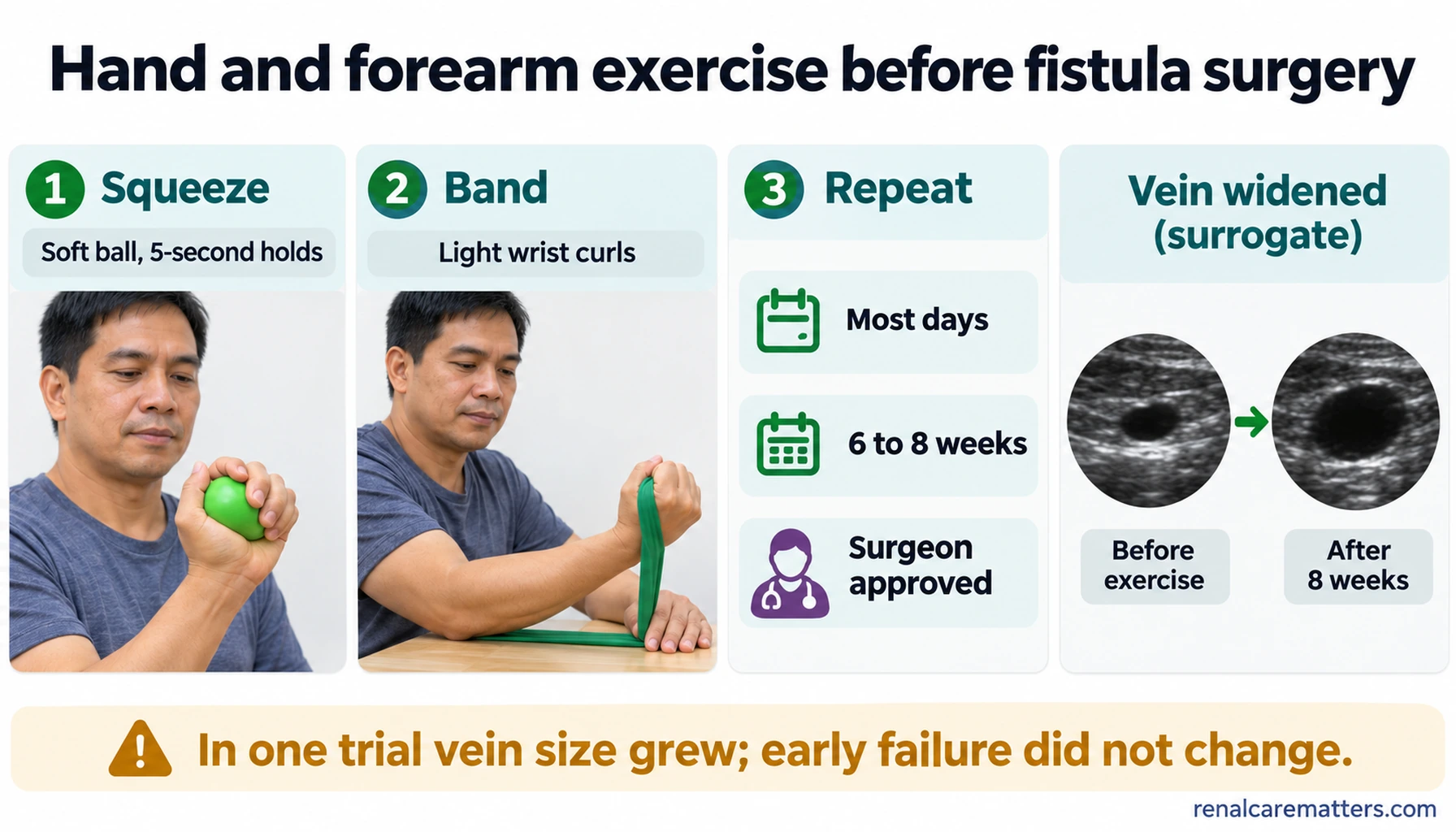
Before surgery. In the PHYSICALFAV randomized trial, 138 patients were assigned to eight weeks of preoperative isometric exercise with a handgrip device and an elastic band, or to no exercise. Vein diameter rose from 2.80 to 3.52 millimeters in the exercise group, and surgeons were able to create a distal radiocephalic fistula in 75 percent of exercisers versus 50.8 percent of controls. The primary failure rate was low in both groups and not significantly different (7 percent versus 14 percent).1 Vein diameter is a surrogate; the patient-important outcomes (a usable fistula, avoided catheter) were not clearly improved.
After surgery. In a randomized trial of 119 patients with new wrist fistulas, more frequent or more intense postoperative handgrip programs (including upper-arm banding) did not increase fistula diameter, flow or clinical use over three months compared with a basic program.2
Figure 3. Hand and forearm exercise before fistula surgery. In one trial it widened the veins; it did not reduce early failure.
So the honest message is this: a simple, surgeon-approved hand and forearm program before surgery is reasonable, may widen the vein and may make a better fistula site possible; after surgery, more is not better than a basic program; and no exercise replaces the surgeon’s and nurse’s monitoring. Any tourniquet or banding is used only if the surgeon orders it.
Illustrative pre-operative program for Mr. Cruz (surgeon-approved). Soft-ball or handgrip squeezes, 5-second holds, 10 to 15 repetitions; then wrist curls with a light elastic band, 10 repetitions; two to three rounds, most days of the week, for the six weeks before surgery. Keep the arm unconstricted; stop for pain, numbness or a cold, pale hand. The vascular team rechecks the vein on ultrasound.
RememberPre-operative exercise may widen the vein; it is a surrogate gain. After surgery, a basic program is as good as an intense one.
Lesson · part 3
Infection prevention for shared rehabilitation equipment
People on hemodialysis are unusually vulnerable to bloodstream infection: their blood leaves the body three times a week, many have catheters, and their immune defenses are weakened. Dialysis units are also places where hepatitis B and C have spread through contaminated surfaces and hands. United States dialysis infection-control guidance treats every station and shared item as a potential route.3
Your equipment—bands, weights, pedal cycles, gait belts, walkers, stopwatches, pens—moves between patients. Treat it like any other shared item in the unit:
Clean your hands before and after every patient contact and before touching clean equipment.
Do not carry equipment from one dialysis station to another without cleaning it with the unit’s approved disinfectant, wet for the label contact time.
Prefer single-patient items (a band kept in the patient’s own bag) for patients on isolation or with hepatitis B.
Keep clean and used equipment physically apart, and never put equipment on the dialysis machine.
RememberEquipment that touches one patient is dirty until it has been cleaned and stayed wet for its contact time.
On the floor
Real situations: problems and solutions
These are fictional but typical. For each one, cover the answer, decide what you would do, then compare. Where a step depends on local rules, your unit’s procedure and your supervisor’s direction come first.
The forgotten cuff
What you see
A blood pressure cuff is still wrapped on a fistula arm.
What is likely going on
A compression risk.
What to do
Remove it, ask the patient about the buzz, tell the nurse.
Why it matters
Compression slows flow and can clot the fistula.
The wet dressing
What you see
A patient with a neck catheter wants to swim at a family outing.
What is likely going on
Infection risk.
What to do
Explain the rule and ask the nurse and nephrologist for advice; never approve it yourself.
Why it matters
Catheter infections can be life-threatening.
One band for all
What you see
The gym has one exercise band used by every patient.
What is likely going on
Cross-contamination risk.
What to do
Clean between patients; move to single-patient bands.
Why it matters
Dialysis patients are vulnerable to bloodborne and bloodstream infection.
Field notes
Ask “Which arm is your fistula?” at every session.
Keep the access arm uncovered.
Clean equipment for the label’s full contact time.
Never adjust a needle, line or dressing.
Case review
Back to the case: The weight on the wrist
Three hazards in the gym. The weight strapped over Mr. Pascual’s fistula and the forgotten blood pressure cuff both compress the access arm. Bea stops the exercise, removes the weight and the cuff, checks with Mr. Pascual whether he can still feel his buzz, and tells the nurse so she can check the fistula. She moves his resistance work to the other arm and the legs, pending the nurse’s advice. The unwiped band goes to the dirty side, is cleaned with the approved disinfectant for the full contact time, and Bea suggests single-patient bands.
What pre-operative exercise can do. A simple, surgeon-approved handgrip and band program for six weeks may widen Mr. Cruz’s cephalic vein and may make a wrist fistula more feasible. It cannot promise that the fistula will mature or be used sooner; the trial evidence is on vein size and fistula site, not on long-term success.
Stop-and-call problems. Bleeding, loss of the thrill, a cold, pale or painful hand, sudden swelling, a dislodged needle, or a slipped or soaked catheter dressing.
Skills lab · with your preceptor
Skills checklist: Access-safe practice and equipment turnover
Demonstrate access precautions and equipment turnover in simulation with a dialysis nurse present. Your preceptor rates each step as satisfactory, needs practice, or not observed. Steps marked Critical must all be satisfactory before sign-off. This checklist supports supervised learning; your unit’s own procedure and competency form are the authority. A printable version of every checklist is on the trainer page.
CriticalAsks the nurse for access type, side, age and any catheter before starting.
CriticalKeeps the access arm uncovered and free of cuffs, straps, weights and sustained pressure throughout.
CriticalUses the non-access arm for observations and handholds.
CriticalStates the first response and the call for access bleeding, lost thrill and catheter dislodgement.
Teaches a surgeon-approved pre-operative hand and forearm program with stop rules.
CriticalPerforms hand hygiene at the correct moments.
CriticalCleans shared equipment with the approved disinfectant for the full contact time and separates clean from used.
Placement activity. Audit one week of your own sessions: did any equipment move between patients without cleaning, and was the access arm ever covered or loaded?
Self-assessment
Check your understanding
Each visit draws 5 questions at random from this module’s 10-question bank. Choose the single best answer for each, then select Check answers; an explanation appears under the best answer. Select New set of questions for a different mix. A good target is 4 of 5 on two different sets. Nothing you select is sent anywhere; scoring happens in your browser.
Educational material for licensed occupational and physical therapists. Completing it is an Academy learning record only. It is not a PRC, DOH, PhilHealth or PSN credential, not CPD units, and not a workplace privilege. Your license, your referral or prescription, your employer’s privileges and the renal team’s plan govern what you may do.