Integrated capstone, disaster readiness and transition
Carry one patient through a typhoon week and an admission, and show your work.
PublishedNailathalaGipatikPepalwal:ReferencesMga SanggunianMga TinubdanReng Reperensya:10Audience: Adult and pediatric nephrology fellows · internal medicine and pediatric residents · medical interns on medicine, pediatrics, ICU and dialysis rotations, and residents who work shifts as dialysis physicians on dutyRead timeOras ng pagbasaOras sa pagbasaOras ning pamamasa:
Training track for nephrology fellows, residents and medical interns
Study material for medical interns, residents and fellows. It explains the reasoning behind common decisions; it is not a protocol and gives no drug doses. Doses, rates and order sets come from current guidelines, product labels, your institution’s approved protocols and your supervising physician. Benefit rules change: confirm them on the date of service. Every case is fictional.
Learning objectives
After this module you should be able to
Intern: Present an integrated case of a dialysis patient who missed sessions, name the immediate dangers in order, and hand off using a structured format.
Resident: Manage an admission end to end, from stabilizing hyperkalemia and fluid overload to arranging dialysis, transfer if needed, and a safe discharge with a disaster plan.
Fellow: Defend a longitudinal plan for the patient and the unit, including disaster readiness, and teach it to the team using an entrustment-based portfolio.
Pre-testBefore you read, answer the 5 self-assessment questions and note your score. After the module, select New set of questions and compare. The difference is what you learned; the questions you still miss are what to reread.
Start here
The big picture, in plain words
Your role · the whole patient, in the worst week of the yearThis module puts the track together. The intern is first to see the patient and must recognize, in minutes, that a man who missed two dialysis sessions is in danger from potassium, fluid and acid, and say so clearly. The resident turns that recognition into a sequence of actions and a plan that survives the night. The fellow asks the longer questions: why did he miss dialysis, what will happen in the next typhoon, and what should this unit and this patient change. All three hand off, document and teach.
In plain wordsThink of a patient on hemodialysis as a house with a blocked drain that is pumped out three times a week. Between pumpings, water and waste rise slowly. Miss one pumping and the level is high; miss two and it is over the doorstep.
The picture has a limit. The things that rise are not one fluid. Potassium rises from food and from cells, and its danger is electrical: the resting membrane potential of heart muscle shifts, conduction slows, and the rhythm can fail without warning. Salt and water rise and fill the lungs. Acid accumulates and drives more potassium out of cells. A storm adds its own insults: no refrigerator, salted and canned food, no medicines, crowded evacuation centers, injury and infection. The danger does not rise in a straight line, and a patient can feel well until shortly before he arrests.
Figure 1 · Key numbers
Hurricane Katrina, 386 New Orleans patients on Hemodialysis (HD)44% missed at least one session and almost 17% missed three or more (survey, Anderson 2009)
Missing three or more sessions and hospitalizationAdjusted odds ratio 2.16 compared with missing none (observational)
Hurricane Sandy, 13,264 patients59% received early dialysis before landfall; emergency department visits 4.1% versus 2.6% and 1.7% in comparison groups (retrospective cohort)
Severe hyperkalemia (UK Kidney Association)Potassium 6.5 mmol/L or higher
Medicines to keep for emergencies (CDC advice to patients)At least a 3-day supply of each
Most patients who miss dialysis in a disaster survive if they are found early, stabilized in the right order and dialyzed. A few die at home or in an evacuation center before anyone knows they missed a session. Your work is to treat the first group quickly and well, and to build the plans, with each patient and with the unit, that make the second group smaller in the next storm.
Opening case · fictional
Case: The morning after the typhoon
Thursday, 5:50 a.m., the emergency room of a provincial hospital in Naga City, Camarines Sur. A strong typhoon crossed the province on Monday. Mr. Rodel Caballero, 54, a fish vendor with diabetes and hypertension, dialyzes every Monday, Wednesday and Friday at a freestanding unit in a nearby town through a left arm fistula. The unit was flooded and without power from Monday to Wednesday, so he missed both sessions. His family brought him by pedicab and then a borrowed truck through flooded roads.
He is sitting upright, breathless and anxious. Blood pressure 178/100 mm Hg, pulse 56 per minute and irregular, respiratory rate 30 per minute, oxygen saturation 87% on room air. He has crackles to both mid-lungs and pitting edema to the knees. The fistula has a good thrill. His potassium is 7.4 mmol/L, bicarbonate 13 mmol/L, glucose 268 mg/dL. The electrocardiogram (ECG) shows peaked T waves, absent P waves and a The ventricular depolarization complex on the ECG (QRS) of 0.14 seconds. During the storm he ate dried fish and canned sardines from the relief packs, and he has had no medicines since Sunday.
The hospital’s hemodialysis (HD) unit is running on a generator; the head nurse says water treatment is working but only two machines can run. The medical intern, Dr. Ana Robles, sees him first. The resident on duty is Dr. Miguel Tan; the nephrology fellow, Dr. Grace Villanueva, is on her way.
Before reading on, decide:
How should the intern present this patient and hand off, and what are the immediate dangers in order?
How should the resident manage the admission from now to discharge, including what to do if dialysis is delayed?
What longitudinal and disaster plan should the fellow defend for Mr. Caballero and for his unit?
Keep your answers in mind. The lesson gives you what you need, and the case review near the end shows one sound response.
Lesson · part 1
Typhoons, floods and power: why dialysis patients are harmed
The Philippines takes typhoons every year, and its dialysis patients depend on electricity, treated water, transport and a unit that stays open. The causal chain of harm is predictable. The storm closes the unit or the road. Sessions are missed. Potassium, fluid and acid accumulate faster because the emergency food is salty and potassium-rich and the medicines have run out. The patient presents late, often at a hospital that is itself on a generator. Each link is a place to intervene.
What the evidence shows. Most of it comes from United States hurricanes, because they were studied. After Hurricane Katrina, 94 dialysis facilities in the Gulf Coast states closed for at least a week, and existing emergency plans did not provide continuity of care.1 Among 386 patients from nine New Orleans units interviewed afterward, 44% missed at least one session and almost 17% missed three or more. Missing three or more was more likely in patients who had been on dialysis less than 2 years, had missed sessions before the storm, lived alone, did not know their facility’s emergency plan, did not evacuate before landfall, or were placed in a shelter, and it was associated with hospitalization (adjusted odds ratio 2.16, 95% confidence interval 1.05 to 4.43).2 After Hurricane Sandy, in 13,264 patients, 59% received early dialysis before landfall; afterward, emergency department visits were 4.1% versus 2.6% and 1.7% in the two comparison groups, hospitalization 4.5% versus 3.2% and 3.8%, and 30-day mortality 1.83% versus 1.47% and 1.60%.3 Both studies are observational, from another health system, and cannot prove that preparation prevents death; they do show who is at risk and that early dialysis before a storm is feasible on a large scale.
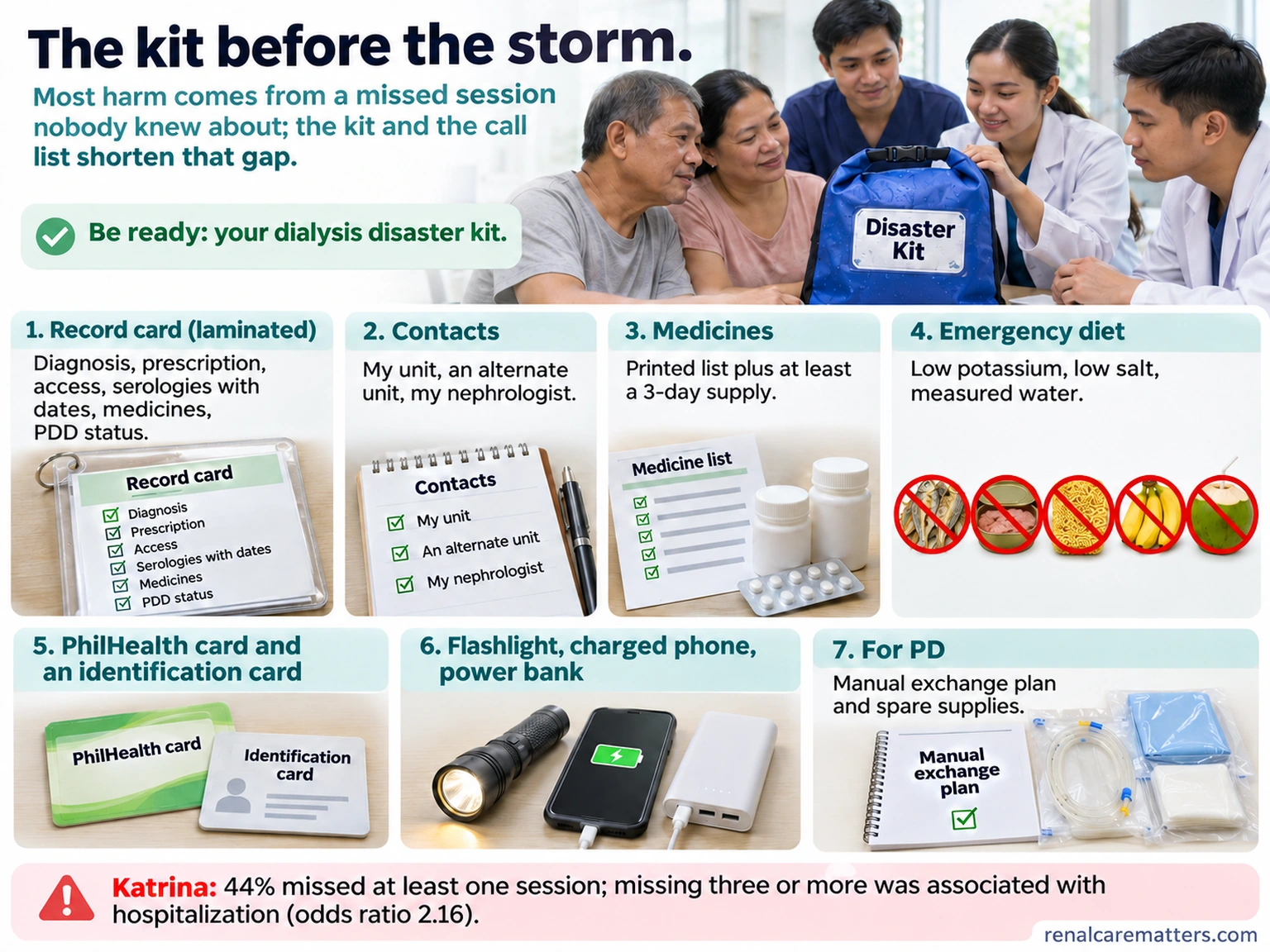
What patients are told to do. The United States Centers for Disease Control and Prevention (CDC) advises dialysis patients to keep an emergency kit with contact numbers for their doctor, their regular unit and another unit nearby, a list of their medicines with at least a 3-day supply of each, to follow a 3-day emergency diet if they cannot get dialysis, and to tell the person in charge of a shelter about their medical needs.4 The emergency diet does not replace dialysis; it limits potassium, salt and fluid to buy time. Adapt it to Filipino relief food: dried fish, canned meat and instant noodles are salty, and bananas and coconut water are high in potassium.
Figure 2. The kit before the storm. Most harm comes from a missed session nobody knew about; the kit and the call list shorten that gap.
Link in the chain
What breaks
What the patient and unit do before the season
Unit closes
Flood, power, water treatment, staff cannot travel
Generator and fuel plan; a written agreement with an alternate unit; staff call tree
Patient cannot reach a unit
Roads flooded, no transport, evacuation
Dialyze early when a strong storm is forecast, per the attending’s decision; know the alternate unit
Records lost
Papers wet; unit offline
Patient carries a waterproof card: diagnosis, prescription, access, serologies with dates, medicines, Philippine Health Insurance Corporation (PhilHealth) Dialysis Database (PDD) status, contacts
Food and fluid
Relief food salty and high in potassium
Teach the emergency diet in Filipino terms; keep low-potassium, low-salt food and measured water
Medicines run out
Pharmacies closed
At least a 3-day supply; a printed list
Payment
Treated at an unfamiliar unit
An active Philippine Health Insurance Corporation (PhilHealth) Dialysis Database (PDD) registration; the benefit card and an identification card in the kit
Peritoneal dialysis (PD) at home
Power out, supplies cut off, home flooded
Manual exchange plan for patients on automated cycles, as their PD team teaches; spare supplies; a clean place to exchange
PhilHealth’s benefit follows the registered patient: patients with chronic kidney disease stage 5 registered in the PDD can avail of up to 156 sessions a year.5 Make sure the registration is active before typhoon season, because a patient who dialyzes at an unfamiliar unit should not have to argue about payment while his potassium climbs. Confirm current benefit rules on the date of service.
At your stageIntern: ask every dialysis patient you admit when the last session was and whether any were missed. Resident: include a disaster plan in every discharge of a dialysis patient during typhoon season. Fellow: help your unit write and test its alternate-unit agreement and patient call list before June.
RememberIn a storm, the most dangerous dialysis patient is the one nobody knows has missed a session. Plan the call list, the alternate unit and the patient’s kit before the season, not during it.
Lesson · part 2
The capstone case: potassium, fluid and acid in the right order
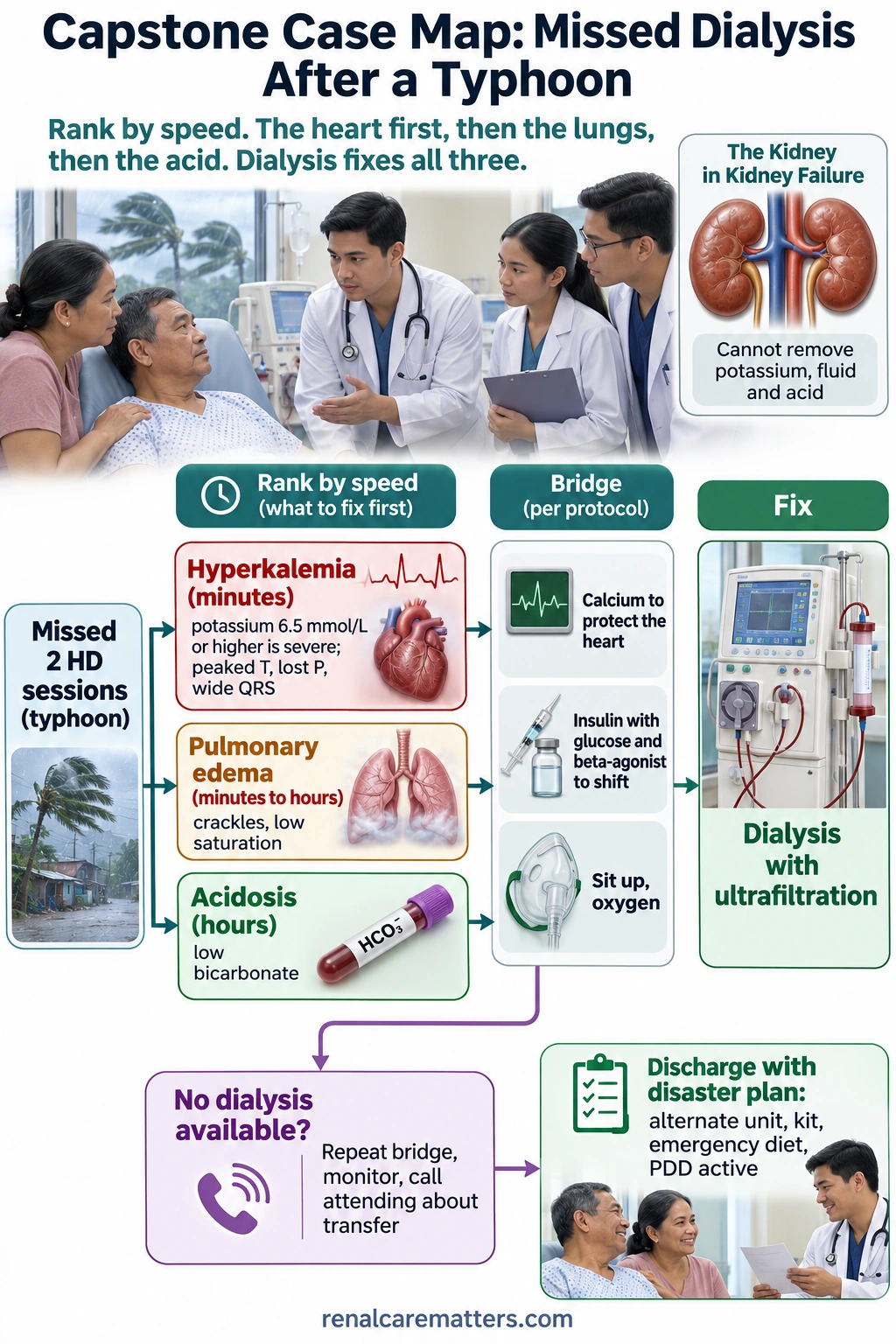
Mr. Caballero has three problems, and they are ranked by how fast they kill. Potassium threatens the heart in minutes; his ECG already shows it. Fluid in the lungs threatens oxygenation in minutes to hours. Acidosis worsens both and will not correct without dialysis. All three have one definitive treatment, dialysis, and the first hour is about keeping him alive until he gets it.
Potassium. The UK Kidney Association classifies potassium of 6.5 mmol/L or higher as severe hyperkalemia.6 The Kidney Disease: Improving Global Outcomes (KDIGO) Controversies Conference on potassium reviewed acute management in kidney disease; its conclusions are conference statements, not graded recommendations.7 The physiology gives the order. First, protect the heart: intravenous calcium raises the threshold potential and stabilizes the membrane within minutes, without lowering potassium. Second, shift potassium into cells: insulin with glucose and inhaled beta-agonists drive it in through the sodium-potassium pump, temporarily. Third, remove it: in a patient on dialysis, that means dialysis, because his kidneys cannot excrete it and other routes are slow. Doses, the glucose plan and repeat checks come from the hospital protocol and the attending. Module 7 covers the detail.
Figure 3 · Stabilize, shift, remove: the first hour for a dialysis patient who missed sessions
RecognizePeaked T waves, absent P waves, wide QRS, a slow or irregular pulse. Put him on a cardiac monitor and get help.
Protect the heartIntravenous calcium per protocol when the ECG shows hyperkalemic changes; repeat the ECG.
ShiftInsulin with glucose and an inhaled beta-agonist per protocol; check glucose often, because he is diabetic and may become hypoglycemic later.
BreatheSit him up, give oxygen, prepare for noninvasive support per protocol; diuretics are unlikely to work in a patient with little urine.
RemoveCall the nephrologist and the HD unit at once; dialysis is the definitive treatment for potassium, fluid and acid.
Watch for reboundPotassium shifts back out of cells within hours; recheck after treatment and after dialysis.
Fluid. He gained fluid over two missed sessions, and his lungs show it. Ultrafiltration on dialysis is the treatment. Until then, position, oxygen and blood pressure control per protocol support him; giving intravenous fluid with his potassium medicines must be kept to the minimum the protocol requires.
When dialysis is delayed. The generator can fail; two machines may be busy; the unit may lack water. Then the bridge measures are repeated per protocol, potassium and ECG are watched closely, and the attending decides early whether to transfer to a center that can dialyze. A potassium binder by mouth acts too slowly to be the main treatment in this setting. The decision to transfer a patient this sick, through flooded roads, is the attending’s, with the family.
Sitting up, oxygen, ventilatory support per protocol
Ultrafiltration
Metabolic acidosis
Acid not removed; worsens potassium shift
Low bicarbonate, fast breathing
Treat the cause; protocol-directed measures
Dialysis
Hidden extras
Infection from floodwater, injury, missed medicines, hyperglycemia
Fever, wounds, high glucose
Look for them on arrival
Specific treatment
Stop and callStop and call the attending nephrologist now, per unit protocol, but always ask the attending nephrologist for guidance, when:
potassium is 6.5 mmol/L or higher, or the ECG shows hyperkalemic changes at any potassium;
oxygen saturation is falling despite oxygen and positioning;
dialysis cannot start soon because of machines, water, power or staff;
the potassium rebounds after the first treatment or after dialysis;
a transfer through disaster conditions is being considered.
Figure 4. Rank by speed. The heart first, then the lungs, then the acid; dialysis fixes all three.
In childrenChildren on dialysis have smaller fluid and potassium reserves, so a missed session or a typhoon week can cause dangerous hyperkalemia and fluid overload faster, and treatment is planned by weight. Many children in the Philippines are on home peritoneal dialysis, where floods and power cuts interrupt automated cycling and supplies, and a manual exchange plan matters. Electrolyte emergencies in children are covered in Attending Pediatric Nephrologist, Module 4.
RememberRank the dangers by how fast they kill: protect the heart, shift the potassium, support breathing, and get dialysis. Everything else waits.
Lesson · part 3
Handoffs, documentation and an entrustment portfolio
A capstone is not only a case well managed; it is evidence that you can be trusted with it. The idea of entrustable professional activities, introduced by ten Cate, is that training should certify units of professional work, such as managing a patient with hyperkalemia or handing off an unstable patient, that a supervisor can entrust to a trainee once competence has been shown, rather than abstract lists of competencies.8 The level of entrustment rises in steps: observe, act with direct supervision, act with supervision available, act independently within the institution’s rules.
Handoff is the activity that ties every stage together. In the multicenter study of a structured resident handoff program, medical errors fell from 24.5 to 18.8 per 100 admissions and preventable adverse events from 4.7 to 3.3 per 100 admissions after implementation, without longer handoffs.9 It was a before-and-after design, so the improvement is associated with the program rather than proven to be caused by it. A common structure is Illness severity, Patient summary, Action list, Situation awareness, Synthesis by receiver (I-PASS): illness severity, patient summary, action list, situation awareness and contingency planning, and synthesis by the receiver.
I-PASS element
Mr. Caballero at 7 a.m.
Illness severity
Unstable: watch closely
Patient summary
54-year-old on HD three times a week, missed two sessions after the typhoon; potassium 7.4 with ECG changes, pulmonary edema, acidosis
Action list
Calcium and shift measures given per protocol at stated times; HD booked on machine 2 at 7:30; recheck potassium and glucose after; restart medicines
Situation awareness and contingency
If the ECG worsens, repeat calcium per protocol and call the fellow; if the generator fails, call the attending about transfer
Synthesis by receiver
The receiver repeats the plan and the triggers
What goes in your portfolio from this module. A written integrated case with your own reasoning; an observed handoff assessed by a supervisor; a discharge plan that includes a disaster plan; for fellows, a unit-level improvement (for example, the alternate-unit agreement) with a measure; and one teaching session, with feedback. The Academy’s Personal Study Record and preceptor sign-off hold the record; your training program decides what counts.
At your stageIntern: present with the structure above and ask your resident to rate one handoff. Resident: collect observed assessments for the acute activities in this track. Fellow: assess residents and interns against the same activities, and record your own entrustment for dialysis, transplant and critical care work.
RememberEntrustment is earned one observed activity at a time. Hand off with a structure, and ask someone to watch you do it.
Lesson · part 4
From this admission to the next stage of training
The case does not end when the potassium is normal. Mr. Caballero will go home to the same province, the same unit and the next typhoon season. The fellow’s longitudinal plan covers his kidneys, his heart, his risk and his life. For people with chronic kidney disease who are not yet on dialysis, the KDIGO 2024 chronic kidney disease (CKD) guideline recommends estimating the absolute risk of kidney failure with an externally validated risk equation, which shapes the timing of modality and access planning (Module 11).10 For Mr. Caballero, already on HD, the plan is different: adequacy, fluid targets, potassium education in the language and foods of his home, medicines he can afford, vaccination, his fistula, transplant referral if he is a candidate (Module 29), and a disaster plan written down with his family.
Part of the plan
What the fellow defends
Linked module
Why he missed dialysis
The unit closed; he had no alternate unit and did not know the unit’s emergency plan
This module
Potassium and diet
Teach which relief foods are dangerous; a low-potassium emergency list
Modules 7 and 15
Fluid and blood pressure
Review target weight after the admission; restart medicines
Modules 5, 12 and 23
Medicines
A 3-day emergency supply and a printed list
Module 16
Benefit continuity
PDD registration active; sessions counted
Module 34
Long-term options
Transplant evaluation if appropriate; PD if home conditions suit
Modules 27 and 29
Goals of care
What matters to him and his family if the next storm is worse
Module 32
Your own next step. Each stage in the Philippine ladder carries different authority. The intern moves toward the licensure examination; the resident toward specialty boards and, for some, fellowship; the fellow toward the Philippine Society of Nephrology (PSN) board and independent practice. Module 1 and Module 33 explain what each stage allows, including the rules for working as a dialysis physician on duty. What carries across every stage is the same set of habits this track has taught: look at the patient and the urine yourself, rank dangers by speed, say the absolute numbers, write the truth, hand off with a structure, and call the attending when the situation exceeds your authority or your experience.
Look after yourself as well. Disaster weeks are long, and trainees often work through their own family’s losses. Fatigue causes errors, and asking for relief is part of patient safety, not a failure.
At your stageIntern: write down three habits from this track you will keep as a resident. Resident: choose the activities you want entrusted next and ask to be observed. Fellow: teach this capstone case to the next group of interns.
RememberA good admission ends with a plan for the next storm. A good training year ends with habits you will keep without being asked.
On the floor
Real situations: problems and solutions
These are fictional but typical. For each one, cover the answer, decide what you would do, then compare. Where a step depends on local rules, your unit’s procedure and your supervisor’s direction come first.
The storm forecast on a Thursday
What you see
A strong typhoon is forecast to make landfall in Aurora province on Saturday; a unit in Baler has 30 patients on Monday-Wednesday-Friday and Tuesday-Thursday-Saturday schedules.
What is likely going on
Saturday patients will likely miss a session, and Monday may be lost too.
What to do
Ask the attending to decide on early sessions on Thursday and Friday, activate the patient call list, confirm the alternate unit, and remind patients of the emergency diet and medicine supply.
Why it matters
Early dialysis before landfall was feasible on a large scale after Hurricane Sandy.
The man in the evacuation center
What you see
A barangay health worker in an evacuation center in Albay calls about a man with a fistula who says he has not had dialysis for four days and feels weak.
What is likely going on
A dialysis patient at high risk of fatal hyperkalemia, outside any health facility.
What to do
Ask for transport to the nearest hospital with dialysis at once, advise him to avoid relief foods high in potassium on the way, and call ahead to the receiving emergency room.
Why it matters
Patients placed in shelters were more likely to miss three or more sessions after Hurricane Katrina.
The child on home PD during a power cut
What you see
A mother in Ormoc calls because the power has been out for two days and her 9-year-old son’s automated PD cycler cannot run.
What is likely going on
Interrupted automated PD in a child with small reserves.
What to do
Follow the manual exchange plan the PD team taught, contact the pediatric nephrologist, and arrange supplies or admission if exchanges cannot be done safely.
Why it matters
Children reach dangerous potassium and fluid levels faster, and automated PD depends on electricity.
The unit on a generator
What you see
In Tacloban after a storm, a hospital HD unit can run only two machines on its generator, and six patients are waiting.
What is likely going on
Too few machines for the demand; some patients are more urgent.
What to do
Triage with the attending by potassium, ECG, oxygenation and time since the last session; give short sessions if the attending decides; contact other units for transfer.
Why it matters
Triage by danger, not by arrival order, saves the patients most at risk.
Field notes
Ask every dialysis patient at discharge: where will you dialyze if your unit is closed?
Give patients a laminated card with their prescription, access, serology dates, medicines, PDD status and contacts.
Teach the emergency diet using the foods in local relief packs.
Keep your own phone list of nearby units and their nephrologists.
In disaster weeks, ask for relief before fatigue causes an error.
Case review
Back to the case: The morning after the typhoon
The intern’s presentation. Ana starts with severity, not history: “Unstable. 54-year-old on HD three times a week, missed Monday and Wednesday because of the typhoon, now with potassium 7.4, ECG with peaked T waves, absent P waves and a wide QRS, pulmonary edema with saturation 87%, and bicarbonate 13.” She names the dangers in order of speed: the heart, the lungs, the acid. She calls the resident at once, asks for a monitor and an ECG repeat, and hands off with I-PASS, including what has been given and what should trigger a call. To rehearse the response with your nurses, technicians and head nurse, run the Academy’s Same event, every role drill.
The resident’s admission. Miguel follows the sequence: monitor, calcium per protocol for the ECG changes, shift measures with glucose checks, upright position and oxygen, and an immediate call to the fellow and the HD unit for emergency dialysis with ultrafiltration. He looks for floodwater infection, wounds and missed medicines. He rechecks potassium and glucose after treatment and after dialysis, watching for rebound. If the generator or the machines fail, he repeats the bridge measures per protocol and asks the attending early about transfer. Before discharge he restarts medicines, reviews the target weight, confirms the next session at a unit that is open, and writes a disaster plan with the family.
The fellow’s longitudinal plan. Grace defends a plan that addresses why he missed dialysis: an alternate unit named in writing, early dialysis when a strong storm is forecast as the attending decides, a waterproof card with his prescription, access, serologies and PDD status, a 3-day medicine supply, and an emergency diet taught with Filipino relief foods in mind. For his unit, she proposes a tested call list and alternate-unit agreement before the next season, measured by the share of patients reached within 24 hours of a storm. She also raises transplant referral and goals of care, and teaches the case to the interns, using the observed handoff for their portfolios.
Skills lab · with your preceptor
Skills checklist: Integrated capstone, disaster readiness and transition
Complete with a preceptor, in simulation or on a real admission. Sign-off is local. Your preceptor rates each step as satisfactory, needs practice, or not observed. Steps marked Critical must all be satisfactory before sign-off. This checklist supports supervised learning; your unit’s own procedure and competency form are the authority. A printable version of every checklist is on the trainer page.
Presents an integrated case of a dialysis patient who missed sessions, ranking dangers by speed
Leads the stabilize-shift-remove sequence in simulation, naming the protocol source for each step
Gives an observed I-PASS handoff of an unstable patient
Writes a discharge plan that includes a disaster plan and an emergency diet adapted to Filipino foods
Reviews or drafts a unit alternate-unit agreement and patient call list
Teaches the capstone case to junior learners and records feedback
Placement activity. Emergency room, ward, dialysis unit or simulation
Self-assessment
Check your understanding
Each visit draws 5 questions at random from this module’s 5-question bank. Choose the single best answer for each, then select Check answers; an explanation appears under the best answer. Select New set of questions for a different mix. A good target is 4 of 5 on two different sets. Nothing you select is sent anywhere; scoring happens in your browser.
Kopp, J. B., Ball, L. K., Cohen, A., Kenney, R. J., Lempert, K. D., Miller, P. E., Muntner, P., Qureshi, N., & Yelton, S. A. (2007). Kidney patient care in disasters: Lessons from the hurricanes and earthquake of 2005. Clinical Journal of the American Society of Nephrology, 2(4), 814–824. https://doi.org/10.2215/CJN.03481006
Anderson, A. H., Cohen, A. J., Kutner, N. G., Kopp, J. B., Kimmel, P. L., & Muntner, P. (2009). Missed dialysis sessions and hospitalization in hemodialysis patients after Hurricane Katrina. Kidney International, 75(11), 1202–1208. https://doi.org/10.1038/ki.2009.5
Kelman, J., Finne, K., Bogdanov, A., Worrall, C., Margolis, G., Rising, K., MaCurdy, T. E., & Lurie, N. (2015). Dialysis care and death following Hurricane Sandy. American Journal of Kidney Diseases, 65(1), 109–115. https://doi.org/10.1053/j.ajkd.2014.07.005
Clase, C. M., Carrero, J. J., Ellison, D. H., Grams, M. E., Hemmelgarn, B. R., Jardine, M. J., Kovesdy, C. P., Kline, G. A., Lindner, G., Obrador, G. T., Palmer, B. F., Cheung, M., Wheeler, D. C., Winkelmayer, W. C., Pecoits-Filho, R., & Conference Participants. (2020). Potassium homeostasis and management of dyskalemia in kidney diseases: Conclusions from a Kidney Disease: Improving Global Outcomes (KDIGO) Controversies Conference. Kidney International, 97(1), 42–61. https://doi.org/10.1016/j.kint.2019.09.018
Starmer, A. J., Spector, N. D., Srivastava, R., West, D. C., Rosenbluth, G., Allen, A. D., Noble, E. L., Tse, L. L., Dalal, A. K., Keohane, C. A., Lipsitz, S. R., Rothschild, J. M., Wien, M. F., Yoon, C. S., Zigmont, K. R., Wilson, K. M., O'Toole, J. K., Solan, L. G., Aylor, M., ... I-PASS Study Group (2014). Changes in medical errors after implementation of a handoff program. The New England Journal of Medicine, 371(19), 1803–1812. https://doi.org/10.1056/NEJMsa1405556
Kidney Disease: Improving Global Outcomes (KDIGO) CKD Work Group. (2024). KDIGO 2024 clinical practice guideline for the evaluation and management of chronic kidney disease. Kidney International, 105(4S), S117–S314. https://doi.org/10.1016/j.kint.2023.10.018
Educational self-study for physicians in training. Clinical tasks need your institution’s authorization and supervision. Completing this track is an Academy learning record only. It does not confer licensure, specialist status, PSN or PNSP membership or board eligibility, procedural privileges, CPD units, or completion of an institutional training program, and it does not replace current guidelines, regulations, your institution’s protocols and formulary, or your supervisor.