Prepare patients and the unit for typhoons, floods, outages and outbreaks.
PublishedNailathalaGipatikPepalwal:ReferencesMga SanggunianMga TinubdanReng Reperensya:4Audience: Practicing nephrologists · senior nephrology fellows · internists who share longitudinal kidney care in the clinic, ward, ICU, dialysis unit, and homeRead timeOras ng pagbasaOras sa pagbasaOras ning pamamasa:
Training track for attending nephrologists in adult practice
This module is study material for attending nephrologists and senior fellows in adult practice. It explains the reasoning behind common decisions; it is not a protocol. Doses and thresholds must be checked against current product labels, guidelines, and your institution’s approved protocols. Regulatory and benefit rules change: confirm them on the date of service. Every case is fictional.
Learning objectives
After this module you should be able to
Prepare patients and the unit for typhoons, floods, outages and outbreaks.
Triage missed treatments by clinical risk and confirm receiving capacity.
Track every deferred patient until care resumes or is formally transferred.
Pre-testBefore you read, answer the 5 self-assessment questions and note your score. After the module, select New set of questions and compare. The difference is what you learned; the questions you still miss are what to reread.
Start here
The big picture, in plain words
Your duty · Section 1.2, 2024 hemodialysis guidelinesUnder the Philippine Society of Nephrology (PSN) guidelines: Coordinate in emergencies (b8), and provide endorsement documents and coordinate with any receiving unit when patients are displaced (b10).
In plain wordsA dialysis patient can survive a few days without treatment if prepared, and can die in one day if not. Preparation before typhoon season decides who is safe when the roads close.
Pre-storm actionExtra or early sessions before forecast landfall
Opening case · fictional
Case: The satellite unit that went under water
A typhoon passed overnight. At 6 a.m., your head nurse calls: the satellite unit in the next town is flooded and closed, probably for a week. Its 30 patients, under five attending nephrologists, normally dialyze across three shifts. Eight of them are yours. Three of yours have already missed a session. One, Mr. Bernardo, has no urine output and told the nurse on the phone that he is breathless and cannot lie flat.
Your main unit can add two extra slots tomorrow morning. The roads to the hospital are partly flooded, and two patients cannot be reached by phone.
Before reading on, decide:
Who is seen first, and is that a slot decision?
How do you decide who gets the two slots?
How will you know when every patient is safe?
Keep your answers in mind. The lesson gives you what you need, and the case review near the end shows one sound response.
Lesson · part 1
How it works
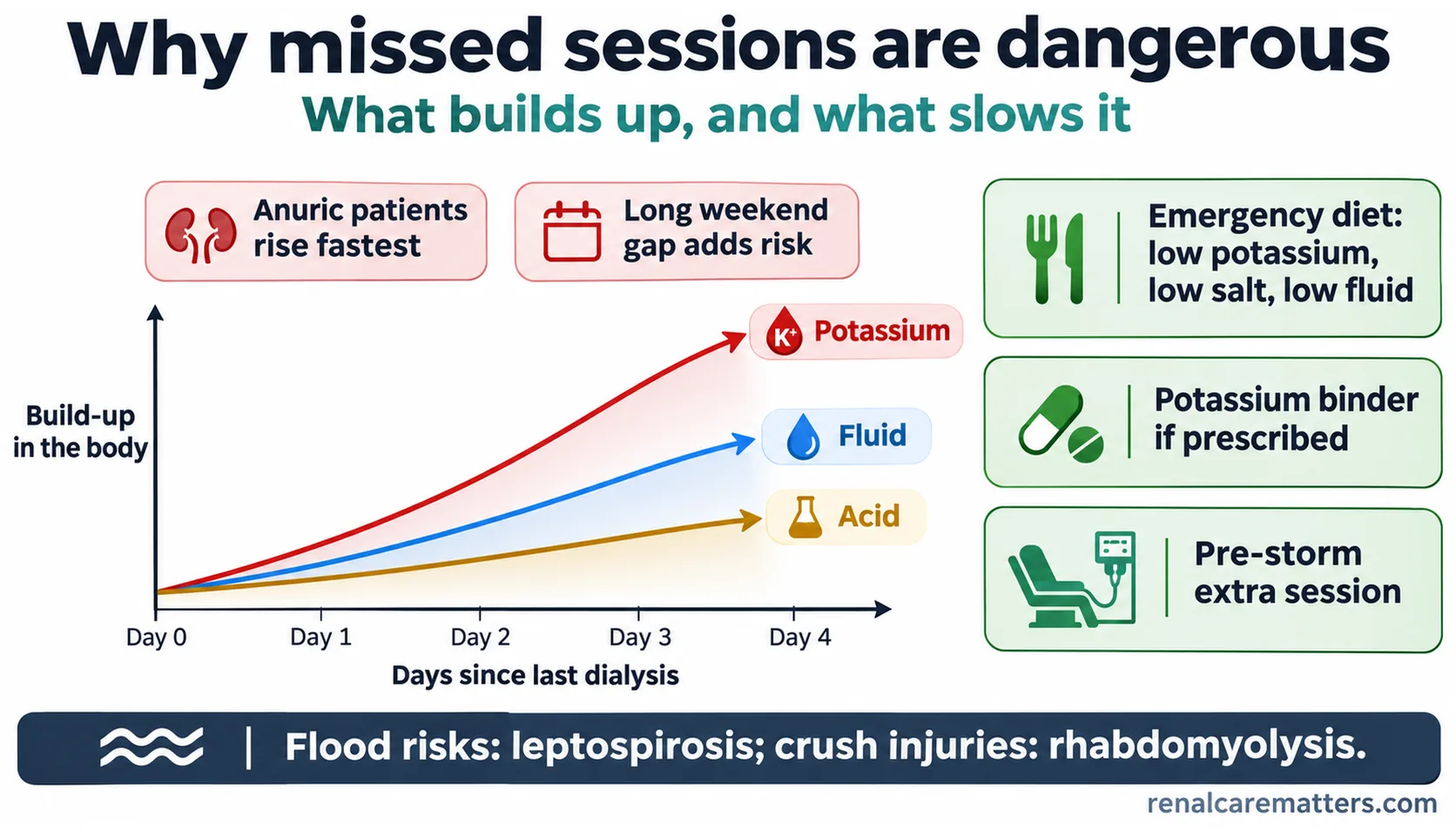
Missing sessions lets potassium, fluid and acid accumulate. Potassium is the most immediate killer; the risk is highest in anuric patients and after the long interdialytic interval. Diet changes this rate: a strict low-potassium, low-salt, low-fluid emergency diet slows the rise, and pre-emptive extra sessions before a storm add a buffer. Floods add leptospirosis risk, crush injuries add rhabdomyolysis, and crowded evacuation centers spread respiratory and gastrointestinal infection.
During a power outage · fictional
Your unit loses power for three days after a storm. Mr. Bernardo, anuric, last dialyzed on Friday. Ms. Cruz still passes a liter of urine a day and dialyzed on Saturday.
You send Mr. Bernardo to the first available slot. He cannot excrete potassium, and the long gap after Friday is when risk peaks. Ms. Cruz can wait one more day with a strict emergency diet and a potassium binder.
What this shows. Triage by days since the last session, urine output, and potassium history.
Figure 2. Why missed sessions are dangerous. Potassium, fluid and acid build up with each day without dialysis, and diet, binders and an extra session slow the rise.
Lesson · part 2
What the evidence shows
Guidance comes from disaster experience rather than trials: the ISN (International Society of Nephrology) Renal Disaster Relief Task Force, US kidney community emergency programs and Philippine typhoon experience. Observational reports after Hurricane Katrina and Hurricane Sandy associated missed treatments with more emergency visits and hospitalizations, and pre-storm dialysis with better outcomes. Infection-prevention responses to outbreaks (isolation, cohorting, hepatitis B segregation) follow Centers for Disease Control and Prevention (CDC) and Department of Health (DOH) standards.
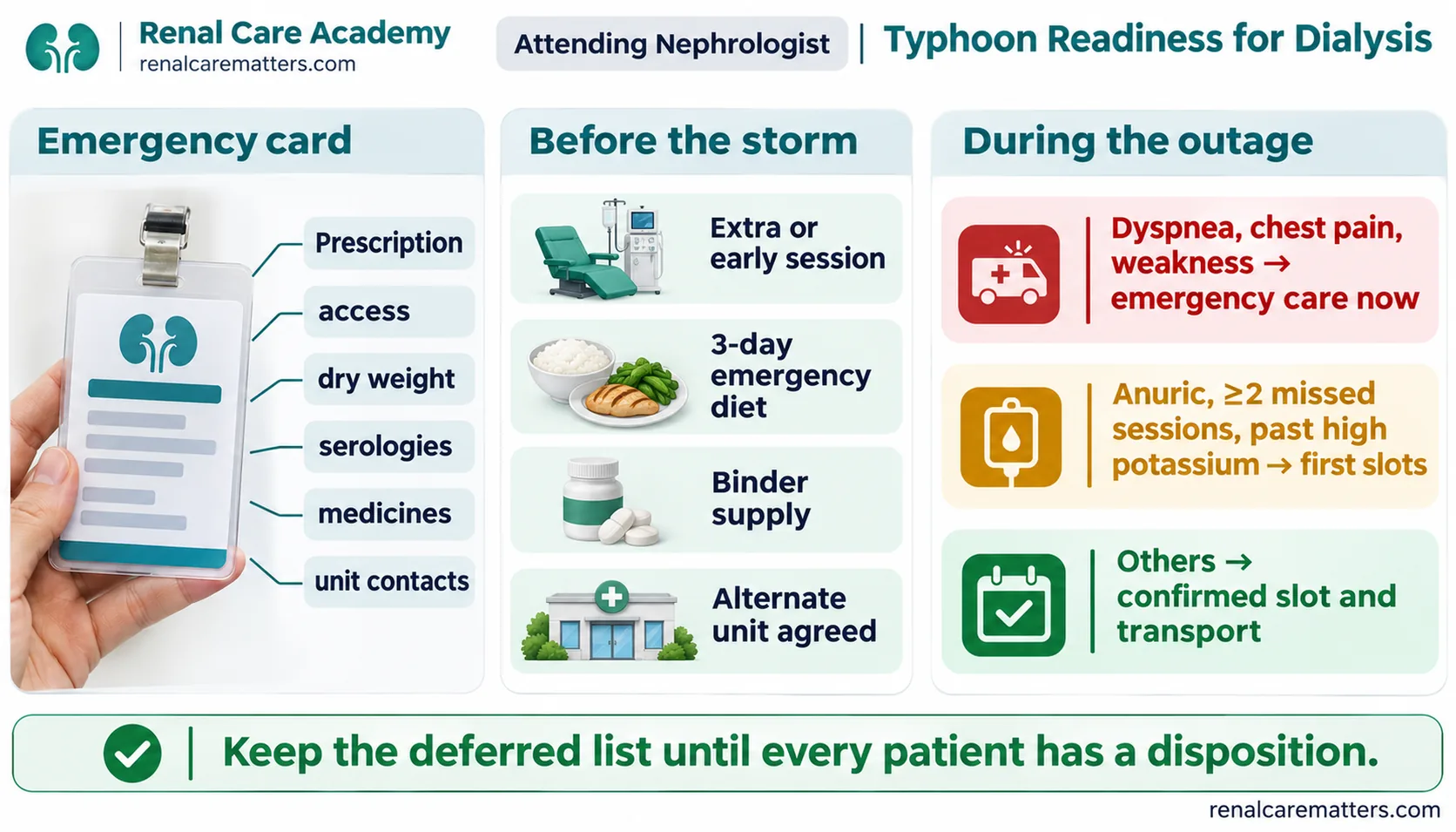
Before typhoon season, give each patient an emergency card (diagnosis, access, dry weight, prescription, medicines, serologies and unit contacts), a 3-day emergency diet and potassium-binder supply, and alternative-unit options. Agree mutual-aid arrangements with nearby units. Schedule extra sessions before a forecast landfall. During an outage, route symptomatic patients (dyspnea, chest pain, weakness) to emergency care first, then triage the rest by days since last treatment, anuria and potassium history, confirming acceptance and transport for each. Keep a deferred-treatment list until every patient has a disposition. During a cluster, involve infection prevention and preserve incident data.
Figure 3. Typhoon readiness for dialysis: the emergency card, steps before the storm, and how to triage patients during an outage.
Before typhoon season · fictional
In May you ask the head nurse to check your patients’ emergency cards. Twelve cards are missing their dry weight, and four list a unit that has closed. The head nurse updates them during the next week’s sessions.
The clinical head signs a mutual-aid agreement with a unit across the river, listing how many extra slots each can offer the other, and you make sure your patients’ cards name that unit.
What this shows. Preparation in May decides who is safe in September.
Stop and call
Dyspnea or chest pain after missed sessions
Anuric patient missing ≥2 sessions
Patient unreachable after the event
Evacuation-center fever or diarrhea cluster among dialysis patients
On the floor
Real situations: problems and solutions
These are fictional but typical. For each one, cover the answer, decide what you would do, then compare. Where a step depends on local rules, your unit’s procedure and your supervisor’s direction come first.
The forecast landfall on Saturday
What you see
A typhoon is forecast to make landfall on Saturday night.
What is likely going on
Monday sessions may be impossible.
What to do
Schedule extra or early sessions on Friday and Saturday, and check that patients have their emergency cards and diet sheets.
Why it matters
Pre-storm dialysis builds a buffer before the roads close.
Fever in the evacuation center
What you see
Several of your patients in the same evacuation center report fever and diarrhea.
What is likely going on
A cluster of infection.
What to do
Involve infection prevention, test, and cohort as needed.
Why it matters
Dialysis patients are vulnerable, and clusters spread through shared spaces.
The generator that ran out
What you see
Power fails during a session, and the backup generator has no fuel.
What is likely going on
The continuity plan was never tested.
What to do
End sessions safely by hand, return blood where safe, and review the generator and fuel plan.
Why it matters
An untested backup is not a backup.
Field notes
Give every patient an emergency card before typhoon season.
Agree mutual aid with nearby units in writing.
Keep a deferred-treatment list until every name is cleared.
Test the generator monthly.
Case review
Back to the case: The satellite unit that went under water
First. Mr. Bernardo goes to emergency assessment now. Breathlessness and orthopnea in an anuric patient who has missed dialysis can mean pulmonary edema or dangerous potassium. That is not a decision about a slot tomorrow. Arrange transport and confirm that the hospital will accept him.
The two slots. Agree with the clinical head and the other attending nephrologists that the slots go to whoever is in most danger, not to whoever’s doctor calls first. Triage by days since the last session, whether they still make urine, and their potassium history. Potassium is the most immediate danger, and anuric patients after the long gap are at highest risk. Confirm acceptance and transport for each patient you place. Give everyone waiting interim advice: the emergency low-potassium, low-salt, low-fluid diet, their potassium binder if they have one, and the warning signs (breathlessness, chest pain, weakness) that mean going to an emergency department instead of waiting.
Every patient safe. Ask the clinical head to keep one deferred-treatment list for all 30 patients, and make sure each of your eight has a plan on it. Remove a name only when that patient has been dialyzed or formally transferred. Keep calling the two who cannot be reached, and ask the barangay health office or the family to check on them. The evidence here comes from disaster experience rather than trials, but it is consistent: missed treatments after storms were associated with more emergency visits and admissions. After the water recedes, review why three patients missed sessions before you knew, and schedule extra sessions before the next forecast landfall.
Skills lab · with your preceptor
Skills checklist: Skills checklist
Complete with a preceptor, in simulation or at your own unit. Sign-off is local. Your preceptor rates each step as satisfactory, needs practice, or not observed. Steps marked Critical must all be satisfactory before sign-off. This checklist supports supervised learning; your unit’s own procedure and competency form are the authority. A printable version of every checklist is on the trainer page.
Prioritizes by clinical risk
Names alternate sites and confirms acceptance
Closes the follow-up list
Placement activity. Simulation or supervised practice
Self-assessment
Check your understanding
Each visit draws 5 questions at random from this module’s 5-question bank. Choose the single best answer for each, then select Check answers; an explanation appears under the best answer. Select New set of questions for a different mix. A good target is 4 of 5 on two different sets. Nothing you select is sent anywhere; scoring happens in your browser.
Educational material for physicians. Completing it is an Academy learning record only. It does not confer CPD units, PSN certification, privileges, or PhilHealth accreditation, and it does not replace current guidelines, regulations, your institution’s protocols, or clinical judgment.