Potassium, calcium, phosphate and magnesium emergencies
Stabilize, shift and remove potassium in a child, and recognize the calcium, phosphate and magnesium emergencies of infancy and tumor lysis.
PublishedNailathalaGipatikPepalwal:ReferencesMga SanggunianMga TinubdanReng Reperensya:10Audience: Pediatric nephrologists · pediatric nephrology fellows · adult nephrologists, intensivists and neonatologists who share kidney care for children in the clinic, ward, NICU, PICU, dialysis unit and homeRead timeOras ng pagbasaOras sa pagbasaOras ning pamamasa:
Training track for attending pediatric nephrologists
This module is study material for attending pediatric nephrologists and fellows. It explains the reasoning behind common decisions; it is not a protocol and it gives no doses. Doses, fill volumes and thresholds must come from current pediatric guidelines, product labels, your institution’s approved pediatric protocols and a pediatric pharmacist. Benefit rules change: confirm them on the date of service. Every case is fictional.
Learning objectives
After this module you should be able to
Explain hyperkalemia at the cell membrane and apply the stabilize, shift and remove sequence in a child, with doses taken from the unit’s pediatric formulary.
Recognize laboratory and clinical tumor lysis syndrome by the Cairo–Bishop definitions and decide when the kidney needs support.
Identify the calcium, phosphate and magnesium emergencies of infancy, refeeding and drug toxicity, and why magnesium must be corrected first.
Pre-testBefore you read, answer the 5 self-assessment questions and note your score. After the module, select New set of questions and compare. The difference is what you learned; the questions you still miss are what to reread.
Start here
The big picture, in plain words
Your role · the kidney consultant to the oncology and pediatric wardsYou are called when a potassium is already high, an electrocardiogram (ECG) already looks wrong, or a child on chemotherapy has stopped passing urine. The pediatric oncologist, the intensivist and you share the child. Your duty is to read the numbers fast, separate the real from the artifact, start the right sequence, and decide early whether the child needs dialysis and where it can be done.
In plain wordsThink of each heart cell as a small battery. Potassium inside the cell, far more than outside, keeps it charged. When the outside potassium rises, the battery runs down: the cell sits closer to firing but fires worse.
The picture has a limit. A battery that runs down simply stops. A heart cell with a raised outside potassium first becomes easier to excite, then slower to conduct, then unable to conduct at all, because the sodium channels that start each beat stay inactivated when the resting voltage drifts up. Calcium does not lower potassium; it moves the firing threshold back and buys time. That is why treatment comes in three steps that do three different things.
Figure 1 · Key numbers
Hyperkalemia in children (review)Plasma potassium above 5.5 mmol/L; severe above 7 mmol/L
Laboratory tumor lysis (Cairo–Bishop)Two or more of: uric acid ≥476 µmol/L, potassium ≥6.0 mmol/L, phosphate ≥2.1 mmol/L in children, calcium ≤1.75 mmol/L, or a 25% change, from 3 days before to 7 days after chemotherapy
Rasburicase versus allopurinol (pediatric randomized controlled trial)Uric acid fell 86% versus 12% four hours after the first dose
Refeeding syndrome (ASPEN 2020)A fall in phosphorus, potassium or magnesium of 10–20% (mild), 20–30% (moderate) or more than 30% (severe) within 5 days of feeding
Most high potassiums in children are real but slow, and some are artifacts from a squeezed heel or a hemolyzed sample. A few kill within minutes. Your work is to know which is which within one phone call, act in the right order, and plan removal, not only shifting.
Opening case · fictional
Case: Day 2 of chemotherapy
It is Wednesday, 6:15 p.m., in the pediatric oncology ward of a tertiary government hospital in Manila. Joshua Ramos is 6 years old and 19 kg, with stage III Burkitt lymphoma and a large abdominal mass. Induction chemotherapy started yesterday with hydration and allopurinol; rasburicase was recommended but the family could not afford it, and the hospital’s stock was out. Since noon his urine output has fallen from 2.5 to 0.6 mL/kg per hour.
His 6 p.m. results: potassium 6.6 mmol/L (5.4 this morning), phosphate 2.9 mmol/L, total calcium 1.65 mmol/L, uric acid 690 µmol/L, creatinine 1.1 mg/dL (0.4 on admission). The sample was venous and not hemolyzed. The ECG shows peaked T waves. He complains of tingling fingers. The oncology fellow asks you two things by phone: should she give calcium to correct his calcium, and can dialysis wait until tomorrow, when the hemodialysis unit has a free slot? His mother, Mrs. Rowena Ramos, a market vendor from Tondo, asks whether the chemotherapy is now hurting his kidneys.
Before reading on, decide:
Does Joshua have tumor lysis syndrome, and what is injuring his kidneys?
What do you do for the potassium in the next 30 minutes, and in what order?
Should his calcium be corrected now, and can dialysis wait until tomorrow?
Keep your answers in mind. The lesson gives you what you need, and the case review near the end shows one sound response.
Lesson · part 1
Hyperkalemia: stabilize, shift, remove
Almost all of the body’s potassium sits inside cells. The ratio of inside to outside potassium sets the resting voltage of heart and muscle cells. The kidney removes the daily load; insulin and beta-adrenergic stimulation move potassium into cells within minutes; acidosis and cell breakdown push it out.
A pediatric review defines hyperkalemia as a plasma potassium above 5.5 mmol/L, moderate at 6 to 7 and severe above 7 mmol/L, and notes that normal values are higher in newborns and infants.1 The ECG may progress from peaked T waves to flattened, broad P waves and QRS widening, and then to heart block, asystole or ventricular arrhythmia.1 Newborns are a special group: a low glomerular filtration rate (GFR), immature tubules and high extrarenal losses all make electrolyte disorders more common in them.2
First, is it real? Pseudohyperkalemia is common in children. The same review attributes it to hemolysis and to potassium leaking from cells during or after collection, more often in small children, where small needles and squeezing the surrounding tissue contribute, as well as to very high white cell counts, clotting and delayed analysis.1 A squeezed heel-prick sample from a well infant with a normal ECG should be repeated by free-flowing venous sampling before anyone gives insulin. A high potassium in a child with leukemia and a very high white count may also be spurious; ask for a whole-blood or blood-gas value taken without delay.
Step
What it does at the membrane
Options (doses from the pediatric formulary)
What it does not do
Stabilize
Raises the threshold for firing; restores conduction
Intravenous calcium, given slowly with monitoring
Lower potassium
Shift
Moves potassium into cells
Insulin with dextrose; inhaled or intravenous beta-2 agonist; bicarbonate only in acidosis
Remove potassium from the body; effect wears off
Remove
Takes potassium out of the body
Loop diuretic if the kidney responds; potassium binders; dialysis
Act quickly (except dialysis)
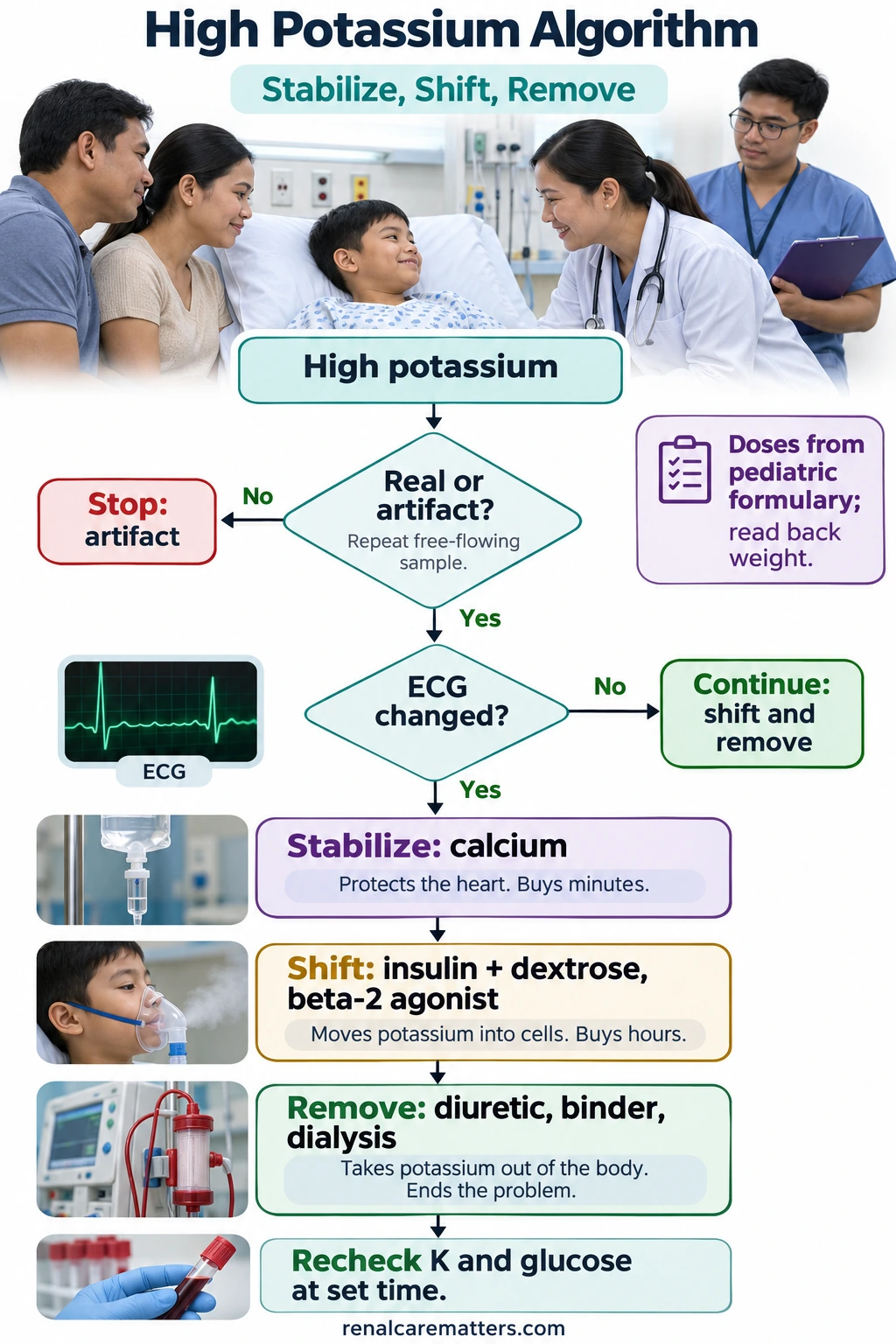
The review calls insulin with dextrose one of the most potent treatments short of dialysis, notes that loop diuretics have the greatest kaliuretic effect, and observes that binders are not supported by high-quality evidence in acute hyperkalemia. It advises against bicarbonate when the pH is above 7.4.1 A Kidney Disease: Improving Global Outcomes (KDIGO) controversies conference reached broadly similar conclusions for kidney patients, mostly from adult data.3 Pediatric trials are few; most of this sequence rests on physiology and adult evidence, and the weight-based doses must come from your unit’s pediatric formulary, double-checked, because tenfold errors are a real risk in small children.
RememberStabilize, shift, remove. Calcium buys minutes, insulin buys hours, and only removal ends the problem.
In the nursery · fictional
A well-looking 5-day-old has a potassium of 7.2 mmol/L on a heel-prick sample taken after a long, difficult stick. The ECG is normal. The resident has drawn up insulin.
You ask him to wait, repeat a free-flowing venous sample, and keep the baby on a monitor meanwhile. The repeat is 5.6 mmol/L.
What this shows. A squeezed heel can raise potassium far more than the baby can. Treat the child and the ECG, and confirm the number.
Lesson · part 2
Tumor lysis syndrome: when the tumor floods the kidney
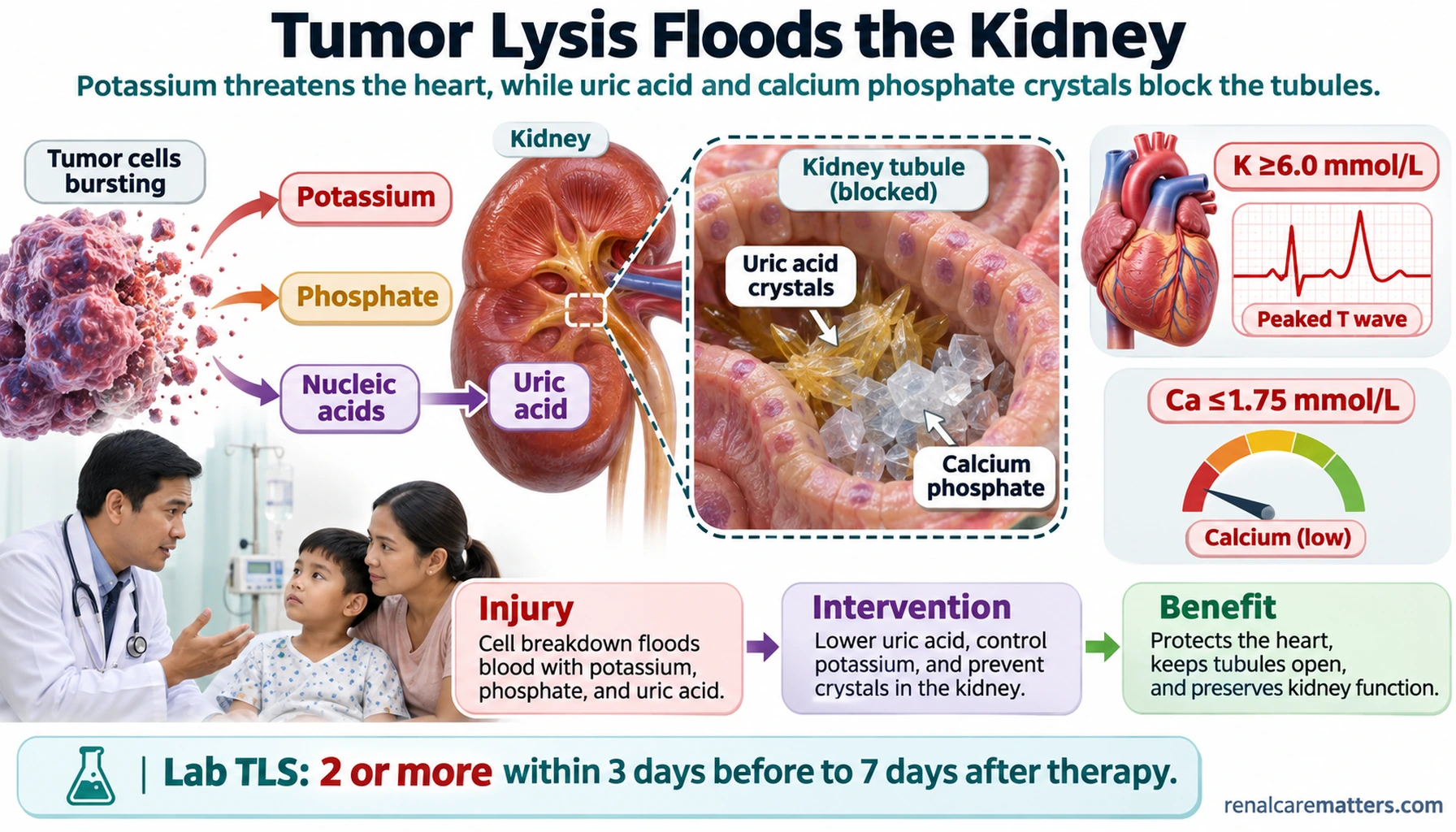
When chemotherapy kills a large, fast-growing tumor, the cells release potassium, phosphate and nucleic acids, which are broken down to uric acid. Cairo and Bishop describe high incidence in tumors with high proliferative rates and burden, such as acute lymphoblastic leukemia and Burkitt lymphoma.4 A recent review describes a large cancer cell mass in children as 300 g/m² of body surface area or more.5 The kidney is injured in two ways: uric acid and calcium phosphate crystallize in the tubules, and volume depletion and inflammation lower perfusion. Phosphate binds calcium, so serum calcium falls, and giving calcium into a high phosphate raises the calcium-phosphate product and the risk of further precipitation in kidney and tissues.
Definitions. Laboratory tumor lysis syndrome (TLS) by Cairo–Bishop is two or more of the following within 3 days before or 7 days after starting cytotoxic therapy: uric acid ≥476 µmol/L (8 mg/dL), potassium ≥6.0 mmol/L, phosphate ≥2.1 mmol/L (6.5 mg/dL) in children, calcium ≤1.75 mmol/L (7 mg/dL), or a 25% change from baseline in any of them. Clinical TLS is laboratory TLS plus a rise in creatinine, an arrhythmia or sudden death, or a seizure.4 An expert panel later built a risk model (low, intermediate, high) based on laboratory TLS, tumor type, bulk and stage, and kidney involvement.6
Released
What happens
What you see
Potassium
Membrane depolarization
Peaked T waves, arrhythmia
Phosphate
Binds calcium; calcium phosphate deposits in tubules
Evidence. The 2008 guideline from pediatric and adult oncologists recommends prevention: hydration and prophylactic rasburicase in high-risk patients, hydration with allopurinol or rasburicase at intermediate risk, and monitoring at low risk. It does not recommend urine alkalinization.7 In a randomized trial in 52 children with leukemia or lymphoma at high risk, rasburicase lowered uric acid exposure over 96 hours (area under the curve 128 versus 329 mg/dL·hour) and reduced uric acid by 86% versus 12% four hours after the first dose.8 Uric acid is a surrogate. The trial was small and was not designed to show a difference in dialysis or death, so its strength is in rapid control of the laboratory value.
Rasburicase is expensive and not always stocked in Philippine hospitals. When it is unavailable, the attending’s job is to see the kidney injury coming earlier, keep urine flowing with hydration where the heart and lungs allow, and plan dialysis before the potassium forces it.
RememberIn tumor lysis, treat the phosphate and the urine output as seriously as the potassium. Calcium is for symptoms and the ECG, not for the number.
Figure 2. How tumor lysis floods the kidney. Potassium threatens the heart, while uric acid and calcium phosphate crystals block the tubules.
Lesson · part 3
Calcium, phosphate and magnesium: infants, refeeding and drugs
Hypocalcemia. The pediatric review lists early and late transient neonatal hypocalcemia among causes in the newborn. Symptoms appear as ionized calcium falls and include tingling of the face and limbs, carpopedal spasm, stridor, tetany, cramps and seizures, with Chvostek and Trousseau signs and reduced cardiac contractility.1 In an infant, a seizure with a normal glucose should prompt an ionized calcium and a magnesium.
Magnesium comes first. Hypomagnesemia, defined in the review as below 0.62 mmol/L, disrupts parathyroid hormone action and causes hypocalcemia and hypokalemia that resist treatment until magnesium is replaced.1 Drugs are a common cause in hospitalized children: aminoglycosides and amphotericin B, diuretics, cisplatin, calcineurin inhibitors and proton pump inhibitors all lower magnesium, through the gut or the tubule.9 A child with refractory hypokalemia on amphotericin or after cisplatin needs a magnesium level before another potassium bolus.
Refeeding. When a malnourished child starts eating, insulin drives phosphate, potassium and magnesium into cells. The American Society for Parenteral and Enteral Nutrition (ASPEN) 2020 consensus, written for hospitalized adults and children, defines refeeding syndrome as a fall in serum phosphorus, potassium or magnesium of 10–20% (mild), 20–30% (moderate), or more than 30% or organ dysfunction (severe), occurring within 5 days of reintroducing calories.10 This is a consensus definition, not a validated outcome measure. Hypophosphatemia, below 0.81 mmol/L in the review, can cause arrhythmias, weakness and seizures.1 Children with severe acute malnutrition, anorexia, long fasting or a long intensive care stay are at risk.
Setting
Electrolyte
Mechanism
What you check
Newborn seizure, normal glucose
Calcium, magnesium
Transient neonatal hypocalcemia
Ionized calcium, magnesium, phosphate
Refractory hypokalemia or hypocalcemia
Magnesium
Renal wasting from drugs; parathyroid hormone (PTH) resistance
Magnesium before more potassium or calcium
Malnourished child starting feeds
Phosphate, potassium, magnesium
Insulin-driven shift into cells
Levels before feeding and daily for 5 days
Tumor lysis
Phosphate high, calcium low
Cell release; calcium-phosphate binding
Phosphate, calcium, urine output every few hours
RememberWhen potassium or calcium will not correct, check magnesium. When a starved child starts eating, check phosphate.
Lesson · part 4
What the attending does
On the first call. Ask for the ECG, the sampling method, the trend, the urine output, the weight and the medicines. Decide whether to treat now or repeat first. If the ECG is abnormal, treat while you repeat.
Order safely. Ask the resident to read back the weight in kilograms and each dose from the pediatric formulary, and to have a second person check insulin and calcium. Write the time of the next potassium and glucose.
Plan removal early. If the urine output is falling, the potassium is rising despite shifting, or the phosphate is climbing in a child with tumor lysis, start the dialysis conversation now. Where can this child be dialyzed tonight? Is there pediatric vascular access, a circuit sized for the child, and a team? Acute peritoneal dialysis is a valid option in a small child when hemodialysis or continuous therapy is not available (Module 16), though it removes potassium and phosphate more slowly.
Figure 3 · A high potassium on the phone
Real or artifactSampling method, hemolysis, white count, delay; repeat by free-flowing venous sample if the child is well and the ECG is normal.
ECGPeaked T waves, wide QRS, arrhythmia: stabilize now with calcium per formulary.
ShiftInsulin with dextrose, beta-2 agonist; glucose checks; bicarbonate only for acidosis.
RemoveLoop diuretic if the kidney responds; binder; dialysis if not.
Find the causeTumor lysis, acute kidney injury, drugs, acidosis, hemolysis, adrenal or tubular disease.
RecheckPotassium and glucose at a written time; ECG after each step.
Stop and call
ECG changes of hyperkalemia, or potassium above 7 mmol/L on a reliable sample
Potassium rising despite shifting therapy
Falling urine output in a child at risk of tumor lysis
Symptomatic hypocalcemia (tetany, stridor, seizure) with a high phosphate
No unit able to dialyze the child within hours
On the intensive care unit · fictional
Rhea, 11, with fungal sepsis on amphotericin B, has had three potassium infusions in two days; her potassium is still 2.8 mmol/L, and she has had two runs of ectopic beats.
You ask for a magnesium level. It is 0.45 mmol/L. After magnesium is replaced, her potassium begins to respond.
What this shows. Low magnesium makes potassium leak from the tubule faster than you can replace it.
RememberEvery hyperkalemia plan ends with removal and a named place for dialysis if removal fails.
Figure 4. Stabilize, shift, remove. Calcium buys minutes, shifting buys hours, and only removal ends the problem; doses come from the pediatric formulary.
On the floor
Real situations: problems and solutions
These are fictional but typical. For each one, cover the answer, decide what you would do, then compare. Where a step depends on local rules, your unit’s procedure and your supervisor’s direction come first.
The leukemia count and the potassium
What you see
A 4-year-old with newly diagnosed leukemia and a white count above 200,000/µL has a laboratory potassium of 7.4 mmol/L but a normal ECG and normal urine output.
What is likely going on
Pseudohyperkalemia from leakage out of fragile white cells in the tube is likely; true tumor lysis is also possible.
What to do
Ask for a blood-gas potassium analyzed immediately, keep the child monitored, and review the TLS markers before giving insulin.
Why it matters
Treating a spurious potassium with insulin risks hypoglycemia; missing a real one risks arrest. A fast, reliable sample settles it.
The tingling hands after chemotherapy
What you see
On day 3 of chemotherapy, a child with Burkitt lymphoma has tingling and carpopedal spasm. Calcium is 1.6 mmol/L and phosphate 3.1 mmol/L.
What is likely going on
Symptomatic hypocalcemia driven by hyperphosphatemia from tumor lysis.
What to do
Treat the symptoms with calcium per formulary, with ECG monitoring, and address the phosphate: urine output, and early dialysis if the kidney is failing.
Why it matters
Correcting calcium without removing phosphate risks calcium phosphate deposition in kidney and tissues.
The malnourished toddler starting feeds
What you see
A 2-year-old with severe acute malnutrition from Mindanao is admitted and started on full feeds. On day 2 she is weak and her phosphate has fallen by 40%.
What is likely going on
Refeeding syndrome (severe by the ASPEN definition).
What to do
Slow the feeds as the nutrition team advises, replace phosphate, potassium and magnesium per protocol, and check levels daily for 5 days.
Why it matters
Refeeding can cause arrhythmia and respiratory failure in a child who looked as if she was finally recovering.
The infant on a loop diuretic
What you see
A 3-month-old with heart failure on a loop diuretic has potassium 2.9 mmol/L and magnesium 0.5 mmol/L; potassium supplements are not working.
What is likely going on
Diuretic-induced magnesium and potassium wasting.
What to do
Replace magnesium first per formulary, then reassess potassium; review the diuretic dose with cardiology.
Why it matters
Potassium will not correct while magnesium is low.
Field notes
Ask how the sample was taken before you treat an infant’s potassium.
Read the weight and every dose back on the phone; insulin and calcium errors in small children are often tenfold.
In a child at risk of tumor lysis, ask for urine output every hour, not every shift.
Order magnesium with every potassium in a child on amphotericin, aminoglycosides, cisplatin or calcineurin inhibitors.
Case review
Back to the case: Day 2 of chemotherapy
Tumor lysis. Yes. Within the Cairo–Bishop window he has a potassium ≥6.0 mmol/L, phosphate ≥2.1 mmol/L, calcium ≤1.75 mmol/L and uric acid ≥476 µmol/L, which is laboratory TLS; with the rise in creatinine it is clinical TLS. His kidneys are being injured by uric acid and calcium phosphate crystals in the tubules and by reduced perfusion. Tell Mrs. Ramos that the treatment is working on the tumor, and that the breakdown of the tumor, not a direct poison, is stressing his kidneys; this is a known risk that the team will manage.
The next 30 minutes. His ECG is abnormal, so treat now and repeat in parallel. Stabilize with intravenous calcium, given slowly with cardiac monitoring, at the dose in the pediatric formulary. Shift with insulin and dextrose, with glucose checks, and consider a beta-2 agonist. Then plan removal: a loop diuretic only if he is not volume depleted and his kidneys respond; otherwise, removal means dialysis. Ask for a repeat potassium and glucose at a written time.
Calcium and dialysis. Treat the calcium only because of his symptoms and the ECG, not to normalize the number: more calcium into a phosphate of 2.9 mmol/L raises the risk of further calcium phosphate deposition. Dialysis should not wait for tomorrow’s slot. He has clinical TLS with a rising potassium, a high phosphate and falling urine output, and shifting therapy will wear off. Arrange kidney replacement tonight with the intensive care team, at the unit that can provide pediatric access and a circuit for a 19 kg child, and document the decision and the plan for rasburicase if it becomes available.
Skills lab · with your preceptor
Skills checklist: Potassium, calcium, phosphate and magnesium emergencies
Complete with a preceptor, in simulation or at your own unit. Sign-off is local. Your preceptor rates each step as satisfactory, needs practice, or not observed. Steps marked Critical must all be satisfactory before sign-off. This checklist supports supervised learning; your unit’s own procedure and competency form are the authority. A printable version of every checklist is on the trainer page.
Distinguishes true hyperkalemia from pseudohyperkalemia and directs a correct repeat sample
Leads a stabilize-shift-remove sequence with formulary doses read back and double-checked
Applies the Cairo–Bishop definitions and identifies when a child with TLS needs dialysis
Checks magnesium in refractory hypokalemia or hypocalcemia and phosphate before refeeding
Placement activity. Pediatric ward, oncology unit, intensive care unit or simulation
Self-assessment
Check your understanding
Each visit draws 5 questions at random from this module’s 5-question bank. Choose the single best answer for each, then select Check answers; an explanation appears under the best answer. Select New set of questions for a different mix. A good target is 4 of 5 on two different sets. Nothing you select is sent anywhere; scoring happens in your browser.
Clase, C. M., Carrero, J. J., Ellison, D. H., Grams, M. E., Hemmelgarn, B. R., Jardine, M. J., Kovesdy, C. P., Kline, G. A., Lindner, G., Obrador, G. T., Palmer, B. F., Cheung, M., Wheeler, D. C., Winkelmayer, W. C., Pecoits-Filho, R., & Conference Participants. (2020). Potassium homeostasis and management of dyskalemia in kidney diseases: Conclusions from a Kidney Disease: Improving Global Outcomes (KDIGO) Controversies Conference. Kidney International, 97(1), 42–61. https://doi.org/10.1016/j.kint.2019.09.018
Cairo, M. S., & Bishop, M. (2004). Tumour lysis syndrome: New therapeutic strategies and classification. British Journal of Haematology, 127(1), 3–11. https://doi.org/10.1111/j.1365-2141.2004.05094.x
Howard, S. C., Avagyan, A., Workeneh, B., & Pui, C. H. (2024). Tumour lysis syndrome. Nature Reviews Disease Primers, 10(1), 58. https://doi.org/10.1038/s41572-024-00542-w
Cairo, M. S., Coiffier, B., Reiter, A., Younes, A., & TLS Expert Panel. (2010). Recommendations for the evaluation of risk and prophylaxis of tumour lysis syndrome (TLS) in adults and children with malignant diseases: An expert TLS panel consensus. British Journal of Haematology, 149(4), 578–586. https://doi.org/10.1111/j.1365-2141.2010.08143.x
Coiffier, B., Altman, A., Pui, C. H., Younes, A., & Cairo, M. S. (2008). Guidelines for the management of pediatric and adult tumor lysis syndrome: An evidence-based review. Journal of Clinical Oncology, 26(16), 2767–2778. https://doi.org/10.1200/JCO.2007.15.0177
Goldman, S. C., Holcenberg, J. S., Finklestein, J. Z., Hutchinson, R., Kreissman, S., Johnson, F. L., Tou, C., Harvey, E., Morris, E., & Cairo, M. S. (2001). A randomized comparison between rasburicase and allopurinol in children with lymphoma or leukemia at high risk for tumor lysis. Blood, 97(10), 2998–3003. https://doi.org/10.1182/blood.v97.10.2998
Liamis, G., Hoorn, E. J., Florentin, M., & Milionis, H. (2021). An overview of diagnosis and management of drug-induced hypomagnesemia. Pharmacology Research & Perspectives, 9(4), e00829. https://doi.org/10.1002/prp2.829
da Silva, J. S. V., Seres, D. S., Sabino, K., Adams, S. C., Berdahl, G. J., Citty, S. W., Cober, M. P., Evans, D. C., Greaves, J. R., Gura, K. M., Michalski, A., Plogsted, S., Sacks, G. S., Tucker, A. M., Worthington, P., Walker, R. N., Ayers, P., & Parenteral Nutrition Safety and Clinical Practice Committees, American Society for Parenteral and Enteral Nutrition. (2020). ASPEN consensus recommendations for refeeding syndrome. Nutrition in Clinical Practice, 35(2), 178–195. https://doi.org/10.1002/ncp.10474
Educational material for physicians. Completing it is an Academy learning record only. It does not confer CPD units, PNSP or board certification, privileges, or PhilHealth accreditation, and it does not replace current guidelines, regulations, your institution’s pediatric protocols and formulary, or clinical judgment.