Evidence appraisal, research, quality improvement and teaching
Appraise a trial in absolute terms, run an ethical QI project, and teach with feedback.
PublishedNailathalaGipatikPepalwal:ReferencesMga SanggunianMga TinubdanReng Reperensya:14Audience: Adult and pediatric nephrology fellows · internal medicine and pediatric residents · medical interns on medicine, pediatrics, ICU and dialysis rotations, and residents who work shifts as dialysis physicians on dutyRead timeOras ng pagbasaOras sa pagbasaOras ning pamamasa:
Training track for nephrology fellows, residents and medical interns
Study material for medical interns, residents and fellows. It explains the reasoning behind common decisions; it is not a protocol and gives no drug doses. Doses, rates and order sets come from current guidelines, product labels, your institution’s approved protocols and your supervising physician. Benefit rules change: confirm them on the date of service. Every case is fictional.
Learning objectives
After this module you should be able to
Intern: Find the population, intervention, comparison and outcome of a trial report, and say in one sentence whether the outcome is one that patients feel or a surrogate.
Resident: Appraise one randomized trial, compute the absolute risk reduction (ARR) and number needed to treat (NNT) from its event rates, and explain the result to a patient in plain numbers.
Fellow: Design an ethical quality improvement (QI) or research project with a run chart or a protocol fit for ethics review, and teach a learner with structured feedback.
Pre-testBefore you read, answer the 5 self-assessment questions and note your score. After the module, select New set of questions and compare. The difference is what you learned; the questions you still miss are what to reread.
Start here
The big picture, in plain words
Your role · turning a paper into a decision, and a decision into a better unitThe intern reads the abstract and asks the plain questions: who was studied, what was compared, and what happened to them? The resident turns the published percentages into numbers a patient can use, and notices the traps. The fellow takes the next step: measures how the unit actually performs, tests one change at a time, knows when a project needs ethics review, and teaches all of this to the people behind them.
In plain wordsThink of a trial as a weather forecast for a crowd. It cannot tell you whether it will rain on one person’s house, but it can tell you that out of 100 houses like hers, about 21 will get wet without an umbrella and about 18 with one.
The picture has a limit. Weather does not change because you watch it; patients in trials are selected, monitored and treated more carefully than the patient in front of you, and the “rain” is often a composite of several different events, some of which patients feel and some of which are laboratory thresholds. A forecast also comes with a cost the trial never counts: in the Philippines, many kidney-protective medicines are paid for out of pocket, and the family decides whether three fewer events per 100 people over about 2.6 years is worth the monthly price. Appraisal is the skill of reading the forecast with all of that in mind.
Figure 1 · Key numbers
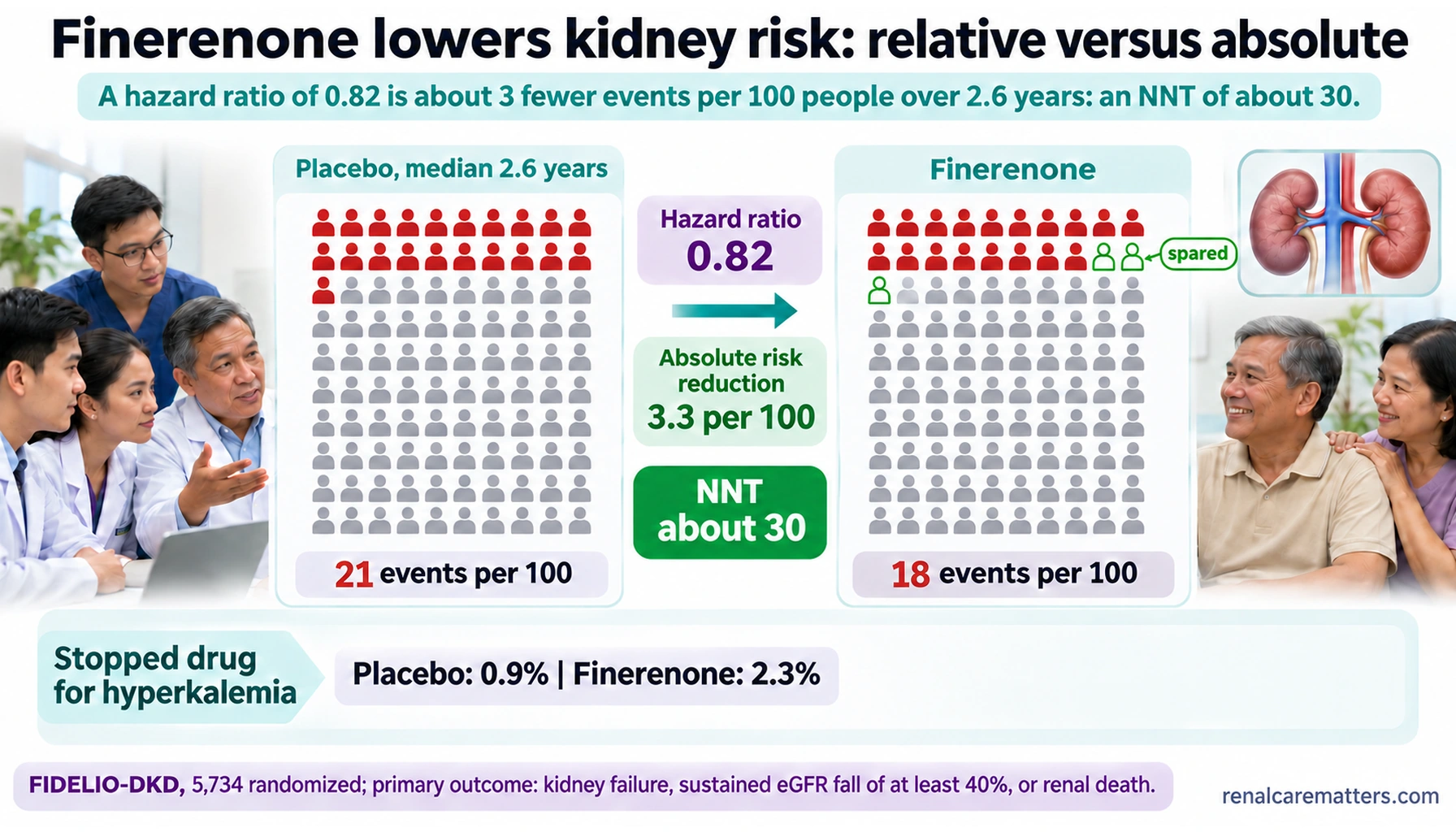
FIDELIO-DKD (diabetic kidney disease) primary kidney outcome, median 2.6 years17.8% with finerenone versus 21.1% with placebo; hazard ratio 0.82 (randomized controlled trial, 5,734 randomized)
Absolute risk reduction, FIDELIO-DKD primary outcome3.3 percentage points; crude NNT about 30 over the trial (this module’s arithmetic from the published proportions)
Hyperkalemia-related stopping of the trial drug, FIDELIO-DKD2.3% versus 0.9%
FIDELITY pooled kidney outcome, median 3.0 years5.5% versus 7.1%; hazard ratio 0.77 (prespecified pooled analysis, 13,026 patients)
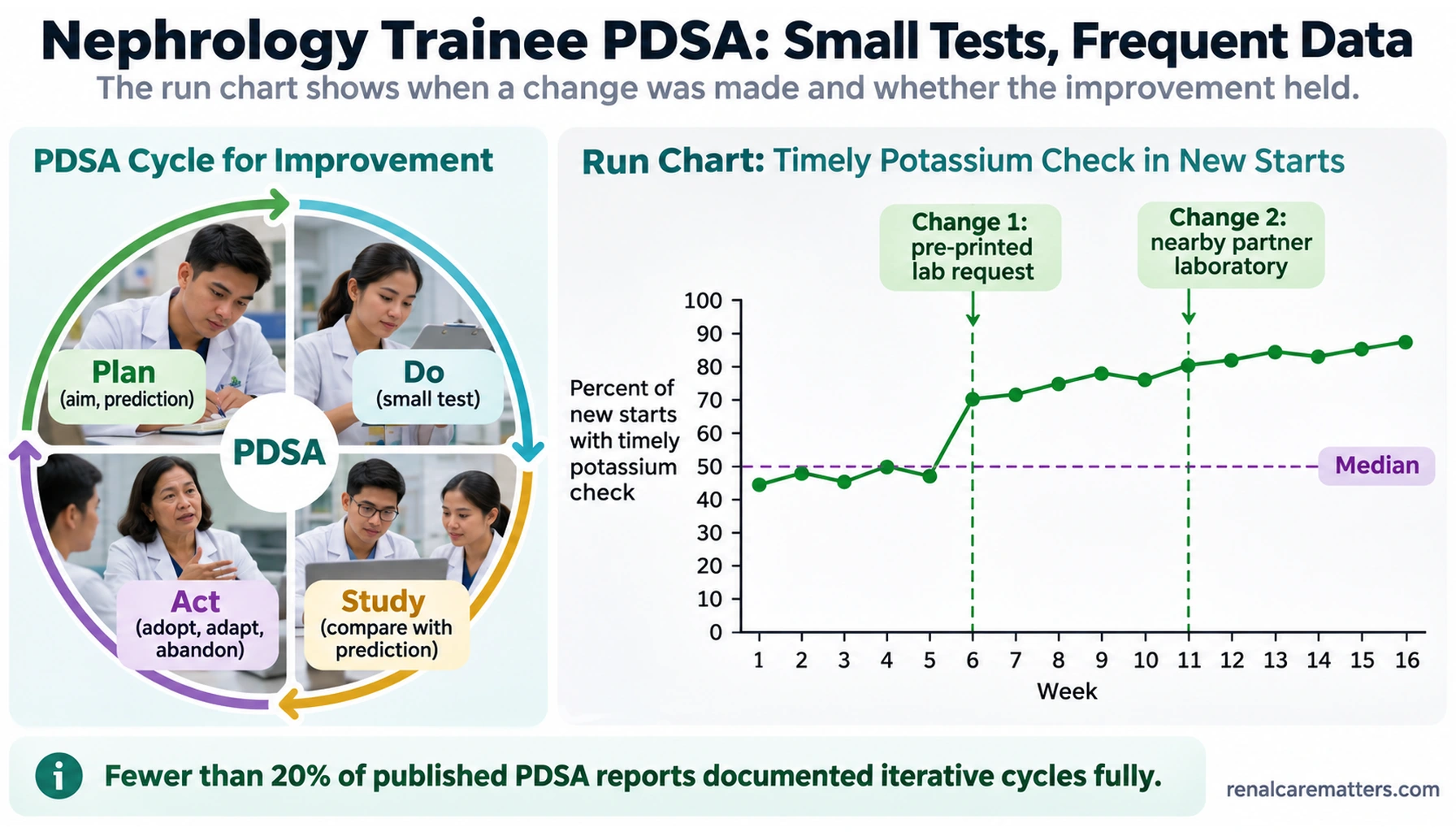
Plan-Do-Study-Act (PDSA) reporting quality (systematic review of 73 articles)Fewer than 20% fully documented a sequence of iterative cycles
Most journal-club arguments are about relative effects quoted without baselines, composite outcomes read as if every part mattered equally, surrogate markers read as if they were outcomes, and subgroups read as if they were proof. A few are about the deeper question of whether the trial population looks like your patients at all. Your work is to convert every claim into absolute numbers for a defined group over a defined time, to name the traps aloud, and then to carry the same discipline into measuring and improving your own unit.
Opening case · fictional
Case: Journal club on a Tuesday
Tuesday, 12:15 p.m., the conference room of a tertiary hospital in Cebu City. Dr. Mia Fernandez, a second-year internal medicine resident, presents FIDELIO-DKD. Her first slide says, in large letters, “Finerenone reduces kidney disease progression by 18%.” Dr. Carlo Aquino, a first-year nephrology fellow, says the drug is too expensive for their clinic patients and that “sodium-glucose cotransporter 2 (SGLT2) inhibitors already do the job.” Another resident shows a newer trial in which a combination lowered albuminuria by about a third more than either drug alone and says, “So the combination must prevent dialysis.”
The patient they have in mind is Mr. Teodoro Lim, 62, a retired jeepney operator from Mandaue with type 2 diabetes, an estimated glomerular filtration rate (eGFR) of 48 mL/min/1.73 m², a urine albumin-to-creatinine ratio of 640 mg/g, and a potassium of 4.7 mmol/L, already on the maximum tolerated dose of an angiotensin receptor blocker and on an SGLT2 inhibitor (SGLT2i) his daughter in Singapore pays for. The attending asks the fellow to propose a unit project afterward, because two patients started on a mineralocorticoid receptor antagonist last year had no potassium checked for three months.
Before reading on, decide:
What are the absolute risk reduction and number needed to treat for FIDELIO-DKD’s primary outcome, and how would you explain them to Mr. Lim?
Which interpretation traps appear in this discussion, and how would you correct each one?
What project should the fellow propose for potassium monitoring, and does it need ethics review?
Keep your answers in mind. The lesson gives you what you need, and the case review near the end shows one sound response.
Lesson · part 1
From the abstract to absolute numbers
Every therapeutic claim reduces to one question: in people like these, over this much time, how many fewer had the bad outcome, and at what cost in harm? Relative effects such as hazard ratios are the natural output of the statistics, but they hide the baseline. An 18% relative reduction means one thing when the baseline risk is 40% and another when it is 4%. Laupacis and colleagues proposed the number needed to treat as the reciprocal of the absolute risk reduction, precisely so that clinicians could see the size of an effect in people rather than in ratios.1
Arithmetic from the FIDELIO-DKD abstract, not a target. ARR = control event rate − treatment event rate = 21.1% − 17.8% = 3.3 percentage points. NNT = 1 ÷ ARR = 1 ÷ 0.033 ≈ 30 people treated for the median 2.6 years to prevent one primary outcome event. Number needed to harm for stopping the drug because of hyperkalemia = 1 ÷ (0.023 − 0.009) ≈ 71.
The trial. The Finerenone in Reducing Kidney Failure and Disease Progression in Diabetic Kidney Disease (FIDELIO-DKD) trial randomized 5,734 patients with type 2 diabetes and chronic kidney disease (CKD), that is, diabetic kidney disease (DKD),, all on renin-angiotensin system blockade adjusted to the maximum labeled dose that did not cause unacceptable side effects, to finerenone or placebo. Eligible patients had a urine albumin-to-creatinine ratio of 30 to under 300 mg/g with an eGFR of 25 to under 60 and diabetic retinopathy, or a ratio of 300 to 5,000 mg/g with an eGFR of 25 to under 75. Over a median 2.6 years, the primary composite of kidney failure, a sustained fall in eGFR of at least 40%, or renal death occurred in 504 of 2,833 patients (17.8%) on finerenone and 600 of 2,841 (21.1%) on placebo, hazard ratio 0.82 (95% confidence interval 0.73 to 0.93). The key cardiovascular secondary outcome occurred in 13.0% versus 14.8%. Overall adverse events were similar; stopping the trial drug because of hyperkalemia was more frequent with finerenone (2.3% versus 0.9%).2
The pooled view. FIDELITY combined FIDELIO-DKD with its companion trial, Finerenone in Reducing Cardiovascular Mortality and Morbidity in Diabetic Kidney Disease (FIGARO-DKD), in a prespecified analysis of 13,026 patients followed for a median 3.0 years. The cardiovascular composite occurred in 12.7% versus 14.4% (hazard ratio 0.86), and a kidney composite that used a stricter threshold, a sustained eGFR fall of at least 57%, occurred in 5.5% versus 7.1% (hazard ratio 0.77). Hyperkalemia leading to permanent discontinuation occurred in 1.7% versus 0.6%.3 The crude absolute differences are 1.7 and 1.6 percentage points, about 59 and 63 people treated for three years per event prevented; a pooled analysis of two trials is still randomized evidence, but its kidney outcome definition differs from FIDELIO-DKD’s, so the numbers are not interchangeable.
The guideline. The Kidney Disease: Improving Global Outcomes (KDIGO) 2022 diabetes guideline places a nonsteroidal mineralocorticoid receptor antagonist with proven kidney or cardiovascular benefit in adults with type 2 diabetes, an eGFR of at least 25 mL/min/1.73 m², a normal serum potassium and albuminuria despite the maximum tolerated dose of a renin-angiotensin system inhibitor.4 Read the guideline itself for the strength and grade attached; this module does not restate a grade it has not checked. KDIGO has also begun a focused update of this chapter, so check for the newest text.
Question
Where to find it
FIDELIO-DKD answer
Who was studied?
Methods: eligibility
Type 2 diabetes, albuminuric CKD, on maximum tolerated renin-angiotensin blockade
What was compared?
Methods: intervention
Finerenone versus placebo, on top of usual care
What happened, absolutely?
Results: event counts
17.8% versus 21.1% over a median 2.6 years
Is the outcome felt by patients?
Outcome definitions
A composite: kidney failure and renal death are felt; a 40% eGFR fall is a laboratory threshold
What harms?
Safety table
More hyperkalemia leading to stopping the drug
Does it fit my patient?
Baseline table
Check eGFR, albuminuria, potassium and background therapy, including how many were on an SGLT2 inhibitor
Philippine practiceA drug the family buys every month competes with food, fares and other medicines. Give the family absolute numbers over a stated time, the harm and its monitoring, and the cost, then let them weigh it. An NNT of about 30 over 2.6 years is a real benefit; it is also an honest statement that most people treated would not have had the event either way.
RememberNever present a relative effect alone. Say how many people in 100, over how many years, avoided the outcome, and how many had the harm.
Figure 2. Relative versus absolute. A hazard ratio of 0.82 is about 3 fewer events per 100 people over 2.6 years: an NNT of about 30.
Lesson · part 2
Traps: relative effects, composites, surrogates and subgroups
Misreading a trial rarely comes from bad arithmetic. It comes from four habits of mind, each with a mechanism you can name. The Grading of Recommendations Assessment, Development and Evaluation (GRADE) approach was built partly to make these judgments explicit: it rates the certainty of evidence for each outcome that matters to patients, and it separates that certainty from the strength of a recommendation.5
Trap
How it misleads
What you say at journal club
Relative effect without a baseline
“18% reduction” sounds the same for a high-risk and a low-risk patient
“From 21.1% to 17.8% over 2.6 years: 3.3 fewer per 100.”
Composite outcome read as one thing
A benefit driven by the softest component is credited to the hardest
“Which components drove the result? Is the eGFR threshold a surrogate?”
Surrogate read as an outcome
A laboratory marker improves; patients may not
“Albuminuria fell. Did kidney failure, death or hospitalization fall?”
Subgroup read as proof
With enough subgroups, some differ by chance
“Was it prespecified, with a stated direction, one of few, and is there a test for interaction?”
Population that does not match
Trial patients are selected and monitored closely
“Would our patient have been eligible? Would we monitor potassium as closely?”
Statistical versus clinical significance
A small p value can attach to a small effect
“What is the confidence interval in absolute terms?”
Surrogates. The CONFIDENCE trial randomized adults with type 2 diabetes, CKD and albuminuria to finerenone, empagliflozin or both. At 180 days, the reduction in urine albumin-to-creatinine ratio with the combination was 29% greater than with finerenone alone and 32% greater than with empagliflozin alone; symptomatic hypotension, acute kidney injury and hyperkalemia leading to stopping were uncommon.6 It was a phase 2 trial with albuminuria as its primary outcome. Albuminuria is a surrogate: it is associated with kidney failure, and lowering it is biologically plausible as a route to benefit, but CONFIDENCE did not measure kidney failure, dialysis or death. “So the combination must prevent dialysis” is a hypothesis, not a finding.
Subgroups. Sun and colleagues set out criteria for judging whether a subgroup effect is believable: among them, whether the subgroup was specified before the analysis with a predicted direction, whether it is one of a small number tested, whether the test for interaction is significant, whether the effect is consistent across related outcomes and studies, and whether there is a compelling biological rationale.7 Most subgroup claims in a slide deck meet few of these.
Reporting. The CONSORT 2025 statement is a 30-item checklist and a flow diagram for reporting randomized trials, with a new section on open science.8 Use it as a reading checklist: if the flow of participants, the prespecified primary outcome or the harms are hard to find, the report is hiding something or the trial was weak.
At your stageIntern: label every outcome you present as felt by patients or surrogate. Resident: put the absolute numbers on your first slide, not your last. Fellow: ask the subgroup and composite questions aloud, kindly, so that residents learn to ask them.
RememberBefore you believe a result, name the outcome, the baseline, the time and the comparison. If any of the four is missing, you do not yet know the effect.
Lesson · part 3
Quality improvement: PDSA cycles and run charts
Research asks whether something works in general. Quality improvement asks whether your unit reliably does what is already known to work, and whether a change helps here. The causal model is different. The evidence for checking potassium after starting a mineralocorticoid receptor antagonist is not in question; what is in question is why two of your patients went three months without a test. The answer lies in the process: who orders the test, who reminds, who reads the result, and what happens when the patient cannot afford the fare to the laboratory.
The plan-do-study-act (PDSA) cycle tests one change on a small scale, predicts what will happen, measures, learns and then adapts, adopts or abandons it before the next cycle. A systematic review of 73 articles reporting PDSA in health care found that many applications did not follow the method’s main features: fewer than 20% (14 of 73) fully documented a sequence of iterative cycles, and only 15% (7 of 47) used quantitative data at monthly or more frequent intervals to guide the cycles.9 The lesson is to keep cycles small, predictions explicit and data frequent.
The run chart plots a measure over time, in order, with a median line. It lets a team see whether changes are followed by real improvement or by ordinary variation, with little mathematics, and it is the foundation for more formal control charts.10 An average before and after hides exactly what a run chart shows: when the change happened and whether it held.
Figure 3. Small tests, frequent data. The run chart shows when a change was made and whether the improvement held.
Figure 4 · A small QI project for potassium monitoring
AimBy the end of three months, 90% of clinic patients started on a mineralocorticoid receptor antagonist have a potassium result within the interval the attending and the unit protocol set.
MeasureEach week, count patients started and those with a timely result. Plot the percentage on a run chart.
Change idea 1A pre-printed laboratory request and return date given with every new prescription.
PredictWrite down what you expect: for example, timely tests rise from half to most.
StudyAfter two to four weeks, look at the run chart and ask the patients who missed why.
ActKeep, adapt or drop the change. If fares are the barrier, test a second idea, such as a nearby partner laboratory or a home extraction service.
QI element
Good practice
Common error
Aim
Specific, measurable, time-bound
“Improve monitoring”
Measure
One outcome measure, one process measure, one balancing measure
Only an end-of-year average
Change
Small, tested on a few patients first
A unit-wide policy on day one
Data
Weekly or monthly points on a run chart
Before-and-after comparison only
Learning
Each cycle recorded with prediction and result
Cycles remembered but not written
At your stageIntern: collect data honestly and record misses without blame. Resident: run one PDSA cycle with your team during the rotation. Fellow: lead a project through several cycles, present the run chart at the unit’s continuous quality improvement (CQI) meeting, and hand it on when you rotate.
RememberMeasure often, change one thing at a time, and let the run chart, not the average, tell you whether it worked.
Lesson · part 4
When a project becomes research: ethics review in the Philippines
The line between QI and research matters because research asks people to accept risks or burdens for knowledge that may benefit others, and that requires independent review. A unit project that changes how reminders are given, uses data the unit already collects, and is meant only to improve local care usually sits on the QI side. A project that randomizes patients, adds tests or contacts beyond usual care, collects data for a general conclusion, or is planned for publication often crosses into research. When in doubt, the decision belongs to a research ethics committee, not to the investigator.
In the Philippines, the Philippine Health Research Ethics Board (PHREB) promulgated the National Ethical Guidelines for Research Involving Human Participants in 2022.11 Internationally, the World Medical Association’s Declaration of Helsinki, revised in 2024 with the title “Ethical Principles for Medical Research Involving Human Participants,” requires that a research protocol be submitted to a research ethics committee for consideration, comment, guidance and approval before the study begins.12 Data handling falls under the Data Privacy Act (Module 33).
Feature of the project
Leans toward QI
Leans toward research
Purpose
Improve care in this unit
Produce generalizable knowledge
Intervention
Implementing known good practice
Testing an unproven intervention
Allocation
Everyone gets the change
Random or deliberate allocation
Burden on patients
None beyond usual care
Extra tests, visits, questionnaires or risks
Data
Routine data, kept within the unit
New data, shared or published
What to do
Follow the hospital’s QI process; ask the research ethics committee if unsure
Write a protocol and get research ethics committee approval before starting
Two Philippine pressures deserve care. Families often defer to the physician and may agree to anything asked of them in a hospital; consent must be informed, voluntary and free of any suggestion that care depends on it. And patients who pay out of pocket for medicines may join a trial to get free drugs; that is a legitimate benefit, but it raises the duty to explain what happens when the trial ends.
At your stageIntern: never collect data for a project without knowing whether it has approval. Resident: ask the research ethics committee before you start a case series or audit you plan to publish. Fellow: write the protocol, including how data are protected, and submit it before the first patient.
RememberIf you plan to publish, randomize, or add any burden for patients, it is research until a research ethics committee says otherwise. Ask before you start.
Lesson · part 5
Teaching on the run: the one-minute preceptor and feedback
Most clinical teaching in a Philippine hospital happens in the corridor, between admissions, with a fellow teaching a resident and a resident teaching an intern. The mechanism of good teaching under these conditions is to make the learner’s reasoning visible, correct it precisely and give one rule they can carry.
Neher and colleagues described five microskills for this setting: get a commitment, probe for supporting evidence, teach a general rule, reinforce what was done right, and correct mistakes.13 The model was described from experience and was well received by teachers; it is a practical framework rather than a trial-tested intervention. Ramani and Krackov’s review of the feedback literature offers twelve tips for clinical teachers, among them establishing a respectful learning climate, basing feedback on direct observation, making it timely and regular, using specific, neutral language about performance rather than the person, and ending with an action plan.14
Microskill
What you say
In the journal club case
Get a commitment
“What do you think we should do for Mr. Lim?”
Mia commits: add finerenone
Probe for evidence
“What makes you say that?”
She cites the 18% reduction
Teach a general rule
“Always translate a relative effect into absolute numbers.”
21.1% to 17.8%, NNT about 30 over 2.6 years
Reinforce what was right
“You chose a trial that matches his eGFR and albuminuria.”
Specific praise
Correct mistakes
“The headline slide left out the baseline and the harm.”
Add hyperkalemia and cost
Feedback works best when it is about something you saw, given soon, in private when it is corrective, and paired with one thing to do next time. “Good job” teaches nothing; “Your first slide gave the relative reduction without the event rates; next time put both on the same line” teaches a habit.
At your stageIntern: ask for feedback on one specific task each week. Resident: use the five microskills once a day with your intern. Fellow: observe a resident directly at least once a week, give feedback that names the behavior, and agree on one action.
RememberTeach by getting a commitment and correcting the reasoning, not by lecturing the answer. Feedback names a behavior you saw and one thing to do next.
On the floor
Real situations: problems and solutions
These are fictional but typical. For each one, cover the answer, decide what you would do, then compare. Where a step depends on local rules, your unit’s procedure and your supervisor’s direction come first.
The drug representative’s brochure
What you see
In a clinic in Bacolod, a brochure says a new drug “cuts the risk of kidney failure by 30%.”
What is likely going on
A relative effect with no baseline, time or comparison.
What to do
Find the trial, read the event rates in both arms and the follow-up, compute the absolute difference and NNT, and check whether the outcome was a surrogate.
Why it matters
Relative effects make every drug look large; patients pay for absolute benefit.
The case series for the regional convention
What you see
A resident in Baguio wants to present ten patients with leptospirosis-associated acute kidney injury (AKI) seen last year, with laboratory tables, at a conference.
What is likely going on
A retrospective case series planned for presentation, using identifiable health data.
What to do
Ask the research ethics committee whether review is needed, remove identifiers, and follow the hospital’s data protection rules before collecting data.
Why it matters
Intent to present or publish often moves a project into research; privacy rules apply either way.
The audit that changed everything at once
What you see
A dialysis unit in General Santos introduces a new catheter dressing, a new hand-hygiene poster and a new nurse schedule in the same week; infections fall.
What is likely going on
No way to know which change helped, if any.
What to do
Plot monthly rates on a run chart, and in future test one change at a time in small PDSA cycles with a written prediction.
Why it matters
Changing everything at once teaches nothing about what to keep.
The intern who never gets feedback
What you see
An intern on the renal rotation in Naga says the only comment she has received in three weeks is “okay.”
What is likely going on
Teaching without observation or specific feedback.
What to do
As her resident, observe one presentation, give specific feedback that names one behavior done well and one to change, and agree on an action for the next day.
Why it matters
Specific, timely feedback based on observation is how habits change.
Field notes
Write the control and treatment event rates and the follow-up time on the first slide of every journal club.
Label each outcome you present as patient-felt or surrogate.
Keep a small notebook of PDSA cycles: date, change, prediction, result, decision.
Ask the research ethics committee before you collect data for anything you might present.
End every teaching moment with one general rule the learner can carry.
Case review
Back to the case: Journal club on a Tuesday
Absolute numbers for Mr. Lim. The ARR for FIDELIO-DKD’s primary outcome is 21.1% minus 17.8%, 3.3 percentage points over a median 2.6 years, and the crude NNT is about 30. For Mr. Lim and his daughter: “In the trial, out of 100 people like you, about 21 on placebo and about 18 on finerenone had kidney failure, a large fall in kidney function, or died from kidney causes over about two and a half years. About 2 in 100 had to stop the drug because of high potassium, compared with about 1 in 100 on placebo. The drug is paid out of pocket.” Then check whether he resembles the trial population, including the SGLT2 inhibitor he already takes, and let the family weigh it with the attending.
The traps. “Reduces progression by 18%” is a relative effect without a baseline; replace it with event rates and time. The primary outcome is a composite that includes a laboratory threshold, so say which parts are felt by patients. The combination trial measured albuminuria, a surrogate, over 180 days, so “prevents dialysis” is a hypothesis. “SGLT2 inhibitors already do the job” is a claim about background therapy: check the baseline table for how many FIDELIO-DKD participants were on one, and do not rescue the argument with a post hoc subgroup unless it meets credibility criteria. Cost is a legitimate part of the decision, not a reason to skip the numbers.
The fellow’s project. The missed potassium checks are a process failure, so a QI project fits: an aim such as 90% of new starts with a timely potassium within three months, a weekly run chart, and small PDSA cycles starting with a pre-printed request and return date, then a nearby laboratory if fares are the barrier. It implements known good practice, uses routine data and adds no burden, so it leans toward QI under the hospital’s process. If the team later wants to publish it or compare strategies by allocation, they write a protocol and ask the research ethics committee first.
Skills lab · with your preceptor
Skills checklist: Evidence, quality improvement and teaching
Complete with a preceptor or program director, at journal club, a CQI meeting or on the ward. Sign-off is local. Your preceptor rates each step as satisfactory, needs practice, or not observed. Steps marked Critical must all be satisfactory before sign-off. This checklist supports supervised learning; your unit’s own procedure and competency form are the authority. A printable version of every checklist is on the trainer page.
Presents one randomized trial with population, comparison, outcome, absolute risk reduction, NNT and harms on the first slide
Labels each outcome in a trial as felt by patients or surrogate and explains why
Applies subgroup credibility criteria to one published subgroup claim
Designs a PDSA cycle with an aim, measures and a run chart, and presents it at a CQI meeting
Decides with the research ethics committee whether a project is QI or research
Teaches a learner with the five microskills and gives specific feedback with an action plan, observed by a preceptor
Each visit draws 5 questions at random from this module’s 5-question bank. Choose the single best answer for each, then select Check answers; an explanation appears under the best answer. Select New set of questions for a different mix. A good target is 4 of 5 on two different sets. Nothing you select is sent anywhere; scoring happens in your browser.
Laupacis, A., Sackett, D. L., & Roberts, R. S. (1988). An assessment of clinically useful measures of the consequences of treatment. The New England Journal of Medicine, 318(26), 1728–1733. https://doi.org/10.1056/NEJM198806303182605
Bakris, G. L., Agarwal, R., Anker, S. D., Pitt, B., Ruilope, L. M., Rossing, P., Kolkhof, P., Nowack, C., Schloemer, P., Joseph, A., Filippatos, G., & FIDELIO-DKD Investigators. (2020). Effect of finerenone on chronic kidney disease outcomes in type 2 diabetes. The New England Journal of Medicine, 383(23), 2219–2229. https://doi.org/10.1056/NEJMoa2025845
Agarwal, R., Filippatos, G., Pitt, B., Anker, S. D., Rossing, P., Joseph, A., Kolkhof, P., Nowack, C., Gebel, M., Ruilope, L. M., Bakris, G. L., & FIDELIO-DKD and FIGARO-DKD Investigators. (2022). Cardiovascular and kidney outcomes with finerenone in patients with type 2 diabetes and chronic kidney disease: The FIDELITY pooled analysis. European Heart Journal, 43(6), 474–484. https://doi.org/10.1093/eurheartj/ehab777
Kidney Disease: Improving Global Outcomes (KDIGO) Diabetes Work Group. (2022). KDIGO 2022 clinical practice guideline for diabetes management in chronic kidney disease. Kidney International, 102(5S), S1–S127. https://doi.org/10.1016/j.kint.2022.06.008
Guyatt, G. H., Oxman, A. D., Vist, G. E., Kunz, R., Falck-Ytter, Y., Alonso-Coello, P., Schünemann, H. J., & GRADE Working Group. (2008). GRADE: An emerging consensus on rating quality of evidence and strength of recommendations. BMJ, 336(7650), 924–926. https://doi.org/10.1136/bmj.39489.470347.AD
Agarwal, R., Green, J. B., Heerspink, H. J. L., Mann, J. F. E., McGill, J. B., Mottl, A. K., Rosenstock, J., Rossing, P., Vaduganathan, M., Brinker, M., Edfors, R., Li, N., Scheerer, M. F., Scott, C., Nangaku, M., & CONFIDENCE Investigators. (2025). Finerenone with empagliflozin in chronic kidney disease and type 2 diabetes. The New England Journal of Medicine, 393(6), 533–543. https://doi.org/10.1056/NEJMoa2410659
Sun, X., Briel, M., Walter, S. D., & Guyatt, G. H. (2010). Is a subgroup effect believable? Updating criteria to evaluate the credibility of subgroup analyses. BMJ, 340, c117. https://doi.org/10.1136/bmj.c117
Hopewell, S., Chan, A.-W., Collins, G. S., Hróbjartsson, A., Moher, D., Schulz, K. F., Tunn, R., Aggarwal, R., Berkwits, M., Berlin, J. A., Bhandari, N., Butcher, N. J., Campbell, M. K., Chidebe, R. C. W., Elbourne, D., Farmer, A., Fergusson, D. A., Golub, R. M., Goodman, S. N., ... Boutron, I. (2025). CONSORT 2025 statement: Updated guideline for reporting randomised trials. BMJ, 389, e081123. https://doi.org/10.1136/bmj-2024-081123
Taylor, M. J., McNicholas, C., Nicolay, C., Darzi, A., Bell, D., & Reed, J. E. (2014). Systematic review of the application of the plan-do-study-act method to improve quality in healthcare. BMJ Quality & Safety, 23(4), 290–298. https://doi.org/10.1136/bmjqs-2013-001862
Perla, R. J., Provost, L. P., & Murray, S. K. (2011). The run chart: A simple analytical tool for learning from variation in healthcare processes. BMJ Quality & Safety, 20(1), 46–51. https://doi.org/10.1136/bmjqs.2009.037895
World Medical Association. (2025). World Medical Association Declaration of Helsinki: Ethical principles for medical research involving human participants. JAMA, 333(1), 71–74. https://doi.org/10.1001/jama.2024.21972
Neher, J. O., Gordon, K. C., Meyer, B., & Stevens, N. (1992). A five-step “microskills” model of clinical teaching. The Journal of the American Board of Family Practice, 5(4), 419–424. https://pubmed.ncbi.nlm.nih.gov/1496899/
Ramani, S., & Krackov, S. K. (2012). Twelve tips for giving feedback effectively in the clinical environment. Medical Teacher, 34(10), 787–791. https://doi.org/10.3109/0142159X.2012.684916
Educational self-study for physicians in training. Clinical tasks need your institution’s authorization and supervision. Completing this track is an Academy learning record only. It does not confer licensure, specialist status, PSN or PNSP membership or board eligibility, procedural privileges, CPD units, or completion of an institutional training program, and it does not replace current guidelines, regulations, your institution’s protocols and formulary, or your supervisor.