Supervision, evidence appraisal and quality improvement
Give behavior-specific feedback and match supervision to entrustment.
PublishedNailathalaGipatikPepalwal:ReferencesMga SanggunianMga TinubdanReng Reperensya:6Audience: Practicing nephrologists · senior nephrology fellows · internists who share longitudinal kidney care in the clinic, ward, ICU, dialysis unit, and homeRead timeOras ng pagbasaOras sa pagbasaOras ning pamamasa:
Training track for attending nephrologists in adult practice
This module is study material for attending nephrologists and senior fellows in adult practice. It explains the reasoning behind common decisions; it is not a protocol. Doses and thresholds must be checked against current product labels, guidelines, and your institution’s approved protocols. Regulatory and benefit rules change: confirm them on the date of service. Every case is fictional.
Learning objectives
After this module you should be able to
Give behavior-specific feedback and match supervision to entrustment.
Appraise trials with absolute effects and applicability.
Design a quality improvement (QI) project with a defined denominator, baseline and balancing measure.
Pre-testBefore you read, answer the 5 self-assessment questions and note your score. After the module, select New set of questions and compare. The difference is what you learned; the questions you still miss are what to reread.
Start here
The big picture, in plain words
Your duty · Section 1.2, 2024 hemodialysis guidelinesUnder the Philippine Society of Nephrology (PSN) guidelines: Stay in active management with the physician on duty and the nurse on duty (b7). Teaching them well is part of that duty.
In plain wordsAn attending improves care three ways: by teaching the next clinician, by reading evidence critically, and by measuring whether the unit is getting better. All three depend on precise definitions.
Figure 1 · Key numbers
number needed to treat (NNT) formulaNNT = 1 / absolute risk reduction (ARR)
FLOW exampleARR about 4.5% over 3.4 years → NNT about 22
Run chart shift rule≥6 consecutive points on one side of the median
Opening case · fictional
Case: Fewer infections, or fewer catheters?
At the unit’s quarterly quality meeting, which the clinical head chairs and the attending nephrologists are invited to, the infection-control nurse presents a slide in green: “Access infections down by half! 3 this quarter, 6 last quarter.” The administrator wants to put it in the newsletter. A new nephrology fellow rotating with you, Dr. Cruz, asks you afterwards whether that proves the new catheter-care bundle works.
You look at the census. Last quarter the unit had about 2,400 catheter-days. This quarter, after many patients moved to fistulas, it had about 1,000.
Before reading on, decide:
Did infections fall?
What would you teach Dr. Cruz from this slide?
How would you test whether the bundle works?
Keep your answers in mind. The lesson gives you what you need, and the case review near the end shows one sound response.
Lesson · part 1
How it works
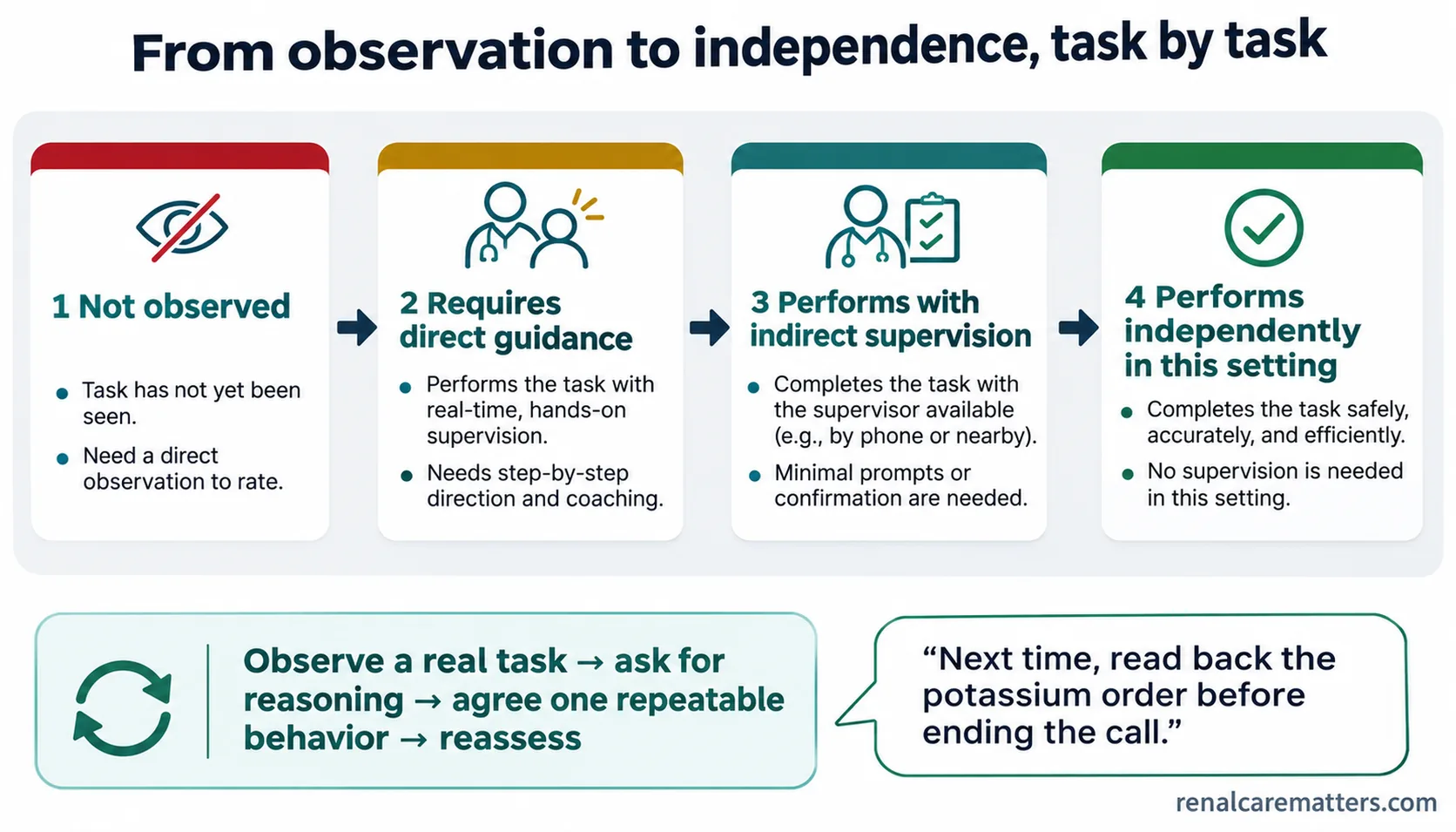
Entrustment is graded: a learner moves from observing, to acting under direct supervision, to indirect supervision, to independent practice, task by task. In evidence appraisal, the relative risk reduction stays roughly constant across baseline risk, while the absolute benefit grows with baseline risk. That is why the same drug helps a high-risk patient more in absolute terms. In QI, a rate needs a numerator, a denominator that reflects exposure, a baseline and enough data points to separate signal from noise. A run chart signals change with six or more consecutive points on one side of the median.
Teaching the number needed to treat · fictional
Dr. Cruz, the rotating fellow, says a new drug “cuts kidney events by 24%.” You ask what the event rate was in the placebo group.
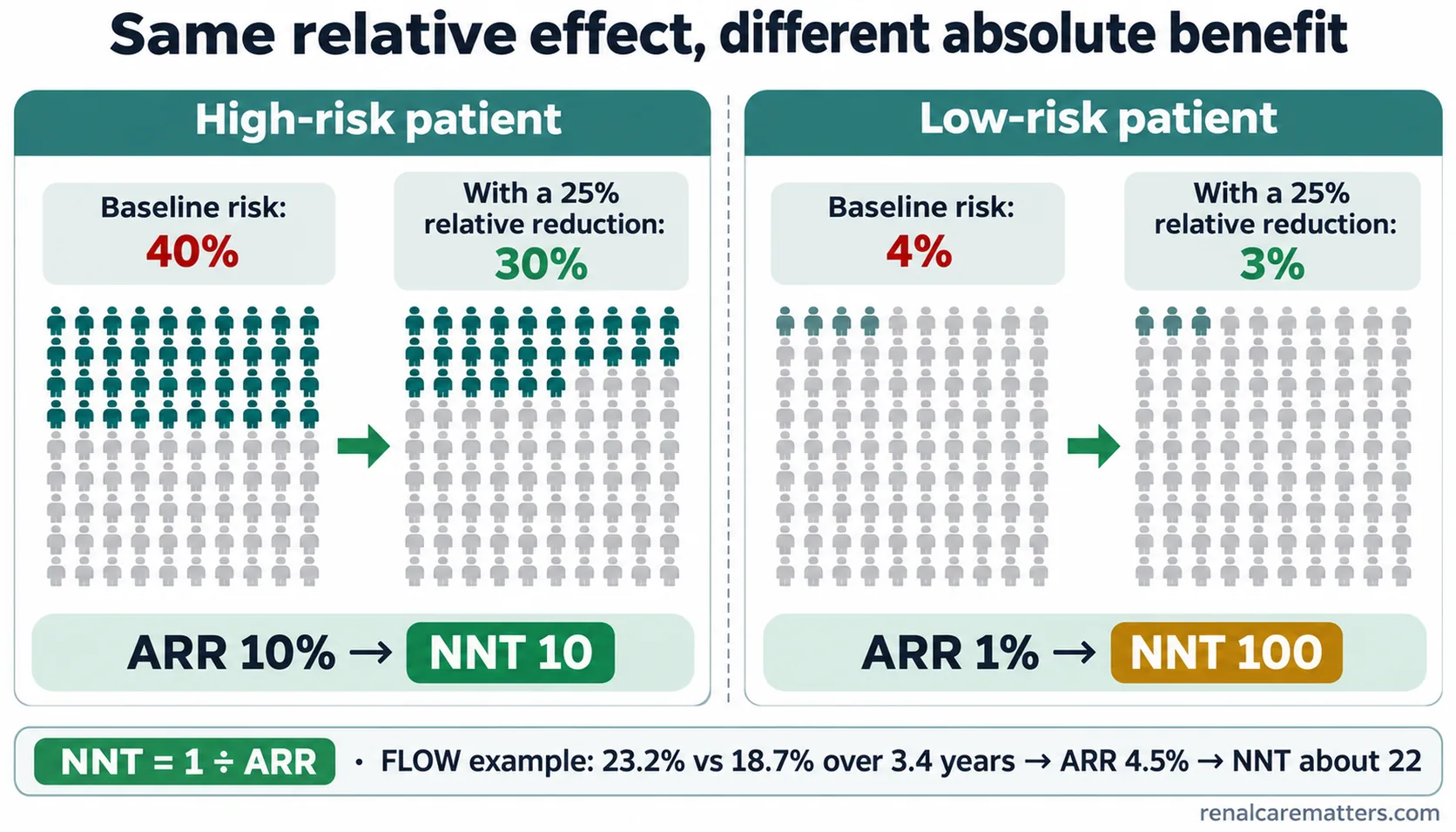
In FLOW it was 23.2%, and 18.7% with semaglutide. The absolute difference is about 4.5 percentage points over a median of 3.4 years, so about 22 patients are treated for one to avoid a major kidney event. For a patient at lower risk, the same 24% would mean a much smaller absolute gain.
What this shows. Relative effects stay roughly constant; absolute benefit depends on baseline risk.
Figure 2. Same relative effect, different absolute benefit. Two grids of 100 people showing that the same relative risk reduction helps many more people when baseline risk is high.
Lesson · part 2
What the evidence shows
Work-based assessment and entrustable professional activities underpin the GMC 2022 renal curriculum and RACP advanced training. The Model for Improvement (aim, measures, change ideas and Plan-Do-Study-Act cycles) is widely used in dialysis QI collaboratives, which report reductions in bloodstream infections in before-and-after designs. For appraisal: number needed to treat (NNT) = 1 / absolute risk reduction (ARR). For FLOW, an ARR of about 4.5 percentage points over a median 3.4 years gives an NNT of about 22.
When supervising, say what the learner may do alone and when to call, observe a real task, ask for reasoning and agree one specific behavior to repeat. When appraising a trial, ask: who was studied, was the outcome patient-important, what was the absolute effect, and does it apply to my patient and my setting (cost, monitoring capacity)? For QI, write a SMART (specific, measurable, achievable, relevant, time-bound) aim, define numerator and denominator, collect a baseline, test one small change, track a process and a balancing measure, and review at a fixed date.
Figure 3. From observation to independence, task by task. Four levels of supervision used in the Academy checklist, with a simple feedback cycle and an example of specific feedback.
The first test of change · fictional
For your own patients on catheters, you and the head nurse set an aim: reduce catheter infections from 3.0 to below 1.5 per 1,000 catheter-days by June. Measures: the infection rate, checklist completion, and minutes of delay to session start.
In month one, checklist completion is 60% and start times are unchanged. You shorten the checklist from twelve items to six and test it again in month two.
What this shows. Test one small change, measure it honestly, and adjust.
Stop and call
Relative risk reduction quoted without absolute effect
Rates compared with different denominators
Improvement claimed from a single data point
No balancing measure for a change that adds work
On the floor
Real situations: problems and solutions
These are fictional but typical. For each one, cover the answer, decide what you would do, then compare. Where a step depends on local rules, your unit’s procedure and your supervisor’s direction come first.
The trial in the drug company’s brochure
What you see
A brochure claims a 40% reduction in events.
What is likely going on
This is a relative reduction without the baseline risk.
What to do
Find the absolute risk reduction and the number needed to treat, and ask whether the trial population matches your patients.
Why it matters
The same relative reduction means very different benefits at different baseline risks.
The fellow who wants to do everything alone
What you see
A fellow insists on handling a hyperkalemia call without telling you.
What is likely going on
Entrustment has not been agreed.
What to do
Tell him what he may do alone and when he must call, observe him on a real case, and give specific feedback.
Why it matters
Entrustment is task by task, and it is earned.
The change that added work
What you see
A new checklist cut catheter infections, but nurses now start sessions 20 minutes late.
What is likely going on
There was no balancing measure.
What to do
Track start times as a balancing measure and simplify the checklist.
Why it matters
Improvement in one place can cause harm in another.
Field notes
NNT = 1 ÷ absolute risk reduction.
Every rate needs a denominator.
Six points on one side of the median signal a shift.
Teach by observing a real task.
Case review
Back to the case: Fewer infections, or fewer catheters?
Did infections fall? No. Counts mislead when exposure changes. Last quarter: 6 ÷ 2,400 × 1,000 = 2.5 infections per 1,000 catheter-days. This quarter: 3 ÷ 1,000 × 1,000 = 3.0. The rate rose. The good news on the slide is real, but it is a different success: fewer patients on catheters.
What to teach. A rate needs a numerator, a denominator that reflects exposure, and a baseline. Ask Dr. Cruz to recalculate it himself, then present the corrected version at the next meeting. That is entrustment in practice: you observe a real task, ask for his reasoning, and agree on one behavior to repeat. Here the behavior is never to compare counts without denominators. The same habit applies when he reads a trial: a relative reduction without the absolute effect is half the story.
Testing the bundle. Check case definitions and data completeness first. Then run one small test of change, such as an audited catheter-care checklist on every shift. Track a process measure (checklist completion), the outcome (infections per 1,000 catheter-days), and a balancing measure (delayed or shortened treatments). Plot the rate monthly on a run chart. Six or more consecutive points on one side of the median signal a real change. One good quarter does not.
Skills lab · with your preceptor
Skills checklist: Skills checklist
Complete with a preceptor, in simulation or at your own unit. Sign-off is local. Your preceptor rates each step as satisfactory, needs practice, or not observed. Steps marked Critical must all be satisfactory before sign-off. This checklist supports supervised learning; your unit’s own procedure and competency form are the authority. A printable version of every checklist is on the trainer page.
Defines numerator and denominator
Gives behavior-specific feedback
Drafts a measurement plan with a balancing measure
Placement activity. Simulation or supervised practice
Self-assessment
Check your understanding
Each visit draws 5 questions at random from this module’s 5-question bank. Choose the single best answer for each, then select Check answers; an explanation appears under the best answer. Select New set of questions for a different mix. A good target is 4 of 5 on two different sets. Nothing you select is sent anywhere; scoring happens in your browser.
Perkovic, V., Tuttle, K. R., Rossing, P., Mahaffey, K. W., Mann, J. F. E., Bakris, G., Baeres, F. M. M., Idorn, T., Bosch-Traberg, H., Lausvig, N. L., Pratley, R., & FLOW Trial Committees and Investigators (2024). Effects of semaglutide on chronic kidney disease in patients with type 2 diabetes. The New England Journal of Medicine, 391(2), 109–121. https://doi.org/10.1056/NEJMoa2403347
Educational material for physicians. Completing it is an Academy learning record only. It does not confer CPD units, PSN certification, privileges, or PhilHealth accreditation, and it does not replace current guidelines, regulations, your institution’s protocols, or clinical judgment.