Explain PD transport, prescribe CAPD and APD, read a PET, and start PD urgently when it fits.
PublishedNailathalaGipatikPepalwal:ReferencesMga SanggunianMga TinubdanReng Reperensya:10Audience: Adult and pediatric nephrology fellows · internal medicine and pediatric residents · medical interns on medicine, pediatrics, ICU and dialysis rotations, and residents who work shifts as dialysis physicians on dutyRead timeOras ng pagbasaOras sa pagbasaOras ning pamamasa:
Training track for nephrology fellows, residents and medical interns
Study material for medical interns, residents and fellows. It explains the reasoning behind common decisions; it is not a protocol and gives no drug doses. Doses, rates and order sets come from current guidelines, product labels, your institution’s approved protocols and your supervising physician. Benefit rules change: confirm them on the date of service. Every case is fictional.
Learning objectives
After this module you should be able to
Intern: Explain in plain words how a peritoneal dialysis (PD) exchange works, record fill and drain volumes, weight and urine output correctly, and report cloudy effluent, pain or a falling drain volume.
Resident: Explain PD transport with the three-pore model, read an exchange record and a peritoneal equilibration test (PET), and separate membrane causes of poor ultrafiltration from mechanical and adherence causes.
Fellow: Prescribe continuous ambulatory PD (CAPD) or automated PD (APD) to goals that the patient sets with the team, assess adequacy without chasing an arbitrary clearance number, protect residual kidney function, and run urgent-start PD safely.
Pre-testBefore you read, answer the 5 self-assessment questions and note your score. After the module, select New set of questions and compare. The difference is what you learned; the questions you still miss are what to reread.
Start here
The big picture, in plain words
Your role · the clinician who sees PD from the wardMost PD patients are seen
by trainees only when they are admitted. The intern records every exchange and every drain volume and knows that a cloudy bag is an emergency.
The resident reads the exchange record and asks why the drain volumes changed before ordering anything. The fellow writes the prescription with
the PD nurse and the attending nephrologist, explains it in terms of the patient’s day, and makes sure the solution supply reaches the house.
In plain wordsThink of the peritoneum as a large, living tea bag. Fresh fluid sits in the belly; waste molecules from the blood steep out into it, and
glucose in the fluid draws water across like sugar drawing juice from fruit. Drain the tea, add fresh water, and the steeping starts again.
The picture has a limit. A tea bag is passive; the peritoneum is a living capillary bed. Glucose does not stay in the belly: it is absorbed
into the blood, so the osmotic pull fades through the dwell, and in some patients it fades within a few hours. Water and solutes cross by
different pathways, so water can move without sodium. And the membrane changes with time, inflammation and every episode of peritonitis. A PD
prescription is therefore a match between the patient’s membrane, the residual kidney function that still works beside it, and the life
the patient wants to live.
Figure 1 · Key numbers
ADEMEX trial, 965 patientsHigher peritoneal clearance did not improve survival (relative risk 1.00)
Hong Kong trial, 320 CAPD patientsNo survival difference across total Kt/V targets of 1.5–1.7, 1.7–2.0 and above 2.0
CANUSA reanalysis, 601 patientsEach 250 mL more urine a day associated with 36% lower risk of death; peritoneal clearance not associated
PET and mortality (meta-analysis, 19 studies)Risk ratio 1.15 for each 0.1 rise in 4-hour dialysate-to-plasma creatinine
International Society for Peritoneal Dialysis (ISPD) 2020No survival advantage in aiming routinely for weekly Kt/V above 1.7 (practice point)
Neutral-pH low-GDP solutions (Cochrane, high certainty)About 114 mL/day more urine preserved
Most PD patients do well on a prescription built around their own day, with enough drain volume to keep them euvolemic and enough residual
function to carry part of the load. A few run into trouble because the membrane transports fast, the urine output falls, the catheter drains
poorly or the exchanges are skipped. Your work is to read the drain volumes like a vital sign, find which of these is happening, and adjust the
prescription to the person rather than to a number.
Opening case · fictional
Case: The overnight bag that came back small
It is Monday morning in the medical ward of a tertiary hospital in Zamboanga City. Mr. Nasser Abubakar, 47, a fish vendor with
hypertensive kidney disease, started CAPD six weeks ago with four daytime and overnight exchanges, using the lowest-strength glucose bags. The PD
catheter was placed by a surgeon eight weeks ago and the training went well.
He is admitted for leg edema, breathlessness when lying flat and a blood pressure of 168/100 mm Hg. He is 3 kg above his weight at the end of
training. His exchange record shows that his daytime exchanges each drain about 150 to 200 mL more than he fills, but his 10-hour overnight bag
drains about 300 mL less than he filled. His urine output has fallen from about 800 mL a day at the start of PD to about 400 mL. He has
been constipated for a week. The effluent is clear. A PET done in week four shows a 4-hour dialysate-to-plasma creatinine ratio of 0.85, which the
unit’s reference classifies as high transport.
His wife says the solution delivery from Manila was delayed by a storm two weeks ago, and for three days he did only three exchanges to save
bags. The fellow asks you, the resident, to work out what is happening before the attending’s round.
Before reading on, decide:
Why does his overnight bag come back smaller than it went in, while his daytime bags drain more?
What else must you exclude before blaming the membrane, and what does the PET add?
What would you propose to change, and how will you protect his residual kidney function within his supply and benefit limits?
Keep your answers in mind. The lesson gives you what you need, and the case review near the end shows one sound response.
Lesson · part 1
The membrane: three pores, two forces and a fading gradient
The peritoneum lines the abdominal wall and the organs, and its capillaries are the real dialysis membrane. Between the blood in those capillaries
and the fluid in the cavity lie the capillary wall, the interstitium and the mesothelium. The capillary wall decides almost everything, and the
three-pore model describes it.1
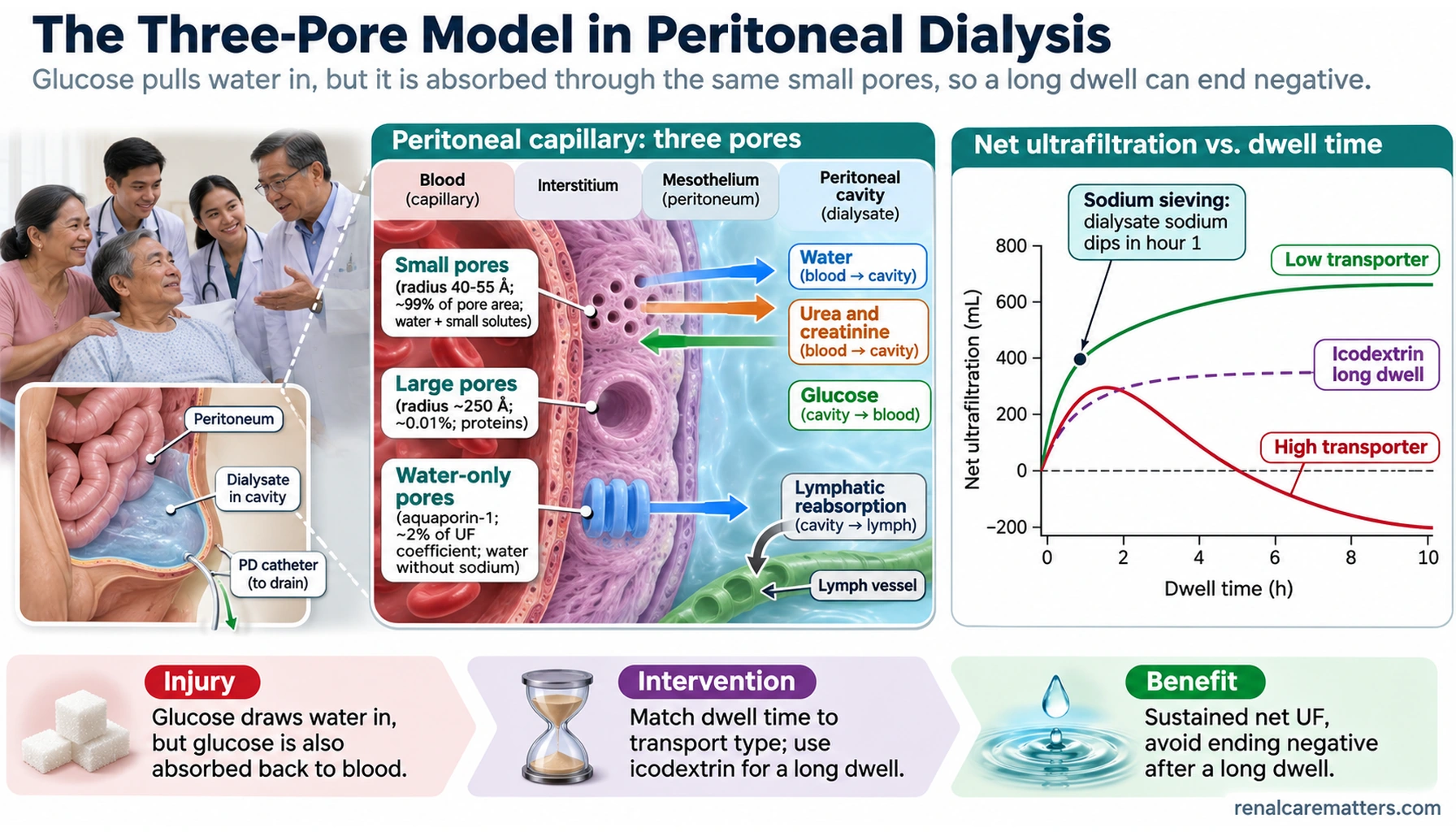
Pathway
Size and share
What crosses
What it means at the bedside
Small pores
Radius about 40–55 Å; about 99% of the pore area and about 90% of the ultrafiltration coefficient
Water with small solutes: urea, creatinine, potassium, glucose, sodium
Most clearance and most fluid removal
Large pores
Radius about 250 Å; about 0.01% of pores
Proteins, including albumin
Protein loss into the effluent; increases with inflammation
Ultrasmall (water-only) pores
About 2% of the ultrafiltration coefficient
Water only, driven by the glucose gradient
Water without sodium early in a dwell (sodium sieving)
The water-only pathway was later attributed to aquaporin-1 channels in the capillary endothelium. Because water crosses there without sodium,
the dialysate sodium falls in the first hour of a hypertonic dwell, then rises as sodium diffuses back. This “sodium sieving”
explains why short, frequent dwells, as in some APD prescriptions, can remove water but relatively little sodium, and why blood pressure can stay
high on a prescription that looks wet enough.
Two forces. Solutes move by diffusion down their concentration gradient, fast at the start of a dwell and slower as the
dialysate approaches the plasma concentration. Water moves by osmosis: glucose in the dialysate draws water across the small pores and the
aquaporins. But glucose is a small molecule, so it diffuses out of the dialysate into the blood through the same small pores. As it is
absorbed, the osmotic gradient fades. Meanwhile lymphatics and the tissues reabsorb fluid from the cavity at a roughly steady rate. Net
ultrafiltration rises early, peaks, and then falls; in a long dwell it can become negative, so the drain volume is smaller than the fill.
The speed at which this happens depends on the transport status. In a high transporter, a large effective capillary surface
lets creatinine equilibrate quickly, which is good for clearance, but glucose is absorbed just as quickly, so the osmotic gradient is lost early
and long dwells drain poorly. In a low transporter the opposite holds: water is removed well over long dwells, but small-solute clearance is
slower. Icodextrin, a glucose polymer too large for the small pores, draws water by colloid osmosis and is absorbed slowly through lymphatics, so
it keeps working through a long dwell.
Arithmetic illustration, not a target. Net ultrafiltration of one exchange = drain volume − fill volume.
Day exchange: fill 2,000 mL, drain 2,180 mL = +180 mL. Overnight 10-hour dwell: fill 2,000 mL, drain 1,700 mL = −300 mL.
Daily net peritoneal ultrafiltration = sum of all exchanges (for example, 3 × 180 − 300 = +240 mL), plus urine output for total fluid removal.
What you do at your stage. The intern records fill and drain volumes for every exchange, not only “drained
well.” The resident computes net ultrafiltration per exchange and sees which dwell is failing. The fellow links the failing dwell to
transport status and chooses whether to shorten it, change the solution or move it to a machine.
RememberRead drain volumes exchange by exchange. A long dwell that drains less than it was filled is the membrane telling you how fast it
absorbs glucose.
Figure 2. Three pores and a fading gradient. Glucose pulls water in, but it is absorbed through the same small pores, so a long dwell can end negative.
Lesson · part 2
Writing a prescription around a person
A PD prescription has a small number of levers. Each one acts on the physiology of the last lesson. The solution strengths, volumes and number
of exchanges for a given patient come from the unit’s protocol, the PD nurse and the attending nephrologist; this lesson is about what each
lever does.
Lever
Physiology
Gain
Cost
Fill volume
More fluid keeps the concentration gradient longer and wets more membrane
Preservation of residual function and urine volume
Cost and availability
CAPD versus APD
Manual daytime exchanges versus a cycler at night with short dwells
APD frees the day, suits high transporters
Machine, electricity, cost; short dwells and sodium sieving
The evidence on solutions. A Cochrane review of 42 randomized trials found, with high certainty, that neutral-pH, low
glucose-degradation-product (GDP) solutions improved preservation of residual kidney function (about 0.54 mL/min/1.73 m² higher glomerular
filtration rate) and residual urine volume (about 114 mL/day more). With moderate certainty, icodextrin reduced episodes of uncontrolled fluid
overload (risk ratio 0.30) and increased peritoneal ultrafiltration (about 449 mL/day more). Effects on peritonitis, technique survival and patient
survival remain uncertain.2 These outcomes are partly surrogates: residual function and urine volume matter because they are associated
with survival, as the next lesson shows.
Goal-directed prescribing. The International Society for Peritoneal Dialysis (ISPD) 2020 recommendations changed the question
from “what Kt/V does this patient need?” to “what goals does this person have, and what prescription meets them with the least
burden?” Care goals are set by shared decision-making with the person doing PD, and the prescription should aim for clinical euvolemia, with
blood pressure as a key objective measure of prescription quality.3 Statements supported by low-certainty evidence are labeled practice
points rather than graded numerically, as the Kidney Disease Outcomes Quality Initiative (KDOQI) commentary on the recommendations notes.4 ISPD also describes incremental PD,
prescribing less than full-dose PD while residual function contributes, and states that it achieves outcomes at least as good as full-dose PD
(practice point).3
In childrenChildren have a larger peritoneal surface relative to body weight, so fill volumes are scaled
to body surface area, not taken from adult habits, and intra-abdominal pressure limits how far they can rise. APD at night is common so the child can attend
school, and growth and nutrition are outcomes in their own right. Read Attending
Pediatric Nephrologist, Module 20 before adjusting a child’s prescription.
Philippine practice. Philippine Health Insurance Corporation (PhilHealth)’s Z Benefits package for PD (Circular 2024-0036) supports PD for eligible adult and pediatric
patients at accredited providers; confirm the current coverage, the eligibility checklist and what it includes on the date of service rather than
quoting amounts from memory.5 Solution bags come by courier, often from Luzon, so typhoons, ferry cancellations and storage space at home
shape the prescription as much as the membrane does. A prescription a family cannot keep supplied is not a prescription.
What you do at your stage. The resident reads the prescription back as a day: when each exchange happens, what strength,
how long it dwells. The fellow writes it with the patient’s work and sleep in mind, uses the lowest glucose exposure that meets the fluid
goal, and plans for the week the delivery does not come.
RememberEvery PD lever trades clearance or water against burden, glucose and cost. Choose the trade with the patient, and write it as a day
they can live.
Lesson · part 3
Adequacy, residual function and the PET
For years PD adequacy meant a weekly Kt/V target. Two randomized trials changed that. ADEMEX randomized 965 patients in Mexico to continue four
2-liter exchanges a day or to a modified prescription aiming for a peritoneal creatinine clearance of 60 L/week/1.73 m². Peritoneal
clearances separated and stayed apart, but survival did not: relative risk of death 1.00 (95% confidence interval 0.80 to 1.24), with 2-year
survival 68.3% in the control group and 69.3% in the intervention group.6 In Hong Kong, 320 new CAPD patients were randomized to total
Kt/V targets of 1.5 to 1.7, 1.7 to 2.0, or above 2.0. Two-year survival was 87.3%, 86.1% and 81.5%, without a significant difference. The lowest
group had more patients withdrawn by their physicians and more needed erythropoietin, so the authors recommended a minimum total Kt/V above
1.7.7
Residual kidney function, by contrast, tracks survival closely. A reanalysis of the CANUSA cohort (601 patients) found that each 5 L/week/1.73
m² of residual glomerular filtration was associated with a 12% lower risk of death, while peritoneal creatinine clearance showed no
association (relative risk 1.00); and each 250 mL of daily urine was associated with a 36% lower risk (relative risk 0.64).8 This is
observational. Patients with more urine may be healthier in other ways. But it fits the physiology: native kidneys remove water, sodium, middle
molecules and phosphate continuously, and produce hormones, which a peritoneal bag does not.
ISPD 2020 draws the conclusion. There is no specific clearance target that guarantees sufficient dialysis for an individual; increasing
small-solute clearance above a weekly Kt/V of 1.7 may improve uremic symptoms if present; there appears to be no survival advantage in aiming
routinely above 1.7; and no prescription change is needed for the sole purpose of reaching an arbitrary clearance target. Residual function and
urine volume should be known for everyone on PD, and management should focus on preserving them as long as possible (practice points).3
Kt/V remains a surrogate worth measuring, as a check, not a goal.
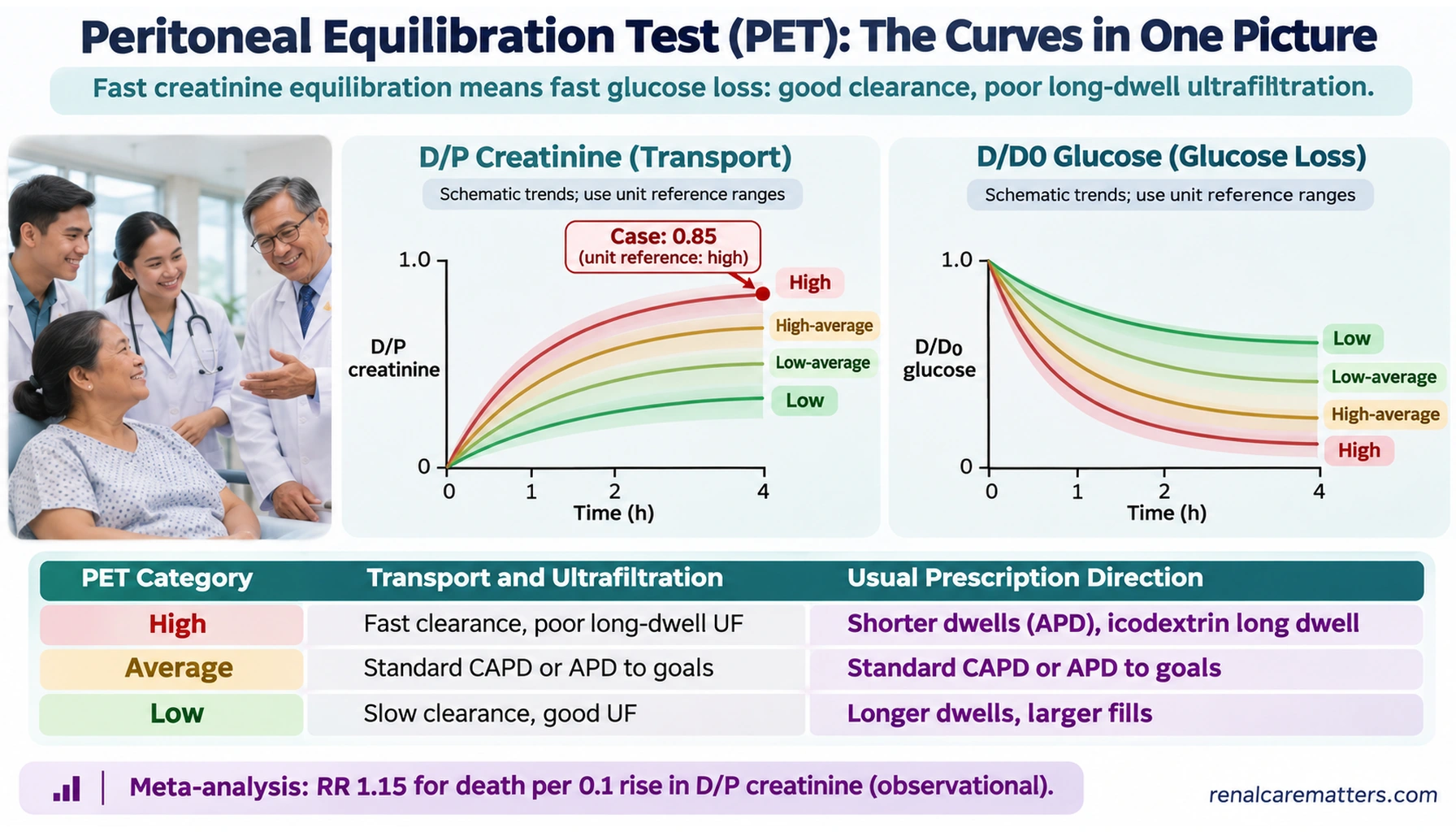
The PET. The peritoneal equilibration test is a standardized 4-hour dwell. The ratio of creatinine in the dialysate to that in
plasma at 4 hours (D/P creatinine) classifies the membrane as high, high-average, low-average or low transport; the drain volume and the fall in
dialysate glucose describe ultrafiltration capacity. In a meta-analysis of 19 observational studies, each 0.1 increase in D/P creatinine was
associated with a 15% higher risk of death (relative risk 1.15, 95% confidence interval 1.07 to 1.23), equal to 21.9%, 45.7% and 77.3% higher risk in
low-average, high-average and high transporters compared with low transporters. Studies with more patients on cycler PD showed a smaller excess
risk.9 The likely mechanism is fluid: high transporters lose the osmotic gradient early, gain fluid on long dwells and absorb more glucose.
The finding is an association, but it tells you what to do with a high transporter: protect the long dwell.
Transport status
Clearance
Ultrafiltration on long dwells
Prescription direction to discuss
High
Fast
Poor; often negative
Shorter dwells (APD), icodextrin for the long dwell
High-average or low-average
Moderate
Moderate
Standard CAPD or APD to goals
Low
Slow
Good
Longer dwells, larger fills; watch clearance as residual function falls
The ISPD 2020 recommendations add, for low- and lower-middle-income settings, that the PET and weekly Kt/V should be encouraged if their cost
does not compromise the person’s ability to continue PD.3 In a Philippine province that may mean a simplified PET done when the
problem appears, rather than a routine one.
What you do at your stage. The intern records urine output every day on a PD patient, because it is part of the
dialysis. The resident avoids nephrotoxins, contrast without good reason and hypotension in a PD patient who still makes urine. The fellow orders a
PET when ultrafiltration changes, interprets it with the exchange record, and treats a falling urine output as a reason to review the prescription.
RememberIn PD, protect the urine first and read the PET second. Kt/V is a check, not the goal, and a high transporter needs its long dwell
rescued.
Figure 3. The PET in one picture. Fast creatinine equilibration means fast glucose loss: good clearance, poor long-dwell ultrafiltration.
Lesson · part 4
Urgent-start PD and the first weeks
Many Philippine patients need dialysis within days of meeting a nephrologist. The default has been a temporary hemodialysis catheter, with its
infection and central vein risks (Module 24). Urgent-start PD offers another path: a PD catheter placed and used within two weeks, usually with
small supine volumes at first so that intra-abdominal pressure stays low while the tissues heal around the cuffs.
The evidence. A Cochrane review identified 16 studies with 2,953 participants: one randomized trial (122 participants) and 15
non-randomized studies. With low-certainty evidence, urgent-start PD may increase dialysate leaks compared with conventional start (risk ratio 3.90,
95% confidence interval 1.56 to 9.78), about 210 more leaks per 1,000 patients. For catheter blockage, malposition, exit-site infection,
peritonitis, technique survival and death, the evidence was very low certainty and the effects uncertain.10 The honest summary: leaks are
more likely, other harms are uncertain, and no trial has compared urgent-start PD with the realistic alternative for most of these patients, an
emergency hemodialysis catheter.
Phase
Physiology
What the team watches
First days after insertion
Tissue around the cuffs and the peritoneal incision is not healed
Leak at the exit site or wound, scrotal or labial swelling, drain failure
Small supine fills
Lower intra-abdominal pressure when lying down
Fluid and potassium control with less clearance than full PD
Gradual increase in fill
Healing allows higher pressure
Hernias, breathlessness, comfort
Training at home
The patient takes over the connections
Technique, hygiene, early peritonitis (Module 28)
Mechanical problems are common in the first weeks and often mimic membrane failure. Constipation pushes bowel against the catheter tip and slows
drainage, so a full colon is the first thing to treat when the drain volume falls. A catheter tip that has migrated out of the pelvis drains poorly in
some positions. Fibrin can block the side holes. A leak into the abdominal wall makes the drain smaller without the membrane changing at all.
Figure 4 · When drain volume falls
Is the effluent clear?Cloudy effluent is peritonitis until proven otherwise (Module 28).
Is it the catheter?Slow inflow or outflow, drainage that changes with position, constipation, fibrin in the bag; an abdominal radiograph shows the tip.
Is it a leak?Wet dressing, swelling of the abdominal wall, scrotum or labia, or a hernia.
Is it adherence or supply?Missed or shortened exchanges, saved bags, wrong strength used.
Is it the membrane?Long dwells drain less than filled; PET shows high transport or reduced ultrafiltration capacity.
Is it the kidneys?Urine output falling; review nephrotoxins and blood pressure.
Stop and callStop and call the attending nephrologist, per unit protocol, but always ask the attending nephrologist for guidance, when:
The
effluent is cloudy or the patient has abdominal pain or fever.
The patient is breathless, hypoxic or hypertensive from fluid overload that
the current prescription cannot remove.
The catheter does not drain, or there is a leak at the exit site, wound, scrotum or labia.
Potassium
is high or low enough to threaten the heart.
Solution supply has failed and the patient cannot do the prescribed exchanges.
What you do at your stage. The intern reports a wet dressing, a swollen scrotum or a bag that drains slowly. The resident
works through the drain-volume sequence above before calling the membrane failed. The fellow decides with the attending and the surgeon whether
urgent-start PD fits the patient, writes the low-volume start, and arranges early training and a home visit.
RememberWhen a new PD catheter drains less, think bowel, tip, leak and missed bags before membrane. Most early problems are mechanical.
On the floor
Real situations: problems and solutions
These are fictional but typical. For each one, cover the answer, decide what you would do, then compare. Where a step depends on local rules, your unit’s procedure and your supervisor’s direction come first.
The storm and the saved bags
What you see
A CAPD patient in Tacloban skipped one exchange a day for four days because the courier could not cross after a typhoon, and arrives edematous.
What is likely going on
Fluid and solute accumulation from missed exchanges, not membrane failure.
What to do
Restore the full prescription, review fluid and potassium, and with the PD nurse set up an emergency stock and a contact with the supplier.
Why it matters
Supply failure is a predictable Philippine problem and belongs in the prescription plan.
The contrast scan on the ward
What you see
A PD patient in Iloilo passing 700 mL of urine a day is scheduled for a contrast Computed tomography (CT) for vague abdominal pain.
What is likely going on
Residual function at risk from contrast and from any hypotension during the admission.
What to do
Ask whether the scan is needed and whether a non-contrast study answers the question; avoid hypotension and other nephrotoxins; document the urine output.
Why it matters
Residual urine output is associated with survival on PD and is easier to lose than to regain.
The cycler and the brownout
What you see
An APD patient in Bacolod loses power for six hours during the night.
What is likely going on
The cycler stops mid-therapy; the night’s dialysis is incomplete.
What to do
Follow the unit’s backup plan: manual exchanges taught in advance, and a call to the PD nurse in the morning.
Why it matters
APD depends on electricity; every APD patient needs a manual fallback.
The clinic Kt/V of 1.6
What you see
A well, euvolemic CAPD patient in Baguio with 1 liter of urine a day has a total Kt/V of 1.6, and a resident proposes a fifth exchange.
What is likely going on
A clearance number slightly below a common threshold in a patient meeting goals.
What to do
Discuss with the fellow: check symptoms, volume and potassium; if all are controlled, consider monitoring rather than adding burden.
Why it matters
ISPD 2020 says no change is needed solely to reach an arbitrary target; extra exchanges cost time, bags and glucose.
Field notes
Write net ultrafiltration per exchange on the record in a separate column.
Ask every PD patient admitted to the ward how much urine they pass and record it daily.
Treat constipation before you call a drain problem a membrane problem.
Ask how many days of bags the family has at home, especially before typhoon season.
Never let a ward team drain or fill a PD catheter without the PD nurse’s protocol.
Case review
Back to the case: The overnight bag that came back small
Why the overnight bag shrinks. Mr. Abubakar is a high transporter: his membrane absorbs glucose fast, so the osmotic
gradient of a low-strength bag fades within a few hours. Daytime dwells are short enough to drain more than they were filled. During a 10-hour
overnight dwell, after the gradient is gone, lymphatic and tissue reabsorption continue, and the bag drains about 300 mL less than the fill. His net
peritoneal ultrafiltration for the day is small, his urine has halved, and the three days of saved bags added fluid on top.
What to exclude first. Clear effluent makes peritonitis unlikely, but check for pain and fever. Treat his constipation,
because a full colon slows drainage. Check that the drain volume does not change with position and that an abdominal radiograph shows the tip in the
pelvis; look for a leak into the abdominal wall or a hernia. Confirm with his wife that exchanges are now complete and the right strengths are used.
Only then read the PET: a D/P creatinine of 0.85, classified by the unit as high transport, together with the negative long dwell, points to the
membrane as the main cause.
What to change. Propose to the attending nephrologist and PD nurse a prescription that rescues the long dwell: icodextrin
for the overnight dwell if it can be supplied, or shorter night dwells on a cycler, with the glucose exposure kept as low as the fluid goal allows. Set
the goals with him: no orthopnea, blood pressure controlled, weight back to his post-training level. Protect his 400 mL of urine by avoiding
hypotension and nephrotoxins; neutral-pH, low-GDP solutions are associated with better preservation where available. Check what the PD Z benefit
covers for icodextrin or a cycler, and plan a two-week buffer of bags before the typhoon season.
Interactive case · fictional
Interactive case: Urgent start, island life
Work through a shift one decision at a time. The panel at the top changes with what you choose. After each choice you see why it is, or is not, the best move; after a weaker one you can try again or carry on and see where it leads. Your first choice at each step is scored. The score stays on this device and nothing is sent anywhere. In real practice, your unit’s protocol and the people responsible for each decision come first.
Skills lab · with your preceptor
Skills checklist: Peritoneal dialysis principles and prescription
Complete with a preceptor in a PD unit, on the ward or by case review. Sign-off is local. Your preceptor rates each step as satisfactory, needs practice, or not observed. Steps marked Critical must all be satisfactory before sign-off. This checklist supports supervised learning; your unit’s own procedure and competency form are the authority. A printable version of every checklist is on the trainer page.
Explains a PD exchange and the three-pore model in plain words to a patient or family
Calculates net ultrafiltration per exchange and per day from an exchange record
Interprets a PET result with the exchange record and states the transport category
Works through the falling-drain-volume sequence: effluent, catheter, leak, adherence, membrane, kidneys
Records residual urine output and lists measures that protect it
Writes a draft prescription as a daily schedule with the PD nurse, for attending review
Placement activity. Supervised PD unit or ward rotation
Self-assessment
Check your understanding
Each visit draws 5 questions at random from this module’s 5-question bank. Choose the single best answer for each, then select Check answers; an explanation appears under the best answer. Select New set of questions for a different mix. A good target is 4 of 5 on two different sets. Nothing you select is sent anywhere; scoring happens in your browser.
Rippe, B. (1993). A three-pore model of peritoneal transport. Peritoneal Dialysis International, 13(Suppl. 2), S35–S38. https://pubmed.ncbi.nlm.nih.gov/8399608/
Htay, H., Johnson, D. W., Wiggins, K. J., Badve, S. V., Craig, J. C., Strippoli, G. F., & Cho, Y. (2018). Biocompatible dialysis fluids for peritoneal dialysis. Cochrane Database of Systematic Reviews, 10(10), CD007554. https://doi.org/10.1002/14651858.CD007554.pub3
Brown, E. A., Blake, P. G., Boudville, N., Davies, S., de Arteaga, J., Dong, J., Finkelstein, F., Foo, M., Hurst, H., Johnson, D. W., Johnson, M., Liew, A., Moraes, T., Perl, J., Shroff, R., Teitelbaum, I., Wang, A. Y., & Warady, B. (2020). International Society for Peritoneal Dialysis practice recommendations: Prescribing high-quality goal-directed peritoneal dialysis. Peritoneal Dialysis International, 40(3), 244–253. https://doi.org/10.1177/0896860819895364
Teitelbaum, I., Glickman, J., Neu, A., Neumann, J., Rivara, M. B., Shen, J., Wallace, E., Watnick, S., & Mehrotra, R. (2021). KDOQI US commentary on the 2020 ISPD practice recommendations for prescribing high-quality goal-directed peritoneal dialysis. American Journal of Kidney Diseases, 77(2), 157–171. https://doi.org/10.1053/j.ajkd.2020.09.010
Paniagua, R., Amato, D., Vonesh, E., Correa-Rotter, R., Ramos, A., Moran, J., & Mujais, S. (2002). Effects of increased peritoneal clearances on mortality rates in peritoneal dialysis: ADEMEX, a prospective, randomized, controlled trial. Journal of the American Society of Nephrology, 13(5), 1307–1320. https://doi.org/10.1681/ASN.V1351307
Lo, W. K., Ho, Y. W., Li, C. S., Wong, K. S., Chan, T. M., Yu, A. W., Ng, F. S., & Cheng, I. K. (2003). Effect of Kt/V on survival and clinical outcome in CAPD patients in a randomized prospective study. Kidney International, 64(2), 649–656. https://doi.org/10.1046/j.1523-1755.2003.00098.x
Bargman, J. M., Thorpe, K. E., & Churchill, D. N. (2001). Relative contribution of residual renal function and peritoneal clearance to adequacy of dialysis: A reanalysis of the CANUSA study. Journal of the American Society of Nephrology, 12(10), 2158–2162. https://doi.org/10.1681/ASN.V12102158
Brimble, K. S., Walker, M., Margetts, P. J., Kundhal, K. K., & Rabbat, C. G. (2006). Meta-analysis: Peritoneal membrane transport, mortality, and technique failure in peritoneal dialysis. Journal of the American Society of Nephrology, 17(9), 2591–2598. https://doi.org/10.1681/ASN.2006030194
Htay, H., Johnson, D. W., Craig, J. C., Teixeira-Pinto, A., Hawley, C. M., & Cho, Y. (2020). Urgent-start peritoneal dialysis versus conventional-start peritoneal dialysis for people with chronic kidney disease. Cochrane Database of Systematic Reviews, 12(12), CD012913. https://doi.org/10.1002/14651858.CD012913.pub2
Educational self-study for physicians in training. Clinical tasks need your institution’s authorization and supervision. Completing this track is an Academy learning record only. It does not confer licensure, specialist status, PSN or PNSP membership or board eligibility, procedural privileges, CPD units, or completion of an institutional training program, and it does not replace current guidelines, regulations, your institution’s protocols and formulary, or your supervisor.