Modality education and kidney replacement planning
Start dialysis for symptoms, not numbers, and lead a shared choice among HD, PD, transplant and conservative care.
PublishedNailathalaGipatikPepalwal:ReferencesMga SanggunianMga TinubdanReng Reperensya:10Audience: Adult and pediatric nephrology fellows · internal medicine and pediatric residents · medical interns on medicine, pediatrics, ICU and dialysis rotations, and residents who work shifts as dialysis physicians on dutyRead timeOras ng pagbasaOras sa pagbasaOras ning pamamasa:
Training track for nephrology fellows, residents and medical interns
Study material for medical interns, residents and fellows. It explains the reasoning behind common decisions; it is not a protocol and gives no drug doses. Doses, rates and order sets come from current guidelines, product labels, your institution’s approved protocols and your supervising physician. Benefit rules change: confirm them on the date of service. Every case is fictional.
Learning objectives
After this module you should be able to
Intern: Explain in plain words what hemodialysis, peritoneal dialysis, transplantation and conservative care involve, check understanding with teach-back, and record what the patient and family understood and asked.
Resident: Time preparation for kidney replacement therapy (KRT) by risk and symptoms, using the Kidney Failure Risk Equation (KFRE) and the Kidney Disease: Improving Global Outcomes (KDIGO) 2024 practice points, and start the practical steps: access referral, vein preservation, transplant referral and benefit registration.
Fellow: Lead a shared modality decision that includes transplantation and comprehensive conservative management, with the family present, the evidence on timing stated honestly, and the patient’s goals at the center.
Pre-testBefore you read, answer the 5 self-assessment questions and note your score. After the module, select New set of questions and compare. The difference is what you learned; the questions you still miss are what to reread.
Start here
The big picture, in plain words
Your role · the patient who is approaching kidney failureThe intern explains the options in plain Tagalog, Ilocano or English, uses teach-back, and writes down what the patient understood and what she fears. The resident notices that the risk of kidney failure is high months before the symptoms come, and starts the slow steps early: access, vaccinations, transplant referral, Philippine Health Insurance Corporation (PhilHealth) registration. The fellow runs the family meeting, lays out every option including transplant and conservative care, and helps the patient choose by what matters to her, not by what the unit is used to.
In plain wordsPicture a family planning to move house before the rainy season. If they start packing in March, they choose the new place, hire a truck and move on a dry day. If they wait until the roof leaks in August, they move at night in the rain, into whatever room is free. Kidney failure is the rainy season. The emergency catheter at 2 a.m. is the night move.
The picture has a limit. A family knows when the rains come. Kidney decline is less predictable: some patients lose function steadily, some plateau for years, and some die of heart disease before they ever need dialysis. That is why planning is driven by an estimate of risk, not by a calendar, and why preparation that turns out not to be needed is not wasted. The other limit is that the move itself is a choice. Dialysis, transplantation and conservative care each suit different people, and the right one depends on the person’s body, home, work, family and goals as much as on her creatinine.
Figure 1 · Key numbers
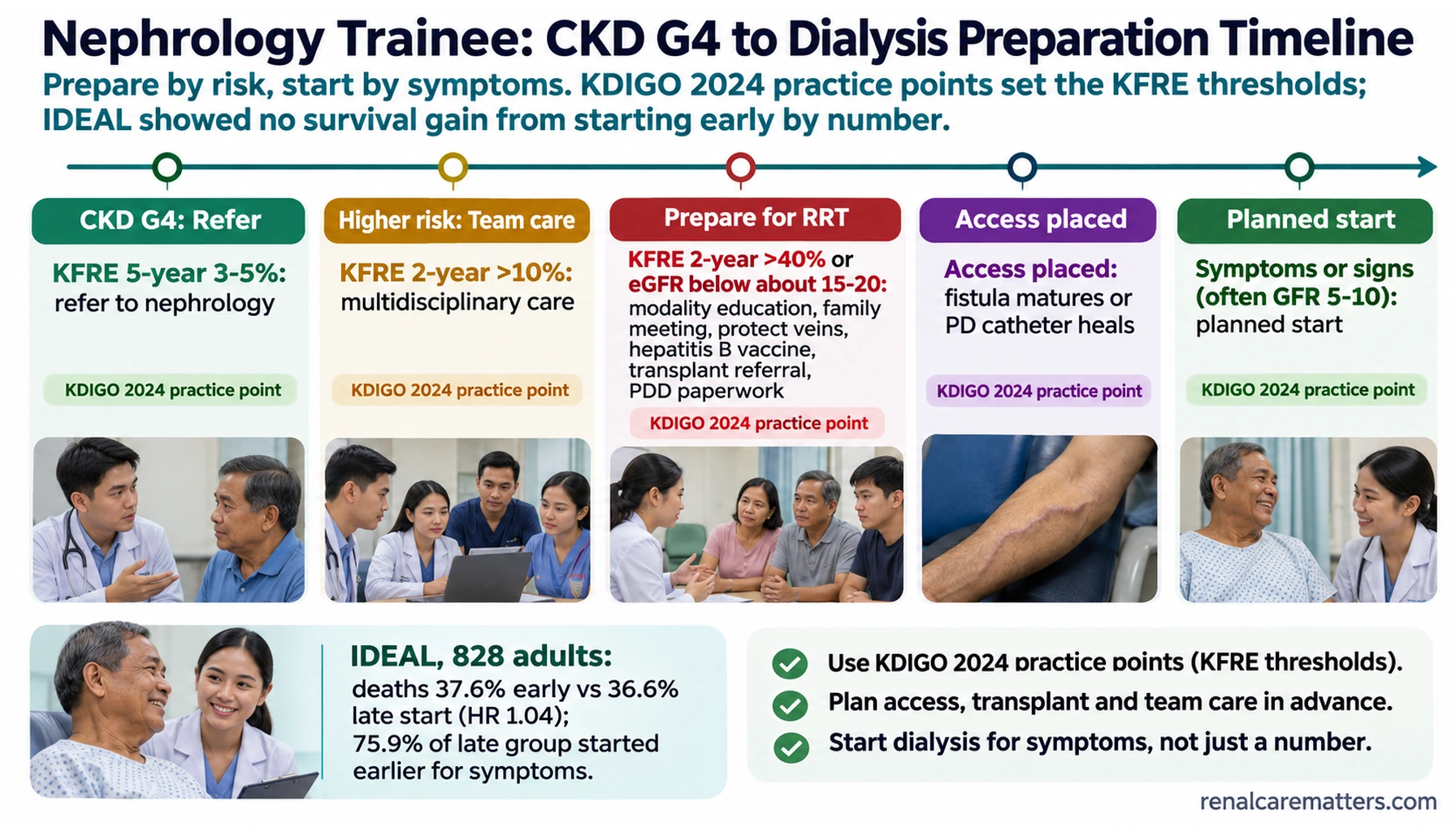
Refer to nephrology (KDIGO 2024)5-year kidney failure risk of 3% to 5% by KFRE (practice point)
Multidisciplinary care (KDIGO 2024)2-year risk above 10% (practice point)
Modality education and preparation (KDIGO 2024)2-year risk above 40%, or glomerular filtration rate (GFR) below about 15 to 20 mL/min/1.73 m² (practice points)
When dialysis usually starts (KDIGO 2024)For symptoms or signs, often but not always at GFR 5 to 10 mL/min/1.73 m² (practice point)
Initiating Dialysis Early and Late trial (IDEAL) trial, 828 adultsDeath 37.6% with early start versus 36.6% with late start (heart rate (HR) 1.04)
PhilHealth hemodialysisUp to 156 sessions a year at PHP 6,350 per session for PDD-registered patients (confirm on date of service)
Most patients who reach kidney failure have been known to a doctor for years. A few arrive for the first time in the emergency room. Your work is to make the first group’s start planned, chosen and safe; to start dialysis for symptoms and signs rather than for a number; and to make sure every patient hears about all the options, including the ones your hospital does not offer.
Opening case · fictional
Case: The kitchen table in Isabela
Wednesday, 3 p.m., the renal clinic of a provincial hospital in Ilagan, Isabela. Mrs. Rosario Dela Cruz, 56, lives with her husband, a rice farmer, in a barangay 40 minutes away by tricycle. She has had type 2 diabetes for eighteen years and chronic kidney disease (CKD) from diabetic kidney disease. Her estimated glomerular filtration rate (eGFR) has fallen from 19 to 11 mL/min/1.73 m² over a year, and her urine albumin-to-creatinine ratio is 1,800 mg/g. The KFRE gives a 2-year risk of kidney failure of about 60%. She feels more tired than last year but eats well, sleeps well, and has no itch, nausea or swelling. Potassium is 5.4 mmol/L, bicarbonate 19 mmol/L, blood pressure 138/82 mm Hg. Diabetic retinopathy has reduced her vision; she reads large print with glasses.
Their concrete house has a spare room and a deep well. Her son and his family live next door. Her daughter, a domestic worker in Hong Kong, joins by video call and says her mother should “have the best, the dialysis in Manila.” The resident, Dr. Jerome Pascual, has written: “eGFR 11. For temporary catheter insertion and hemodialysis next week.”
Before reading on, decide:
Does Mrs. Dela Cruz need dialysis next week, and what should decide when she starts?
How would you present her options, and which of them fit her life?
What should be done this month so that, whenever she starts, the start is planned?
Keep your answers in mind. The lesson gives you what you need, and the case review near the end shows one sound response.
Lesson · part 1
When to start: symptoms and signs, not a single number
For decades, many units started dialysis at a set level of kidney function, and the trend worldwide was to start earlier. The reasoning seemed sound: uremic toxins accumulate, so why wait? The answer came from a randomized trial.
IDEAL randomized 828 adults with progressive CKD at 32 centers in Australia and New Zealand to planned dialysis start at an estimated GFR of 10.0 to 14.0 mL/min (early) or 5.0 to 7.0 mL/min (late), estimated by the Cockcroft–Gault equation. The early group started a median of 1.8 months after randomization, the late group 7.4 months. Over a median of 3.6 years, 37.6% of the early group and 36.6% of the late group died (hazard ratio [HR] 1.04, 95% confidence interval 0.83 to 1.30), and cardiovascular events, infections and dialysis complications did not differ. Of the late group, 75.9% started above the 7.0 mL/min target because symptoms appeared.1
Read IDEAL in two ways. It shows that starting early, by a number, does not help survival. It also shows that most patients assigned to wait developed symptoms and started a little earlier than planned. The lesson is to watch closely and start for the right reasons, not to delay at all costs.
KDIGO 2024 practice point
What it means for your plan
Decide on starting by weighing symptoms, signs, quality of life, preferences, GFR and laboratory abnormalities together
A single eGFR value never decides alone
Start dialysis for one or more indications: symptoms of kidney failure, inability to control volume or blood pressure, nutritional decline or cognitive impairment not responding to diet; this often but not invariably occurs at GFR 5 to 10 mL/min/1.73 m²
Ask about appetite, nausea, itch, sleep, concentration, weight and breathlessness at every visit
Plan preemptive transplantation or dialysis access when GFR falls below about 15 to 20 mL/min/1.73 m², or when the 2-year KRT risk is above 40%
Preparation starts months before the start
The practice points are from the KDIGO 2024 CKD guideline.2 They are practice points, which KDIGO uses for advice not backed by a systematic evidence review, so they carry no grade.
Predicting the rainy season: the KFRE
The KFRE uses age, sex, eGFR and urine albumin-to-creatinine ratio to estimate the 2-year and 5-year risk of needing dialysis or a transplant. A multinational meta-analysis of cohorts across many countries confirmed that it predicts accurately, with recalibration needed in some regions.3 KDIGO 2024 uses it at three thresholds: a 5-year risk of 3% to 5% to refer to nephrology, a 2-year risk above 10% to begin multidisciplinary care, and a 2-year risk above 40% to begin modality education and preparation, each in addition to eGFR-based criteria (practice points).2 The KFRE predicts kidney failure, not death. In an older or very sick patient, death from heart disease may come first, which is one reason the conversation must include conservative care.
Figure 2. Prepare by risk, start by symptoms. KDIGO 2024 practice points set the KFRE thresholds; IDEAL showed no survival gain from starting early by number.
In many Philippine hospitals, patients still start dialysis in the emergency room, through a temporary catheter, often after years of clinic visits where no one began the preparation. Each of those starts is a planning failure that the resident can prevent.
Stop and callStop and call the attending nephrologist for an urgent start when a patient with advanced CKD has
potassium that is high with electrocardiogram changes or does not respond to treatment;
pulmonary edema or fluid overload not responding to diuretics;
severe metabolic acidosis;
pericardial rub or effusion, encephalopathy, seizures or uremic bleeding.
Do this per unit protocol, but always ask the attending nephrologist for guidance.
RememberStart dialysis for symptoms and signs, not for a number. Start preparing when the 2-year KFRE risk passes 40% or the eGFR falls below about 15 to 20, whichever comes first.
Lesson · part 2
The options: what each one asks of the patient and family
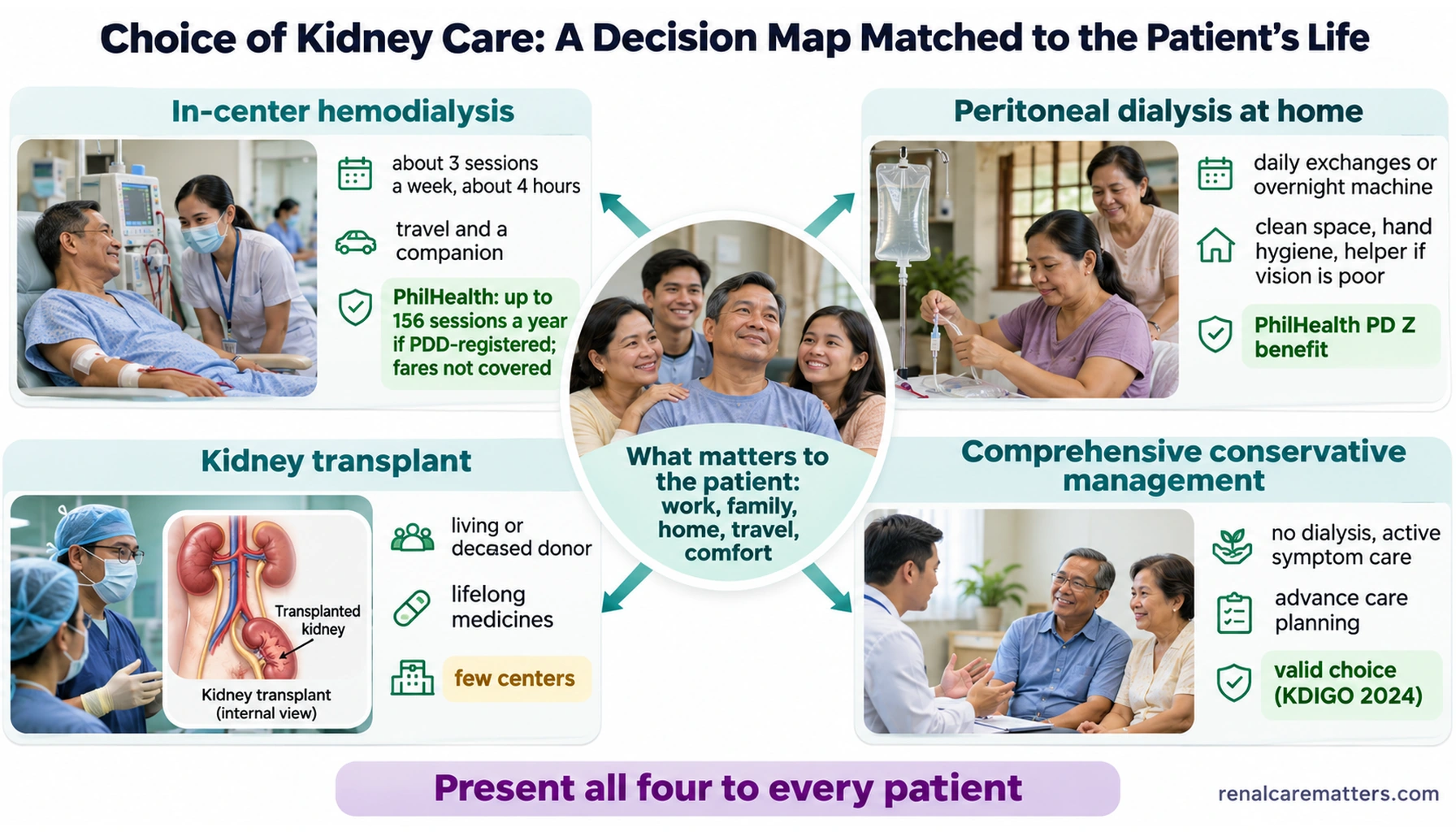
Every patient approaching kidney failure should hear about four paths. KDIGO 2024 asks that people with CKD be informed about all kidney replacement options and about comprehensive conservative management (practice point).2 The KDIGO controversies conference on dialysis initiation called for moving away from a one-size-fits-all approach toward care built on each patient’s goals and preferences, within quality and safety standards.4
Option
What it involves
What it asks of the patient and family
Philippine coverage and access
In-center hemodialysis (HD)
Usually three sessions a week of about four hours, through a fistula, graft or catheter
Travel three times a week, time away from work or farm, a companion for some patients
PhilHealth covers up to 156 sessions a year for patients in the PhilHealth Dialysis Database (PDD); transport and take-home medicines are not covered
Peritoneal dialysis (PD)
Exchanges at home through a catheter in the abdomen, by hand several times a day or by machine overnight
A clean space for supplies, hand hygiene, training, vision and dexterity or a trained helper
PhilHealth Z benefit package for PD; supply delivery depends on the provider and location
Kidney transplantation
A kidney from a living or deceased donor, with lifelong immunosuppression
Evaluation tests, a suitable donor, travel to a transplant center, adherence for life
Concentrated in a few centers; PhilHealth transplant benefits exist, and the 2026 revision should be confirmed before quoting amounts
Comprehensive conservative management
No dialysis; active treatment of symptoms, anemia, acidosis, fluid and potassium; planning for the end of life
Regular visits, honest conversations about prognosis, home or hospice support
Clinic visits and medicines are mostly out of pocket; palliative services are limited outside cities
The hemodialysis package of PHP 6,350 per session took effect on October 9, 2024, under the circular that institutionalized 156 sessions a year.5 The PD benefit is a separate Z benefit package.6 Confirm current rules and amounts on the date of service, and never let the size of a benefit choose the modality for the patient.
What the evidence can and cannot tell you
No large trial has randomized patients between hemodialysis and peritoneal dialysis; observational comparisons are confounded by who chooses which. In practice, the two give broadly similar outcomes for patients who can do either, and PD often preserves residual kidney function and daily freedom. The International Society for Peritoneal Dialysis (ISPD) recommends that PD be prescribed in a goal-directed way, agreed with the patient, to support the life the patient wants to live.7
For older adults, conservative management is a real choice. In a Dutch single-center cohort of 311 patients aged 70 or older, dialysis was associated with longer survival overall, but among those 80 or older the difference was no longer statistically significant, and it shrank with heavy comorbidity.8 This was observational and the groups differed in age. KDIGO 2024 asks that conservative management be offered as a valid option to people who choose not to have kidney replacement therapy (practice point).2
Transplantation, for those who can receive it, usually offers the most life and the most freedom. Ask early whether the patient has a willing, healthy relative. In the Philippines that relative may be working overseas, which affects timing and testing, and the law and the transplant center’s ethics committee govern who may donate.
In childrenFor a child with progressive kidney failure, KDIGO 2024 calls preemptive transplantation from a living or deceased donor the preferred treatment, usually timed at an eGFR of about 5 to 15 mL/min/1.73 m² depending on age, size and rate of progression, and it adds poor growth despite optimized care as an indication to start KRT (practice points).2 PD at home is often the first dialysis option for small children because it suits their size and lets them stay in school. See Attending Pediatric Nephrologist, Module 19.
RememberPresent all four paths to every patient: hemodialysis, peritoneal dialysis, transplantation and conservative care, whether or not your hospital offers them. Leaving one out is a decision made for the patient.
Lesson · part 3
The shared decision: from teach-back to the family meeting
A modality choice is a decision with no single right answer. The person who will live with it should make it, with the information, time and support to choose well. KDIGO 2024 asks the multidisciplinary team to provide education and counseling about KRT options, transplantation, access surgery, and the ethical, psychological and social issues, and to include care partners where appropriate (practice points).2
The intern’s part: plain words and teach-back
Teach-back means asking the patient to explain, in her own words, what she has understood, then correcting and asking again. It tests your explanation, not the patient. Say: “I want to be sure I explained it well. Can you tell me how peritoneal dialysis is done at home?” Write down the answer, the questions, and the fears. A patient who says “once you start dialysis you die soon” is telling you what she has seen in her barangay; address it gently with facts.
Step
What to do
Words that help
Make the choice visible
Say there is a decision to make and more than one good answer
“There are several ways to care for your kidneys from here. We will choose together.”
Explain each option
Use a printed chart or decision aid in her language; include benefits, burdens and costs
“This one is done at home every day. This one means traveling to the unit three times a week.”
“What would a good day look like for you a year from now?”
Check understanding
Teach-back
“Can you tell me in your own words what we discussed?”
Decide, or decide when
Allow time; a decision can be revisited
“You do not have to decide today. Let us meet again in two weeks with your family.”
The fellow’s part: the family meeting
In the Philippines a modality decision is almost always a family decision. The spouse, the eldest child, a sibling abroad, and sometimes a parish priest or pastor may all have a voice. Plan the meeting: book a quiet room, invite those the patient wants, connect the relative abroad by video at a time that suits both time zones, and bring a nurse or social worker.
Start by asking the patient, alone first if she wishes, what she wants the family to know. In the meeting, describe her kidney function and her risk simply, present every option, and invite questions from each person. When a relative abroad pushes for “the best,” help the family see that the best is the option that fits the patient’s body and life, not the most expensive or the most distant. Name the burden on the family member who will do the daily work, whether that is driving to the unit or helping with exchanges.
Figure 3. Four paths, one person at the center. Each option is matched to the patient’s body, home, work, family and goals.
Home factors decide much of PD’s feasibility: a clean room or corner for supplies, clean water for hand washing, a place to store boxes, and either good vision and hand function or a trained helper. Visual impairment from retinopathy does not rule out PD; many patients succeed with large-print guides, assisted exchanges or a family helper. A nurse home visit, where available, answers these questions better than a clinic interview.
RememberLet the patient choose what fits her life. Ask what a good day looks like for her, test your explanation with teach-back, and bring the family in on her terms.
Lesson · part 4
Preparation: access, transplant referral, vaccines and paperwork
Preparation takes months, and every step has a lead time. An arteriovenous fistula needs weeks to months to mature. A PD catheter needs time to heal before full use. Transplant evaluation needs tests, specialist visits and donor work-up. Benefit registration needs documents. That is why KDIGO 2024 ties preparation to a 2-year risk above 40% or a GFR below about 15 to 20, not to the day dialysis starts.2
Access and the life-plan
The Kidney Disease Outcomes Quality Initiative (KDOQI) 2019 vascular access guideline asks the team to build an end-stage kidney disease (ESKD) Life-Plan: a long-term plan for the sequence of modalities and accesses a patient may need over a lifetime, chosen with the patient, rather than a reflex fistula for everyone.9 For a patient choosing hemodialysis, that usually means referral to a vascular surgeon in time for a fistula to mature. For a patient choosing PD, it means a catheter placed by a trained operator with time to heal. For a patient waiting for a preemptive transplant, it may mean preserving veins and planning a backup.
Vein preservation is everyone’s job, and the intern can do it today. In any patient with advanced CKD, protect the veins of the arm most likely to carry a future fistula: draw blood and place intravenous lines on the back of the hand or the other arm when possible, avoid peripherally inserted central catheters unless the attending agrees, and write “protect veins” on the chart and the bed.
The preparation checklist
Step
Who leads
Why it cannot wait
Modality education and family meeting
Fellow and nurse educator
The choice decides every later step
Access referral (fistula or PD catheter)
Resident with the attending
Maturation and healing take weeks to months
Transplant referral and donor discussion
Fellow with the transplant center
Evaluation is long; preemptive transplant is best for suitable patients
Hepatitis B serology and vaccination
Resident
Dialysis units require serology, and vaccination takes months to complete
Hepatitis C and human immunodeficiency virus (HIV) screening as the unit requires
Resident
Determines machine and room assignment in the unit
PhilHealth membership and PDD registration
Social worker with the unit
The hemodialysis benefit applies to patients registered in the PDD
Transport, work and family plan
Social worker, patient, family
Three trips a week or daily exchanges change a household’s routine and income
Medicines, anemia, acidosis, potassium, diet
Resident and dietitian
A well-prepared body tolerates the start better
The PDD requirement and the 156-session coverage come from the PhilHealth circular.5 Ask the social worker to start PhilHealth paperwork when preparation starts, not when the first session is booked. Explore Malasakit Center assistance for costs outside the packages.
KFRE 2-year risk above 40% or eGFR below about 15 to 20Modality education, family meeting, vein preservation, hepatitis B vaccination, transplant referral.
Choice madeAccess referral for the chosen modality; PhilHealth and PDD paperwork; transport plan.
Watch closelySymptoms, nutrition, volume, potassium, acidosis at every visit; KFRE and eGFR trend.
Planned startBegin dialysis for symptoms or signs, on a working access, on a day chosen in advance. Or continue conservative care if that is the choice.
If the patient chooses conservative management, the preparation is different but just as real: a symptom plan, advance care planning, and a clear route to help at home. KDIGO 2024 asks that people with a recognized need for end-of-life care, including those on conservative management, have access to advance care planning resources (practice point).2 The KDIGO conference on supportive care describes this as part of kidney care, not a separate service.10
RememberStart every preparation step when the 2-year risk passes 40%: the conversation, the access, the transplant referral, the vaccine and the paperwork. A planned start is built months before the first session.
On the floor
Real situations: problems and solutions
These are fictional but typical. For each one, cover the answer, decide what you would do, then compare. Where a step depends on local rules, your unit’s procedure and your supervisor’s direction come first.
The crash start after years of clinic visits
What you see
A 48-year-old tricycle driver in Bacolod comes to the emergency room with breathlessness and potassium of 7.0 mmol/L. His chart shows CKD clinic visits every three months for four years, with eGFR falling from 25 to 8.
What is likely going on
A missed preparation window; he now needs an urgent start through a temporary catheter.
What to do
Manage the emergency per protocol and call the attending nephrologist; once stable, hold the modality conversation and plan a permanent access.
Why it matters
A KFRE check and a preparation plan two years earlier could have given him a planned start on a working access.
The daughter abroad who wants Manila
What you see
A 63-year-old woman in Tuguegarao is choosing a modality. Her son in Dubai wants her to move to Manila for hemodialysis at a large center.
What is likely going on
A family preference that may not fit the patient’s home, support or wishes.
What to do
Hold a family meeting with the son on video; ask the patient what she wants; present PD at home and local hemodialysis alongside the Manila option, with travel and cost.
Why it matters
The best option is the one that fits the patient’s life, not the most distant or expensive one.
The eGFR of 9 with no symptoms
What you see
A 59-year-old retired seaman in Batangas has eGFR 9, eats well, has no edema, and potassium 5.1 mmol/L. A resident books him for hemodialysis next week.
What is likely going on
A low number without indications to start.
What to do
Review symptoms, nutrition, volume and laboratory values; continue close follow-up while access matures; start when indications appear.
Why it matters
IDEAL found no survival benefit from starting early by a number; KDIGO advises starting for symptoms and signs.
The arm full of needle marks
What you see
A 55-year-old woman with CKD G5 in Cagayan de Oro has had daily blood draws and two intravenous lines in her left forearm during a long admission. She has chosen hemodialysis.
What is likely going on
Her best fistula veins are being damaged before surgery.
What to do
Mark “protect veins” on the chart and bed, move draws to the back of the hand or the other arm, and refer to the vascular surgeon for vein mapping.
Why it matters
Vein preservation is part of the ESKD Life-Plan; lost veins mean more catheters.
Field notes
Calculate the KFRE at every CKD G4 visit and write the 2-year risk in the note.
Write “protect veins” on the chart of every patient with advanced CKD on the day you meet them.
Use teach-back after every modality explanation and record the patient’s own words.
Schedule family meetings at a time that suits relatives working abroad, and test the video link before the meeting.
Start PhilHealth and PDD paperwork when preparation starts, not when the first session is booked.
Case review
Back to the case: The kitchen table in Isabela
Not next week. An eGFR of 11 alone is not a reason to start. Mrs. Dela Cruz eats and sleeps well, has no uremic symptoms, no fluid overload, controlled blood pressure, and a manageable potassium and bicarbonate. IDEAL showed no survival benefit from starting early by a number, and KDIGO 2024 asks that the start be decided by symptoms, signs and preferences, often at a GFR of 5 to 10. Her 2-year KFRE risk of about 60% and eGFR below 15 do mean preparation should begin now. A temporary catheter next week would expose her to infection and to a crash-like start she does not need. Treat her acidosis and potassium, review her diet, and see her often.
The options. Present all four. In-center hemodialysis in Ilagan means three tricycle trips of 40 minutes each way every week; PhilHealth covers the sessions once she is registered in the PDD, but not the fares. PD at home suits her spare room and her son’s family next door; her reduced vision is a challenge, not a bar, if a family member trains as her helper. Ask whether a healthy relative might donate a kidney and whether she wants a transplant evaluation. Conservative management should be mentioned as a valid choice, even if she is unlikely to choose it at 56. Ask her what a good day looks like a year from now. Hold a family meeting with her daughter on video at a time that suits Hong Kong, and gently explain that the best treatment is the one that fits her mother’s life.
This month. Write “protect veins” on her chart and use the back of the hand for blood draws. Check hepatitis B serology and start vaccination if she is not immune; screen as the unit requires. Ask the social worker to begin PhilHealth and PDD paperwork and to look at transport support. Once she chooses, refer for a fistula or a PD catheter in time to mature or heal. If a relative may donate, refer both to the transplant center. Record the education given and her teach-back. Agree on how often she will be seen and which symptoms should bring her in sooner.
Interactive case · fictional
Interactive case: Packing before the rains
Work through a shift one decision at a time. The panel at the top changes with what you choose. After each choice you see why it is, or is not, the best move; after a weaker one you can try again or carry on and see where it leads. Your first choice at each step is scored. The score stays on this device and nothing is sent anywhere. In real practice, your unit’s protocol and the people responsible for each decision come first.
Skills lab · with your preceptor
Skills checklist: Modality education and preparation
Complete with a preceptor on two patients with advanced CKD approaching kidney failure. Sign-off is local. Your preceptor rates each step as satisfactory, needs practice, or not observed. Steps marked Critical must all be satisfactory before sign-off. This checklist supports supervised learning; your unit’s own procedure and competency form are the authority. A printable version of every checklist is on the trainer page.
Explains hemodialysis, peritoneal dialysis, transplantation and conservative management in plain language and confirms understanding with teach-back.
Calculates the 2-year and 5-year KFRE and states the KDIGO 2024 practice point each result triggers.
Distinguishes indications to start dialysis from a low eGFR alone, citing IDEAL.
Completes a preparation checklist: vein preservation, hepatitis B status, access referral, transplant discussion and PDD registration.
Plans or takes part in a family meeting, including a relative abroad by video, and documents the decision and the reasons.
Placement activity. CKD clinic, renal ward or dialysis unit
Self-assessment
Check your understanding
Each visit draws 5 questions at random from this module’s 5-question bank. Choose the single best answer for each, then select Check answers; an explanation appears under the best answer. Select New set of questions for a different mix. A good target is 4 of 5 on two different sets. Nothing you select is sent anywhere; scoring happens in your browser.
Cooper, B. A., Branley, P., Bulfone, L., Collins, J. F., Craig, J. C., Fraenkel, M. B., Harris, A., Johnson, D. W., Kesselhut, J., Li, J. J., Luxton, G., Pilmore, A., Tiller, D. J., Harris, D. C., Pollock, C. A., & IDEAL Study (2010). A randomized, controlled trial of early versus late initiation of dialysis. The New England Journal of Medicine, 363(7), 609–619. https://doi.org/10.1056/NEJMoa1000552
Kidney Disease: Improving Global Outcomes (KDIGO) CKD Work Group. (2024). KDIGO 2024 clinical practice guideline for the evaluation and management of chronic kidney disease. Kidney International, 105(4S), S117–S314. https://doi.org/10.1016/j.kint.2023.10.018
Tangri, N., Grams, M. E., Levey, A. S., Coresh, J., Appel, L. J., Astor, B. C., Chodick, G., Collins, A. J., Djurdjev, O., Elley, C. R., Evans, M., Garg, A. X., Hallan, S. I., Inker, L. A., Ito, S., Jee, S. H., Kovesdy, C. P., Kronenberg, F., Heerspink, H. J., ... CKD Prognosis Consortium (2016). Multinational assessment of accuracy of equations for predicting risk of kidney failure: A meta-analysis. JAMA, 315(2), 164–174. https://doi.org/10.1001/jama.2015.18202
Chan, C. T., Blankestijn, P. J., Dember, L. M., Gallieni, M., Harris, D. C. H., Lok, C. E., Mehrotra, R., Stevens, P. E., Wang, A. Y.-M., Cheung, M., Wheeler, D. C., Winkelmayer, W. C., Pollock, C. A., & Conference Participants. (2019). Dialysis initiation, modality choice, access, and prescription: Conclusions from a Kidney Disease: Improving Global Outcomes (KDIGO) Controversies Conference. Kidney International, 96(1), 37–47. https://doi.org/10.1016/j.kint.2019.01.017
Brown, E. A., Blake, P. G., Boudville, N., Davies, S., de Arteaga, J., Dong, J., Finkelstein, F., Foo, M., Hurst, H., Johnson, D. W., Johnson, M., Liew, A., Moraes, T., Perl, J., Shroff, R., Teitelbaum, I., Wang, A. Y., & Warady, B. (2020). International Society for Peritoneal Dialysis practice recommendations: Prescribing high-quality goal-directed peritoneal dialysis. Peritoneal Dialysis International, 40(3), 244–253. https://doi.org/10.1177/0896860819895364
Verberne, W. R., Geers, A. B. M. T., Jellema, W. T., Vincent, H. H., van Delden, J. J. M., & Bos, W. J. W. (2016). Comparative survival among older adults with advanced kidney disease managed conservatively versus with dialysis. Clinical Journal of the American Society of Nephrology, 11(4), 633–640. https://doi.org/10.2215/CJN.07510715
Lok, C. E., Huber, T. S., Lee, T., Shenoy, S., Yevzlin, A. S., Abreo, K., Allon, M., Asif, A., Astor, B. C., Glickman, M. H., Graham, J., Moist, L. M., Rajan, D. K., Roberts, C., Vachharajani, T. J., Valentini, R. P., & National Kidney Foundation. (2020). KDOQI clinical practice guideline for vascular access: 2019 update. American Journal of Kidney Diseases, 75(4 Suppl 2), S1–S164. https://doi.org/10.1053/j.ajkd.2019.12.001
Davison, S. N., Levin, A., Moss, A. H., Jha, V., Brown, E. A., Brennan, F., Murtagh, F. E. M., Naicker, S., Germain, M. J., O’Donoghue, D. J., Morton, R. L., Obrador, G. T., & Kidney Disease: Improving Global Outcomes (KDIGO). (2015). Executive summary of the KDIGO Controversies Conference on Supportive Care in Chronic Kidney Disease: Developing a roadmap to improving quality care. Kidney International, 88(3), 447–459. https://doi.org/10.1038/ki.2015.110
Educational self-study for physicians in training. Clinical tasks need your institution’s authorization and supervision. Completing this track is an Academy learning record only. It does not confer licensure, specialist status, PSN or PNSP membership or board eligibility, procedural privileges, CPD units, or completion of an institutional training program, and it does not replace current guidelines, regulations, your institution’s protocols and formulary, or your supervisor.