Compare hemodialysis (HD), peritoneal dialysis (PD), transplantation and conservative care with the patient’s life in view.
PublishedNailathalaGipatikPepalwal:ReferencesMga SanggunianMga TinubdanReng Reperensya:7Audience: Practicing nephrologists · senior nephrology fellows · internists who share longitudinal kidney care in the clinic, ward, ICU, dialysis unit, and homeRead timeOras ng pagbasaOras sa pagbasaOras ning pamamasa:
Training track for attending nephrologists in adult practice
This module is study material for attending nephrologists and senior fellows in adult practice. It explains the reasoning behind common decisions; it is not a protocol. Doses and thresholds must be checked against current product labels, guidelines, and your institution’s approved protocols. Regulatory and benefit rules change: confirm them on the date of service. Every case is fictional.
Learning objectives
After this module you should be able to
Compare hemodialysis (HD), peritoneal dialysis (PD), transplantation and conservative care with the patient’s life in view.
Time initiation by symptoms, refractory complications and trajectory rather than estimated glomerular filtration rate (eGFR) alone.
Plan access and referrals early, and return to shared planning after an urgent start.
Pre-testBefore you read, answer the 5 self-assessment questions and note your score. After the module, select New set of questions and compare. The difference is what you learned; the questions you still miss are what to reread.
Start here
The big picture, in plain words
Your duty · Section 1.2, 2024 hemodialysis guidelinesUnder the Philippine Society of Nephrology (PSN) guidelines: Explain every option and document consent, preferably witnessed by two people (b1); assess completely before starting (b2); write the initial and maintenance prescription (b4); and plan long-term care (b9).
In plain wordsStarting dialysis is less a moment than a slope. The best starts are planned months ahead, so that when symptoms arrive the patient already has an access, a chosen modality and a transplant referral in motion.
Figure 1 · Key numbers
Initiating Dialysis Early and Late trial (IDEAL) start eGFR arms10–14 vs 5–7 mL/min/1.73 m²; no survival difference
Philippine Health Insurance Corporation (PhilHealth) HD coverageUp to 156 sessions per year
Opening case · fictional
Case: “The number is very low, Doctor”
Mr. Torres, 55, has chronic kidney disease (CKD) G5 with an eGFR of 9. He has been coming to your pre-dialysis clinic for a year and has said many times that he wants dialysis at home. The peritoneal dialysis training center is 2 hours away by bus, and he does not drive.
Today his wife and two adult children come with him. They have read his result online. “The number is very low, Doctor. Please start him on the machine today. There is a free chair, we saw it.” He has mild nausea in the mornings, no swelling, and a potassium of 5.0 mmol/L. He has no fistula yet.
Before reading on, decide:
Does he need to start dialysis today?
How can you keep his choice of home therapy alive?
What will you tell the family, and what will you write?
Keep your answers in mind. The lesson gives you what you need, and the case review near the end shows one sound response.
Lesson · part 1
How it works
Uremic symptoms reflect retained solutes beyond urea (guanidines, indoxyl sulfate, p-cresyl sulfate, middle molecules), plus volume and acid-base disturbance. At the same eGFR, patients differ widely in muscle mass, residual tubular secretion and diet, so a number cannot stand in for the person. Residual kidney function is worth protecting. Each mL/min of native clearance removes middle molecules and phosphate around the clock, eases fluid limits, and is associated with better survival on both HD and PD.
In the pre-dialysis clinic · fictional
Mr. Garcia and Mrs. Tan both have an eGFR of 8. He is a 45-year-old mason with large muscles who feels well and is still working. She is 72, weighs 42 kilograms, has lost her appetite, and has been vomiting each morning.
Same number, different patients. Her uremia shows in her intake and her weight; his creatinine reflects his muscle as much as his kidneys.
What this shows. Start dialysis for the person, not for the number.
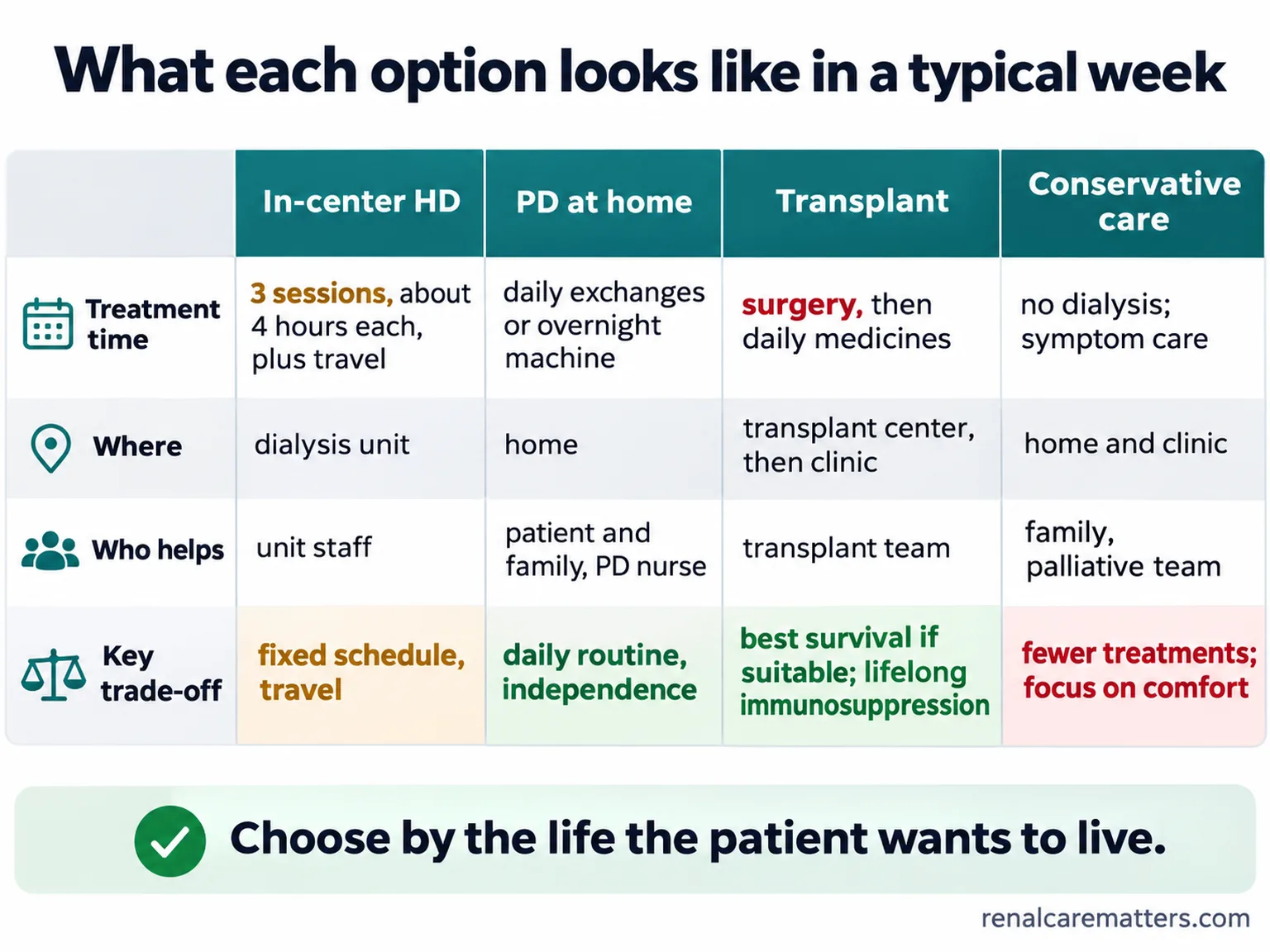
Figure 2. What each option looks like in a typical week. Comparison of a typical week on in-center hemodialysis, home peritoneal dialysis, transplant and conservative care.
Lesson · part 2
What the evidence shows
IDEAL (N Engl J Med 2010) randomized patients to start dialysis at eGFR 10–14 versus 5–7 and found no difference in survival or quality of life. Most of the late group started earlier than planned because symptoms appeared. KDIGO 2024 advises starting kidney replacement therapy (KRT) for symptoms or signs of kidney failure, inability to control volume or blood pressure, or progressive nutritional decline, which often happens at eGFR 5–10, and using a 2-year KFRE risk above 40% to begin preparation. Kidney Disease Outcomes Quality Initiative (KDOQI) 2019 frames access as part of an individualized end-stage kidney disease (ESKD) Life-Plan rather than ’fistula first’ for everyone.
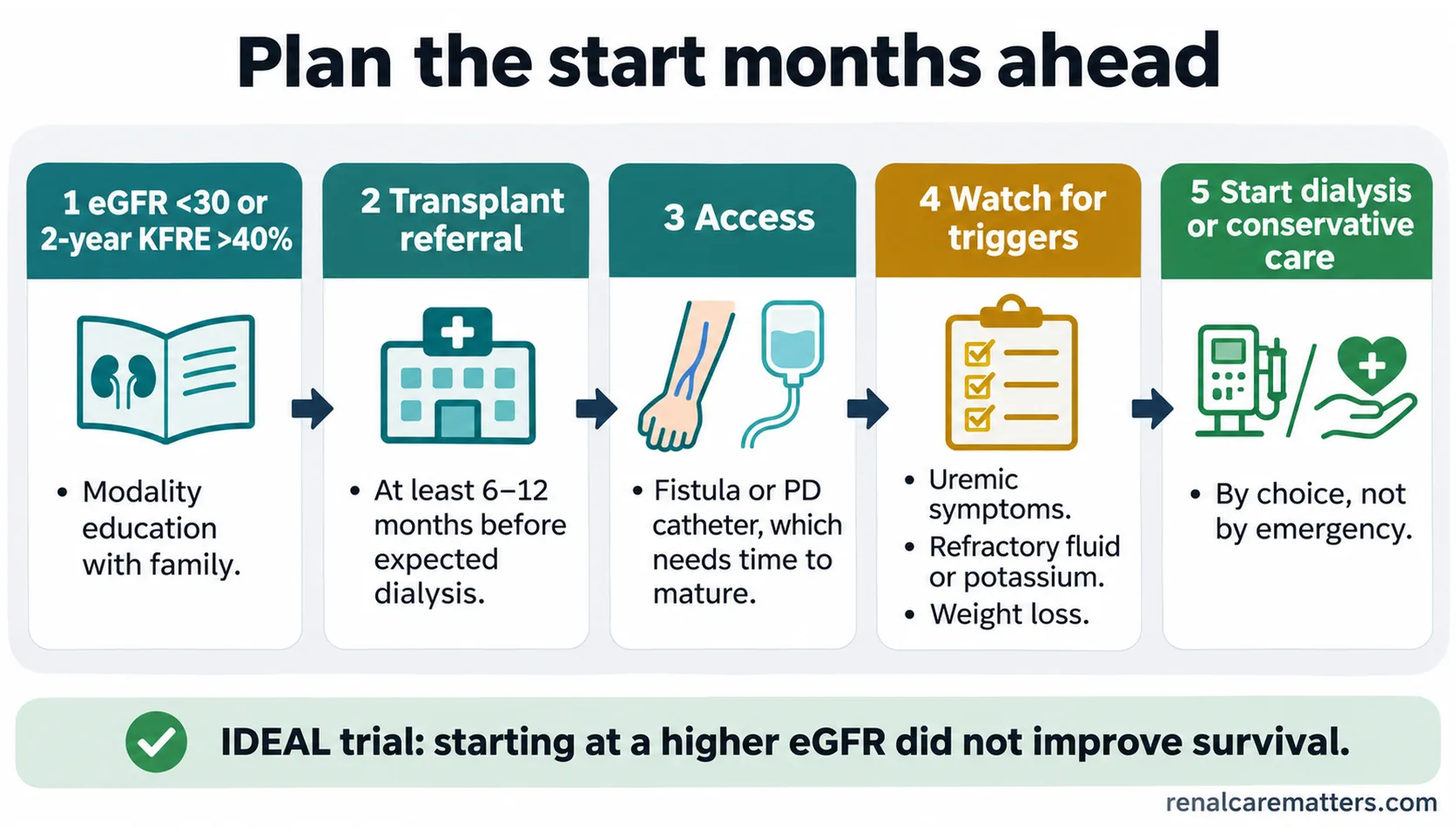
Start modality education when eGFR is under 20–30 or the 2-year KFRE exceeds 40%, and include the family. Describe each option in terms of a typical week: travel, time, diet, work and who helps at home. Refer for transplant evaluation and create an access plan at the same time; a fistula needs months to mature. Watch for the triggers that should start dialysis: uremic symptoms, refractory volume or potassium, worsening nutrition, pericarditis or encephalopathy. After an urgent start, record the indication and return to the shared decision once the patient is stable. Some urgent starters are good PD candidates.
Figure 3. Plan the start months ahead. Five steps to prepare for kidney failure: education, transplant referral, access, start triggers, and a chosen start.
Describing a typical week · fictional
Mrs. Tan’s son asks which dialysis is “better.” You answer with a calendar. Hemodialysis: Monday, Wednesday, Friday, four hours each, plus travel by tricycle, with fluid and diet limits between sessions. Peritoneal dialysis: four exchanges at home each day, or a machine at night, with someone trained to help.
Then you add the third option: conservative care at home, with symptom control. The family looks at the calendar for a long time.
What this shows. People choose between weeks, not between modalities.
Stop and call
Uremic pericarditis or encephalopathy
Refractory hyperkalemia or pulmonary edema
Progressive weight and albumin loss
No access plan with 2-year KFRE >40%
On the floor
Real situations: problems and solutions
These are fictional but typical. For each one, cover the answer, decide what you would do, then compare. Where a step depends on local rules, your unit’s procedure and your supervisor’s direction come first.
The urgent start nobody planned
What you see
A patient you have followed for two years arrives breathless and needs dialysis through a catheter.
What is likely going on
The preparation started too late.
What to do
Dialyze him, then return to the modality decision once he is stable, and review why his access was not ready.
Why it matters
A missed access plan is a system failure that can be measured and fixed.
“No dialysis, ever”
What you see
A patient says she will never accept dialysis, but has not heard about conservative care.
What is likely going on
Her refusal may be fear rather than an informed choice.
What to do
Explain all three paths: hemodialysis, peritoneal dialysis, and conservative kidney management, in terms of a typical week.
Why it matters
An informed refusal is respected; an uninformed one deserves a conversation.
The fistula that matured too late
What you see
A fistula created when eGFR was 8 is not ready when dialysis begins.
What is likely going on
Fistulas need months to mature.
What to do
Create access early, guided by the KFRE and the patient’s life-plan.
Why it matters
Timing the access is part of the treatment.
Field notes
Describe each option as a typical week.
Refer for transplant and plan access at the same visit.
Write the triggers for starting dialysis in the chart.
An urgent start is not a final choice.
Case review
Back to the case: “The number is very low, Doctor”
Today? No. He has no emergency indication: no severe potassium, no fluid overload, no pericarditis, no confusion. In the IDEAL trial, starting at a higher eGFR did not improve survival, and most late starters began when symptoms appeared. An eGFR of 9 tells you to prepare quickly. It does not set the start date.
Keeping home therapy alive. Arrange a peritoneal dialysis catheter now, so the catheter is ready before he needs it. Ask the PD program whether home-visit training or training at a closer site is possible. That solves the transport problem without giving up his choice. Refer him for transplant evaluation at the same time. If he ends up starting hemodialysis urgently, record why, and come back to the decision once he is stable. An urgent start does not have to be permanent.
The family. Thank them for coming. Explain that you are watching for specific signs: worsening nausea, weight loss, swelling, breathlessness, or rising potassium. Give them those signs in writing, with the number to call. Use teach-back with the whole family. Then document his preference in his own words. The free chair they saw will still be there; a planned start is safer than an unplanned one.
Skills lab · with your preceptor
Skills checklist: Skills checklist
Complete with a preceptor, in simulation or at your own unit. Sign-off is local. Your preceptor rates each step as satisfactory, needs practice, or not observed. Steps marked Critical must all be satisfactory before sign-off. This checklist supports supervised learning; your unit’s own procedure and competency form are the authority. A printable version of every checklist is on the trainer page.
Compares modality burdens in daily-life terms
Creates a timeline with access and transplant referral
Documents a shared decision and start triggers
Placement activity. Simulation or supervised practice
Self-assessment
Check your understanding
Each visit draws 5 questions at random from this module’s 5-question bank. Choose the single best answer for each, then select Check answers; an explanation appears under the best answer. Select New set of questions for a different mix. A good target is 4 of 5 on two different sets. Nothing you select is sent anywhere; scoring happens in your browser.
Kidney Disease: Improving Global Outcomes (KDIGO) CKD Work Group (2024). KDIGO 2024 clinical practice guideline for the evaluation and management of chronic kidney disease. Kidney International, 105(4S), S117–S314. https://doi.org/10.1016/j.kint.2023.10.018
Cooper, B. A., Branley, P., Bulfone, L., Collins, J. F., Craig, J. C., Fraenkel, M. B., Harris, A., Johnson, D. W., Kesselhut, J., Li, J. J., Luxton, G., Pilmore, A., Tiller, D. J., Harris, D. C., Pollock, C. A., & IDEAL Study (2010). A randomized, controlled trial of early versus late initiation of dialysis. The New England Journal of Medicine, 363(7), 609–619. https://doi.org/10.1056/NEJMoa1000552
Lok, C. E., Huber, T. S., Lee, T., Shenoy, S., Yevzlin, A. S., Abreo, K., Allon, M., Asif, A., Astor, B. C., Glickman, M. H., Graham, J., Moist, L. M., Rajan, D. K., Roberts, C., Vachharajani, T. J., Valentini, R. P., & National Kidney Foundation. (2020). KDOQI clinical practice guideline for vascular access: 2019 update. American Journal of Kidney Diseases, 75(4 Suppl 2), S1–S164. https://doi.org/10.1053/j.ajkd.2019.12.001
Tangri, N., Grams, M. E., Levey, A. S., Coresh, J., Appel, L. J., Astor, B. C., Chodick, G., Collins, A. J., Djurdjev, O., Elley, C. R., Evans, M., Garg, A. X., Hallan, S. I., Inker, L. A., Ito, S., Jee, S. H., Kovesdy, C. P., Kronenberg, F., Heerspink, H. J., ... CKD Prognosis Consortium (2016). Multinational assessment of accuracy of equations for predicting risk of kidney failure: A meta-analysis. JAMA, 315(2), 164–174. https://doi.org/10.1001/jama.2015.18202
Educational material for physicians. Completing it is an Academy learning record only. It does not confer CPD units, PSN certification, privileges, or PhilHealth accreditation, and it does not replace current guidelines, regulations, your institution’s protocols, or clinical judgment.