Adapt kidney care to pregnancy, to the child seen by an adult team, and to the frail older adult.
PublishedNailathalaGipatikPepalwal:ReferencesMga SanggunianMga TinubdanReng Reperensya:14Audience: Adult and pediatric nephrology fellows · internal medicine and pediatric residents · medical interns on medicine, pediatrics, ICU and dialysis rotations, and residents who work shifts as dialysis physicians on dutyRead timeOras ng pagbasaOras sa pagbasaOras ning pamamasa:
Training track for nephrology fellows, residents and medical interns
Study material for medical interns, residents and fellows. It explains the reasoning behind common decisions; it is not a protocol and gives no drug doses. Doses, rates and order sets come from current guidelines, product labels, your institution’s approved protocols and your supervising physician. Benefit rules change: confirm them on the date of service. Every case is fictional.
Learning objectives
After this module you should be able to
Intern: Recognize three patients who look well until they do not: the pregnant woman with new hypertension after 20 weeks, the child whose blood pressure, urine output or weight has not been measured correctly, and the frail older adult whose creatinine looks “normal.” Report each one early.
Resident: Adapt acute kidney injury (AKI) and chronic kidney disease (CKD) care to pregnancy, childhood and old age: read creatinine against the physiology of each, use pediatric estimating equations and blood pressure percentiles, and review medicines for fetal, pediatric and geriatric risk.
Fellow: Counsel a woman with CKD or on dialysis about pregnancy using absolute and relative risks, plan an adolescent’s transition to adult care, and offer conservative kidney management to an older adult as a real option alongside dialysis.
Pre-testBefore you read, answer the 5 self-assessment questions and note your score. After the module, select New set of questions and compare. The difference is what you learned; the questions you still miss are what to reread.
Start here
The big picture, in plain words
Your role · three patients the adult renal service often gets wrongThe intern measures and reports: the blood pressure and urine dipstick of a pregnant woman, the weight and cuff size of a child, the falls and confusion of an older adult. The resident reinterprets the numbers for the body in front of them and reviews every medicine for the baby, the child or the frail elder. The fellow holds the long conversations: whether and when to become pregnant, when a teenager is ready for the adult clinic, and whether dialysis will give an 85-year-old more good days or fewer.
In plain wordsPicture a jeepney built for twenty passengers. Most days it runs fine with sixteen. Load it with twenty-four, as in pregnancy, and the same engine must work harder; small faults show quickly. Put a child behind the wheel and every control is the wrong size. Drive an old jeepney with a worn engine and a quiet dashboard, and the gauges stay in the normal range until the engine stops.
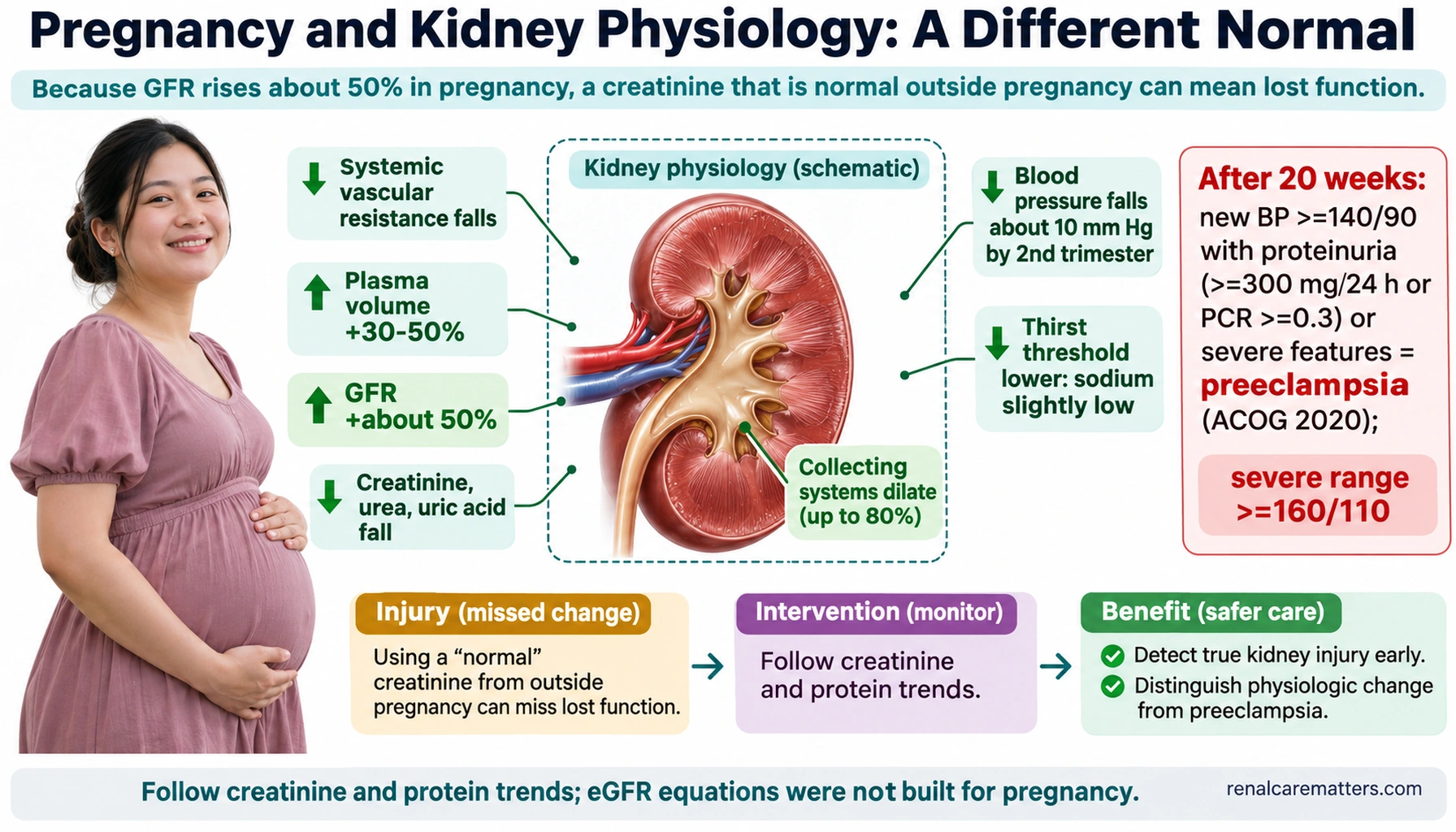
The picture has a limit. A jeepney does not change its own engine. The body does. In pregnancy the glomerular filtration rate (GFR) rises by about 50%, plasma volume grows by 30% to 50%, and blood pressure falls by about 10 mm Hg by the second trimester, so a creatinine that is “normal” for a nonpregnant woman may already mean lost function.1 In children, GFR matures through infancy and creatinine rises with muscle as the child grows, so adult reference ranges and adult equations do not apply.2 In older adults, muscle mass falls, so a low creatinine can hide a low GFR, and frailty, not age, predicts who is harmed by treatment.3
Figure 1 · Key numbers
GFR in pregnancyRises about 50%; creatinine, urea and uric acid fall (review)
Preeclampsia (ACOG 2020)Blood pressure ≥140/90 mm Hg after 20 weeks with proteinuria or severe features; severe range ≥160/110
CKD and pregnancy (meta-analysis, 506,340 pregnancies)Preeclampsia odds ratio 10.36; premature delivery odds ratio 5.72
Intensive hemodialysis in pregnancy (cohort comparison)Live births 85% with more than 36 hours a week versus 48% with 20 hours or less
Adolescents 13 and older (AAP 2017)Stage 1 hypertension 130/80 to 139/89 mm Hg
Nursing home residents starting dialysis (US cohort)At 12 months, 58% had died and 13% kept their earlier function
Most pregnant women with mild CKD, most children seen on an adult ward and most older adults with CKD do well when the team adjusts its habits. A few are harmed because no one did: the preeclampsia called a “flare,” the child given adult fluids, the elder started on dialysis without being asked what she wanted. Your work is to change your reference points for each of these three bodies, to call the specialist who knows them best, and to keep the person’s own goals at the center.
Opening case · fictional
Case: Ten weeks
Monday, 2 p.m., the renal clinic of a government hospital in San Fernando, Pampanga. Mrs. Kristine Aquino, 30, a public school teacher, has immunoglobulin A nephropathy (IgAN), diagnosed by biopsy two years ago. Her estimated glomerular filtration rate (eGFR) is 52 mL/min/1.73 m², urine protein-to-creatinine ratio 1.1 g/g, and clinic blood pressure 132/84 mm Hg. She takes losartan and a statin.
She is ten weeks pregnant. The pregnancy was not planned, and she and her husband are happy. Her mother, who came with her, says she should stop “all those chemicals” for the baby’s sake. Her obstetrician at the district hospital has asked the renal service for “clearance.” The resident, Dr. Mark Dizon, has written “continue home meds” on the referral form.
Before reading on, decide:
What must change in her medicines and monitoring now, and who needs to know?
What are her risks in this pregnancy, and how would you explain them in numbers she can follow?
At 28 weeks her blood pressure is 152/98 mm Hg and her proteinuria has doubled. How would you separate preeclampsia from an IgAN flare, and who leads?
Keep your answers in mind. The lesson gives you what you need, and the case review near the end shows one sound response.
Lesson · part 1
Pregnancy: a different normal, a narrower margin
Pregnancy reshapes the kidney within weeks. Systemic vascular resistance falls, partly because vessels become less sensitive to vasoconstrictor hormones. The renin-angiotensin-aldosterone system switches on in response, and the body retains sodium and water, so plasma volume expands by 30% to 50%. Kidney blood flow and GFR rise by about 50%, and serum creatinine, urea and uric acid fall. The thirst threshold resets lower, so serum sodium runs slightly low. The kidneys lengthen, and physiologic dilation of the collecting systems is seen in up to 80% of women.1
Three practical consequences follow. A creatinine that would be normal outside pregnancy may represent reduced function. Mild hydronephrosis on ultrasound is often physiologic, especially on the right. And estimating equations were not built for pregnancy, so follow the trend in creatinine and protein rather than an eGFR.
Figure 2. A different normal. Because GFR rises about 50% in pregnancy, a creatinine that is normal outside pregnancy can mean lost function.
Preeclampsia: recognize it early
The American College of Obstetricians and Gynecologists (ACOG) defines preeclampsia as new blood pressure of 140/90 mm Hg or higher on two occasions at least four hours apart after 20 weeks of gestation, with proteinuria (300 mg or more in 24 hours, or a protein-to-creatinine ratio of 0.3 mg/mg or more) or, in the absence of proteinuria, with severe features: thrombocytopenia, rising creatinine, raised liver enzymes, pulmonary edema, or new headache or visual disturbance. Blood pressure of 160/110 mm Hg or higher is in the severe range.4 HELLP syndrome (hemolysis, elevated liver enzymes and low platelets) is a severe form.
Finding after 20 weeks
Points toward preeclampsia
Points toward the kidney disease itself
Blood pressure
New or sharply rising, with headache or visual change
Hypertension present before 20 weeks
Urine
Rising protein with a bland sediment
Active sediment: dysmorphic red cells, red cell casts
The overlap is real, and the two can coexist. Separating them is a joint task for the obstetrician and the nephrologist, because the treatment of severe preeclampsia is delivery, which the obstetric team leads.
Pregnancy with CKD: risks in numbers
A meta-analysis of 23 studies with 506,340 pregnancies found that women with CKD had higher odds of preeclampsia (odds ratio 10.36), premature delivery (5.72), small-for-gestational-age or low birth weight (4.85), cesarean section (2.67) and pregnancy failure (1.80) than women without CKD. In the nine studies with long-term kidney follow-up, pregnancy was not associated with faster CKD progression (odds ratio 0.96, 95% confidence interval 0.69 to 1.35).5 These are pooled observational data and relative odds; the absolute risk depends on the baseline.
The Torino-Cagliari Observational Study (TOCOS) gives the absolute picture. Comparing 504 pregnancies in women with CKD with 836 low-risk pregnancies, a combined outcome of preterm delivery, neonatal intensive care or small-for-gestational-age occurred in 34.1% of women with CKD stage 1 and 90.0% of those with stages 4 to 5. Even women with stage 1 CKD and no hypertension, proteinuria or systemic disease had higher odds of the combined outcome than controls (odds ratio 1.88).6 Risk rises with stage, hypertension and proteinuria, and it is never zero.
Pregnancy on dialysis
Fertility falls in advanced CKD, and pregnancy on dialysis is uncommon and high risk. In a comparison of 22 pregnancies in a Toronto program that used intensive hemodialysis with 70 pregnancies in a United States registry, live births were 86.4% versus 61.4%, and median gestation was 36 versus 27 weeks. Live births were 48% in women dialyzed 20 hours a week or less and 85% in those dialyzed more than 36 hours a week.7 This was an observational comparison of small cohorts from different eras; it supports intensifying dialysis in pregnancy but does not set a number of hours. In the Philippines, intensive hemodialysis means extra sessions beyond the usual schedule. Plan early with the unit and the family how they will be arranged and paid for, and confirm Philippine Health Insurance Corporation (PhilHealth) session counts on the date of service.
Medicines
Angiotensin-converting enzyme (ACE) inhibitors and angiotensin receptor blockers (ARBs) carry fetal risk, which the Kidney Disease: Improving Global Outcomes (KDIGO) blood pressure guideline lists among the cautions for these first-line agents.8 Mycophenolate is teratogenic and must be replaced before conception in women with lupus or a transplant. Statins are usually stopped in pregnancy. ACOG recommends low-dose aspirin, started in the late first or early second trimester, for women at high risk of preeclampsia, a group that includes women with kidney disease.4 The choice and timing of each change are made with the obstetrician and the attending nephrologist; the doses come from them and the formulary.
Stop and callStop and call the attending nephrologist and the obstetric team now when a pregnant woman with kidney disease has
blood pressure of 160/110 mm Hg or higher;
headache, visual change, epigastric pain or breathlessness;
a rising creatinine, falling platelets or rising liver enzymes;
a fall in urine output or new edema of the face.
Do this per unit protocol, but always ask the attending nephrologist for guidance.
RememberIn pregnancy, judge creatinine against a lower normal, follow trends rather than eGFR, and treat every new rise in blood pressure after 20 weeks as preeclampsia until the obstetrician and nephrologist agree it is not.
Lesson · part 2
The child seen by an adult team: what must change
Many Philippine provincial hospitals have no pediatric nephrologist. The child with acute kidney injury, nephrotic syndrome or hypertension may be seen first by an adult internal medicine resident or an adult nephrology fellow on a shared call schedule. A child is not a small adult, and the errors come from adult habits.
Adult habit
Why it fails in a child
What to do instead
Reading creatinine against adult ranges
Normal creatinine is much lower in children and rises with age and muscle
Use a pediatric estimating equation such as the Chronic Kidney Disease in Children under-25 (Chronic Kidney Disease in Children study (CKiD) U25) equation
Fixed blood pressure cut points
Normal pressure rises with age, sex and height
Use percentiles for children under 13; adult-style cut points from 13
Fluids by the liter
Volume, electrolytes and glucose needs scale with weight; hypotonic fluids cause hyponatremia
Weight-based fluids with isotonic maintenance solutions, per the pediatric protocol
Doses from memory
Doses are by weight or body surface area, with maximums
Use the pediatric formulary; have a second person check
Consent from the patient alone
Parents give permission; the child gives assent as able
Explain to both, in words the child understands
The estimating equations matter because creatinine-based GFR in children depends on height. The CKiD U25 equations, developed in children and young adults with CKD, use age- and sex-specific constants from 1 to 25 years and allow one equation to follow a patient across the move to adult care.2 The site’s pediatric eGFR calculators carry them.
The American Academy of Pediatrics (AAP) 2017 guideline defines hypertension in children aged 1 to under 13 by percentiles for age, sex and height, with stage 1 starting at the 95th percentile, and uses adult-style cut points from age 13: stage 1 at 130/80 to 139/89 mm Hg and stage 2 at 140/90 mm Hg or higher.9 Use a cuff whose bladder width is at least 40% of the arm circumference; a cuff too small gives falsely high readings.9
For maintenance intravenous fluids, the AAP 2018 guideline recommends isotonic solutions with appropriate potassium chloride and dextrose for patients from 28 days to 18 years of age (evidence quality A, strong recommendation), with stated exclusions such as neurosurgical, cardiac and kidney disorders that need individual plans.10 A child with AKI or nephrotic syndrome often falls into that excluded group, which is exactly why the pediatric nephrologist should be called.
When to call the pediatric nephrologist
Call the pediatric nephrologist, by phone or teleconsultation if none is on site, for every child with AKI, nephrotic syndrome at first presentation or with complications, stage 2 hypertension or hypertension with symptoms, hematuria with proteinuria or a rising creatinine, a suspected congenital anomaly of the kidney and urinary tract, or any child being considered for dialysis. In the Philippines, transfer to a regional pediatric center often depends on the family’s money and transport; start that conversation early.
In childrenThe Attending Pediatric Nephrologist track is the pediatric spine of this course. Its Module 2 covers GFR maturation, the estimating equations and blood pressure measurement in children, and its Module 28 covers pediatric medicines and safeguarding. Pediatric residents should read both alongside this module. See Attending Pediatric Nephrologist, Module 2 and Attending Pediatric Nephrologist, Module 28.
RememberWhen a child arrives on an adult service, change four things at once: the creatinine reference, the blood pressure reference, the fluid plan and the dose source. Then call the pediatric nephrologist.
Lesson · part 3
Older adults: frailty, misleading creatinine and the question of dialysis
The older adult with CKD brings three traps. Creatinine underestimates the problem. Medicines pile up. And dialysis, offered by default, may not deliver what the patient hopes for.
Creatinine and the shrinking muscle
Creatinine comes from muscle. A frail 80-year-old woman who weighs 40 kg makes little creatinine, so her serum value may sit in the laboratory’s normal range while her GFR is low. Estimating equations partly adjust for age, but not for unusually low muscle mass. KDIGO 2024 advises adding cystatin C when creatinine-based estimates are likely to be inaccurate and the decision matters.11 Cystatin C is expensive and not available in many Philippine laboratories. When you cannot get it, say in the note that the eGFR probably overestimates function, and dose medicines cautiously.
Frailty, not age
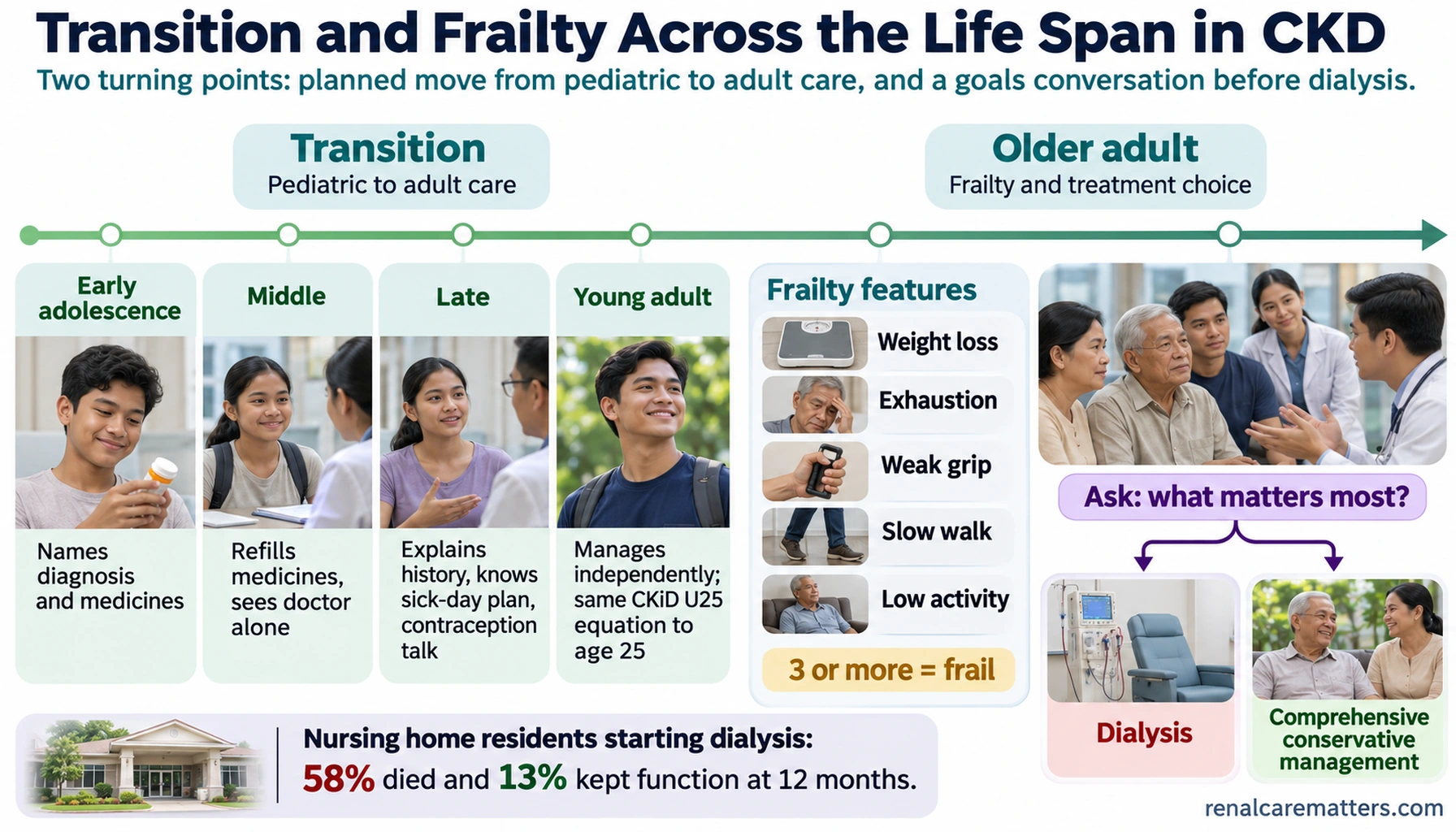
Fried and colleagues defined frailty in 5,317 adults aged 65 and older as three or more of five features: unintentional weight loss, self-reported exhaustion, weak grip, slow walking and low physical activity. Frailty affected 6.9% of these community-dwelling adults and predicted falls, worsening disability, hospital admission and death independently of other illness.3 Frailty is far more common in people with advanced CKD and on dialysis than in the community, and it is what separates the 80-year-old who will do well on dialysis from the one who will not.
Domain of a geriatric assessment
What to check on a renal ward
Why it changes the kidney plan
Function
Walking, bathing, toileting; falls in the past year
Predicts tolerance of dialysis and travel
Cognition and mood
Memory, delirium, depression
Shapes consent and self-care
Nutrition
Weight loss, appetite, teeth
Protein-energy wasting changes prognosis and diet advice
Medicines
Every tablet, including herbal and over-the-counter
Doses by kidney function; falls and bleeding risk
Social support
Who lives with the patient, who brings them to clinic, who pays
Three trips a week to a dialysis unit need a person and a fare
Goals
What matters most: time, comfort, home, family
The basis of the modality choice
Figure 3. Two turning points on one timeline: the planned move from pediatric to adult care, and the goals conversation with a frail older adult before dialysis.
What dialysis does and does not give the frail elder
In 3,702 United States nursing home residents who started dialysis, the median score for dependence in daily activities worsened in the three months after starting. By 12 months, 58% had died and only 13% had kept their pre-dialysis level of function.12 In a single Dutch center, 311 patients aged 70 or older chose either dialysis or conservative management. Overall, median survival was longer with dialysis (3.1 versus 1.5 years from the time of choice), but among patients aged 80 or older the difference was no longer statistically significant (2.1 versus 1.4 years), and it shrank in those with heavy comorbidity.13 Both studies are observational and the groups differed; they do not prove that dialysis causes decline. They show that for some older adults, dialysis adds treatment burden without adding much time.
KDIGO 2024 asks you to inform people with CKD about kidney replacement options and about comprehensive conservative management, and to offer conservative management as a valid choice for people who choose not to pursue kidney replacement therapy (practice points).11 Conservative management is not “doing nothing.” It treats symptoms, anemia, acidosis, fluid and potassium, and plans for the end of life. Module 32 covers the conversation in depth.
In the Philippines the decision is usually a family decision. The eldest child, a sibling working abroad, and the lola herself may hold different views. Ask the patient first, alone if she wishes, what matters most to her. Then hold a family meeting with the attending, and write down what was decided and why.
RememberIn an older adult, measure frailty and ask about goals before you discuss dialysis. Age alone tells you little; frailty and the patient’s own priorities tell you most.
Lesson · part 4
From pediatric to adult care: transition, not transfer
An adolescent with CKD, a kidney transplant or a glomerular disease must move from a pediatric service, where parents managed appointments and medicines, to an adult service, where the young adult is expected to manage alone. The move happens at the age when risk-taking, school and work changes, and the wish to be like everyone else are strongest. Missed doses and missed visits around this time are a well-known cause of lost kidney function and transplant rejection.
The International Society of Nephrology (ISN) and the International Pediatric Nephrology Association (IPNA) published a consensus statement that frames transition as a planned, gradual process rather than a single transfer of records, with shared responsibility between pediatric and adult services.14 It is a consensus, not a graded guideline. In practice it means starting early, teaching skills step by step, and handing over when the young person is ready and clinically stable, not in the middle of a crisis.
Stage
What the young person learns
What the adult team does
Early adolescence
Names the diagnosis and each medicine; answers some questions in clinic
Nothing yet, but the pediatric team mentions that a move will come
Middle adolescence
Refills medicines, books appointments, sees the doctor alone for part of the visit
Shares information about the adult clinic; a joint visit if possible
Late adolescence
Explains the history to a new doctor, knows what to do when sick, understands contraception and pregnancy risks with their medicines
Receives a written summary; a named person meets the young adult at the first visits
Young adulthood
Manages independently, with family support if wanted
Keeps visits frequent in the first year; follows up quickly on any missed visit
The CKiD U25 equation runs to age 25, so the same estimate can follow the young adult across the move and avoid a false jump in eGFR when the adult team switches equations.2
In the Philippines, transition often coincides with leaving home for college in Manila or Cebu, or with a first job. Ask where the patient will live and study, find an adult clinic near there, and check that their medicines and laboratory tests will remain affordable. A young woman on an ACE inhibitor or mycophenolate needs a private conversation about contraception and pregnancy before she leaves pediatric care.
Figure 4 · Transition checklist for the adult team
Before the first visitGet a written summary: diagnosis, biopsy, transplant details, medicines, allergies, recent results.
First visitSee the young adult alone for part of the visit; ask about school, work, relationships and who pays for medicines.
MedicinesConfirm doses and a refill plan the patient can afford; check that the eGFR equation is consistent.
Reproductive healthDiscuss contraception and pregnancy risks with teratogenic or fetotoxic medicines.
Follow-upBook the next visit before they leave; call if they miss it.
RememberTransition is a process that starts years before the transfer. On the adult side, see the young adult alone, keep the same eGFR equation, and act quickly on the first missed visit.
On the floor
Real situations: problems and solutions
These are fictional but typical. For each one, cover the answer, decide what you would do, then compare. Where a step depends on local rules, your unit’s procedure and your supervisor’s direction come first.
The “lupus flare” at 32 weeks
What you see
A 26-year-old woman with lupus nephritis in Iloilo, 32 weeks pregnant, has blood pressure 158/104 mm Hg, rising proteinuria, platelets of 90,000 and raised liver enzymes. The ward team has written for higher-dose steroids for a flare.
What is likely going on
Preeclampsia with severe features is likely, possibly with HELLP; a lupus flare may coexist.
What to do
Call the attending nephrologist and the obstetric team now; check the urine sediment and complement; let the obstetric team lead on delivery.
Why it matters
Treating severe preeclampsia as a flare delays delivery, the treatment that protects the mother.
The 12-year-old on the adult ward
What you see
A 12-year-old girl in a Samar provincial hospital is admitted with nephrotic syndrome to an adult ward because the pediatric ward is full. She weighs 34 kg and her blood pressure was taken with an adult cuff.
What is likely going on
Adult habits are being applied to a child: cuff size, fluids and doses may all be wrong.
What to do
Recheck the pressure with a correctly sized cuff, classify it by AAP percentiles, use pediatric fluid and dose references, and call the pediatric nephrologist by teleconsult if needed.
Why it matters
A cuff that is too small gives falsely high readings, and adult fluids and doses risk harm in a child.
The “normal” creatinine in the frail lola
What you see
An 86-year-old woman in Baguio who weighs 38 kg has a creatinine of 1.1 mg/dL and is about to start a renally cleared antibiotic at the standard adult dose.
What is likely going on
Low muscle mass hides a low GFR; the eGFR probably overestimates her function.
What to do
Note that the estimate likely overestimates function, consider cystatin C if available, and ask the pharmacist and attending to dose for reduced function.
Why it matters
Older adults with low muscle mass are often overdosed when creatinine is read as reassuring.
The college freshman who stopped his tablets
What you see
An 18-year-old with a kidney transplant from Bicol moved to Manila for college. His creatinine has risen, and he admits skipping evening doses because his dormitory mates might see.
What is likely going on
Nonadherence around the transition to independence, with risk of rejection.
What to do
Inform the transplant team today, check drug levels, and talk with him privately about practical ways to take his medicines; link him to an adult clinic near his school.
Why it matters
The years around transfer to adult care are a high-risk period for missed doses and graft loss.
Field notes
Write “pregnant, weeks of gestation: __” at the top of every renal note for a pregnant patient, so no one reads her creatinine against the wrong normal.
Keep a pediatric cuff set and a printed AAP percentile table, or the site’s calculator, on any adult ward that admits children.
Weigh every child before writing fluids or doses, and write the weight on the order.
In an older adult, ask “What matters most to you now?” before you say the word dialysis.
When an adolescent moves to your clinic, book the second visit before the first one ends.
Case review
Back to the case: Ten weeks
Medicines and monitoring now. “Continue home meds” is wrong. Losartan carries fetal risk and should be stopped now, with blood pressure controlled by an agent the obstetrician and attending nephrologist consider safe in pregnancy; the statin is usually stopped too. She should not stop everything, as her mother suggests, because uncontrolled pressure harms both her and the baby. Discuss low-dose aspirin with the obstetrician, since kidney disease places her at high risk of preeclampsia. Agree on a joint plan with the district hospital obstetrician: blood pressure at every visit and at home, urine protein-to-creatinine ratio and creatinine at set intervals, and a clear route back to the renal clinic.
Her risks in numbers. Explain that women with CKD have about ten times the odds of preeclampsia and about six times the odds of premature delivery compared with women without CKD, but that pregnancy has not been shown to speed up CKD on average. Use absolute terms too: in TOCOS, about one in three women with stage 1 CKD and most women with stages 4 to 5 had preterm delivery, neonatal intensive care or a small baby. Her CKD stage, proteinuria above 1 g/g and borderline pressure place her in a middle-risk group. Many women like her have a healthy baby, often delivered early, but the risks are real and need close joint care. Say this to her and her husband first, then with her mother if she wishes.
Preeclampsia or flare at 28 weeks. New blood pressure above 140/90 mm Hg after 20 weeks with doubled proteinuria fits preeclampsia until shown otherwise; it can also coexist with an IgAN flare. Check platelets, liver enzymes, creatinine, and urine sediment. A bland sediment with falling platelets and rising liver enzymes points to preeclampsia; new dysmorphic red cells or red cell casts point to active IgAN. Ask about headache and vision. The obstetric team leads, because the treatment of severe preeclampsia is delivery; the nephrologist advises on blood pressure, kidney function and whether a flare needs treatment after delivery. If her pressure reaches 160/110 mm Hg or she has symptoms, this is an emergency.
Interactive case · fictional
Interactive case: A nine-year-old on the adult ward
Work through a shift one decision at a time. The panel at the top changes with what you choose. After each choice you see why it is, or is not, the best move; after a weaker one you can try again or carry on and see where it leads. Your first choice at each step is scored. The score stays on this device and nothing is sent anywhere. In real practice, your unit’s protocol and the people responsible for each decision come first.
Skills lab · with your preceptor
Skills checklist: Pregnancy, child and older-adult adjustments
Complete with a preceptor across at least two of the three patient groups, on the ward, in clinic or in simulation. Sign-off is local. Your preceptor rates each step as satisfactory, needs practice, or not observed. Steps marked Critical must all be satisfactory before sign-off. This checklist supports supervised learning; your unit’s own procedure and competency form are the authority. A printable version of every checklist is on the trainer page.
States the ACOG definition of preeclampsia and its severe features, and lists the findings that separate it from active glomerular disease.
Reviews a pregnant woman’s medicine list and identifies fetotoxic or teratogenic drugs for discussion with the obstetrician.
Measures a child’s blood pressure with a correctly sized cuff and classifies it by AAP 2017 percentiles or adolescent cut points.
Calculates a pediatric eGFR with the CKiD U25 equation and explains why adult equations do not apply.
Completes a frailty screen and a goals conversation with an older adult with advanced CKD before dialysis is discussed.
Writes a transition summary for an adolescent moving to adult care.
Each visit draws 5 questions at random from this module’s 5-question bank. Choose the single best answer for each, then select Check answers; an explanation appears under the best answer. Select New set of questions for a different mix. A good target is 4 of 5 on two different sets. Nothing you select is sent anywhere; scoring happens in your browser.
Pierce, C. B., Muñoz, A., Ng, D. K., Warady, B. A., Furth, S. L., & Schwartz, G. J. (2021). Age- and sex-dependent clinical equations to estimate glomerular filtration rates in children and young adults with chronic kidney disease. Kidney International, 99(4), 948–956. https://doi.org/10.1016/j.kint.2020.10.047
Fried, L. P., Tangen, C. M., Walston, J., Newman, A. B., Hirsch, C., Gottdiener, J., Seeman, T., Tracy, R., Kop, W. J., Burke, G., McBurnie, M. A., & Cardiovascular Health Study Collaborative Research Group. (2001). Frailty in older adults: Evidence for a phenotype. The Journals of Gerontology, Series A: Biological Sciences and Medical Sciences, 56(3), M146–M156. https://doi.org/10.1093/gerona/56.3.m146
American College of Obstetricians and Gynecologists. (2020). Gestational hypertension and preeclampsia: ACOG Practice Bulletin, number 222. Obstetrics and Gynecology, 135(6), e237–e260. https://doi.org/10.1097/AOG.0000000000003891
Zhang, J.-J., Ma, X.-X., Hao, L., Liu, L.-J., Lv, J.-C., & Zhang, H. (2015). A systematic review and meta-analysis of outcomes of pregnancy in CKD and CKD outcomes in pregnancy. Clinical Journal of the American Society of Nephrology, 10(11), 1964–1978. https://doi.org/10.2215/CJN.09250914
Piccoli, G. B., Cabiddu, G., Attini, R., Vigotti, F. N., Maxia, S., Lepori, N., Tuveri, M., Massidda, M., Marchi, C., Mura, S., Coscia, A., Biolcati, M., Gaglioti, P., Nichelatti, M., Pibiri, L., Chessa, G., Pani, A., & Todros, T. (2015). Risk of adverse pregnancy outcomes in women with CKD. Journal of the American Society of Nephrology, 26(8), 2011–2022. https://doi.org/10.1681/ASN.2014050459
Hladunewich, M. A., Hou, S., Odutayo, A., Cornelis, T., Pierratos, A., Goldstein, M., Tennankore, K., Keunen, J., Hui, D., & Chan, C. T. (2014). Intensive hemodialysis associates with improved pregnancy outcomes: A Canadian and United States cohort comparison. Journal of the American Society of Nephrology, 25(5), 1103–1109. https://doi.org/10.1681/ASN.2013080825
Kidney Disease: Improving Global Outcomes (KDIGO) Blood Pressure Work Group. (2021). KDIGO 2021 clinical practice guideline for the management of blood pressure in chronic kidney disease. Kidney International, 99(3S), S1–S87. https://doi.org/10.1016/j.kint.2020.11.003
Flynn, J. T., Kaelber, D. C., Baker-Smith, C. M., Blowey, D., Carroll, A. E., Daniels, S. R., de Ferranti, S. D., Dionne, J. M., Falkner, B., Flinn, S. K., Gidding, S. S., Goodwin, C., Leu, M. G., Powers, M. E., Rea, C., Samuels, J., Simasek, M., Thaker, V. V., Urbina, E. M., & Subcommittee on Screening and Management of High Blood Pressure in Children. (2017). Clinical practice guideline for screening and management of high blood pressure in children and adolescents. Pediatrics, 140(3), e20171904. https://doi.org/10.1542/peds.2017-1904
Feld, L. G., Neuspiel, D. R., Foster, B. A., Leu, M. G., Garber, M. D., Austin, K., Basu, R. K., Conway, E. E., Fehr, J. J., Hawkins, C., Kaplan, R. L., Rowe, E. V., Waseem, M., Moritz, M. L., & Subcommittee on Fluid and Electrolyte Therapy. (2018). Clinical practice guideline: Maintenance intravenous fluids in children. Pediatrics, 142(6), e20183083. https://doi.org/10.1542/peds.2018-3083
Kidney Disease: Improving Global Outcomes (KDIGO) CKD Work Group. (2024). KDIGO 2024 clinical practice guideline for the evaluation and management of chronic kidney disease. Kidney International, 105(4S), S117–S314. https://doi.org/10.1016/j.kint.2023.10.018
Kurella Tamura, M., Covinsky, K. E., Chertow, G. M., Yaffe, K., Landefeld, C. S., & McCulloch, C. E. (2009). Functional status of elderly adults before and after initiation of dialysis. The New England Journal of Medicine, 361(16), 1539–1547. https://doi.org/10.1056/NEJMoa0904655
Verberne, W. R., Geers, A. B. M. T., Jellema, W. T., Vincent, H. H., van Delden, J. J. M., & Bos, W. J. W. (2016). Comparative survival among older adults with advanced kidney disease managed conservatively versus with dialysis. Clinical Journal of the American Society of Nephrology, 11(4), 633–640. https://doi.org/10.2215/CJN.07510715
Watson, A. R., Harden, P. N., Ferris, M. E., Kerr, P. G., Mahan, J. D., Ramzy, M. F., International Society of Nephrology, & International Pediatric Nephrology Association. (2011). Transition from pediatric to adult renal services: A consensus statement by the International Society of Nephrology (ISN) and the International Pediatric Nephrology Association (IPNA). Kidney International, 80(7), 704–707. https://doi.org/10.1038/ki.2011.209
Educational self-study for physicians in training. Clinical tasks need your institution’s authorization and supervision. Completing this track is an Academy learning record only. It does not confer licensure, specialist status, PSN or PNSP membership or board eligibility, procedural privileges, CPD units, or completion of an institutional training program, and it does not replace current guidelines, regulations, your institution’s protocols and formulary, or your supervisor.