Separate iron deficiency, inflammation and erythropoietin deficiency as drivers of anemia.
PublishedNailathalaGipatikPepalwal:ReferencesMga SanggunianMga TinubdanReng Reperensya:4Audience: Practicing nephrologists · senior nephrology fellows · internists who share longitudinal kidney care in the clinic, ward, ICU, dialysis unit, and homeRead timeOras ng pagbasaOras sa pagbasaOras ning pamamasa:
Training track for attending nephrologists in adult practice
This module is study material for attending nephrologists and senior fellows in adult practice. It explains the reasoning behind common decisions; it is not a protocol. Doses and thresholds must be checked against current product labels, guidelines, and your institution’s approved protocols. Regulatory and benefit rules change: confirm them on the date of service. Every case is fictional.
Learning objectives
After this module you should be able to
Separate iron deficiency, inflammation and erythropoietin deficiency as drivers of anemia.
Apply the Kidney Disease: Improving Global Outcomes (KDIGO) 2026 anemia guideline to iron, erythropoiesis-stimulating agent (ESA) and hypoxia-inducible factor (HIF) prolyl hydroxylase inhibitor (HIF-PHI) decisions.
Interpret chronic kidney disease–mineral and bone disorder (CKD-MBD), acidosis and symptoms as trends within one plan.
Pre-testBefore you read, answer the 5 self-assessment questions and note your score. After the module, select New set of questions and compare. The difference is what you learned; the questions you still miss are what to reread.
Start here
The big picture, in plain words
Your duty · Section 1.2, 2024 hemodialysis guidelinesUnder the Philippine Society of Nephrology (PSN) guidelines: Plan long-term care with the patient (b9). The physician on duty coordinates new laboratory results with you; acting on them is yours.
In plain wordsThe failing kidney sends three wrong signals at once: too little erythropoietin, too much hepcidin-driven iron lockdown, and broken mineral control. Treating one number without asking which signal produced it is how patients end up on high-dose ESA (erythropoiesis-stimulating agent) while iron-starved.
On your monthly visit to the dialysis center, the head nurse flags Mr. Fajardo, 71, one of your patients, who has been on hemodialysis for two years. He spent last week in hospital with pneumonia. His hemoglobin is 8.9 g/dL, down from 10.5. Ferritin is 780 ng/mL, transferrin saturation 14%, and his C-reactive protein is high.
The unit’s standing order, which covers every attending nephrologist’s patients, calls for 100 mg of intravenous iron every session when transferrin saturation is below 20%, and the nurse has an ampoule ready. The physician on duty suggests doubling his erythropoietin dose. Mr. Fajardo tells you he is tired and has barely eaten since he was discharged.
Before reading on, decide:
Is he iron deficient?
Should the nurse give the iron today, and should the erythropoietin be doubled?
What else needs checking before you call this the anemia of kidney disease?
Keep your answers in mind. The lesson gives you what you need, and the case review near the end shows one sound response.
Lesson · part 1
How it works
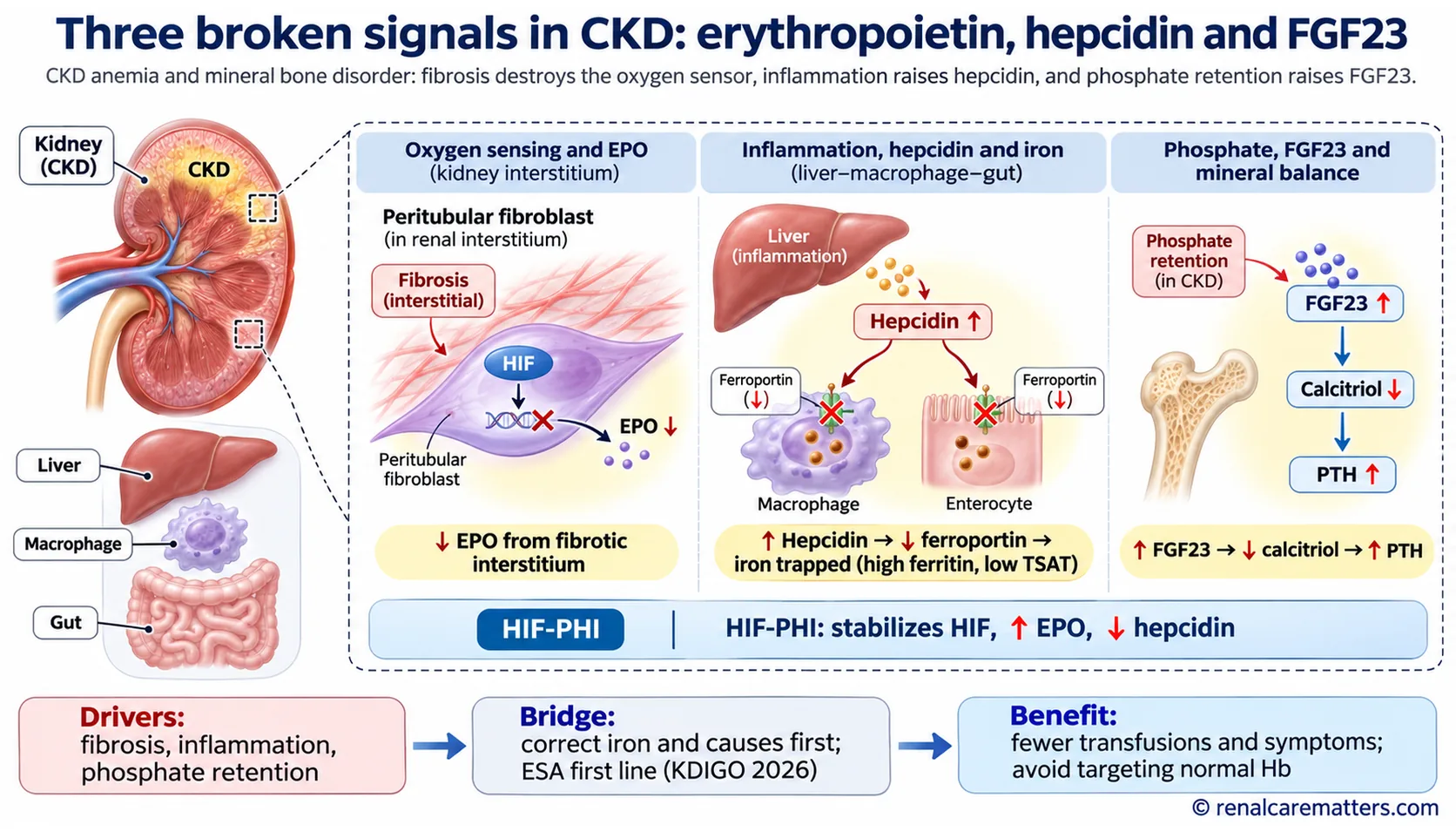
Peritubular fibroblasts make erythropoietin in response to hypoxia via HIF (hypoxia-inducible factor). Fibrosis destroys this sensor. Inflammation and reduced clearance raise hepcidin, which degrades ferroportin and traps iron in macrophages and enterocytes. Ferritin rises as an acute-phase protein while TSAT (transferrin saturation) falls: functional iron deficiency. HIF-PHIs (hypoxia-inducible factor prolyl hydroxylase inhibitors) stabilize HIF, raising endogenous erythropoietin and lowering hepcidin. In mineral metabolism, falling phosphate excretion raises FGF23 (fibroblast growth factor 23), which suppresses calcitriol. Low calcitriol and later hyperphosphatemia drive parathyroid hormone up. Metabolic acidosis from reduced ammonium excretion breaks down muscle and bone.
At the monthly anemia review · fictional
Nurse Cabral lists six of your patients whose erythropoietin doses have doubled in three months. Four of them have a transferrin saturation below 20% with a ferritin above 500 ng/mL. Three had infections.
You explain the lock. Inflammation raises hepcidin, hepcidin closes the iron exit from cells, and the marrow starves while the stores look full. Higher erythropoietin doses cannot make red cells without available iron.
What this shows. Ferritin is an acute-phase protein. Read it with transferrin saturation and C-reactive protein.
Figure 2. The kidney, liver and gut showing why CKD causes anemia, iron lockdown and mineral imbalance.
Lesson · part 2
What the evidence shows
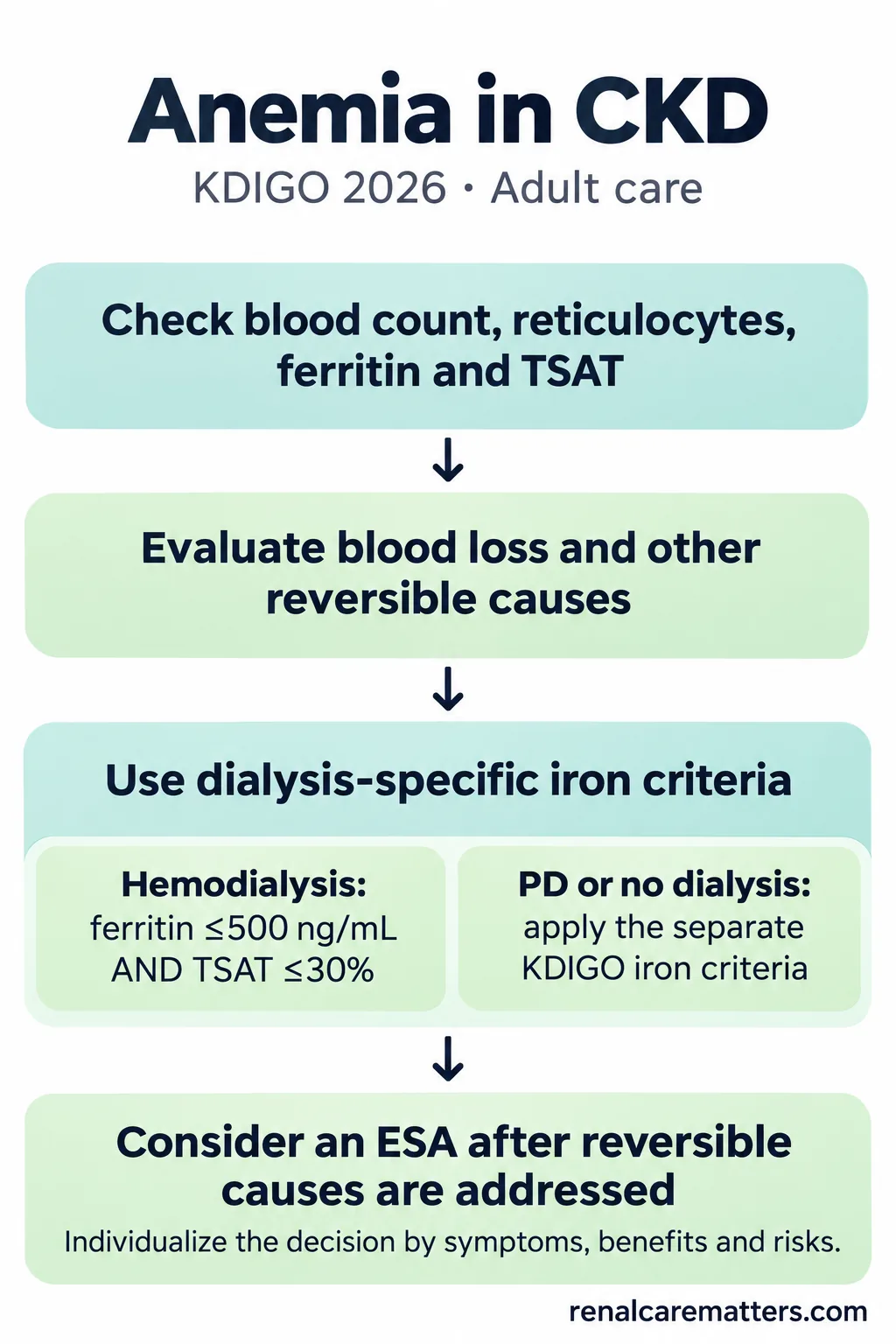
KDIGO 2026 anemia (Kidney Int 2026, evidence through October 2024) favors individualized decisions over fixed targets. It defines anemia as hemoglobin <13 g/dL in men and <12 g/dL in women. It screens with complete blood count, reticulocytes, ferritin and TSAT, treats severe iron deficiency (ferritin <45 ng/mL) and prefers intravenous (IV) iron in HD. It suggests ESAs rather than HIF-PHIs as first-line therapy, citing uncertainty about the long-term cardiovascular and thrombotic safety of HIF-PHIs. It suggests considering an ESA in non-dialysis CKD generally at hemoglobin ≤8.5–10 g/dL based on symptoms, and at ≤9–10 g/dL in HD. HIF-PHIs should not be used with active malignancy or a recent cardiovascular or thrombotic event. They remain an option for patients who prefer an oral agent, cannot tolerate ESAs or lack refrigeration. Earlier trials (CHOIR, TREAT) showed harm when hemoglobin was targeted to normal. PIVOTAL (2019) supported proactive IV iron in HD. KDIGO 2024 suggests considering alkali therapy when bicarbonate is below 18 mmol/L.
For anemia, check for blood loss, B12, folate and hemolysis. Interpret ferritin with TSAT and CRP (C-reactive protein), and suspend IV iron during active infection. Use IV iron in HD and oral or IV iron in non-dialysis CKD according to preference and response. Start an ESA at the lowest effective dose and monitor hemoglobin every 2–4 weeks after changes. For CKD-MBD, follow calcium, phosphate, parathyroid hormone (PTH) and alkaline phosphatase trends. Lower phosphate toward normal with diet and binders, avoid hypercalcemia and treat progressive PTH rise. Screen for pruritus, sleep disturbance, frailty and poor intake, and involve the renal dietitian at each review.
Figure 3. Anemia in CKD (KDIGO 2026). Treatment pathway for anemia in kidney disease based on the 2026 KDIGO guideline.
On your monthly visit, the binder taken at the wrong time · fictional
Mrs. Garcia’s phosphate stays high despite three binder tablets a day. You ask when she takes them. “Before breakfast, all three, so I don’t forget.”
A binder works only when it meets the phosphate in food. You ask her to take one with each meal, and you ask the dietitian to review her processed-food intake.
What this shows. Before adding a drug, check how the current one is being taken.
Stop and call
Falling hemoglobin with positive stool occult blood
Ferritin very high with low TSAT during infection (hold IV iron)
Hypercalcemia on calcitriol or calcium-based binders
Calciphylaxis (painful violaceous skin lesions)
On the floor
Real situations: problems and solutions
These are fictional but typical. For each one, cover the answer, decide what you would do, then compare. Where a step depends on local rules, your unit’s procedure and your supervisor’s direction come first.
Erythropoietin keeps going up
What you see
A patient’s erythropoietin dose has tripled over six months while his hemoglobin has stayed at 9 g/dL.
What is likely going on
Something is blocking the response: iron deficiency, inflammation, blood loss, or underdialysis.
What to do
Check iron indices with C-reactive protein, look for bleeding and infection, and review his dialysis adequacy before increasing the dose again.
Why it matters
High doses chasing a target have been associated with harm in trials.
Phosphate 2.5 mmol/L and a new binder
What you see
A patient’s phosphate is high despite binders. She takes them before meals.
What is likely going on
Binders work only when they meet the phosphate in food.
What to do
Teach her to take the binder with meals, and ask the dietitian to review her diet, including processed foods.
Why it matters
Timing is often the cheapest fix.
A painful dark patch on the thigh
What you see
A patient on dialysis has a painful purple skin lesion with a dark center.
What is likely going on
This may be calciphylaxis.
What to do
Refer urgently, stop calcium-based binders and active vitamin D if calcium is high, and review her dialysis.
Why it matters
Calciphylaxis is rare but often fatal, and early recognition matters.
Field notes
Read ferritin together with TSAT and C-reactive protein.
Hold intravenous iron during active infection.
Ask the dietitian to see every patient at each quarterly review.
Watch calcium when using calcium binders or calcitriol.
Case review
Back to the case: Hemoglobin 8.9 after pneumonia
Is he iron deficient? Not in the way the order assumes. A high ferritin with a low transferrin saturation during an infection means hepcidin is locking iron inside his cells. His stores are not full, but iron given now cannot reach his bone marrow.
Today’s iron, and the erythropoietin. Hold the intravenous iron while the infection is active, and write the reason in the order so the next shift does not give it. Do not double the erythropoietin on one value taken during an illness. Inflammation blunts the response, and chasing hemoglobin with high doses is how patients end up on large doses while their iron is unavailable. Recheck hemoglobin and iron indices in four to six weeks, after the infection has settled.
What else. Look for blood loss: ask about black stools, check stool occult blood, and look for bleeding from the access. Check B12 and folate. Ask the renal dietitian to see him this week, because poor intake after an admission makes everything worse. Then raise the standing order with the clinical head, because it covers every attending’s patients, not only yours. A rule that runs on transferrin saturation alone, with no ferritin, no CRP, and no stop for infection, will do this again to the next patient.
Skills lab · with your preceptor
Skills checklist: Skills checklist
Complete with a preceptor, in simulation or at your own unit. Sign-off is local. Your preceptor rates each step as satisfactory, needs practice, or not observed. Steps marked Critical must all be satisfactory before sign-off. This checklist supports supervised learning; your unit’s own procedure and competency form are the authority. A printable version of every checklist is on the trainer page.
Interprets anemia data with inflammation in context
Interprets serial mineral labs together
Documents symptom and nutrition goals
Placement activity. Simulation or supervised practice
Self-assessment
Check your understanding
Each visit draws 5 questions at random from this module’s 5-question bank. Choose the single best answer for each, then select Check answers; an explanation appears under the best answer. Select New set of questions for a different mix. A good target is 4 of 5 on two different sets. Nothing you select is sent anywhere; scoring happens in your browser.
Kidney Disease: Improving Global Outcomes (KDIGO) CKD Work Group (2024). KDIGO 2024 clinical practice guideline for the evaluation and management of chronic kidney disease. Kidney International, 105(4S), S117–S314. https://doi.org/10.1016/j.kint.2023.10.018
Babitt, J. L., Berns, J. S., Bozkurt, B., Cheung Khedairy, R. S., Cuevas, Y., Effa, E. E., Eisenga, M. F., Fishbane, S., Ginzburg, Y. Z., Haase, V. H., Hedayati, S. S., Kim, S., Moura-Neto, J. A., Nagler, E. V., Rossignol, P., Sahay, M., Tanaka, T., Yee-Moon Wang, A., Wheeler, D. C., ... Tonelli, M. (2026). Executive summary of the KDIGO 2026 clinical practice guideline for the management of anemia in chronic kidney disease (CKD). Kidney International, 109(1), 44–56. https://doi.org/10.1016/j.kint.2025.06.005
Pfeffer, M. A., Burdmann, E. A., Chen, C. Y., Cooper, M. E., de Zeeuw, D., Eckardt, K. U., Feyzi, J. M., Ivanovich, P., Kewalramani, R., Levey, A. S., Lewis, E. F., McGill, J. B., McMurray, J. J., Parfrey, P., Parving, H. H., Remuzzi, G., Singh, A. K., Solomon, S. D., Toto, R., & TREAT Investigators (2009). A trial of darbepoetin alfa in type 2 diabetes and chronic kidney disease. The New England Journal of Medicine, 361(21), 2019–2032. https://doi.org/10.1056/NEJMoa0907845
Macdougall, I. C., White, C., Anker, S. D., Bhandari, S., Farrington, K., Kalra, P. A., McMurray, J. J. V., Murray, H., Tomson, C. R. V., Wheeler, D. C., Winearls, C. G., Ford, I., & PIVOTAL Investigators and Committees (2019). Intravenous iron in patients undergoing maintenance hemodialysis. The New England Journal of Medicine, 380(5), 447–458. https://doi.org/10.1056/NEJMoa1810742
Educational material for physicians. Completing it is an Academy learning record only. It does not confer CPD units, PSN certification, privileges, or PhilHealth accreditation, and it does not replace current guidelines, regulations, your institution’s protocols, or clinical judgment.