Name the primary disorder, check compensation and gaps, and find the cause in DKA, toxic alcohols and RTA.
PublishedNailathalaGipatikPepalwal:ReferencesMga SanggunianMga TinubdanReng Reperensya:11Audience: Adult and pediatric nephrology fellows · internal medicine and pediatric residents · medical interns on medicine, pediatrics, ICU and dialysis rotations, and residents who work shifts as dialysis physicians on dutyRead timeOras ng pagbasaOras sa pagbasaOras ning pamamasa:
Training track for nephrology fellows, residents and medical interns
Study material for medical interns, residents and fellows. It explains the reasoning behind common decisions; it is not a protocol and gives no drug doses. Doses, rates and order sets come from current guidelines, product labels, your institution’s approved protocols and your supervising physician. Benefit rules change: confirm them on the date of service. Every case is fictional.
Learning objectives
After this module you should be able to
Intern: Read the pH, the partial pressure of carbon dioxide (PaCO₂) and the bicarbonate on a blood gas, name the primary disorder, and report a pH below 7.2 or a rising anion gap at once.
Resident: Check compensation, calculate the albumin-corrected anion gap, the osmolal gap and, where useful, the urine anion gap, and use them to find the cause.
Fellow: Teach the bicarbonate-centered and Stewart approaches, untangle mixed disorders, and manage toxic alcohol poisoning, diabetic ketoacidosis (DKA) and severe acidemia, including the decision to dialyze.
Pre-testBefore you read, answer the 5 self-assessment questions and note your score. After the module, select New set of questions and compare. The difference is what you learned; the questions you still miss are what to reread.
Start here
The big picture, in plain words
Your role · three numbers and a storyA blood gas is three numbers that only make sense with a story. The intern owns the first read: acidemia or alkalemia, metabolic or respiratory, and a call when the pH is dangerous. The resident owns the arithmetic: compensation, the gaps, and a differential that fits them. The fellow owns the hard cases: the mixed disorder hiding behind a near-normal pH, the poisoning that needs dialysis tonight, and the teaching that makes the next intern faster.
In plain wordsThink of bicarbonate as the money in a household’s emergency fund. Every day, acids from food and metabolism withdraw from it. The lungs act like a fast teller who can rebalance the account within minutes by blowing off carbon dioxide. The kidneys are the slow but steady earner who rebuilds the fund over days.
The picture has a limit. A bank account holds a fixed sum, but the bicarbonate buffer is an open system. Carbon dioxide and bicarbonate are linked through carbonic acid, and the pH depends on their ratio, not on either alone, as the Henderson–Hasselbalch equation states. Because the lungs can change carbon dioxide in minutes, the system buffers far more acid than its concentration suggests. The kidneys do more than save: they reclaim all the filtered bicarbonate in the proximal tubule, and they generate new bicarbonate in the distal nephron by excreting acid as ammonium and as titratable acid such as phosphate. When kidney function falls, ammonium excretion falls first, and a chronic metabolic acidosis appears.1
The Stewart approach describes the same chemistry differently. It treats the pH as set by three independent variables: the strong ion difference (mainly sodium minus chloride), the total weak acids (mainly albumin and phosphate) and the PaCO₂. A chloride load from saline lowers the strong ion difference and causes acidosis; a low albumin removes weak acid and pushes toward alkalosis. The two approaches give the same diagnosis when used carefully; the Stewart frame is most useful when albumin and chloride are both abnormal, as in the intensive care unit (ICU).
Figure 1 · Key numbers
Expected PaCO₂ in metabolic acidosis (Albert, Dell and Winters 1967)1.5 × bicarbonate + 8 (±2) mm Hg
Albumin correction (Figge 1998)Each 1 g/dL fall in albumin lowers the anion gap by about 2.5 mmol/L
Methanol, EXTRIP 2015Extracorporeal treatment for severe poisoning, including coma, seizures, new vision deficits, pH ≤7.15, persistent acidosis or anion gap above 24 mmol/L (consensus)
DKA, 2024 consensusGlucose ≥200 mg/dL or known diabetes; beta-hydroxybutyrate ≥3.0 mmol/L or urine ketones ≥2+; pH below 7.3 and/or bicarbonate below 18 mmol/L
BICAR-ICU, 389 patientsPrimary outcome 71% control versus 66% bicarbonate (not significant)
Most blood gases on a medical service tell a simple story: sepsis with lactate, vomiting with alkalosis, chronic kidney disease (CKD) with a low bicarbonate. A few hide two or three disorders at once, and a few are poisonings in which the hours before dialysis decide whether the patient sees again. Your work is to read every gas in the same order, to let the gaps point to the cause, and to recognize the patients who need the attending and a dialysis machine tonight.
Opening case · fictional
Case: The drinking session in Rizal, Laguna
Sunday, 9 p.m., the emergency room of a provincial hospital in Laguna. Three men arrive together from a birthday celebration the night before in the town of Rizal, where they shared bottles of lambanog bought from a neighborhood store. All three have headache, abdominal pain and vomiting. Two say their vision is blurred, “like looking through fog.”
The sickest is Mr. Romeo Dimaculangan, 44, breathing deep and fast at 32 per minute. His arterial gas shows pH 7.08, PaCO₂ 18 mm Hg and bicarbonate 5 mmol/L. His sodium is 138 mmol/L, chloride 100 mmol/L, potassium 5.0 mmol/L, glucose 110 mg/dL, blood urea nitrogen 14 mg/dL, creatinine 1.4 mg/dL and albumin 4.0 g/dL. Measured serum osmolality is 330 mOsm/kg. Blood ethanol is not detected. The second man, Mr. Jun Robles, has a bicarbonate of 14 mmol/L and blurred vision. The third, Mr. Nestor Cuevas, kept drinking beer this morning; he is drowsy, smells of alcohol, and his bicarbonate is 21 mmol/L.
The intern, Dr. Paulo Garcia, hands the gases to the internal medicine resident, Dr. Lianne Sarmiento. The nephrology fellow, Dr. Mark Bautista, is called.
Before reading on, decide:
What is Mr. Dimaculangan’s primary disorder, and is his breathing compensating as expected?
What do the anion gap and the osmolal gap tell you, and why is Mr. Cuevas less acidotic?
What does the fellow arrange tonight, and how should three patients share one dialysis machine?
Keep your answers in mind. The lesson gives you what you need, and the case review near the end shows one sound response.
Lesson · part 1
Buffers, lungs and kidneys: the physiology behind the numbers
Each day, metabolism produces carbon dioxide in large amounts and a much smaller load of nonvolatile acid from protein and other sources. The carbon dioxide leaves through the lungs. The nonvolatile acid is first buffered, mostly by bicarbonate, and then excreted by the kidneys, which regenerate the bicarbonate used. Three lines of defense act on three time scales.
Defense
Speed
How it works
What failure looks like
Chemical buffers (bicarbonate, proteins, phosphate, bone)
Seconds
Bind hydrogen ions
A falling bicarbonate as the buffer is used up
Lungs
Minutes to hours
Change ventilation to change PaCO₂
Respiratory acidosis when the patient tires or is sedated; Kussmaul breathing in metabolic acidosis
Kidneys
Hours to days
Reclaim filtered bicarbonate; make new bicarbonate by excreting ammonium and titratable acid
Chronic metabolic acidosis in CKD and renal tubular acidosis
Compensation always moves the second variable in the same direction as the first. In metabolic acidosis the bicarbonate falls, so ventilation increases and the PaCO₂ falls too. Compensation reduces the change in pH but rarely returns it fully to normal. A normal pH with an abnormal bicarbonate and PaCO₂ should make you suspect two opposing disorders, not perfect compensation.1
A venous blood gas gives a pH and bicarbonate close enough to arterial values for most metabolic questions, but not an oxygen value and not a reliable PaCO₂ in shock. Many Philippine emergency rooms have a blood gas machine; many provincial hospitals send the sample to a laboratory with a delay. When the gas is delayed, the electrolyte panel already gives you the bicarbonate and the anion gap.
RememberCompensation moves in the same direction and never quite reaches normal. A normal pH with abnormal parts means two disorders until proven otherwise.
Lesson · part 2
A stepwise reading you can do at 3 a.m.
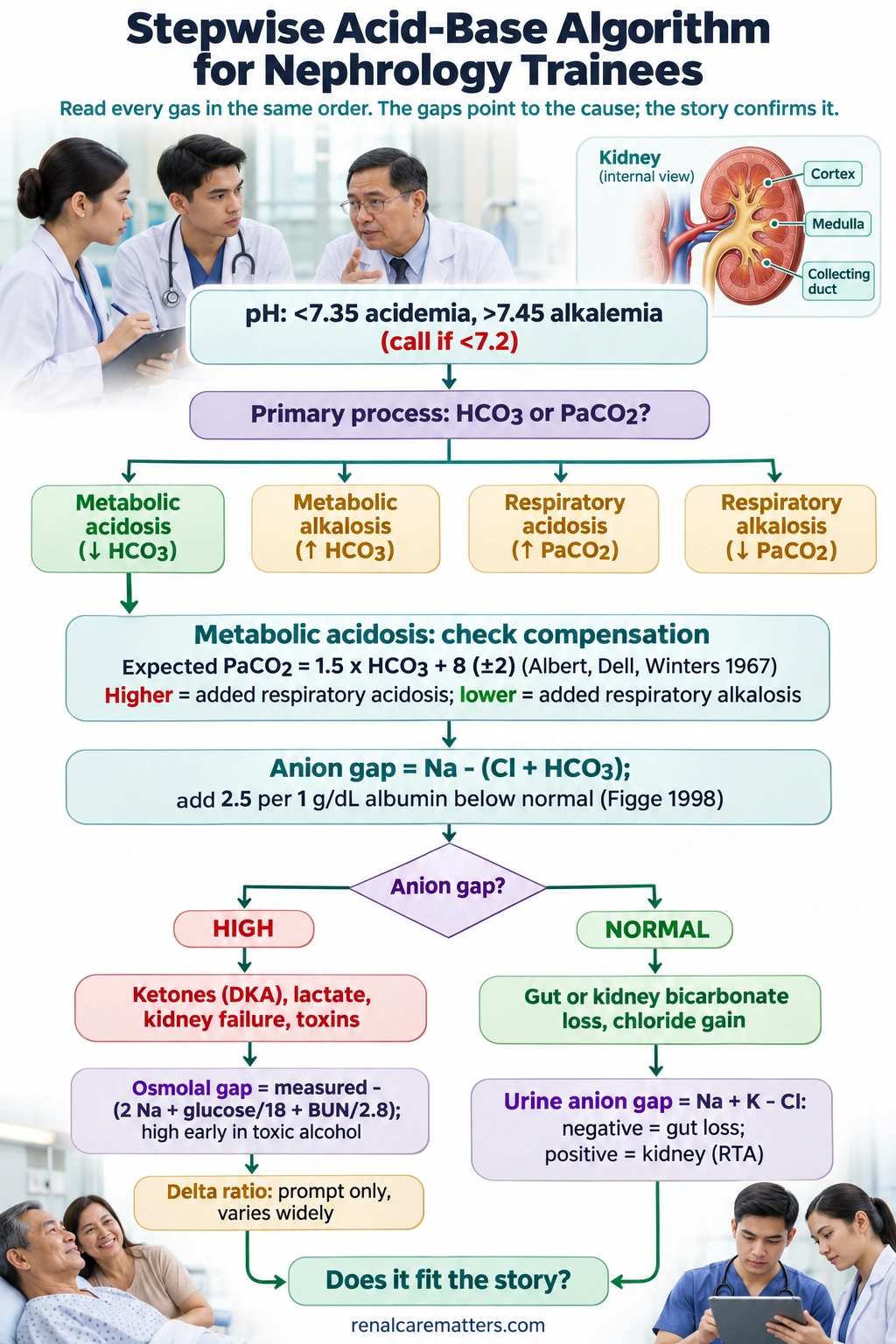
Read every gas in the same order. The order protects you from anchoring on the first abnormal number.
Figure 2 · Reading a blood gas
1. The pHBelow 7.35 is acidemia; above 7.45 is alkalemia. A pH below 7.2 needs a call now.
2. The primary processIn acidemia, a low bicarbonate means metabolic acidosis and a high PaCO₂ means respiratory acidosis. In alkalemia, a high bicarbonate means metabolic alkalosis and a low PaCO₂ means respiratory alkalosis.
3. CompensationFor metabolic acidosis, compare the PaCO₂ with 1.5 × bicarbonate + 8 (±2). Higher than expected means a respiratory acidosis as well; lower means a respiratory alkalosis as well. Use the site’s calculators for the other disorders.
4. The anion gapSodium minus (chloride plus bicarbonate), corrected for albumin. Always calculate it, even when the pH looks normal.
5. If the gap is highCompare the rise in the gap with the fall in bicarbonate, and calculate the osmolal gap if a toxic alcohol is possible.
6. If the gap is normalThink of bicarbonate loss from the gut or kidney, or chloride gain; the urine anion gap helps separate them.
7. The storyDoes the diagnosis fit the history, the medicines and the examination? If not, read again.
The compensation formula for metabolic acidosis comes from Albert, Dell and Winters, who derived it in 1967 from patients with metabolic acidosis: expected PaCO₂ = 1.5 × bicarbonate + 8, ±2 mm Hg.2 It applies to a steady state; for an hour or two after a sudden acid load, ventilation may not have caught up.
Arithmetic illustration, not a target. Bicarbonate 12 mmol/L: expected PaCO₂ = 1.5 × 12 + 8 = 26 mm Hg (range 24 to 28). Measured PaCO₂ 34 mm Hg: higher than expected, so a respiratory acidosis is present as well, for example a tiring patient or sedation. Measured PaCO₂ 18 mm Hg: lower than expected, so a respiratory alkalosis is present as well, for example sepsis or salicylate poisoning.
Primary disorder
Common causes on a Philippine medical service
A clue at the bedside
Metabolic acidosis
Sepsis, diarrhea, DKA, acute kidney injury (AKI) and CKD, toxic alcohols, leptospirosis with AKI
Low chloride, low potassium, a history of vomiting or diuretics
Respiratory acidosis
Chronic obstructive lung disease, sedation, neuromuscular weakness, a tiring patient
Drowsiness, shallow breathing
Respiratory alkalosis
Sepsis, liver disease, pregnancy, anxiety, early salicylate poisoning
Fast breathing with a high pH
Stage
What you own in reading a gas
Intern
Steps 1 and 2 on every gas; report a pH below 7.2, a bicarbonate below 10 mmol/L or a rising anion gap at once
Resident
Steps 3 to 7; write the full interpretation in the note with the gaps and the differential
Fellow
Mixed and triple disorders; teach both approaches; decide with the attending when acidemia needs dialysis
RememberRead every gas in the same seven steps. Calculate the anion gap every time, because a normal pH can hide a high-gap acidosis and an alkalosis together.
Lesson · part 3
The gaps: anion, osmolal and urine
The anion gap
Blood is electrically neutral. The anion gap, sodium minus the sum of chloride and bicarbonate, reflects anions that are not measured, chiefly albumin. When an acid such as lactic acid, ketoacid or formic acid accumulates, its hydrogen ion consumes bicarbonate and its anion stays behind, so the gap rises. When bicarbonate is lost from the gut or kidney, chloride replaces it and the gap stays normal.
The normal range varies widely between laboratories and methods, so know your own laboratory’s range.3 Albumin carries most of the normal gap. Figge and colleagues studied 152 critically ill patients and found that each 1 g/L fall in albumin lowered the observed gap by 0.25 mmol/L, which is 2.5 mmol/L for each 1 g/dL.4 In a patient with an albumin of 2.0 g/dL, a “normal” gap of 12 mmol/L may hide an acidosis.
Arithmetic illustration, not a target. Anion gap = sodium − (chloride + bicarbonate). Albumin-corrected gap = measured gap + 2.5 × (normal albumin − measured albumin, in g/dL). Sodium 136, chloride 104, bicarbonate 18, albumin 2.0 g/dL (normal taken as 4.0): measured gap 14; corrected gap 14 + 2.5 × 2 = 19 mmol/L.
The delta ratio compares the rise in the gap with the fall in bicarbonate, to look for a second metabolic disorder: a fall in bicarbonate much larger than the rise in the gap suggests an added normal-gap acidosis; a much smaller fall suggests an added metabolic alkalosis. Kraut and Madias caution that the ratio varies considerably within high-gap acidosis, so it should not be used alone to diagnose a mixed disorder.3 Use it as a prompt to look harder, not as a verdict.
The osmolal gap
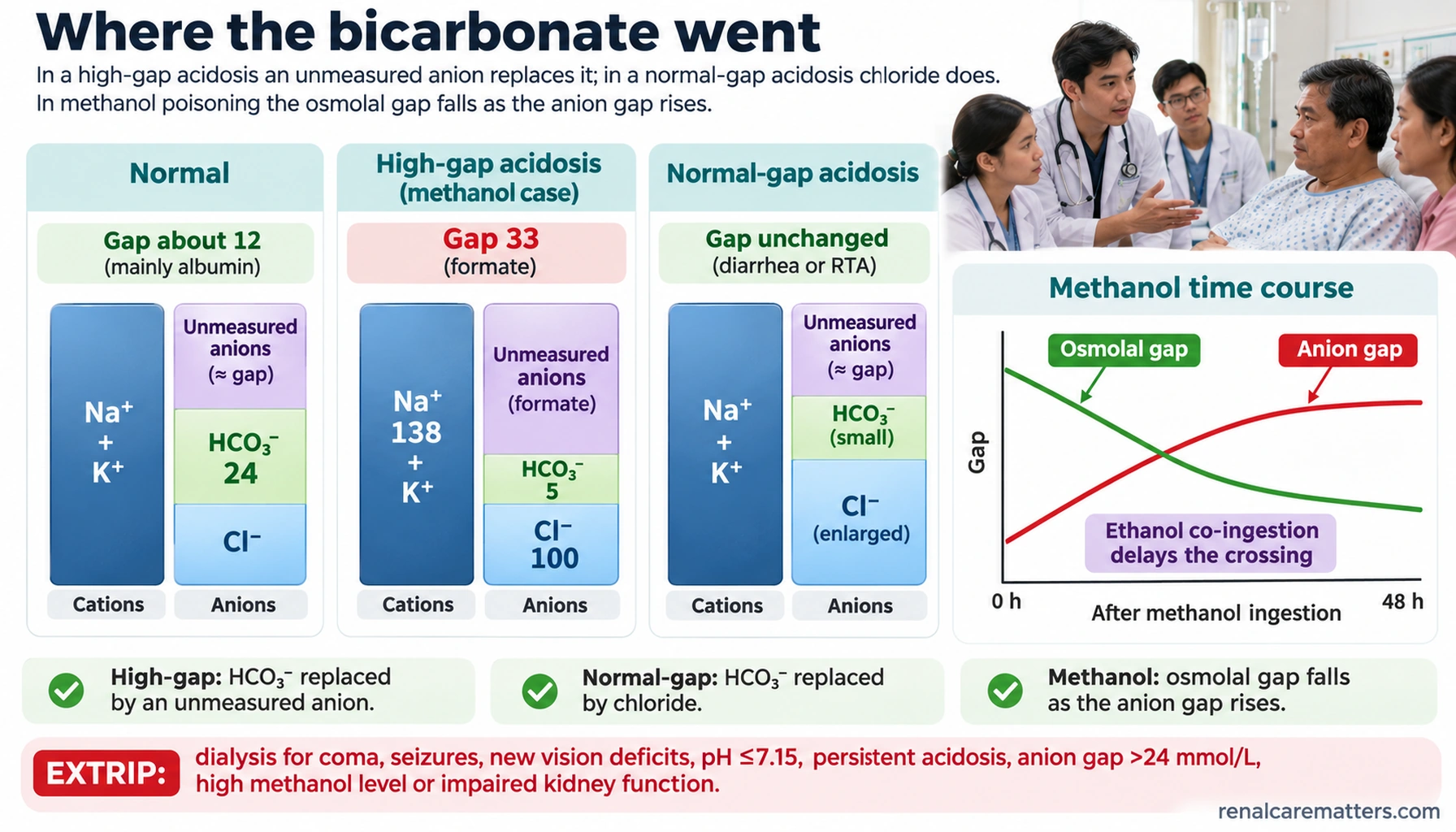
Methanol, ethylene glycol and other alcohols are small, osmotically active molecules that are not counted in the calculated osmolality. The osmolal gap, measured minus calculated osmolality, rises when they are present, before they are metabolized. As the parent alcohol is converted to toxic acids, the osmolal gap falls and the anion gap rises. A patient seen late may have a normal osmolal gap and a very high anion gap; a patient seen early may have the reverse.5 A normal osmolal gap therefore does not exclude a toxic alcohol, and ethanol raises the osmolal gap by itself and must be accounted for.
In a normal-gap acidosis, the question is whether the kidney is responding by excreting acid. The kidney excretes acid mostly as ammonium, which the laboratory does not measure, but ammonium travels with chloride. Batlle and colleagues measured urine sodium plus potassium minus chloride in 46 patients. In normal subjects given an acid load, the gap was negative (about −27 mmol/L), and in patients with diarrhea it was also negative (about −20 mmol/L) despite a urine pH above 5.3. In patients with impaired distal acidification, renal tubular acidosis or selective aldosterone deficiency, it was positive.6 A negative urine anion gap suggests gut loss of bicarbonate with an intact kidney response; a positive one suggests the kidney is failing to excrete acid. It is a rough index of ammonium and misleads when other unmeasured anions, such as ketones, are in the urine.
Gap
What it detects
Main trap
Serum anion gap
Unmeasured acid anions
Low albumin hides it; laboratory ranges differ
Delta ratio
A second metabolic disorder
Wide natural variation; never use alone
Osmolal gap
Unmeasured osmoles such as toxic alcohols
Normal late in poisoning; raised by ethanol
Urine anion gap
Urine ammonium in normal-gap acidosis
Misleads with ketonuria and other urine anions
Figure 3. Where the bicarbonate went. In a high-gap acidosis an unmeasured anion replaces it; in a normal-gap acidosis chloride does. In methanol poisoning the osmolal gap falls as the anion gap rises.
RememberCorrect the anion gap for albumin, read the osmolal gap with the clock in mind, and remember that every gap is a clue, not a diagnosis.
Lesson · part 4
DKA, toxic alcohols, lactic acidosis, renal tubular acidosis and alkalosis
Toxic alcohols, and the Philippine outbreaks
Methanol itself is relatively harmless. Alcohol dehydrogenase converts it to formaldehyde and then formic acid, which poisons mitochondria in the retina and the basal ganglia. That is why vision fails and why the patient may look well for many hours before the acidosis appears. Ethanol and fomepizole compete for or block alcohol dehydrogenase and stop the conversion; dialysis removes both methanol and formate.5
Philippine outbreaks of methanol poisoning have been linked to lambanog, a distilled coconut liquor, when illegally or poorly distilled batches contain methanol. In December 2019, the Department of Health (DOH) office for Calabarzon confirmed 23 deaths in an outbreak that began in Rizal, Laguna, and spread to Quezon province.7 Outbreaks bring many patients at once to hospitals with one or two dialysis machines.
The Extracorporeal Treatments in Poisoning (EXTRIP) workgroup recommends extracorporeal treatment for severe methanol poisoning, including any of coma, seizures, new vision deficits, a blood pH of 7.15 or less, persistent metabolic acidosis despite supportive measures and antidotes, or an anion gap above 24 mmol/L, as well as for high methanol concentrations, or impaired kidney function. In the absence of a methanol level, the osmolal gap may be informative. Intermittent hemodialysis is the modality of choice, and continuous modalities are acceptable alternatives. The workgroup noted that the relative importance of each indication for triage in an epidemic, when need exceeds resources, is unknown, and that decisions about cost and availability must be made locally.8 Few Philippine hospitals can measure methanol, and fomepizole is not stocked everywhere; ask early what your hospital has.
Stop and callStop and call the attending nephrologist now, per unit protocol, but always ask the attending nephrologist for guidance, when:
The pH is below 7.2, or the bicarbonate is below 10 mmol/L
A high anion gap acidosis comes with visual symptoms, an osmolal gap, or a history of homemade or unlabeled liquor
Several patients arrive from the same drinking session or the same source
A patient with DKA is drowsy, or a patient taking a sodium–glucose cotransporter 2 (SGLT2) inhibitor has ketoacidosis with a near-normal glucose
Acidemia is worsening despite treatment, or the patient is tiring
Diabetic ketoacidosis, including with SGLT2 inhibitors
The 2024 consensus report defines DKA by three criteria: a glucose of 200 mg/dL or more or a known history of diabetes; ketosis, with beta-hydroxybutyrate of 3.0 mmol/L or more or urine ketones of 2+ or more; and metabolic acidosis, with a pH below 7.3 and/or a bicarbonate below 18 mmol/L.9 The anion gap is no longer a diagnostic criterion, and the lower glucose threshold and the “known diabetes” clause capture euglycemic DKA. SGLT2 inhibitors lower glucose by glycosuria, so a patient can be ketoacidotic with a glucose that looks reassuring. These drugs are increasingly used in the Philippines for diabetes, heart failure and CKD, often bought out of pocket. Ask about them in every patient with an unexplained high-gap acidosis, especially after surgery, fasting or acute illness.
Lactic acidosis and bicarbonate
Lactic acidosis from shock (type A) is treated by restoring perfusion; lactic acidosis without shock (type B) has causes such as metformin accumulation in AKI, liver failure, thiamine deficiency and malignancy. Bicarbonate therapy was tested in the BICAR-ICU (sodium bicarbonate for severe metabolic acidemia in the ICU) trial, which randomized 389 ICU patients with severe metabolic acidemia (pH 7.20 or less, PaCO₂ 45 mm Hg or less, bicarbonate 20 mmol/L or less). The primary outcome, death by day 28 or organ failure at day 7, occurred in 71% of controls and 66% with bicarbonate (absolute difference −5.5 percentage points, not significant). In a prespecified stratum with moderate to severe AKI, 28-day survival was 37% without and 54% with bicarbonate.10 A subgroup finding is a hypothesis, not proof. Metabolic alkalosis, hypernatremia and hypocalcemia were more frequent with bicarbonate.
Renal tubular acidosis and metabolic alkalosis
Disorder
Mechanism
Clues
Distal (type 1) renal tubular acidosis
Collecting duct cannot secrete acid
Normal-gap acidosis, low potassium, positive urine anion gap, urine pH that cannot fall, stones and nephrocalcinosis; autoimmune disease
Proximal (type 2) renal tubular acidosis
Proximal tubule cannot reclaim bicarbonate
Normal-gap acidosis, often with glycosuria at normal glucose, phosphate and urate wasting (Fanconi syndrome); some drugs and myeloma
Type 4 (hyperkalemic) renal tubular acidosis
Low aldosterone effect
Normal-gap acidosis with high potassium; diabetes, renin–angiotensin–aldosterone system (RAAS) inhibitors, trimethoprim
Chloride-responsive metabolic alkalosis
Chloride and volume loss maintain bicarbonate reabsorption
Vomiting, nasogastric suction, past diuretics; low urine chloride
Chloride-resistant metabolic alkalosis
Mineralocorticoid excess or ongoing diuretic
High blood pressure or current diuretic; high urine chloride
Figure 4. Read every gas in the same order. The gaps point to the cause; the story confirms it.
In childrenChildren with DKA are at risk of cerebral injury during treatment. The Pediatric Emergency Care Applied Research Network (PECARN) FLUID trial randomized 1,389 DKA episodes in 1,255 children to faster or slower fluid and to 0.9% or 0.45% sodium chloride; mental status declined in 3.5% of episodes and clinically apparent brain injury occurred in 0.9%, with no significant differences between groups.11 Normal blood gas values and compensation differ in neonates, and inherited metabolic disorders and renal tubular acidosis present early in life. See Attending Pediatric Nephrologist, Module 03.
RememberIn a high-gap acidosis, ask four questions: ketones, lactate, kidney failure, toxin. If the story includes unlabeled liquor or blurred vision, call the attending and prepare for dialysis before the methanol level returns.
On the floor
Real situations: problems and solutions
These are fictional but typical. For each one, cover the answer, decide what you would do, then compare. Where a step depends on local rules, your unit’s procedure and your supervisor’s direction come first.
The normal pH that was not normal
What you see
A 60-year-old man in Batangas with CKD stage 4 has been vomiting for three days. His pH is 7.40, bicarbonate 24 mmol/L, PaCO₂ 40 mm Hg, sodium 140, chloride 86.
What is likely going on
A high anion gap acidosis (gap 30) from CKD hidden by a metabolic alkalosis from vomiting.
What to do
Calculate the anion gap on every gas, report the double disorder, replace volume and chloride, and look for the cause of the acid.
Why it matters
A normal pH with a high anion gap means two disorders; skipping the gap misses both.
The diarrhea patient with a positive urine gap
What you see
A 38-year-old woman in Cagayan de Oro with Sjögren syndrome has a normal-gap acidosis, a potassium of 2.9 mmol/L and kidney stones, but no diarrhea. Her urine anion gap is positive.
What is likely going on
Distal renal tubular acidosis from autoimmune disease.
What to do
Report to the resident; a positive urine anion gap points to impaired kidney acid excretion; the attending plans further tests.
Why it matters
Distal renal tubular acidosis is treatable and causes stones and bone disease if missed.
Ketoacidosis with a glucose of 180
What you see
A 49-year-old man in Davao on empagliflozin is admitted fasting before a cholecystectomy with nausea and fast breathing. His glucose is 180 mg/dL and bicarbonate 12 mmol/L.
What is likely going on
Euglycemic DKA associated with an SGLT2 inhibitor during fasting and surgical stress.
What to do
Check beta-hydroxybutyrate and a blood gas, call the resident, and hold the SGLT2 inhibitor per the attending; treat as DKA.
Why it matters
The 2024 criteria accept known diabetes in place of high glucose; a reassuring glucose can hide DKA.
The third drinker sent home
What you see
After a lambanog outbreak in Quezon, a man who felt only mildly unwell and still smelled of alcohol was sent home from a clinic. He returns the next day blind.
What is likely going on
Methanol poisoning delayed by concurrent ethanol, which slowed the conversion to formic acid.
What to do
Treat every exposed person as poisoned until assessed with gaps or a level; start an antidote and consult the attending about dialysis.
Why it matters
Ethanol delays toxicity but does not remove methanol; when it wears off, the poisoning proceeds.
Field notes
Write pH, PaCO₂, bicarbonate, anion gap and albumin on one line every time you record a gas.
Know your laboratory’s normal anion gap range; it varies between methods.
Order serum osmolality with the first gas when a toxic alcohol is possible; it cannot be added back later.
Ask every patient with an unexplained high-gap acidosis about SGLT2 inhibitors, metformin and liquor.
When several patients arrive from one source, call the attending and the DOH regional office early.
Case review
Back to the case: The drinking session in Rizal, Laguna
The primary disorder and its compensation. The pH of 7.08 is severe acidemia, and the bicarbonate of 5 mmol/L makes it a metabolic acidosis. Expected PaCO₂ is 1.5 × 5 + 8 = 15.5, range 13.5 to 17.5 mm Hg. His measured 18 mm Hg sits just above that range: his breathing is not quite keeping up, which may mean he is beginning to tire. Dr. Garcia should report the pH below 7.2 at once, and the team should watch his breathing closely, because if ventilation fails, the pH will fall sharply.
The gaps, and the third man. His anion gap is 138 − (100 + 5) = 33 mmol/L with a normal albumin, a high-gap acidosis. The rise in the gap (about 21 above a typical 12) roughly matches the fall in bicarbonate (about 19), so there is no strong sign of a second metabolic disorder, keeping in mind that the ratio varies. His calculated osmolality is about 287 and his measured 330, an osmolal gap of about 43, with no ethanol to explain it. A high anion gap, a high osmolal gap, blurred vision and lambanog point to methanol poisoning. Mr. Cuevas is less acidotic because he kept drinking ethanol, which competes for alcohol dehydrogenase and slows the conversion of methanol to formic acid; he is not safe, and he needs the same assessment and an antidote once the ethanol wanes.
Tonight’s plan and the one machine. Dr. Bautista calls the attending nephrologist. An alcohol dehydrogenase blocker is started for all three, using what the hospital stocks, per protocol. Mr. Dimaculangan meets several EXTRIP indications: vision changes, a pH of 7.08 and an anion gap above 24 mmol/L; Mr. Robles has vision changes. The attending decides the order of dialysis, the fellow prepares the circuit without systemic anticoagulation if possible, and the team contacts the nearest center with a second machine for transfer. EXTRIP notes that triage in an epidemic has no evidence base, so the decision is clinical and documented. The resident notifies the DOH regional office, because other drinkers from the same store may be at home with early symptoms.
Interactive case · fictional
Interactive case: “The sugar is under 200”
Work through a shift one decision at a time. The panel at the top changes with what you choose. After each choice you see why it is, or is not, the best move; after a weaker one you can try again or carry on and see where it leads. Your first choice at each step is scored. The score stays on this device and nothing is sent anywhere. In real practice, your unit’s protocol and the people responsible for each decision come first.
Skills lab · with your preceptor
Skills checklist: Blood gas interpretation and toxic alcohol response
Complete with a preceptor using real or teaching blood gases. Sign-off is local. Your preceptor rates each step as satisfactory, needs practice, or not observed. Steps marked Critical must all be satisfactory before sign-off. This checklist supports supervised learning; your unit’s own procedure and competency form are the authority. A printable version of every checklist is on the trainer page.
Reads ten blood gases in the seven-step order and names the primary disorder correctly in each
Calculates expected PaCO₂ with the Winters formula and identifies a concurrent respiratory disorder
Calculates the albumin-corrected anion gap and the osmolal gap, and explains the time course of each in methanol poisoning
Uses the urine anion gap to separate gut from kidney causes of a normal-gap acidosis, naming its limits
States the EXTRIP indications for dialysis in methanol poisoning and what the hospital stocks as an antidote
Placement activity. Emergency room, medical ward, ICU or hemodialysis unit
Self-assessment
Check your understanding
Each visit draws 5 questions at random from this module’s 5-question bank. Choose the single best answer for each, then select Check answers; an explanation appears under the best answer. Select New set of questions for a different mix. A good target is 4 of 5 on two different sets. Nothing you select is sent anywhere; scoring happens in your browser.
Berend, K., de Vries, A. P. J., & Gans, R. O. B. (2014). Physiological approach to assessment of acid–base disturbances. New England Journal of Medicine, 371(15), 1434–1445. https://doi.org/10.1056/NEJMra1003327
Albert, M. S., Dell, R. B., & Winters, R. W. (1967). Quantitative displacement of acid–base equilibrium in metabolic acidosis. Annals of Internal Medicine, 66(2), 312–322. https://doi.org/10.7326/0003-4819-66-2-312
Kraut, J. A., & Madias, N. E. (2007). Serum anion gap: Its uses and limitations in clinical medicine. Clinical Journal of the American Society of Nephrology, 2(1), 162–174. https://doi.org/10.2215/CJN.03020906
Batlle, D. C., Hizon, M., Cohen, E., Gutterman, C., & Gupta, R. (1988). The use of the urinary anion gap in the diagnosis of hyperchloremic metabolic acidosis. New England Journal of Medicine, 318(10), 594–599. https://doi.org/10.1056/NEJM198803103181002
Roberts, D. M., Yates, C., Megarbane, B., Winchester, J. F., Maclaren, R., Gosselin, S., Nolin, T. D., Lavergne, V., Hoffman, R. S., Ghannoum, M., & EXTRIP Work Group. (2015). Recommendations for the role of extracorporeal treatments in the management of acute methanol poisoning: A systematic review and consensus statement. Critical Care Medicine, 43(2), 461–472. https://doi.org/10.1097/CCM.0000000000000708
Umpierrez, G. E., Davis, G. M., ElSayed, N. A., Fadini, G. P., Galindo, R. J., Hirsch, I. B., Klonoff, D. C., McCoy, R. G., Misra, S., Gabbay, R. A., Bannuru, R. R., & Dhatariya, K. K. (2024). Hyperglycemic crises in adults with diabetes: A consensus report. Diabetes Care, 47(8), 1257–1275. https://doi.org/10.2337/dci24-0032
Jaber, S., Paugam, C., Futier, E., Lefrant, J. Y., Lasocki, S., Lescot, T., Pottecher, J., Demoule, A., Ferrandière, M., Asehnoune, K., Dellamonica, J., Velly, L., Abback, P. S., de Jong, A., Brunot, V., Belafia, F., Roquilly, A., Chanques, G., Muller, L., ... Jung, B. (2018). Sodium bicarbonate therapy for patients with severe metabolic acidaemia in the intensive care unit (BICAR-ICU): A multicentre, open-label, randomised controlled, phase 3 trial. The Lancet, 392(10141), 31–40. https://doi.org/10.1016/S0140-6736(18)31080-8
Kuppermann, N., Ghetti, S., Schunk, J. E., Stoner, M. J., Rewers, A., McManemy, J. K., Myers, S. R., Nigrovic, L. E., Garro, A., Brown, K. M., Quayle, K. S., Trainor, J. L., Tzimenatos, L., Bennett, J. E., DePiero, A. D., Kwok, M. Y., Perry, C. S., Olsen, C. S., Casper, T. C., ... Glaser, N. S. (2018). Clinical trial of fluid infusion rates for pediatric diabetic ketoacidosis. New England Journal of Medicine, 378(24), 2275–2287. https://doi.org/10.1056/NEJMoa1716816
Educational self-study for physicians in training. Clinical tasks need your institution’s authorization and supervision. Completing this track is an Academy learning record only. It does not confer licensure, specialist status, PSN or PNSP membership or board eligibility, procedural privileges, CPD units, or completion of an institutional training program, and it does not replace current guidelines, regulations, your institution’s protocols and formulary, or your supervisor.