Stabilize the heart, shift and remove potassium, and prevent the next episode without stopping kidney protection.
PublishedNailathalaGipatikPepalwal:ReferencesMga SanggunianMga TinubdanReng Reperensya:13Audience: Adult and pediatric nephrology fellows · internal medicine and pediatric residents · medical interns on medicine, pediatrics, ICU and dialysis rotations, and residents who work shifts as dialysis physicians on dutyRead timeOras ng pagbasaOras sa pagbasaOras ning pamamasa:
Training track for nephrology fellows, residents and medical interns
Study material for medical interns, residents and fellows. It explains the reasoning behind common decisions; it is not a protocol and gives no drug doses. Doses, rates and order sets come from current guidelines, product labels, your institution’s approved protocols and your supervising physician. Benefit rules change: confirm them on the date of service. Every case is fictional.
Learning objectives
After this module you should be able to
Intern: Recognize electrocardiogram (ECG) danger signs of hyperkalemia and hypokalemia, put the patient on a cardiac monitor, and call your resident at once with the potassium, the ECG and the dialysis history.
Resident: Run the stabilize, shift and remove sequence for hyperkalemia under supervision, monitor potassium and glucose for rebound and hypoglycemia, and treat hypokalemia with attention to magnesium.
Fellow: Prevent recurrence by finding the cause, keeping renin–angiotensin–aldosterone system (RAAS) inhibitors where they protect the patient, choosing potassium binders that are available and affordable, and building a dialysis and disaster plan.
Pre-testBefore you read, answer the 5 self-assessment questions and note your score. After the module, select New set of questions and compare. The difference is what you learned; the questions you still miss are what to reread.
Start here
The big picture, in plain words
Your role · the heart’s electrical marginPotassium kills through the heart, sometimes within minutes and often without warning symptoms. The intern owns the first look: a monitor on the patient, an ECG in hand, and a call before anyone debates the number. The resident owns the sequence: protect the heart, push potassium into cells, then take it out of the body. The fellow owns the next episode: why it happened, what keeps it from happening again, and how to do that without taking away the medicines that protect the kidney and heart.
In plain wordsThink of a heart cell as a dam holding back a river. The water level on the far side, the resting membrane potential, is set mainly by how much potassium sits inside the cell compared with outside. The gate that opens to start each heartbeat needs a clear drop between the water and the top of the dam.
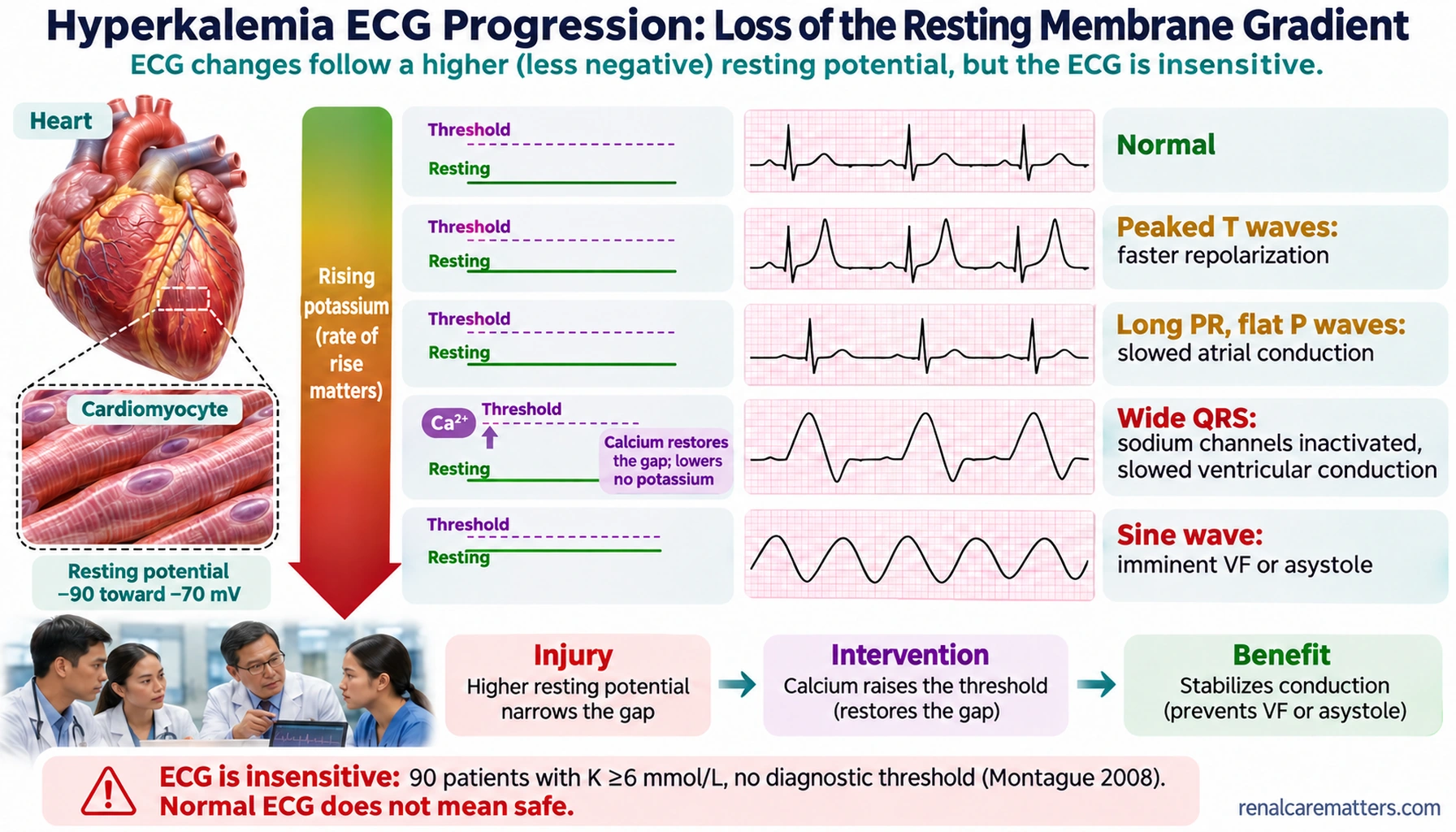
The picture has a limit. A dam either holds or breaks, but a heart cell fails in graded steps. When plasma potassium rises, the gradient across the membrane narrows and the resting potential becomes less negative. At first the cell is easier to excite. Then sodium channels, which must reset at a negative voltage, start to stay inactivated, conduction slows, and the ECG changes from peaked T waves to a lengthened PR interval, a widening QRS, a sine wave, and finally ventricular fibrillation or asystole. When plasma potassium falls, the resting potential becomes more negative but repolarization slows, the QT and U waves lengthen, and ectopic beats and torsades become more likely, especially with digoxin or ischemia. The same number can be safe in one patient and lethal in another, depending on how fast it changed and what else the heart carries.
About 98% of the body’s potassium is inside cells, held there by the sodium–potassium pump. Insulin and beta-2 adrenergic stimulation drive the pump and move potassium into cells within minutes. Over hours, the kidney excretes the daily intake in the distal nephron, where aldosterone and sodium delivery set the pace. In kidney failure, the gut takes over part of that excretion, and dialysis removes the rest. Each layer is a treatment target.
Figure 1 · Key numbers
Severity (UK Kidney Association)Mild 5.5–5.9; moderate 6.0–6.4; severe ≥6.5 mmol/L
ECG sensitivity (Montague 2008)In 90 patients with potassium ≥6 mmol/L, the ECG was insensitive; no diagnostic threshold could be set
STOP angiotensin-converting enzyme inhibitor (ACEi), 411 patients with estimated glomerular filtration rate (eGFR) below 30eGFR at 3 years 12.6 after stopping versus 13.3 after continuing RAS inhibitors (no significant difference)
DIAMOND, 878 patients with heart failureHyperkalemia events 77.7 versus 118.2 per 100 person-years with patiromer versus placebo
Kidney Disease: Improving Global Outcomes (KDIGO) 2020 potassium conferenceConference statements, not graded recommendations
Most hyperkalemia on a medical service is mild, chronic and drug related, and the work is adjustment rather than rescue. A few patients arrive with a potassium and an ECG that can stop the heart within the hour, most often a dialysis patient who missed sessions. Your work is to recognize that patient at once, to treat in the right order, and then to prevent the next episode without abandoning the kidney-protective medicines that caused the first.
Opening case · fictional
Case: Two sessions missed after the storm
Tuesday, 4 p.m., the emergency room of a regional hospital in Tacloban City, four days after a typhoon. Mr. Danilo Pacaña, 58, a fisherman with diabetic kidney disease, dialyzes every Monday, Wednesday and Friday through a left arm fistula at a freestanding unit. The unit lost power and road access, and he missed Friday’s and Monday’s sessions. He takes losartan and makes almost no urine. With the town short of food, his family has been eating bananas and drinking coconut water from fallen trees.
He says his legs feel heavy and weak. His blood pressure is 168/96 mm Hg, his pulse 52 per minute, his oxygen saturation 94% on room air, and he has mild crackles at both bases. His potassium is 7.4 mmol/L, bicarbonate 15 mmol/L and glucose 186 mg/dL. The ECG shows tall, peaked T waves, a PR interval of 240 ms and a QRS of 130 ms.
The intern, Dr. Rhea Abellana, has just attached the leads. The internal medicine resident on duty, Dr. Miguel Dacanay, arrives. The nearest hospital hemodialysis unit is running on a generator and has a waiting list.
Before reading on, decide:
Which findings are dangerous, and what is the very first treatment?
What is the full sequence for the next two hours, and what will you monitor?
How will the team prevent the next episode, including his losartan and the next typhoon?
Keep your answers in mind. The lesson gives you what you need, and the case review near the end shows one sound response.
Lesson · part 1
Potassium physiology: shift, excretion and the heart
Potassium handling has two clocks. The fast clock is internal balance: the shift of potassium between cells and plasma over minutes. The slow clock is external balance: excretion by the kidney and gut over hours to days. A meal containing potassium would raise the plasma level dangerously if insulin and catecholamines did not first move most of it into cells while the kidney slowly excretes it.
The kidney filters potassium and reabsorbs most of it before the distal nephron. What appears in the urine is mostly secreted in the connecting tubule and collecting duct. Secretion needs three things: sodium arriving to be reabsorbed through the epithelial sodium channel, which leaves the lumen negative; aldosterone, which increases sodium channels and the pump; and enough tubular flow to carry the secreted potassium away through the renal outer medullary potassium (ROMK) channel. Any drug that blocks one of these steps raises potassium.
Step
What raises potassium
What lowers potassium
Shift into cells
Insulin deficiency, beta blockade, acidosis from mineral acids, hypertonicity, cell breakdown (rhabdomyolysis, tumor lysis, hemolysis)
Insulin, beta-2 agonists, alkalosis, refeeding, rapid red cell production
Loop and thiazide diuretics, osmotic diuresis, vomiting with bicarbonaturia
Intake
Salt substitutes, bananas, coconut water and other high-potassium foods when excretion is limited; potassium supplements
Poor intake (rarely alone)
Extra-renal loss
Missed dialysis; constipation in kidney failure
Diarrhea, laxatives, gastrointestinal fistulas
Is the potassium real?
Before you treat, ask whether the sample is telling the truth. Hemolysis during a difficult blood draw, a tight tourniquet with fist clenching, delayed processing, very high platelet or white cell counts, and drawing above an infusion can all raise measured potassium without raising the plasma level in the patient (pseudohyperkalemia). A high potassium in a patient with a normal ECG and no reason for it deserves an immediate repeat, ideally from a free-flowing vein, with a heparinized sample if the platelet or white count is very high. A high potassium with a reason, or with ECG change, is treated while you repeat it.
RememberLook at three things together: the number, the ECG and the reason. A dangerous potassium with a reason is treated at once; a surprising potassium with no reason and a normal ECG is repeated at once.
Lesson · part 2
Hyperkalemia: stabilize, shift, remove
The UK Kidney Association (UKKA) guideline grades hyperkalemia as mild (5.5 to 5.9 mmol/L), moderate (6.0 to 6.4 mmol/L) and severe (6.5 mmol/L or more).1 The Kidney Disease: Improving Global Outcomes (KDIGO) 2020 Controversies Conference addressed acute and chronic hyperkalemia in kidney disease; its conclusions are conference statements, not graded recommendations.2 Both describe the same physiological sequence.
The ECG helps when it is abnormal and misleads when it is normal. Montague and colleagues reviewed 90 patients admitted with potassium of 6 mmol/L or more and a concurrent ECG; the ECG was insensitive for hyperkalemia, changes became more likely as potassium rose, readers agreed only moderately, and no diagnostic threshold could be established.3 A normal ECG does not make a potassium of 7 mmol/L safe. Chronic dialysis patients often tolerate levels that would cause arrhythmias in someone whose potassium rose suddenly, but no one can predict which patient will arrest.
Figure 2. ECG changes in hyperkalemia follow loss of the resting membrane gradient, but the ECG is insensitive: a normal tracing does not make a high potassium safe.
Step
Mechanism
Onset and duration
What you must watch
1. Stabilize: intravenous calcium
Restores the gap between resting and threshold potential; does not lower potassium
Minutes; effect wears off, so repeat ECG and treatment may be needed
Give for ECG changes or severe hyperkalemia per protocol; caution with digoxin
2. Shift: insulin with glucose
Drives the sodium–potassium pump; potassium moves into cells
Within the first hour; lasts a few hours
Glucose for several hours afterward; hypoglycemia is common when kidney function is low
2. Shift: nebulized beta-2 agonist
Drives the pump through beta-2 receptors
Within the first hour; additive to insulin
Tachycardia; some patients respond little
2. Shift: sodium bicarbonate
Small, slow effect on potassium
Unreliable
Reserve for metabolic acidosis; sodium and volume load
3. Remove: potassium binders
Exchange potassium in the gut
Hours
Constipation, sodium load, availability and cost
3. Remove: diuretics
Increase distal flow and secretion
Hours, if the kidney responds
Volume status; useless in anuria
3. Remove: hemodialysis
Diffusion into potassium-poor dialysate
Fastest removal; rebound after the session
Arrhythmia risk if potassium falls very fast; recheck after
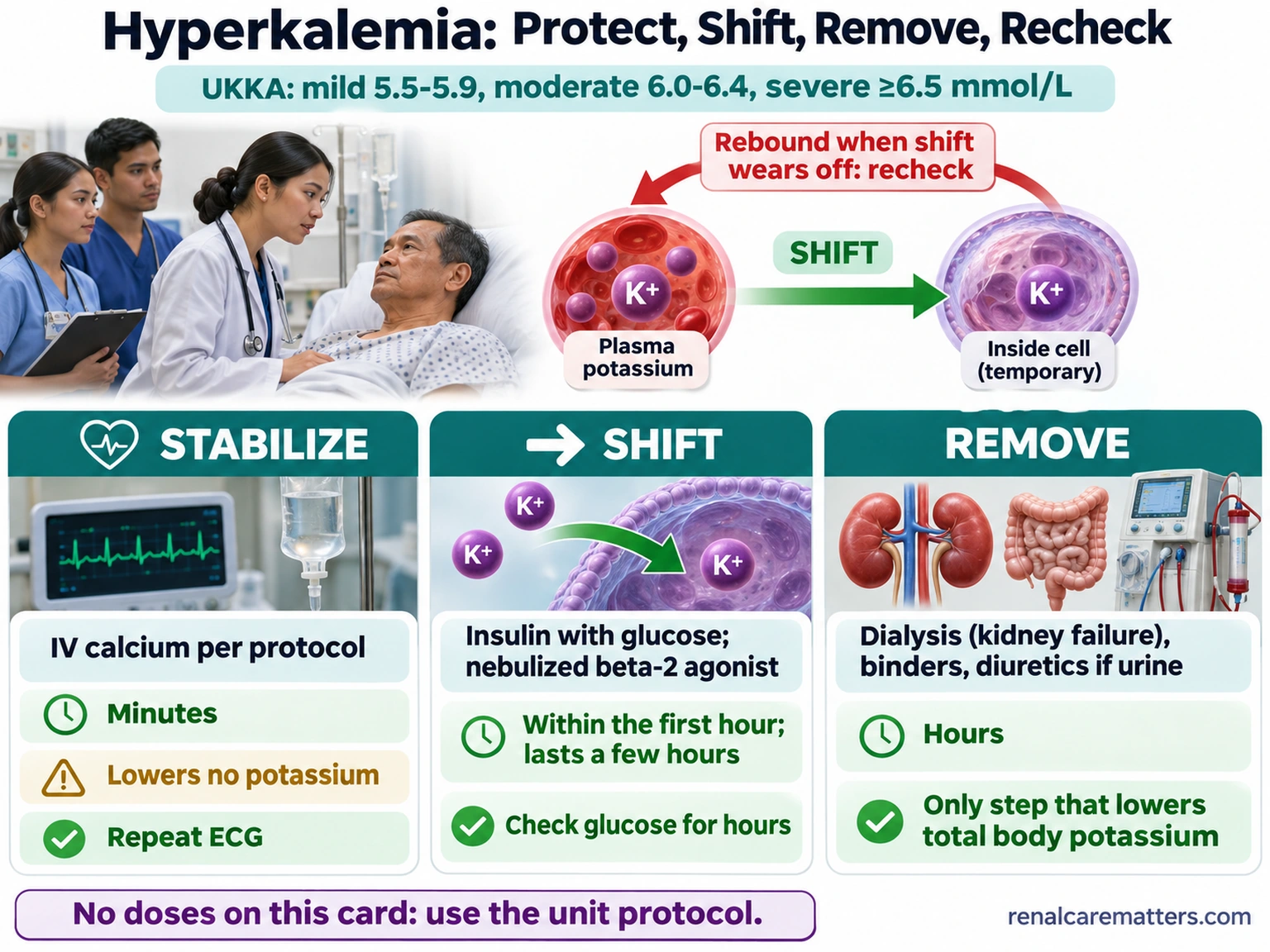
The shift agents buy time; they do not remove potassium. When they wear off, potassium returns to the plasma. Recheck potassium within the first hours, as your protocol sets, and again later for rebound, and recheck glucose repeatedly after insulin. The specific drugs, doses and concentrations come from your unit’s protocol and the attending; this module gives none.
In a patient with kidney failure, dialysis is the removal step. A missed session is the commonest cause of life-threatening hyperkalemia in a dialysis patient. After Hurricane Katrina in the United States, missed sessions were associated with hospitalization among hemodialysis patients.4 Philippine typhoons, floods and power outages do the same. Philippine Health Insurance Corporation (PhilHealth) covers up to 156 hemodialysis sessions a year for patients registered in the PhilHealth Dialysis Database (PDD), at PHP 6,350 per session effective October 9, 2024; confirm the rates on the date of service.5,6 Coverage does not help if the unit is flooded, so the plan for a missed session must exist before the storm.
Figure 3 · Hyperkalemia: the first two hours
Monitor and ECGCardiac monitor, 12-lead ECG, intravenous access, repeat potassium if no reason and normal ECG. Check glucose.
StabilizeIntravenous calcium per protocol for ECG changes or severe hyperkalemia. Repeat the ECG after.
ShiftInsulin with glucose, with or without a nebulized beta-2 agonist, per protocol. Glucose checks for several hours.
RemoveArrange dialysis for a patient with kidney failure; binders and diuretics where the kidney or gut can do the work. Stop potassium sources, supplements and offending drugs for now.
RecheckPotassium within the first hours per protocol and again later for rebound; ECG after each step; glucose repeatedly.
Hand offWrite the potassium times, treatments, ECG changes and the plan for removal in the note and the handoff.
Stage
What you own in hyperkalemia
Intern
Monitor, ECG and call within minutes; note dialysis schedule, last session, urine output and every medicine; draw the repeat sample correctly
Resident
Lead the sequence under supervision; set recheck times; escalate to dialysis early in kidney failure; watch for hypoglycemia
Fellow
Decide on urgent dialysis and the dialysate potassium with the attending; investigate the cause; plan prevention
Stop and callStop and call the attending nephrologist now, per unit protocol, but always ask the attending nephrologist for guidance, when:
The ECG shows a widening QRS, bradycardia, a sine-wave pattern or any arrhythmia
Potassium is 6.5 mmol/L or more, or rising despite treatment
A dialysis patient has missed sessions and has a high potassium or fluid overload
Glucose falls after insulin, or the potassium rebounds after the shift agents wear off
Dialysis is not available within the time the patient needs it
Figure 4. Protect, shift, remove, recheck. Only removal lowers total body potassium; shift agents wear off and potassium returns.
RememberProtect, shift, remove, recheck. Calcium protects the heart but lowers nothing; insulin and beta-agonists move potassium but remove nothing; only the kidney, the gut and dialysis take it out.
Lesson · part 3
Hypokalemia and magnesium: the refill that leaks
Hypokalemia comes from too little intake (rarely alone), a shift into cells, or losses through the gut or kidney. Weakness, ileus, rhabdomyolysis and arrhythmia follow as it deepens. The ECG shows flattened T waves, U waves and a longer QT interval; the risk is highest with digoxin, heart disease and other QT-prolonging drugs. Severe hypokalemia can paralyze the respiratory muscles.
Magnesium is the partner most often forgotten. Magnesium inside the cell normally blocks potassium leaving through ROMK channels in the distal nephron. Huang and Kuo reviewed evidence that magnesium deficiency removes that block and increases distal potassium secretion, so hypokalemia becomes refractory to potassium replacement. Magnesium deficiency alone does not always cause hypokalemia; increased distal sodium delivery or high aldosterone, as with diuretics or vomiting, is usually needed as well.7 Drugs commonly cause hypomagnesemia, including diuretics and proton pump inhibitors.8 Proton pump inhibitors are widely used and bought without prescription in the Philippines.
Cause group
Urine clue
Examples
Shift into cells
Urine potassium low; total body potassium normal
Insulin, beta-2 agonists, thyrotoxic or familial periodic paralysis, refeeding
Gastrointestinal loss
Urine potassium low (unless vomiting with bicarbonaturia)
Diarrhea, laxatives
Kidney loss with high blood pressure
Urine potassium high
Primary aldosteronism, licorice, Cushing syndrome
Kidney loss with normal or low blood pressure
Urine potassium high
Diuretics, vomiting, magnesium deficiency, tubulopathies, some antibiotics and amphotericin
The urine potassium-to-creatinine ratio on a spot sample separates kidney from extra-renal loss, and the site has calculators for it. The transtubular potassium gradient (TTKG) rests on assumptions about urea and osmole handling in the collecting duct that often fail, so read it with caution. The KDIGO 2020 conference proposed a diagnostic algorithm for hypokalemia that puts the clinical context first.2 The context usually answers the question faster than any ratio: a woman on a diuretic, a man with diarrhea, a young adult with sudden paralysis after a large carbohydrate meal.
Arithmetic illustration, not a target. Urine potassium-to-creatinine ratio = urine potassium (mmol/L) ÷ urine creatinine (mmol/L). Urine potassium 30 mmol/L and urine creatinine 6 mmol/L: ratio 5 mmol/mmol, which points to kidney loss in a hypokalemic patient; a low ratio points to gut loss or a shift.
RememberWhen hypokalemia will not correct, check and correct magnesium. Potassium poured into a leaking bucket keeps draining until the magnesium plugs the leak.
Lesson · part 4
Preventing the next episode without losing kidney protection
Many patients with hyperkalemia are taking an ACE inhibitor, an Angiotensin receptor blocker (ARB) or a mineralocorticoid receptor antagonist, because these drugs slow CKD and save lives in heart failure. Stopping them after one high potassium removes that protection permanently in many patients, because nobody restarts them. The KDIGO 2021 blood pressure guideline includes a practice point that hyperkalemia associated with renin–angiotensin system (RAS) inhibitors (RASi) can often be managed by measures to lower potassium rather than by decreasing the dose or stopping the drug.9
The STOP ACEi (stopping ACE inhibitors or ARBs in advanced CKD) trial tested stopping in advanced CKD. It randomized 411 patients with an estimated glomerular filtration rate (eGFR) below 30 mL/min per 1.73 m² and progressive disease to stop or continue RAS inhibitors. At 3 years the eGFR was 12.6 with stopping and 13.3 with continuing, a difference of −0.7 that was not significant. Kidney failure or the start of kidney replacement therapy (KRT) occurred in 62% versus 56% (hazard ratio 1.28, 95% confidence interval 0.99 to 1.65), and cardiovascular events and deaths were similar.10 Stopping did not help kidney function; eGFR is a surrogate, but the hard kidney outcome also did not favor stopping.
Potassium binders
The newer binders were tested mainly on potassium, a surrogate, and on the ability to keep RAAS inhibitors. In the HARMONIZE (sodium zirconium cyclosilicate in outpatients) trial, open-label sodium zirconium cyclosilicate lowered potassium from 5.6 to 4.5 mmol/L at 48 hours in 258 outpatients, with 84% normokalemic by 24 hours; in the randomized maintenance phase all three doses kept potassium lower than placebo for 28 days. Edema was more common at the highest dose (14% versus 2% with placebo), and hypokalemia occurred at the higher doses.11 In the DIAMOND (patiromer in heart failure) trial of 878 patients with heart failure and reduced ejection fraction who reached target RAAS inhibitor doses during a patiromer run-in, patiromer reduced hyperkalemia events (77.7 versus 118.2 per 100 person-years; hazard ratio 0.66) and the need to reduce mineralocorticoid receptor antagonist doses, with similar adverse events.12 Neither trial showed fewer deaths or kidney failure.
Binder type
What the evidence shows
Philippine reality
Sodium zirconium cyclosilicate
Fast, sustained potassium lowering (HARMONIZE); sodium load and edema at higher doses
Out-of-pocket; may not be stocked in provincial hospitals
Patiromer
Fewer hyperkalemia events while keeping RAAS inhibitors in heart failure (DIAMOND)
Out-of-pocket; availability varies
Older resins (sodium or calcium polystyrene sulfonate)
Older and weaker evidence; gut adverse effects
Widely available and cheaper; often the only option
The KDIGO 2020 conference noted growing evidence associating plant-based diets with better outcomes and urged a shift from blanket dietary potassium restriction toward healthy eating patterns, while noting that few data show diet changes restore an abnormal potassium to normal.2 For a dialysis patient, the advice is different: high-potassium foods such as bananas and coconut water can be dangerous when sessions are missed. Teach the family what to eat during a typhoon week, when dialysis may stop for days.
In childrenPseudohyperkalemia is common in infants and young children because heel-prick and squeezed capillary samples hemolyze easily; repeat a surprising result from a free-flowing sample. Newborns, especially preterm infants, can have high potassium in the first days of life, and treatments are dosed by weight from the pediatric formulary. A review of electrolyte emergencies in children describes the same stabilize, shift and remove sequence with pediatric dosing.13 See Attending Pediatric Nephrologist, Module 04.
Stage
What you own in prevention
Intern
List every potassium source and potassium-raising drug, including salt substitutes and herbal products; ask about missed sessions and food during disasters
Resident
Propose a plan to keep or restart RAAS inhibitors with monitoring; consider binders, diuretics and acidosis correction
Fellow
Choose an affordable binder strategy; write the dialysis patient’s emergency plan (alternative unit, diet during disruption, when to come to the emergency room)
RememberTreat the high potassium, not the drug that protects the kidney. Stop the RAAS inhibitor only when other measures fail, and if you stop it, write when it will be restarted.
On the floor
Real situations: problems and solutions
These are fictional but typical. For each one, cover the answer, decide what you would do, then compare. Where a step depends on local rules, your unit’s procedure and your supervisor’s direction come first.
The potassium from the hemolyzed sample
What you see
A 35-year-old woman in Makati admitted for cellulitis has a potassium of 6.4 mmol/L on a sample the laboratory flags as hemolyzed. Her kidney function and ECG are normal.
What is likely going on
Probable pseudohyperkalemia from hemolysis.
What to do
Repeat the potassium at once from a free-flowing vein without prolonged tourniquet; treat only if the repeat is high or the ECG changes.
Why it matters
Treating a false potassium exposes the patient to insulin and hypoglycemia for nothing.
The diabetic man on three potassium-raising drugs
What you see
A 66-year-old man in Angeles City with CKD stage 4 on lisinopril, spironolactone and a salt substitute has a potassium of 6.1 mmol/L and a normal ECG.
What is likely going on
Chronic, drug- and diet-related hyperkalemia in advanced CKD.
What to do
Stop the salt substitute, review the spironolactone with the attending, check acidosis, consider a binder, and plan to keep the ACE inhibitor if possible.
Why it matters
Losing the ACE inhibitor removes protection; STOP ACEi showed no kidney benefit from stopping in advanced CKD.
Weakness after a rice meal
What you see
A 24-year-old man in Pasig wakes unable to move his legs after a large dinner and a basketball game. His potassium is 2.1 mmol/L and he has a tremor and a fast pulse.
What is likely going on
Hypokalemic periodic paralysis, possibly thyrotoxic, from a shift of potassium into cells.
What to do
Monitor the heart, replace potassium cautiously with the attending because rebound hyperkalemia can follow, and check thyroid function.
Why it matters
Total body potassium is normal in a shift; aggressive replacement can overshoot when the shift reverses.
The dialysis patient before the storm
What you see
A PAGASA warning is issued for a strong typhoon to hit Samar in two days. A hemodialysis patient asks what to do.
What is likely going on
A predictable risk of missed sessions and hyperkalemia.
What to do
Ask the attending about an extra or earlier session, give a low-potassium food list for the week, confirm the nearest alternative unit, and tell him to seek care for weakness or palpitations.
Why it matters
Missed sessions after major storms are associated with hospitalization; the plan must exist before the storm.
Field notes
Put the patient on a monitor before you discuss the potassium.
Write the clock time of every potassium and every treatment on one line of the chart.
After insulin for hyperkalemia, write glucose checks into the orders, not just the plan.
Check magnesium with every low potassium that does not correct.
When you stop an ACE inhibitor or ARB, write the date to review restarting it.
Case review
Back to the case: Two sessions missed after the storm
The danger, and the first treatment. Mr. Pacaña has severe hyperkalemia with ECG changes that signal impaired conduction: a long PR interval, a QRS of 130 ms and a slow pulse of 52. His weak, heavy legs fit hyperkalemic muscle weakness. Dr. Abellana has him on a monitor and calls immediately. The first treatment is intravenous calcium per protocol, to stabilize the membrane; it buys minutes and lowers no potassium. Dr. Dacanay repeats the ECG after it and watches for narrowing of the QRS.
The sequence, and what to monitor. Next comes the shift: insulin with glucose and a nebulized beta-2 agonist, per protocol, with capillary glucose checks for several hours because insulin acts longer when kidney function is absent. His acidosis may justify bicarbonate on the attending’s advice, mindful of his crackles and the sodium load. The removal step is dialysis: he is anuric, so binders alone are too slow. Dr. Dacanay calls the attending nephrologist, who arranges urgent dialysis at the hospital unit despite the waiting list. Potassium is rechecked within the first hours and again later, because the shift wears off; the ECG is repeated after each step.
The next episode. The cause was two missed sessions, a high-potassium diet during the food shortage, and losartan. The fellow reviews him the next day. Losartan protects his heart, and the decision whether to continue it, perhaps with a binder the family can afford, belongs to the attending; it should not be stopped and forgotten. The family is taught which foods to avoid when a session is missed. The fellow writes an emergency plan: the nearest alternative dialysis unit, the phone numbers, a low-potassium food list for typhoon weeks, and the rule to come to the emergency room for weakness or palpitations after a missed session.
Interactive case · fictional
Interactive case: Diarrhea, a salt substitute and a slow pulse
Work through a shift one decision at a time. The panel at the top changes with what you choose. After each choice you see why it is, or is not, the best move; after a weaker one you can try again or carry on and see where it leads. Your first choice at each step is scored. The score stays on this device and nothing is sent anywhere. In real practice, your unit’s protocol and the people responsible for each decision come first.
Skills lab · with your preceptor
Skills checklist: Hyperkalemia response and prevention plan
Complete with a preceptor on a real or simulated patient. Sign-off is local. Your preceptor rates each step as satisfactory, needs practice, or not observed. Steps marked Critical must all be satisfactory before sign-off. This checklist supports supervised learning; your unit’s own procedure and competency form are the authority. A printable version of every checklist is on the trainer page.
Recognizes ECG features of dangerous hyperkalemia (peaked T waves, long PR, wide QRS, bradycardia, sine wave) on sample tracings
States when to repeat a potassium for possible pseudohyperkalemia and how to draw the repeat correctly
Runs the stabilize, shift, remove sequence in the correct order in simulation, naming the purpose and limit of each step without quoting doses
Writes recheck times for potassium and glucose after shift therapy
Explains the magnesium–potassium link and checks magnesium in refractory hypokalemia
Writes an emergency plan for a dialysis patient covering a missed session during a typhoon
Placement activity. Emergency room, medical ward or hemodialysis unit
Self-assessment
Check your understanding
Each visit draws 5 questions at random from this module’s 5-question bank. Choose the single best answer for each, then select Check answers; an explanation appears under the best answer. Select New set of questions for a different mix. A good target is 4 of 5 on two different sets. Nothing you select is sent anywhere; scoring happens in your browser.
Clase, C. M., Carrero, J. J., Ellison, D. H., Grams, M. E., Hemmelgarn, B. R., Jardine, M. J., Kovesdy, C. P., Kline, G. A., Lindner, G., Obrador, G. T., Palmer, B. F., Cheung, M., Wheeler, D. C., Winkelmayer, W. C., Pecoits-Filho, R., & Conference Participants. (2020). Potassium homeostasis and management of dyskalemia in kidney diseases: Conclusions from a Kidney Disease: Improving Global Outcomes (KDIGO) Controversies Conference. Kidney International, 97(1), 42–61. https://doi.org/10.1016/j.kint.2019.09.018
Montague, B. T., Ouellette, J. R., & Buller, G. K. (2008). Retrospective review of the frequency of ECG changes in hyperkalemia. Clinical Journal of the American Society of Nephrology, 3(2), 324–330. https://doi.org/10.2215/CJN.04611007
Anderson, A. H., Cohen, A. J., Kutner, N. G., Kopp, J. B., Kimmel, P. L., & Muntner, P. (2009). Missed dialysis sessions and hospitalization in hemodialysis patients after Hurricane Katrina. Kidney International, 75(11), 1202–1208. https://doi.org/10.1038/ki.2009.5
Huang, C. L., & Kuo, E. (2007). Mechanism of hypokalemia in magnesium deficiency. Journal of the American Society of Nephrology, 18(10), 2649–2652. https://doi.org/10.1681/ASN.2007070792
Liamis, G., Hoorn, E. J., Florentin, M., & Milionis, H. (2021). An overview of diagnosis and management of drug-induced hypomagnesemia. Pharmacology Research & Perspectives, 9(4), e00829. https://doi.org/10.1002/prp2.829
Kidney Disease: Improving Global Outcomes (KDIGO) Blood Pressure Work Group. (2021). KDIGO 2021 clinical practice guideline for the management of blood pressure in chronic kidney disease. Kidney International, 99(3S), S1–S87. https://doi.org/10.1016/j.kint.2020.11.003
Bhandari, S., Mehta, S., Khwaja, A., Cleland, J. G. F., Ives, N., Brettell, E., Chadburn, M., Cockwell, P., & STOP ACEi Trial Investigators. (2022). Renin–angiotensin system inhibition in advanced chronic kidney disease. New England Journal of Medicine, 387(22), 2021–2032. https://doi.org/10.1056/NEJMoa2210639
Kosiborod, M., Rasmussen, H. S., Lavin, P., Qunibi, W. Y., Spinowitz, B., Packham, D., Roger, S. D., Yang, A., Lerma, E., & Singh, B. (2014). Effect of sodium zirconium cyclosilicate on potassium lowering for 28 days among outpatients with hyperkalemia: The HARMONIZE randomized clinical trial. JAMA, 312(21), 2223–2233. https://doi.org/10.1001/jama.2014.15688
Butler, J., Anker, S. D., Lund, L. H., Coats, A. J. S., Filippatos, G., Siddiqi, T. J., Friede, T., Fabien, V., Kosiborod, M., Metra, M., Piña, I. L., Pinto, F., Rossignol, P., van der Meer, P., Bahit, C., Belohlavek, J., Böhm, M., Brugts, J. J., Cleland, J. G. F., ... Pitt, B. (2022). Patiromer for the management of hyperkalemia in heart failure with reduced ejection fraction: The DIAMOND trial. European Heart Journal, 43(41), 4362–4373. https://doi.org/10.1093/eurheartj/ehac401
Educational self-study for physicians in training. Clinical tasks need your institution’s authorization and supervision. Completing this track is an Academy learning record only. It does not confer licensure, specialist status, PSN or PNSP membership or board eligibility, procedural privileges, CPD units, or completion of an institutional training program, and it does not replace current guidelines, regulations, your institution’s protocols and formulary, or your supervisor.