Coding: ICD-10 Today, ICD-11 Tomorrow, and Compliant Queries
Coding only from authenticated notes, tabular verification, diagnosis versus procedure fields, the ICD-11 transition, and non-leading queries.
PublishedNailathalaGipatikPepalwal:ReferencesMga SanggunianMga TinubdanReng Reperensya:4Audience: Designated medical records officers, custodians, and deputies in standalone and hospital-based hemodialysis units · hospital health information management staff assigned to dialysis · unit managers who supervise recordsRead timeOras ng pagbasaOras sa pagbasaOras ning pamamasa:
Training track for the records officers of hemodialysis units
This module is study material for the records officers of hemodialysis units. It explains the reasoning behind common records decisions; it is not a records manual and not legal advice. Regulations change: confirm every rule against the current text and your facility’s approved policy before you rely on it. Clinical content belongs to its clinical author; questions about a patient’s care go to the attending nephrologist. Every case, name, and identifier is fictional.
Learning objectives
After this module you should be able to
Code only from authenticated physician documentation, and explain why treatment patterns and reimbursement never establish a diagnosis.
Confirm a code in the tabular list and record its classification and version.
Place diagnosis and procedure codes in their correct fields.
Explain the current position on the International Classification of Diseases, 10th Revision (ICD-10) and its successor ICD-11 for Philippine Health Insurance Corporation (PhilHealth) claims, and what is still unconfirmed.
Write a compliant, non-leading physician query and hold the claim while it is open.
Pre-testBefore you read, answer the 8 self-assessment questions and note your score. After the module, select New set of questions and compare. The difference is what you learned; the questions you still miss are what to reread.
Start here
The big picture, in plain words
In plain wordsA code is a translation. The physician writes a diagnosis in words; the code translates it into a language that payers, registries, and statisticians can count. Like any translation, it can only be as faithful as the original. A translator who improves on the author has stopped translating.
The picture is useful, and it has one limit. A translator who finds a vague sentence can usually ask the author what they meant, and so can you. But in a busy unit the author is often not at the desk, the claim is due, and someone nearby is sure they know the answer. That is the moment this module is about.
When the source note is vague, the temptation is to help: to pick the code that pays, or the one that seems clinically likely. That turns a translation into an invention, which is the exact failure payer audits are designed to catch. When the note is unclear, the records officer’s tool is a question to the physician, never a guess.
Figure 1 · Key terms for this module
International Classification of Diseases, 10th Revision (ICD-10)The classification most Philippine claims and statistics use today.
ICD-11The 11th Revision, in effect globally since January 1, 2022.
Alphabetic indexThe part of the classification where you look a term up first.
Tabular listThe main body of the classification, where a code is confirmed and its notes are read.
QueryA written request to a clinician to clarify documentation.
Acute kidney injury (AKI)A sudden loss of kidney function, which may recover.
Chronic kidney disease (CKD)Kidney damage or reduced function lasting more than three months; stage 5 is kidney failure.
Opening case · fictional
Case: AKI or CKD5?
Mrs. Leonora Castillo, 54, started hemodialysis at your unit on November 2 after a hospital stay. Her signed hospital discharge abstract, dated October 28, gives the diagnosis as “AKI.” An intake note in your unit, dated November 2 and not yet signed, says “CKD5?”
The claims staging list already shows her sessions with procedure code 90935 and diagnosis code N18.5, chronic kidney disease stage 5.
Mr. Boyet Ramos, the claims clerk, shrugs. “She dialyzes three times a week. It’s obviously CKD5. If we put AKI, PhilHealth will just ask more questions. Can you sign off so I can send the batch today?”
Before reading on, decide:
Can the claim go out as staged?
What does a compliant query to the physician look like?
What happens to the claim while the query is open?
Keep your answers in mind. The lesson gives you what you need, and the case review near the end shows one sound response.
Lesson · part 1
Start from the authenticated note
The diagnosis comes from the physician’s signed documentation. It never comes from a laboratory value, a treatment pattern, a previous code, or the expected payment.
Why be so strict? Because each of those other sources can be right most of the time and dangerously wrong some of the time. A patient on dialysis three times a week usually has chronic kidney disease (CKD) stage 5. But some patients start dialysis for acute kidney injury (AKI) and recover enough to stop. If the record calls them CKD stage 5 from day one, the error follows them into registries, insurance, employment paperwork, and the clinical thinking of every physician who reads the chart later.
Source
Can it prompt a query?
Can it establish a diagnosis?
Signed physician diagnosis
—
Yes
Unsigned or draft note
Yes
No, until authenticated
Laboratory result (a high creatinine, a low hemoglobin)
Yes
No
Treatment pattern (three sessions a week)
Yes
No
Last year’s code
Yes
No
What the claim needs to pay
No
Never
Two steps for every code
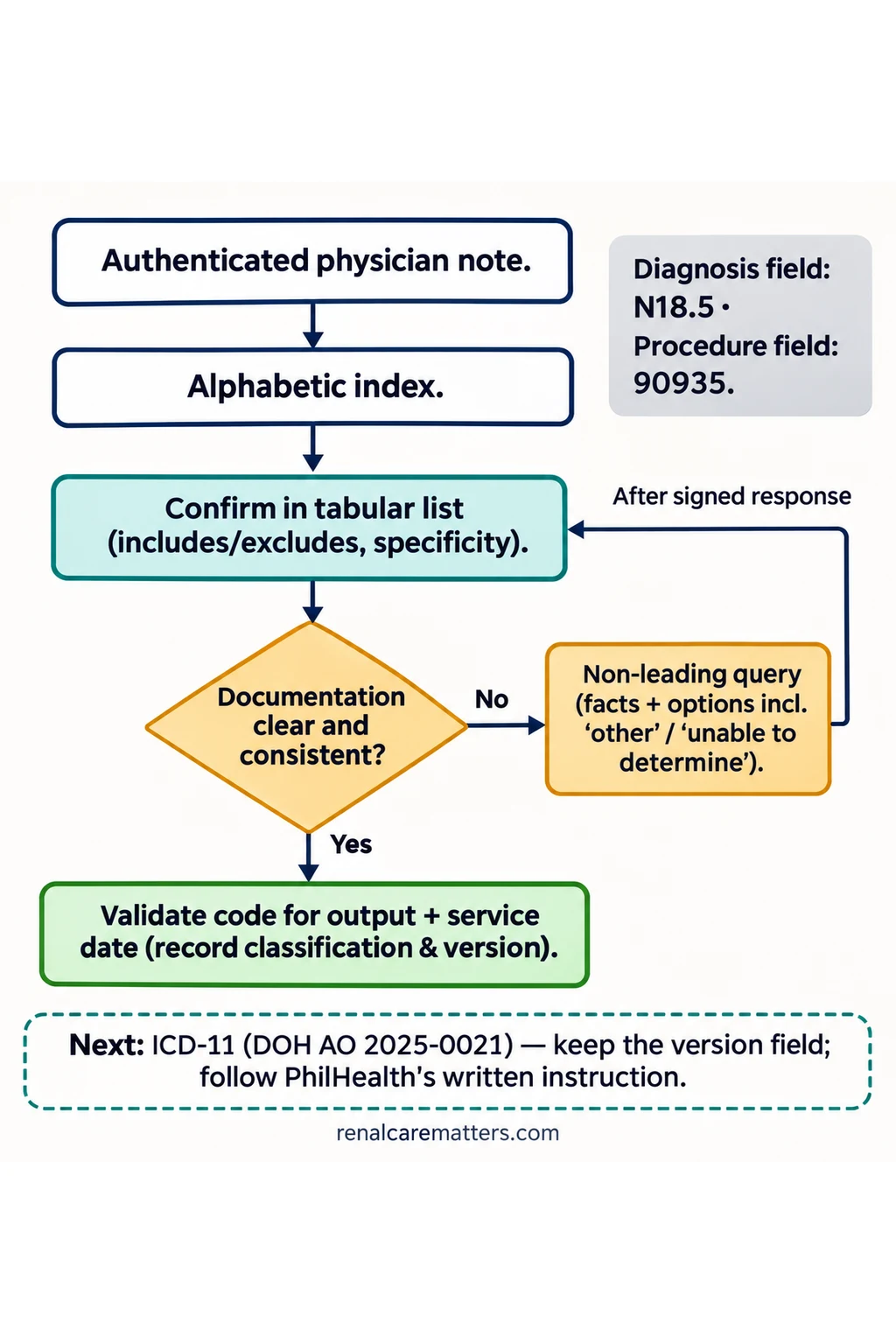
Verify every code in two steps. First, look up the term in the alphabetic index. Second, confirm the code in the tabular list, reading its inclusion and exclusion notes, any “use additional code” instructions, and the level of specificity required. The index points you to a neighborhood; the tabular list tells you whether you are at the right address. Record the source note, the service date, the classification and version, and who verified it.
Figure 2. From note to code. Code only what an authenticated note says; ask, do not lead.
On the floor · The patient who stopped dialysis
Mr. Wilfredo Cajucom started dialysis after a severe infection. His intake note said “CKD5?”; his signed discharge abstract said “AKI.” The records officer coded nothing until the physician answered her query: “AKI, monitor for recovery.”
Six weeks later his urine output returned and dialysis was stopped. His record, registry entry, and PhilHealth claims all said AKI, so nothing had to be unwound.
A treatment pattern suggested chronic kidney failure. The physician knew better, and the query let the record say so.
Illustrative scenario. Names and details are invented.
Lesson · part 2
Diagnosis, procedure, and which classification
Diagnosis codes and procedure codes answer different questions, and they live in different fields.
Code
Kind
Answers
N18.5
Diagnosis (ICD-10)
What the patient has: CKD stage 5
N17 category
Diagnosis (ICD-10)
What the patient has: AKI
90935
Procedure (relative value scale)
What was done: hemodialysis
A claim with the two swapped will reject. The Philippine Health Insurance Corporation (PhilHealth) hemodialysis circular distinguishes CKD stage 5 (N18.5) from AKI (the N17 category) for emergency hemodialysis, so the distinction in Mrs. Castillo’s case is not academic.1
ICD-10, ICD-11, and the claim
Claims follow the code lists in PhilHealth’s own issuances, not the newest edition of the classification. When the Department of Health (DOH) updated ICD-10 for statistics in 2016, PhilHealth told providers to keep using the codes in its case-rate circulars until it issued a new instruction.2
ICD-11 took effect globally on January 1, 2022, and the World Health Organization allows countries to keep ICD-10 during transition.3 DOH Administrative Order 2025-0021, dated October 14, 2025, sets ICD-11 implementation guidelines and covers DOH offices, PhilHealth, local governments, and public and private facilities.4 Its claims switch-over and dual-coding dates are not confirmed in this course.
So the rule for now is simple. Wait for PhilHealth’s written instruction, through your claims lead, before changing any code on a claim. Meanwhile, record the classification and version on every coded record, so that when the switch comes, every code can be traced to the classification it was assigned in.
On the floor · The swapped fields
A batch of claims comes back rejected. On every one, the clerk had typed N18.5 into the procedure field and 90935 into the diagnosis field, after a change to the claims software rearranged the screen.
The records officer shows the clerk the difference: one code says what the patient has, the other what was done. The claims lead asks the vendor to label the fields clearly, and the batch is corrected and resubmitted with both original and corrected copies kept.
Diagnosis and procedure codes answer different questions. A screen change does not change which is which.
Illustrative scenario. Names and details are invented.
Lesson · part 3
Asking without leading
When documentation is unclear, conflicting, or incomplete, ask the responsible physician in writing, in the chart’s query workflow. A good query has four features.
It presents the facts already in the record, each with its source and date.
It asks an open question, or offers clinically reasonable options that include “other” and “unable to determine.”
It never mentions reimbursement, the claim, or the deadline.
It never suggests a diagnosis the record does not support.
Leading (do not use)
Non-leading
“Please document CKD stage 5 so the claim can be filed.”
“The discharge abstract (October 28, signed) states AKI. The intake note (November 2, unsigned) states CKD5?. Please clarify the diagnosis and, if applicable, the CKD stage: AKI / CKD (stage __) / both / other / unable to determine.”
“Patient is on hemodialysis (HD) 3x a week. CKD5, right?”
“Please clarify the diagnosis supporting maintenance dialysis, based on your clinical judgment.”
“PhilHealth will deny AKI. Can we use N18.5?”
Do not send. A query never discusses payment.
Keep the query, the physician’s response, and the final code together in the record. An unanswered query stays pending. It never defaults to the coder’s guess, and it never expires into a code.
Why does leading matter so much? Because a physician answering a leading query is no longer giving an independent clinical opinion. They are agreeing with yours. If an auditor later sees a query that names the answer and mentions the claim, the code that followed looks like a code chosen for payment, whatever the truth.
RememberCode only what an authenticated note says. Ask; do not lead. Never mention money in a query.
On the floor · The query that changed nothing, and everything
A query asks Dr. Salvador Ilagan to clarify Mrs. Josefina Mercado’s diagnosis: “AKI / CKD (stage __) / both / other / unable to determine.” He writes back: “Both. CKD stage 4 at baseline, AKI on CKD this admission.”
That answer was not among the guesses anyone in the office had made. It changed her code, her registry status, and the plan to recheck her kidney function in three months.
Offering “both” and “other” is not politeness. It is how the record gets the answer no one expected.
Illustrative scenario. Names and details are invented.
Lesson · part 4
When someone wants the code changed
Pressure to change a code rarely sounds like fraud. It sounds like common sense, deadlines, and kindness to the patient.
What you may hear
A good response
“It’s obviously CKD5.”
“It may well be. The physician needs to write it, and I’ll send the query now.”
“The batch goes out today.”
“Then we hold this one claim and send the rest. A late claim can be filed; a wrong one has to be explained.”
“The patient can’t afford a denial.”
“Agreed. That’s why we’ll get the documentation right, so the claim holds up.”
“The doctor said verbally it’s CKD5.”
“Good. Can you ask the doctor to sign the intake note or answer the query? Then I can code it.”
If pressure continues, or comes from someone senior, write down what was asked and escalate to the claims lead and the Dialysis Clinical Head. You are not being difficult. You are protecting the unit, the physician, and the patient from a record that cannot be defended.
On the floor
Real situations: problems and solutions
These are fictional but typical. For each one, cover the answer, decide what you would do, then compare. Where a step depends on local rules, your unit’s procedure and your supervisor’s direction come first.
The diagnosis in the laboratory report
What you see
A laboratory report says “consistent with diabetic nephropathy,” but the physician’s notes do not mention it.
What is likely going on
A laboratory interpretation, not a physician diagnosis.
What to do
Send a non-leading query asking the physician to clarify the cause of kidney disease. Do not code from the laboratory report.
Why it matters
Only the treating physician establishes a diagnosis.
The physician who answers “as above”
What you see
You receive a query reply that says only “as above.”
What is likely going on
A busy physician who has not read the options.
What to do
Politely re-send the query, or ask in person, explaining that the record needs one of the listed answers in her words.
Why it matters
An unclear answer to a query is not an answer.
Last year’s code
What you see
A patient’s new claim was staged by copying last year’s diagnosis code.
What is likely going on
Convenient, and possibly out of date.
What to do
Check the code against the current signed diagnosis and the current PhilHealth list for the service date.
Why it matters
Diagnoses and code lists both change.
ICD-11 enthusiasm
What you see
A new coder, fresh from a seminar, starts entering ICD-11 codes on PhilHealth claims.
What is likely going on
Good intentions, ahead of the payer’s instruction.
What to do
Stop the claims change, thank her for the initiative, and explain that claims follow PhilHealth’s written instruction. Keep a note of the version on every code.
Why it matters
A correct code in the wrong classification still rejects.
The query that mentions money
What you see
A colleague drafts a query: “Please confirm CKD5 for PhilHealth purposes.”
What is likely going on
A leading query.
What to do
Rewrite it to present the documented facts and open options, with no mention of payment.
Why it matters
A query that names the payment makes the answer look bought.
Field notes
Confirm every code in the tabular list, not only the index.
Keep queries, answers, and codes together.
An open query is a hold, not a deadline to guess.
Record the classification and version on every coded record.
Never mention payment in a query.
Case review
Back to the case: AKI or CKD5?
Can the claim go out as staged? No. The only authenticated diagnosis says AKI. N18.5 is unsupported until the physician clarifies. The treatment pattern can prompt a question; it cannot answer it.
The query. Send it to the attending physician through the query workflow. Cite both notes with their dates and authentication status, and offer AKI, CKD (stage __), both, other, or unable to determine. Do not mention the claim, PhilHealth, or the batch date.
While it is open. Hold Mrs. Castillo’s staged claims and tell the claims lead why. The rest of the batch can go. When the signed answer arrives, the authorized coder validates the code for each service date against the current PhilHealth list and the approved form.
And Mr. Ramos? Explain kindly, and without lecturing, that you can only code what the physician has signed. He is trying to help the patient and the unit. So are you.
The physician may well answer “CKD stage 5.” If so, nothing was lost except a day. If the answer is “AKI, recovering,” the query may have changed the course of her care. Part of your role is to make sure the record reflects what the physician actually decided.
Skills lab · with your preceptor
Skills checklist: Code validation and compliant query
Validate two fictional coded encounters and write one query while your preceptor observes. Your preceptor rates each step as satisfactory, needs practice, or not observed. Steps marked Critical must all be satisfactory before sign-off. This checklist supports supervised learning; your unit’s own procedure and competency form are the authority. A printable version of every checklist is on the trainer page.
CriticalCodes only from authenticated documentation.
States why a treatment pattern or laboratory value cannot establish a diagnosis.
Confirms the code in the tabular list and records classification and version.
Places diagnosis and procedure codes in the correct fields.
CriticalWrites a query that presents facts, offers options including other and unable to determine, and omits reimbursement.
CriticalHolds the claim while the query is pending and tells the claims lead.
Responds to pressure to change a code without conceding and escalates if it continues.
Placement activity. Ask your claims lead for PhilHealth’s latest written instruction on ICD-10 and ICD-11 for claims and file it in your source register.
Self-assessment
Check your understanding
Each visit draws 8 questions at random from this module’s 15-question bank. Choose the single best answer for each, then select Check answers; an explanation appears under the best answer. Select New set of questions for a different mix. A good target is 7 of 8 on two different sets. Nothing you select is sent anywhere; scoring happens in your browser.
Philippine Health Insurance Corporation. (2024). PhilHealth Circular No. 2024-0023: Institutionalization of 156 hemodialysis sessions and coverage expansion (Revision 2).
Philippine Health Insurance Corporation. (2017). PhilHealth Advisory No. 2017-0008: Clarification on 2016 ICD-10 updates. https://www.philhealth.gov.ph/advisories/2017/adv2017-0008.pdf
World Health Organization. (2025). ICD-11 implementation: Frequently asked questions. https://www.who.int/standards/classifications/frequently-asked-questions/icd-11-implementation
Department of Health. (2025). Administrative Order No. 2025-0021: ICD-11 implementation guidelines. Retrieved November 24, 2026, from https://sites.google.com/view/doh-hfdb/2025-q4-updates/ao-2025-0021
Educational material for records staff. Completing it is an Academy learning record only. It does not confer DOH-recognized training credit, a facility designation, or system access, and it does not replace current regulations, your facility’s records manual, or advice from your data protection officer or counsel.