PhilHealth: Eligibility, the 156-Session Ledger, and the Claim Packet
The current HD package, the per-session Annex A, the session ledger, three separate proofs, and duplicates.
PublishedNailathalaGipatikPepalwal:ReferencesMga SanggunianMga TinubdanReng Reperensya:6Audience: Designated medical records officers, custodians, and deputies in standalone and hospital-based hemodialysis units · hospital health information management staff assigned to dialysis · unit managers who supervise recordsRead timeOras ng pagbasaOras sa pagbasaOras ning pamamasa:
Training track for the records officers of hemodialysis units
This module is study material for the records officers of hemodialysis units. It explains the reasoning behind common records decisions; it is not a records manual and not legal advice. Regulations change: confirm every rule against the current text and your facility’s approved policy before you rely on it. Clinical content belongs to its clinical author; questions about a patient’s care go to the attending nephrologist. Every case, name, and identifier is fictional.
Learning objectives
After this module you should be able to
State the main facts of the Philippine Health Insurance Corporation (PhilHealth) hemodialysis (HD) package and attach each to its source and effective date.
Prove eligibility, delivery, and documentation separately for every claimed session.
Detect a canceled session or a duplicate service before it reaches a claim.
Keep a per-patient session ledger and project the date the annual cap will be reached.
Handle a returned claim so that both the original and the corrected submission remain traceable.
Pre-testBefore you read, answer the 8 self-assessment questions and note your score. After the module, select New set of questions and compare. The difference is what you learned; the questions you still miss are what to reread.
Start here
The big picture, in plain words
In plain wordsA dialysis claim makes three promises at once. This person is covered. This treatment happened. The paperwork matches. Think of it as a three-legged stool: each leg needs its own proof, and a stool with two strong legs still falls over.
The picture is useful, and it has one limit. A wobbly stool is noticed the moment someone sits on it. A wobbly claim may be paid, and the problem appears months later in an audit, when the people who could have fixed it have moved on. By then, a gap in one claim often turns out to be a pattern across hundreds.
Most denials and audit findings trace to one proof being assumed from another: treating registration in the PhilHealth Dialysis Database (PDD) as if it proved a session happened, or treating a schedule as if it proved a treatment. The records officer does not file claims. Claims staff do. Your part is to make sure that every claimed session stands on three legs of evidence that you can retrieve on request.
Figure 1 · Key terms for this module
PhilHealth Dialysis Database (PDD)The registry of patients eligible for the Philippine Health Insurance Corporation hemodialysis package.
Annex AThe PhilHealth Hemodialysis Benefits Package Agreement Form, signed for every session.
Statement of account (SOA)The itemized bill for the session; electronic statement of account (eSOA) when filed electronically.
Session ledgerA per-patient count of covered sessions used and remaining in the calendar year.
Return to hospitalA claim sent back to the facility for correction.
Service dateThe date the treatment was given, which decides which rules apply.
Opening case · fictional
Case: Four rows, one patient
It is Monday, November 9. Ms. Marites Lopez, the claims lead, sends you the staging list for Mrs. Carmelita Ramos, 58, who dialyzes on Monday, Wednesday, and Friday. There are four rows.
Row
Service date
What the paperwork shows
D1
November 3
Run sheet signed and complete; Annex A signed
D2
November 5
Staged by the scheduler; the run sheet says “canceled before start, fever, sent to the emergency room”
D3
November 7
Run sheet signed and complete; Annex A missing
D4
November 3
Same service ID as D1; already in accepted batch B-14
Her PDD eligibility is verified. Her ledger shows 141 sessions accepted for 2026, including November 3, and 2 delivered sessions pending: October 31, sent in batch B-15 and awaiting acknowledgment, and D3.
Before reading on, decide:
What is the disposition of each row?
What does batch B-14 mean for D1?
Will Mrs. Ramos reach 156 sessions before December 31, and who should know now?
Keep your answers in mind. The lesson gives you what you need, and the case review near the end shows one sound response.
Lesson · part 1
The package, as of November 2026
Know the main facts of the Philippine Health Insurance Corporation (PhilHealth) hemodialysis package, and know where each one comes from.
Fact
Detail
Rate
₱6,350 per session, effective October 9, 2024 (₱990,600 a year at 156 sessions)1,2
Annual cap
Up to 156 sessions per calendar year; unused sessions do not carry over3
45-day rule
Lifted for confinements effective April 4, 2025; hemodialysis stays capped at 1564
Eligibility
Chronic kidney disease (CKD) stage 5, International Classification of Diseases, 10th Revision (ICD-10) code N18.5, registered in the PDD5
Per-session form
Annex A for every session, whether or not extra services or co-payment occurred6
Minimum standard
Erythropoiesis-stimulating agent, iron sucrose, unfractionated heparin; scheduled laboratory tests; up to 32 dialyzers a year, each reusable up to 5 times6
Co-payment
No co-payment for services in the circular’s tables; a professional-fee co-payment of up to ₱450 for listed additional services, itemized on Annex A6
Rates and forms change, and they changed twice in 2024 alone. Attach the circular revision to the service date in your ledger, not the filing date. A session given before a rate change is paid at the old rate even if the claim is filed after it. Confirm current rules with your claims lead, and record each change in your source register (Module 1).
On the floor · The October filing
A unit files September sessions in mid-October. The clerk uses the new form version released on October 1, which asks for a field the September form did not have.
The records officer checks the advisory: the new form applies to sessions from its effective date, not to filings after it. The September claims are refiled on the version in force on their service dates, and the source register gets a note: “Forms follow the service date.”
Rates and forms change on a date. The date that matters is the day of treatment.
Illustrative scenario. Names and details are invented.
Lesson · part 2
Eligibility, delivery, documentation
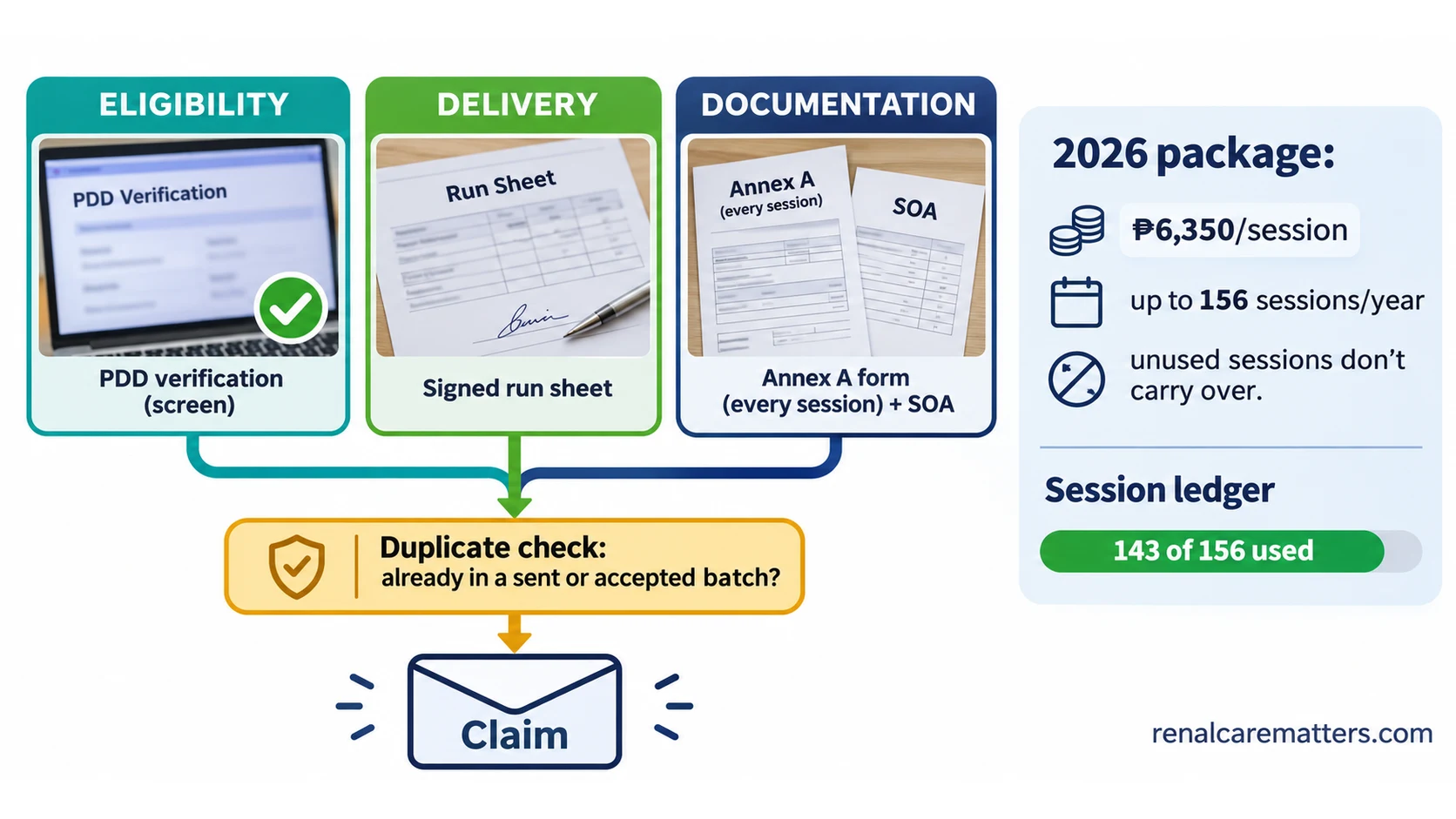
Figure 2. Three proofs and a duplicate check. Eligibility, delivery, and documentation are proved separately.
Proof
Question
Evidence
Not enough on its own
Eligibility
Is this person covered on this date?
Current PDD registration and the verification result for the service date
“She was registered last year”
Delivery
Did the treatment happen?
The authenticated run sheet for that date, signed and complete
The schedule; the attendance list; a registered patient
Documentation
Does the paperwork match?
Signed Annex A; the SOA and claim form per current specifications; any co-payment itemized exactly as on Annex A
A complete run sheet with no Annex A
Figure 3 · The claim packet
EligibilityCurrent PDD registration and the verification result for the service date, with proof of the check.
DeliveryThe authenticated run sheet for that date, signed and complete.
DocumentationThe signed Annex A; the SOA and claim form per current specifications; any co-payment itemized exactly as on Annex A.
Duplicate checkHas this patient, date, and service appeared in any sent or accepted batch? If so, stop and reconcile.
Cancellations and partial sessions
Patients are sent to the emergency room before needling. Machines fail. Patients arrive, feel unwell, and go home. The scheduler may still have staged the session, because the schedule does not know what happened at the chair.
A session canceled before treatment is not a delivered service, however complete the rest of its paperwork looks. A session that started and ended early is a clinical question: the run sheet shows what was delivered, and the claims lead decides, under current PhilHealth rules, how it is handled. Your job is to make sure the run sheet says clearly which of the two happened.
Stop and callA session canceled before treatment goes on exception with the documented cancellation. It is never claimed, whatever the staging list says. If you are told to claim it anyway, write down who asked and escalate to the facility head.
Duplicates
Duplicates usually come from honest causes: a batch resent after a network error, a service staged twice by two staff members, or a corrected claim filed without retiring the original. Before any batch goes out, check every row against every sent and accepted batch for the same patient, date, and service. Claiming one session twice, even by accident, is a payment the unit will have to explain and return.
On the floor · Registered, scheduled, not treated
Mr. Gregorio Santos is registered in the PhilHealth Dialysis Database and booked for Friday morning. On Friday his daughter calls: he was admitted to hospital overnight. The schedule still shows him, and the staging list picks up the session.
The records officer checks the three proofs. Eligibility: yes. Delivery: no run sheet, because no treatment happened. The session is removed from the batch with the daughter’s call documented.
Eligibility and a booking are two of three legs. Without the run sheet, the stool falls.
Illustrative scenario. Names and details are invented.
Lesson · part 3
The session ledger and corrections
For each patient, per calendar year, keep a session ledger.
Column
Why it matters
Sessions accepted
Paid; counted against the cap
Sessions pending
Delivered and sent or held; will count when accepted
Sessions returned
Need correction; still delivered
Sessions remaining of 156
What is left for the year
Projected cap date
When coverage will run out at the current schedule
Remaining = 156 − accepted − pending. Three sessions a week use about 13 a month; 156 sessions at that pace reach the cap near the end of December. One extra session a month brings the cap forward by about a month.
The projection matters to people, not only to claims. Sessions beyond 156 are not covered, and a family that learns this in the third week of December has no time to plan. Tell the patient, the social worker, and the claims lead early, ideally by October for anyone whose ledger is ahead of pace. Extra sessions for fluid overload, a hospital stay that used dialysis sessions, or a transfer-in partway through the year are the usual reasons a patient runs ahead.
The toolkit’s session-ledger calculator does the counting and the projection.
Returned claims
For a return to hospital, log the reason, fix the underlying document through its owner, keep both the original submission and the corrected one, and mark the item corrected only when the amended document and the new acknowledgment are both traceable. Never resubmit an unchanged batch under a new identifier. That is not a correction; it is a second claim for the same service.
RememberEligibility is not delivery, and delivery is not documentation. Prove each, then check for duplicates.
Mrs. Adoracion Villafuerte needed extra sessions in June and July for fluid overload. On October 5 her ledger shows 138 sessions used, and the projection puts her cap in the third week of November.
The records officer tells the claims lead, who tells the social worker, who meets the family. They apply for assistance from the local government and a charity program, and when the cap arrives, the remaining sessions are covered.
The same number on December 15 would have been a crisis. On October 5, it was a plan.
Illustrative scenario. Names and details are invented.
On the floor
Real situations: problems and solutions
These are fictional but typical. For each one, cover the answer, decide what you would do, then compare. Where a step depends on local rules, your unit’s procedure and your supervisor’s direction come first.
Annex A signed in advance
What you see
You find a patient’s Annex A forms for next week already signed.
What is likely going on
A shortcut to save time on busy days.
What to do
Stop it kindly, explain that Annex A is signed for each session delivered, and tell the charge nurse and the claims lead.
Why it matters
A form signed before a session cannot prove the session happened.
The patient who will hit the cap in November
What you see
A patient’s ledger shows 140 sessions used by October 20 because of extra sessions for fluid overload.
What is likely going on
A patient running well ahead of pace.
What to do
Project the cap date, tell the claims lead, the social worker, and the patient now, and document that you did.
Why it matters
Families need weeks to plan for uncovered sessions.
The resubmitted batch
What you see
After a network error, a clerk plans to resend yesterday’s batch under a new batch number.
What is likely going on
A fix that may create duplicates.
What to do
Check whether any rows were received before resending, and resend only rows with no acknowledgment, through the claims lead.
Why it matters
A session claimed twice must be explained and returned.
The transfer-in mid-year
What you see
A patient transfers in during August from a unit in Cebu.
What is likely going on
Sessions already used at the previous unit count toward this year’s cap.
What to do
Ask the previous unit and the patient for the session count, and start your ledger from it.
Why it matters
The annual count follows the patient, not the unit.
Canceled but complete
What you see
A session canceled because of fever has a fully completed Annex A.
What is likely going on
The form was signed at arrival, before the cancellation.
What to do
Mark the session as canceled before treatment, exclude it from claims, and note the reason with the run sheet.
Why it matters
A complete form does not turn a canceled session into a delivered one.
Field notes
Attach each session to the circular in force on its service date.
Check every batch for duplicates before it leaves.
Review ledgers of patients ahead of pace every October.
Keep originals and corrections of returned claims together.
When a staging list and a run sheet disagree, the run sheet wins.
Case review
Back to the case: Four rows, one patient
D1 and D4. They are the same November 3 service. Batch B-14 already accepted it, so D1 must not be submitted again. Reconcile the two identifiers with Ms. Lopez and find out how the service came to be staged twice, so the cause can be fixed.
D2. Exception: canceled before treatment, with the run sheet note as evidence. Never claimed.
D3. Held until Annex A is signed. Ask the charge nurse to have Mrs. Ramos sign at her next session, and check that the date on the form is the service date.
The cap. 156 − 141 accepted − 2 pending leaves 13 sessions. At three a week from November 9, the last covered session is Monday, December 7. Mrs. Ramos will have about three and a half weeks of uncovered sessions before the new year. Tell Ms. Lopez, the social worker, and Mrs. Ramos now, while there is still time to plan.
The four rows looked like a claims problem. The most important finding was a family about to face three weeks of uncovered dialysis. Part of your role is to see that in a ledger before December does.
Skills lab · with your preceptor
Skills checklist: Claims readiness and the session ledger
Disposition a fictional claims staging list and update the session ledger while your preceptor observes. Your preceptor rates each step as satisfactory, needs practice, or not observed. Steps marked Critical must all be satisfactory before sign-off. This checklist supports supervised learning; your unit’s own procedure and competency form are the authority. A printable version of every checklist is on the trainer page.
States the rate, cap, eligibility rule, and per-session form, each with its source and effective date.
Proves eligibility, delivery, and documentation separately for each session.
CriticalExcludes a session canceled before treatment.
CriticalDetects a service already in a sent or accepted batch and stops resubmission.
Computes sessions remaining and projects the cap date.
Notifies the claims lead, patient, and social worker of an early cap.
Preserves original and corrected submissions for a returned claim.
Placement activity. Pick three patients and reconcile their session ledgers against this year’s accepted batches. Project each one’s cap date.
Self-assessment
Check your understanding
Each visit draws 8 questions at random from this module’s 15-question bank. Choose the single best answer for each, then select Check answers; an explanation appears under the best answer. Select New set of questions for a different mix. A good target is 7 of 8 on two different sets. Nothing you select is sent anywhere; scoring happens in your browser.
Philippine Health Insurance Corporation. (2024). PhilHealth Circular No. 2024-0023: Institutionalization of 156 hemodialysis sessions and coverage expansion (Revision 2).
Philippine Health Insurance Corporation. (2025, March 27). PhilHealth’s expanded benefits bring financial relief to dialysis patients [News release]. https://www.philhealth.gov.ph/news/up/article/2025/news_67e9e793775ed.php
Philippine Health Insurance Corporation. (2023). PhilHealth Circular No. 2023-0009: Institutionalization of 156 hemodialysis sessions. https://www.philhealth.gov.ph/circulars/2023/PC2023-0009.pdf
Philippine Health Insurance Corporation. (2025). PhilHealth Advisory No. 2025-0035: Effectivity of lifting of the 45-day benefit limit rule. https://www.philhealth.gov.ph/advisories/2025/PA2025-0035.pdf
Educational material for records staff. Completing it is an Academy learning record only. It does not confer DOH-recognized training credit, a facility designation, or system access, and it does not replace current regulations, your facility’s records manual, or advice from your data protection officer or counsel.