Exercise types, objectives and injects, the facilitator's script, the watcher rule, the hot wash, and the after-action report.
PublishedNailathalaGipatikPepalwal:ReferencesMga SanggunianMga TinubdanReng Reperensya:5Audience: Every member of the dialysis unit: hemodialysis, charge, head and safety nurses, physicians-on-duty, the Dialysis Clinical Head and attending nephrologists, dialysis, water treatment, biomedical and reprocessing technicians, nurse assistants and support staff, social workers, records officers, dietitians, unit managers and ownersRead timeOras ng pagbasaOras sa pagbasaOras ning pamamasa:
This module is study material for dialysis teams. It explains the reasoning behind disaster decisions; it is not a unit protocol or an order set. Early dialysis, shortened sessions, priority rosters and emergency diets are decisions of the attending nephrologist and the Dialysis Clinical Head. Escalation follows your unit protocol, and you always ask the attending nephrologist for guidance. Every case, name, and identifier is fictional.
Learning objectives
After this module you should be able to
Choose the right exercise type: orientation, drill, tabletop, functional or full-scale.
Write one or two objectives and a set of timed injects for a dialysis tabletop exercise.
Run a drill safely on a working floor with a named watcher, and never run an evacuation drill with patients on machines.
Lead a hot wash and write a one-page after-action report with owned, dated actions.
State what the evidence shows about drills, and what it does not.
Classroom 1 hSkills lab 0.5 hSupervised placement 0 h
Pre-testBefore you read, answer the 5 self-assessment questions and note your score. After the module, select New set of questions and compare. The difference is what you learned; the questions you still miss are what to reread.
Start here
The big picture, in plain words
In plain wordsA drill is a rehearsal, and like any rehearsal its value is in the mistakes. A play that runs perfectly in rehearsal teaches nothing; a rehearsal where a door sticks and an actor forgets a line saves the opening night.
The picture has a limit. A missed line in a rehearsal costs nothing, but a dialysis drill happens beside real patients on real machines. So the first rule of every drill is protecting the patients still dialyzing, and the second is that every problem found gets an owner and a date. A drill that finds problems and fixes none is a performance, not a rehearsal.
The facilitator is the unit’s safety nurse (or the head nurse, where none is designated), with the unit manager owning the schedule and the Dialysis Clinical Head leading the clinical decisions in a tabletop. The full drill table is on the facilitator kit page.
Figure 1 · Key terms for this module
Tabletop exerciseA discussion-based exercise where the team talks through a scenario and decides actions, without moving patients or equipment.
InjectA new piece of information released during an exercise, such as “the generator is at 30% fuel.”
Hot washA short debrief immediately after the exercise.
After-action reportThe one-page record of what the exercise showed, with actions, owners and dates.
WatcherThe staff member whose only job during a drill is the patients still dialyzing.
Functional exerciseAn exercise that tests one function (such as communications) with real actions but no full deployment.
Opening case · fictional
Case: Her first tabletop
Ms. Angela Ramos, a nurse in a 16-station unit in Davao City, has just been named the unit’s safety nurse. Typhoon season is six weeks away. The unit manager asks her to run the unit’s first disaster tabletop exercise next Saturday afternoon, after the last shift, with the head nurse, two charge nurses, the water and biomedical technicians, the social worker, the records officer and the Dialysis Clinical Head.
She has 90 minutes, a printed floor plan, the unit’s one-page plan, and the tabletop simulator on the practice page. The unit manager says, “Make sure it shows what we need to fix before the season.”
Before reading on, decide:
What exercise type fits, and what are her one or two objectives?
What injects would test the unit’s weakest points?
What does she hand the unit manager at the end?
Keep your answers in mind. The lesson gives you what you need, and the case review near the end shows one sound response.
Lesson · part 1
Choose the right exercise
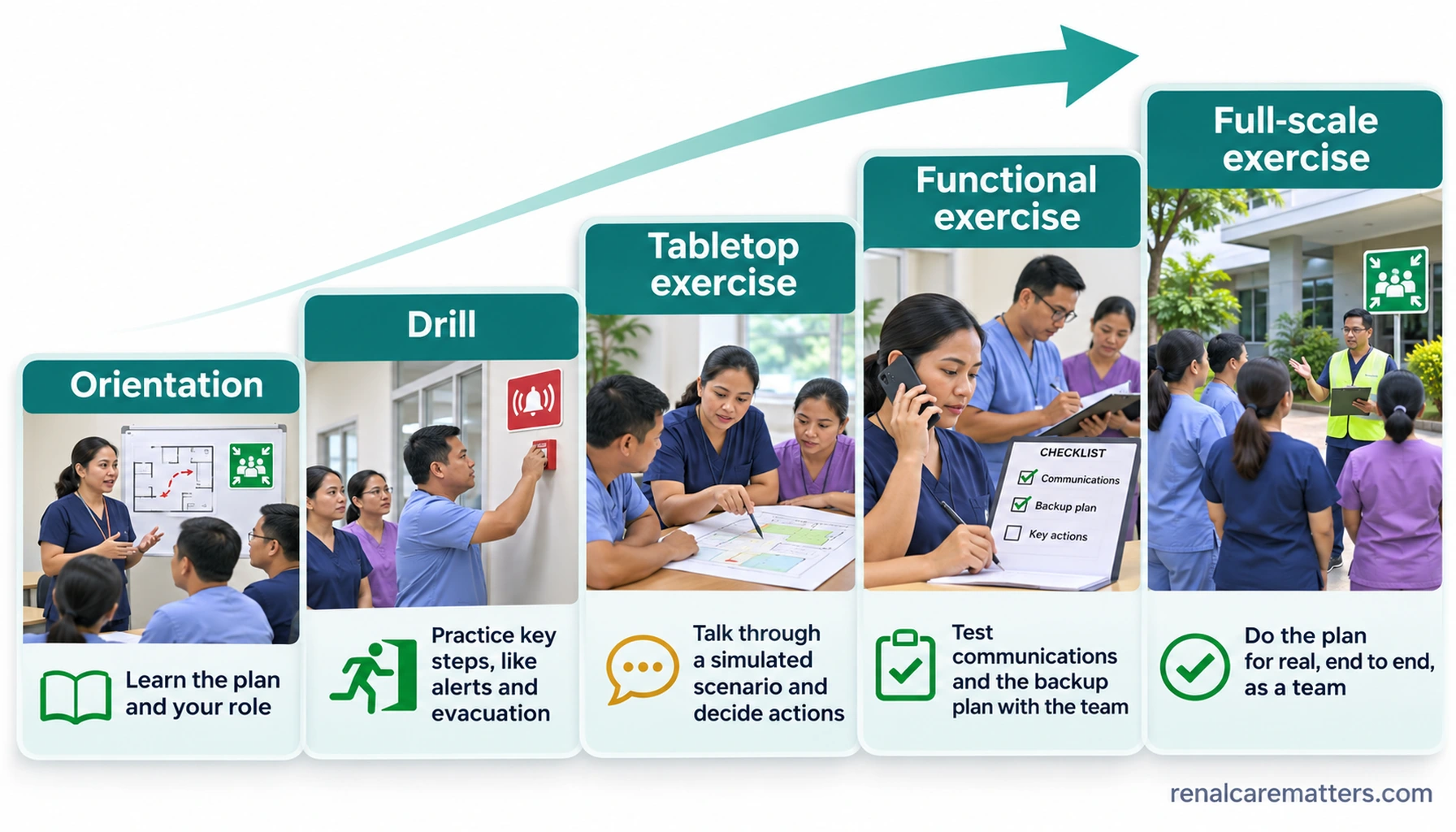
Exercises climb a ladder from talking to doing. Start low and climb as the plan matures.
Figure 2. Exercises climb from talking through the plan to doing it for real.
Type
What happens
Good for
Orientation
Walk through the plan and each role
New staff, a new plan
Drill
Practice one skill: the take-off, the hand crank, the census
Hands-on steps (Modules 6 to 8)
Tabletop
Talk through a scenario and decide actions as injects arrive
Decisions, roles, gaps in the plan
Functional
Test one function for real, such as the call-down or the radio tree
Communications, tracking
Full-scale
Run the plan end to end with the whole team
A mature plan, with no patients on machines
The drill program on the facilitator kit page sets a suggested rhythm: a call-down check and a tabletop before typhoon season, a power-loss drill twice a year, an earthquake drill with the quarterly Nationwide Simultaneous Earthquake Drill (NSED), and an evacuation drill yearly. These frequencies are Academy suggestions, not legal requirements.
Lesson · part 2
Objectives, injects and the script
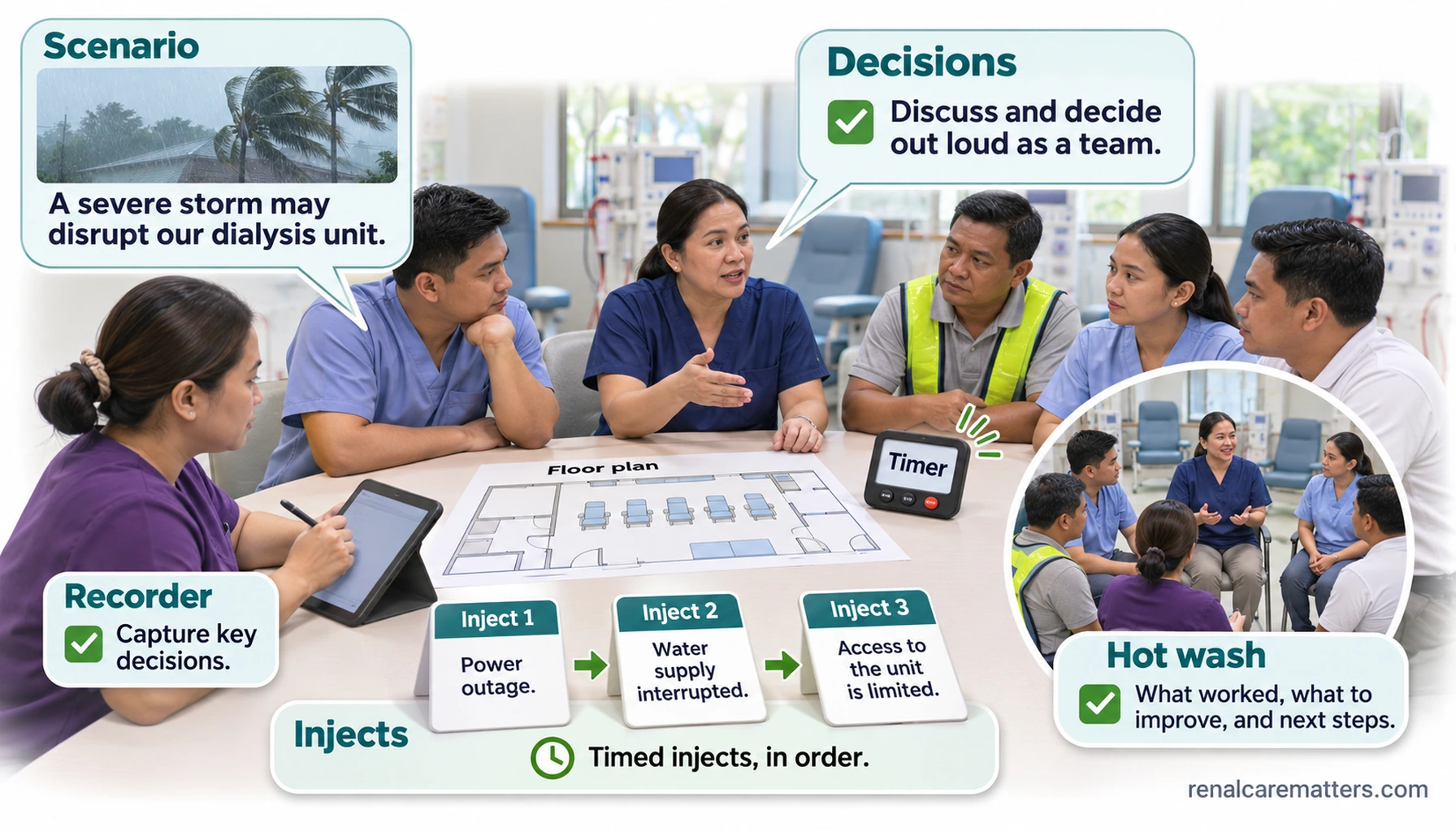
A good tabletop has one or two objectives and a handful of injects aimed at them.
Figure 3. A tabletop exercise: a scenario, timed injects, decisions out loud, and a hot wash at the end.
Objectives: specific and checkable, for example “the team names the incident lead and deputy for each shift” or “the team decides early dialysis for the Thursday group within 15 minutes of Signal No. 2.”
Scenario: realistic for your unit, from the hazard matrix (Module 2).
Injects: released on a clock, each forcing a decision: “Philippine Atmospheric, Geophysical and Astronomical Services Administration (PAGASA) raises Signal No. 3; two nurses cannot come in.” “The generator is at 30% fuel.” “Patient 14 has not answered two calls.” “The receiving unit’s contact does not answer.”
Roles: the facilitator (does not play), a recorder who logs decisions and times, and the team in their real roles.
The script: a short opening (objectives, ground rules: no blame, decide out loud), the injects, and the hot wash.
The tabletop simulator on the practice page releases injects on a clock and records the team’s actions; its timeline becomes the after-action report’s evidence.
Lesson · part 3
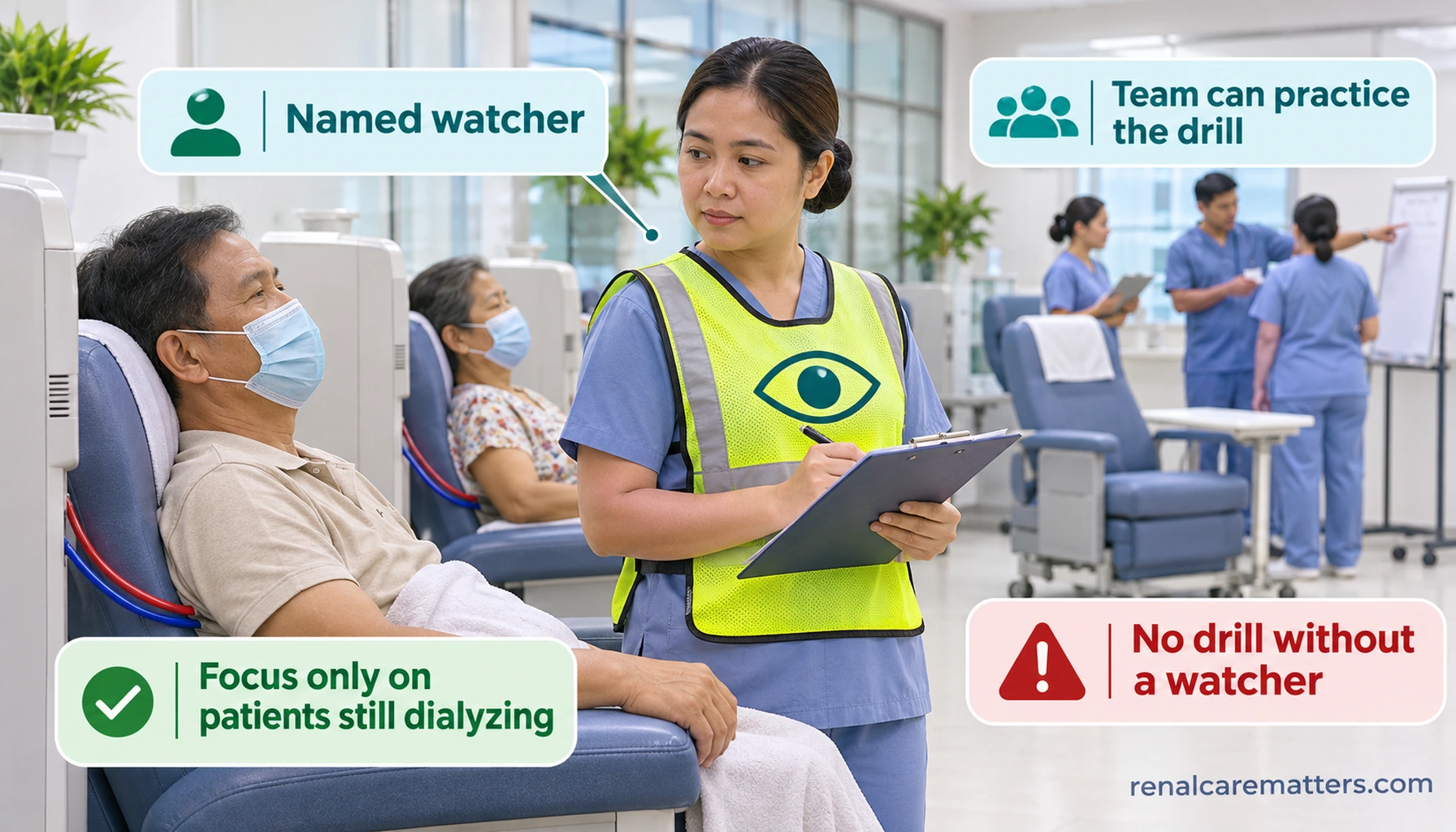
The watcher rule
No drill on a working floor without a named watcher whose only job is the patients still dialyzing. The watcher does not join the drill, answers every alarm, and can stop the drill at any time.
Figure 4. No drill on a working floor without a named watcher whose only job is the patients still dialyzing.
Hands-on drills (take-off, hand crank) use an empty station, a manikin and a training circuit, never a live patient.
No evacuation drill with patients on machines. Patients take part in an earthquake drill only in the protect-in-place step, only if they agree.
Hospital-based units drill inside the hospital plan and its emergency preparedness committee;1,2 freestanding units coordinate routes and warnings with the local disaster risk reduction and management office (LDRRMO).3
Lesson · part 4
The hot wash and the one-page report
The hot wash happens right after the exercise, while memory is fresh: what worked, what did not, what surprised us. Keep it short and about the system, not the person.
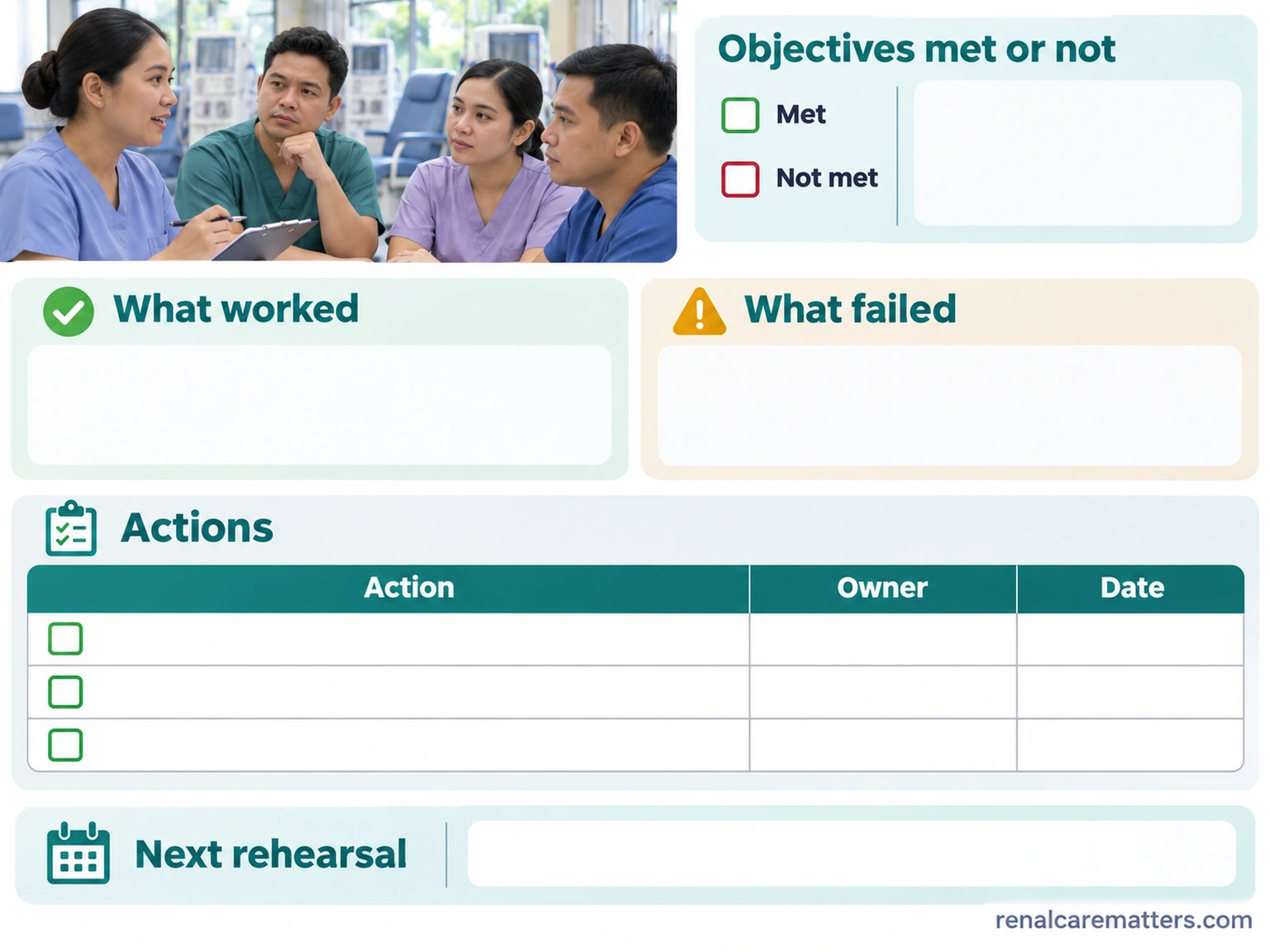
Figure 5. The after-action report: one page, with every action owned and dated.
The after-action report is one page: objectives met or not; what worked; what failed; actions, each with an owner and a date; and when the team will rehearse again. The unit manager keeps disaster records; the Dialysis Clinical Head reviews them each quarter with the resuscitation records. An action with no owner is not an action.
What the evidence shows. A systematic review of hospital mass-casualty training found that drills help staff learn procedures and expose problems, but study quality was low and none of the studies tested tabletop exercises.4 In one Taiwanese hemodialysis unit, tabletop simulation, drills and audits raised staff fire-response knowledge and skill scores from about 58% to 100%: one before-and-after project, showing feasibility, not proof.5 Drill effectiveness is supported by low-quality evidence. Drill because a drill finds the problem before the disaster does.
RememberOne or two objectives, injects aimed at them, a watcher for the real patients, and a one-page report with an owner and a date for every action.
On the floor
Real situations: problems and solutions
These are fictional but typical. For each one, cover the answer, decide what you would do, then compare. Where a step depends on local rules, your unit’s procedure and your supervisor’s direction come first.
The perfect drill
What you see
A tabletop ends with everyone agreeing the plan worked and no actions listed.
What is likely going on
The injects were too easy, or the team avoided naming problems.
What to do
Rewrite injects aimed at known weak points, and ask in the hot wash, “What surprised us?”
Why it matters
A drill with no findings usually missed them.
The drill that took the watcher
What you see
During a power-loss drill, the nurse named as watcher joins to help with the hand crank.
What is likely going on
The real patients are now unwatched.
What to do
Stop the drill; the watcher returns to the patients.
Why it matters
The watcher rule protects the patients still dialyzing.
The report in a drawer
What you see
Last year’s after-action report lists five actions; none was done.
What is likely going on
Actions had no owners or dates.
What to do
Assign an owner and a date to each, and review them at the next quarterly meeting.
Why it matters
Owned, dated actions are what change practice.
Field notes
Use the tabletop simulator’s timeline as the after-action report’s evidence.
Schedule the next rehearsal before the hot wash ends.
Case review
Back to the case: Her first tabletop
Type and objectives. A tabletop fits a first exercise: it tests decisions and roles without moving anyone. Two objectives: the team names the incident lead and deputy for each shift and activates the plan at the right signal; and the team decides early dialysis and finds every patient within the exercise’s 24-hour clock.
Injects. Aim them at the weak points from the hazard matrix and the last disruption: Signal No. 2 raised on a Sunday; two nurses cannot come in; the generator at 30% fuel; Patient 14 not answering; the receiving unit’s contact retired. Run them from the tabletop simulator so the timeline is recorded.
What she hands over. A one-page after-action report: objectives met or not, what worked, what failed, and each action with an owner and a date (for example, “update receiving-unit contacts: unit manager, by July 1”), plus the date of the next rehearsal. That is what the unit manager asked for: what to fix before the season.
Skills lab · with your preceptor
Skills checklist: Facilitator capstone: plan, run and report a tabletop
Plan and run one tabletop exercise for your unit, observed by an experienced facilitator, the head nurse or the Dialysis Clinical Head. Your preceptor rates each step as satisfactory, needs practice, or not observed. Steps marked Critical must all be satisfactory before sign-off. This checklist supports supervised learning; your unit’s own procedure and competency form are the authority. A printable version of every checklist is on the trainer page.
CriticalWrites one or two specific, checkable objectives.
Prepares at least four injects aimed at the objectives, with a timeline.
Names a recorder and does not play a role as facilitator.
CriticalNames a watcher for any patients still dialyzing and never runs an evacuation drill with patients on machines.
Leads a hot wash focused on the system, not individuals.
CriticalWrites a one-page after-action report with an owner and date for every action.
Placement activity. File the after-action report with the unit manager and schedule the next rehearsal.
Self-assessment
Check your understanding
Each visit draws 5 questions at random from this module’s 10-question bank. Choose the single best answer for each, then select Check answers; an explanation appears under the best answer. Select New set of questions for a different mix. A good target is 4 of 5 on two different sets. Nothing you select is sent anywhere; scoring happens in your browser.
Glossary & abbreviationsTalahulugan at mga daglatTalaan sa mga pulong ug daglatTalatinigan ampo reng daglatterms used on this page
Abbreviations
LDRRMO
Local disaster risk reduction and management office — The city or municipal office for warnings, evacuation and local response.
NSED
Nationwide Simultaneous Earthquake Drill — The quarterly national earthquake drill led by the Office of Civil Defense.
PAGASA
Philippine Atmospheric, Geophysical and Astronomical Services Administration — The national weather agency; it raises the tropical cyclone wind signals.
Terms in plain words
Tabletop exercise
A discussion-based exercise through a scenario, without moving patients or equipment.
Inject
New information released during an exercise.
Hot wash
A short debrief right after the exercise.
After-action report
The one-page record with actions, owners and dates.
Watcher
The staff member whose only job during a drill is the patients still dialyzing.
Functional exercise
An exercise that tests one function with real actions.
Department of Health. (2019, October 29). National policy on disaster risk reduction and management in health (DRRM-H) (Administrative Order No. 2019-0046). Republic of the Philippines.
Hsu, E. B., Jenckes, M. W., Catlett, C. L., Robinson, K. A., Feuerstein, C., Cosgrove, S. E., Green, G. B., & Bass, E. B. (2004). Effectiveness of hospital staff mass-casualty incident training methods: A systematic literature review. Prehospital and Disaster Medicine, 19(3), 191–199. https://doi.org/10.1017/s1049023x00001771
Lin, W.-H., Lin, Y.-J., Wang, M.-F., Yeh, S.-M., Hsu, T.-C., & Chang, Y.-T. (2021). [A project to improve the ability of hemodialysis staff to respond to fire emergencies]. Hu Li Za Zhi, 68(2), 65–74. https://doi.org/10.6224/JN.202104_68(2).09
Educational course and drill resource for dialysis units. It is not a hospital disaster plan, a licensing requirement, or a substitute for your unit’s approved protocol, the machine manufacturer’s instructions, or instructions from PAGASA, PHIVOLCS, the Bureau of Fire Protection or your local disaster office. Clinical decisions in a disaster (early dialysis, shortened sessions, priority, diet) belong to the attending nephrologist.