The causal chain from warning to restart, what the studies show and their limits, and the hazards a Philippine unit plans for.
PublishedNailathalaGipatikPepalwal:ReferencesMga SanggunianMga TinubdanReng Reperensya:12Audience: Every member of the dialysis unit: hemodialysis, charge, head and safety nurses, physicians-on-duty, the Dialysis Clinical Head and attending nephrologists, dialysis, water treatment, biomedical and reprocessing technicians, nurse assistants and support staff, social workers, records officers, dietitians, unit managers and ownersRead timeOras ng pagbasaOras sa pagbasaOras ning pamamasa:
This module is study material for dialysis teams. It explains the reasoning behind disaster decisions; it is not a unit protocol or an order set. Early dialysis, shortened sessions, priority rosters and emergency diets are decisions of the attending nephrologist and the Dialysis Clinical Head. Escalation follows your unit protocol, and you always ask the attending nephrologist for guidance. Every case, name, and identifier is fictional.
Learning objectives
After this module you should be able to
Explain why a disaster harms a dialysis patient twice: first through the event, then through missed treatment in the days after it.
Trace the six links of the causal chain (warning, event, access, physiology, late presentation, restart) and name the place where the unit can act at each link.
Describe what the disaster studies show about missed sessions, early dialysis, planning and patient self-disconnection, and state the limits of that evidence in the right words.
Name the hazards a Philippine dialysis unit plans for and the agencies that warn about them.
Classroom 1 hSkills lab 0.5 hSupervised placement 0 h
Pre-testBefore you read, answer the 5 self-assessment questions and note your score. After the module, select New set of questions and compare. The difference is what you learned; the questions you still miss are what to reread.
Start here
The big picture, in plain words
In plain wordsPicture a dialysis unit as a bridge that patients must cross three times a week. A disaster can shake the bridge while people are on it, and it can also close the bridge for days. The shaking is frightening, but more people are hurt by the days the bridge stays closed, because the river of water, salt and potassium keeps rising on the far side.
The picture has a limit. A closed bridge simply waits. A body without dialysis does not wait: every day without treatment adds a day of water, salt, potassium and acid to a patient who cannot remove them. And in a disaster the bridge does not close for everyone at once. Some patients are stranded, some reach another unit, and some arrive days later at a hospital that is itself running on a generator.
This module gives the whole course its logic. Each later module sits on one link of the chain below and teaches what the unit can do there.
Figure 1 · Key terms for this module
DisasterAn event that harms many patients at once or stops the unit from treating them, such as a typhoon, flood, earthquake, fire, outage or outbreak.
Missed sessionA scheduled hemodialysis treatment that does not happen.
Early dialysisA session moved ahead of schedule because a disruption is expected.
Receiving unitAnother dialysis unit that agrees to treat your patients when yours cannot.
RestartReopening the unit after a disruption, only when it is safe to treat again.
Observational studyA study that watches what happened without assigning treatments; it shows associations, not proof.
Opening case · fictional
Case: Four days in Marikina
A freestanding 14-station unit in Marikina closes for four days after floodwater reaches its ground floor. It reopens on a Friday. By the end of the first shift, the head nurse has a list: of 52 patients, 31 dialyzed somewhere during the closure, 14 missed one or two sessions, and 7 missed three or more. Two of those seven are in the hospital with fluid overload and a potassium above 7 mmol/L.
The head nurse asks the safety nurse a simple question: “Why these seven?” The safety nurse checks the call log. Four had a wrong or old phone number. Two live in barangays where the roads flooded first. One said, “Nobody told me the other unit would take me.”
Before reading on, decide:
At which link of the chain was each of the seven patients lost?
Which of those losses could the unit have changed before the flood?
What would you measure next season to know whether the plan worked?
Keep your answers in mind. The lesson gives you what you need, and the case review near the end shows one sound response.
Lesson · part 1
Six links, and a place to act at each one
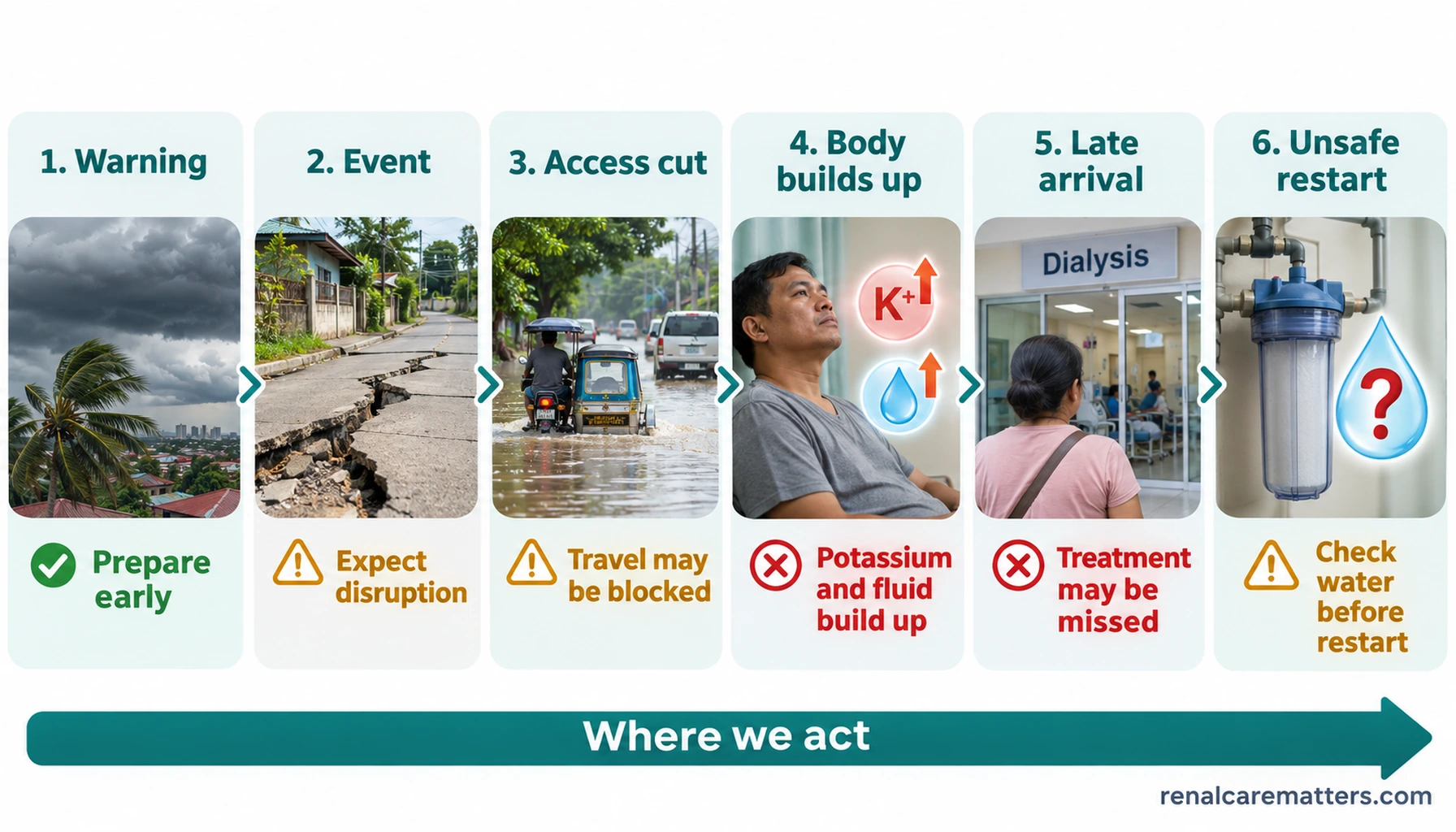
Disasters harm dialysis patients through a chain that repeats from storm to storm and country to country.1 Seeing it as a chain matters, because each link has a different owner and a different fix.
Figure 2. Disasters hurt dialysis patients twice: through the event, then through missed treatment. Each link is a place to act.
Link
What happens
Where this course acts
1. Warning
The storm is coming; staff and patients are not told what to do
Activation triggers, early dialysis, call-down (Modules 3 and 5)
2. Event
Patients are on machines when the ground shakes, the power fails or a fire starts
Protect in place, take-off and evacuation, quick cards (Modules 6 to 8)
3. Access
Roads flood, the unit closes, the patient cannot reach any unit
Receiving-unit agreements, patient tracking (Modules 3 and 10)
4. Physiology
Missed sessions; salty, potassium-rich relief food; no medicines
Emergency diet, emergency card, priority roster (Modules 4 and 10)
5. Late presentation
The patient arrives with high potassium and fluid overload, often at a hospital on a generator
Handoff to the Resuscitation Lab and the physician modules
6. Restart
The unit reopens before water, power or machines are safe
Five signed restart gates (Module 11)
Link 4 is the reason a missed session is dangerous. A failed kidney no longer removes the water, salt, potassium and acid that enter the body each day. Dialysis opens the drain for a few hours, then closes it until the next session. Each missed session adds two or three more days of intake to a body that cannot clear it, and relief food (instant noodles, canned meat, dried fish) is often high in salt and potassium. Potassium can reach a level that disturbs the heart rhythm before the patient feels short of breath, so a patient who looks well can still be in danger.
RememberThe event is the first harm; missed treatment is the second and usually the larger. Every link of the chain has a place where the unit can act before the disaster.
Lesson · part 2
What the evidence shows, and what it does not
Most of the evidence comes from United States hurricanes and Japanese earthquakes, because those events were studied. None of it comes from randomized trials. That is not a reason to ignore it; it is a reason to use the right words.
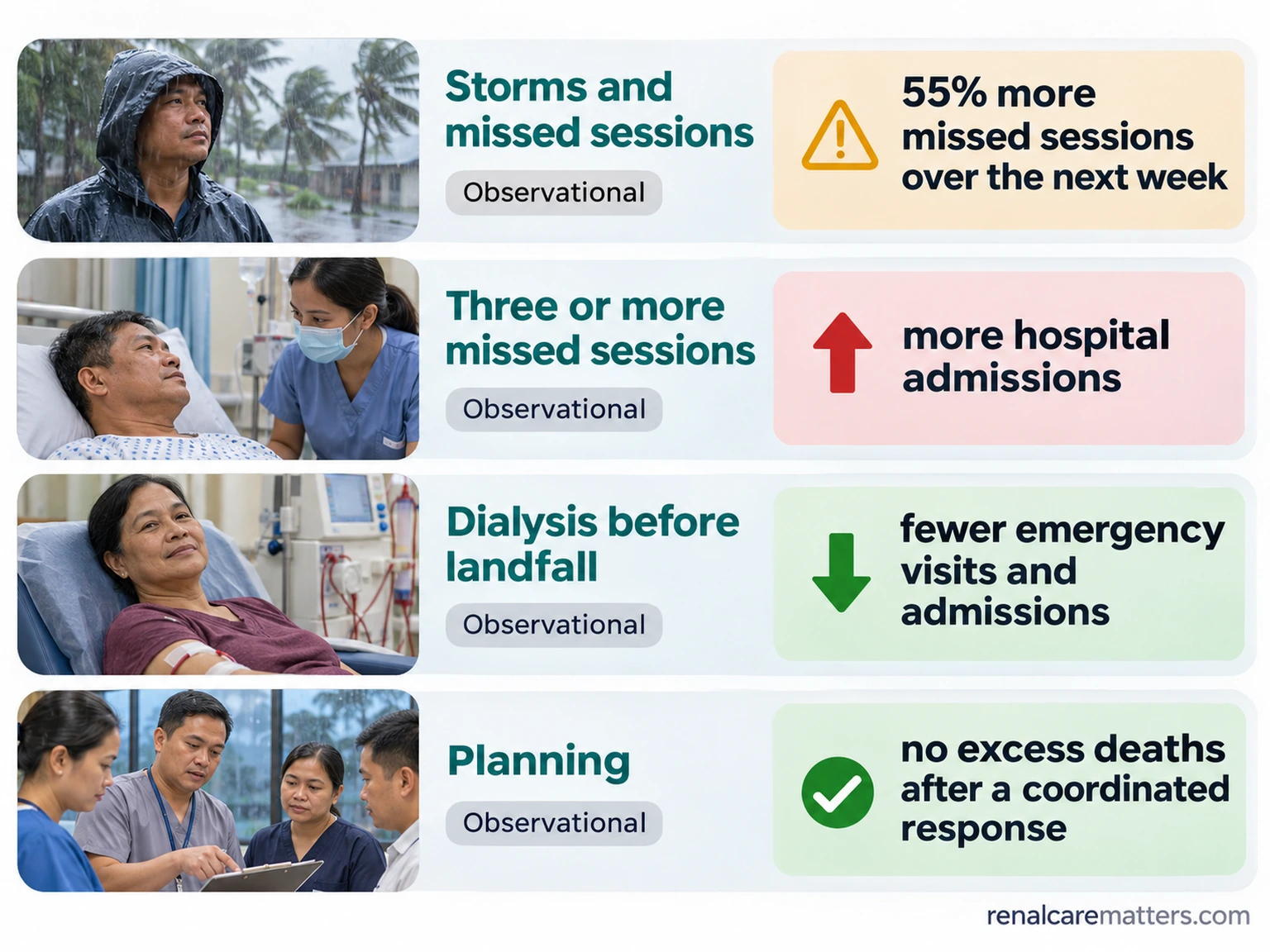
Figure 3. What the studies show, and their limit: every finding is an association from observational data.
Missed sessions follow storms. In 60,135 patients in the northeastern United States, exposure to a hurricane or tropical storm was associated with a 55% higher risk of missed appointments over the following week (rate ratio 1.55, 95% confidence interval 1.22 to 1.98).2
Missing three or more sessions is associated with hospitalization. Among 386 New Orleans patients after Hurricane Katrina, 44% missed at least one session and about 17% missed three or more. Patients who did not know their unit’s emergency plan were among the more likely to miss three or more, and missing three or more was associated with hospitalization (adjusted odds ratio 2.16, 95% confidence interval 1.05 to 4.43).3
Early dialysis before landfall is associated with better outcomes. Of 13,836 patients in the areas hit by Hurricane Sandy, 60% were dialyzed ahead of schedule. Early dialysis was associated with lower odds of an emergency department visit (odds ratio 0.80), hospitalization (0.79) and death within 30 days (0.72, 95% confidence interval 0.52 to 0.997). The study could not tell who was offered early dialysis and declined, so healthier patients may have been the ones who came.4
A regional response can prevent excess deaths. In patients from 94 clinics hit by Katrina, the storm was not significantly associated with mortality in adjusted models.5 After Hurricane Maria, many patients were dialyzed outside Puerto Rico, and mortality did not change significantly; the authors suggest preparedness as one explanation.6 Both findings argue that planning works. Neither shows that disasters are harmless.
Patients cannot be relied on to self-disconnect. In 626 hemodialysis patients in 10 centers across six countries, 20.0% had been trained in emergency self-disconnection and 22.4% said they knew how; on a checklist, 40.3% identified the first stage correctly and 38.3% the second.7 This course’s position follows: patients are not taught to self-disconnect. They stay calm, stay connected, protect the access arm and wait for staff (Module 4).
Reviews of disasters and kidney care describe the same failures again and again: no written plan, patients with no emergency instructions or diet advice, lost records, staff who cannot reach work, and no agreements with backup units.1,8,9 A 2026 scoping review of 30 studies from 10 countries found that, in 10 of 11 studies that measured it, 23% to 59% of patients had their dialysis disrupted, and it named lack of preparedness among the risk factors for worse outcomes.10
RememberSay “is associated with” for these findings, never “prevents death.” The direction is consistent: units that plan, warn and move sessions early keep more patients dialyzed.
Lesson · part 3
The hazards a Philippine unit plans for
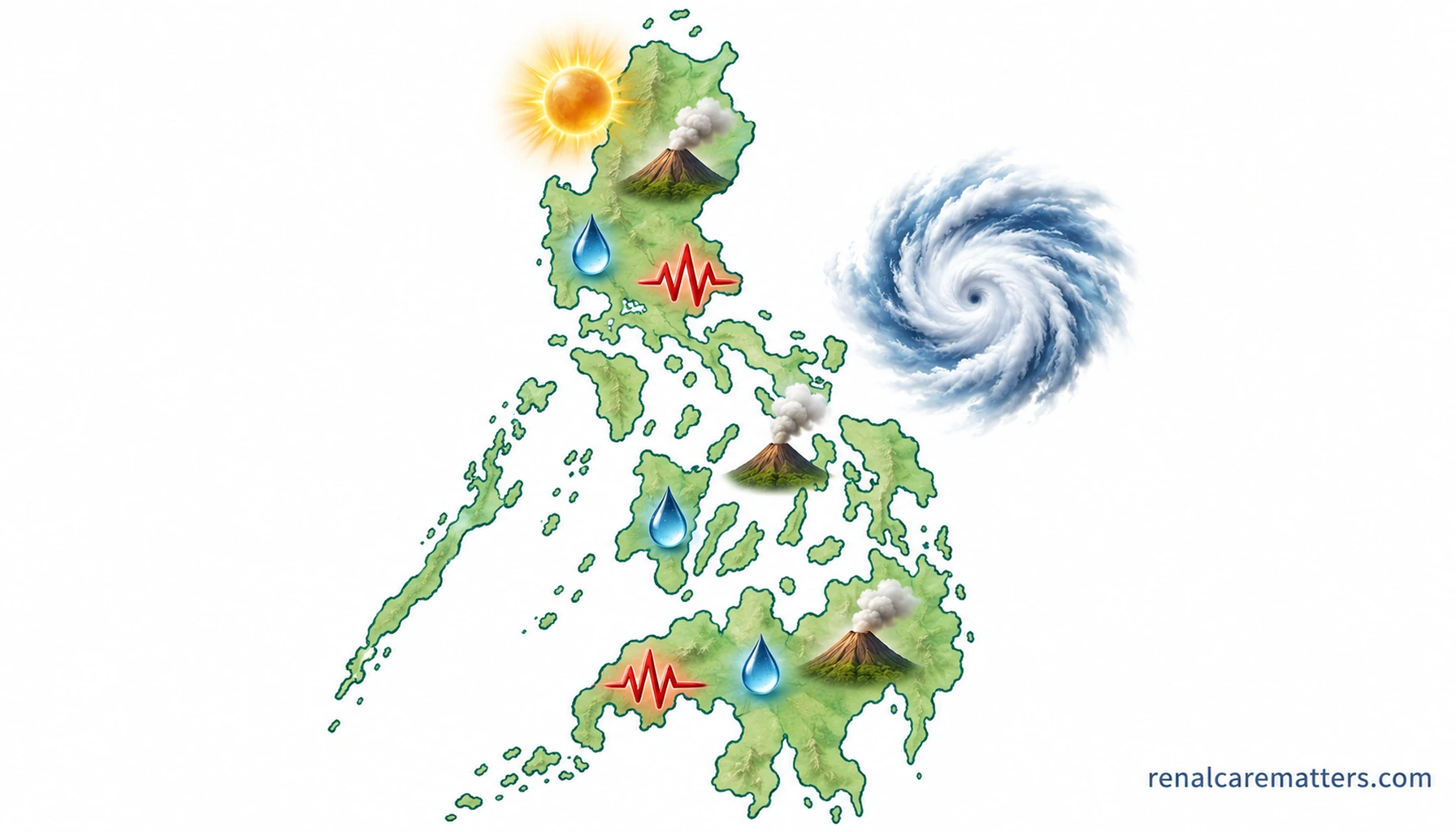
The Philippines faces nearly every hazard on this list, often in the same year: typhoons and the floods that follow them, earthquakes, volcanic eruptions and ashfall, extreme heat, fires, long power interruptions, water supply failures, and infectious outbreaks. Each hazard reaches a dialysis unit through the same few dependencies: power, water, staff, supplies, transport, records and communications (Module 2).
Figure 4. Typhoons, floods, earthquakes, volcanoes and heat: the hazards a Philippine dialysis unit plans for.
Hazard
Who warns
Warning time
Module
Typhoon and flood
PAGASA (wind signals and rainfall warnings); the local disaster risk reduction and management office (LDRRMO)
Hours to days
5
Earthquake
PHIVOLCS (reports after the event; tsunami warnings)
None
6
Fire
The unit’s own alarm; the Bureau of Fire Protection responds
None
7
Power and water failure
Utility notices for planned interruptions; none for faults
None to days
8
Heat, ashfall, outbreaks
PAGASA heat index; PHIVOLCS volcano alert levels; the Department of Health
Days to weeks
9
Warning time changes the job. A typhoon gives a day or two to move sessions, warn patients and stock supplies; an earthquake gives seconds. That is why the plan has two halves: things done before any warning (the dependency map, the call list, the emergency cards, the drills) and things done when a warning or an event arrives.
The national framework is Republic Act No. 10121, the Philippine Disaster Risk Reduction and Management Act, which set up the national council and the local disaster offices.11 The Department of Health applies it to health services through its policy on disaster risk reduction and management in health (disaster risk reduction and management (DRRM)-H).12 A hospital-based unit works inside its hospital’s plan; a freestanding unit coordinates with its city or municipal LDRRMO.
RememberPlan for every hazard through the same dependencies. Use the warning time a typhoon gives you; assume you will get none for an earthquake or a fire.
On the floor
Real situations: problems and solutions
These are fictional but typical. For each one, cover the answer, decide what you would do, then compare. Where a step depends on local rules, your unit’s procedure and your supervisor’s direction come first.
“He looked fine on Thursday”
What you see
After a three-day closure, a patient walks in looking well, saying he only ate rice and noodles.
What is likely going on
Potassium and fluid can be dangerous before symptoms appear; noodles are salty.
What to do
Weigh him, check his pressure and breathing, and tell the physician-on-duty; his potassium is checked per protocol before or at the start of the session.
Why it matters
A patient who looks well after missed sessions can still be in danger.
The plan in a drawer
What you see
The unit has a written disaster plan, but no patient has ever been told what it says.
What is likely going on
Patients who do not know the plan are more likely to miss sessions.
What to do
Put the backup unit, the emergency number and the rule on the machine on every patient’s emergency card (Module 4).
Why it matters
A plan helps only the people who know it.
“Early dialysis saves lives”
What you see
A colleague tells patients that coming early before the storm will prevent death.
What is likely going on
The evidence is observational and cannot prove prevention.
What to do
Say instead that coming early is associated with fewer emergency visits, admissions and deaths, and that the nephrologist decides who comes early.
Why it matters
Honest words keep patients’ trust when outcomes differ.
Field notes
Keep a one-line note of every patient who missed a session during any disruption; it becomes next season’s plan.
Review your unit’s hazard list each year before typhoon season.
Case review
Back to the case: Four days in Marikina
Where each patient was lost. The four with wrong phone numbers were lost at link 1 (warning): the call-down could not reach them. The two in flooded barangays were lost at link 3 (access). The patient who did not know another unit would take him was lost at links 1 and 3 together: no one told him the plan.
What the unit could have changed. A call-list check before typhoon season would have found the wrong numbers (Module 3 and the call-down drill). Patients in flood-prone barangays could have been flagged for early dialysis with the nephrologist’s approval before the water rose (Module 5). Every patient could have carried an emergency card naming the backup unit (Module 4).
What to measure next season. The share of patients reached within 24 hours of activation, the number who missed three or more sessions, and the reasons. The call-down timer on the practice page gives the first number; the reconciliation in Module 11 gives the others.
Skills lab · with your preceptor
Skills checklist: Reading your unit's last disruption
With the safety nurse or head nurse, review the records of your unit’s most recent disruption (a typhoon closure, a long outage, or a drill if there has been none). Your preceptor rates each step as satisfactory, needs practice, or not observed. Steps marked Critical must all be satisfactory before sign-off. This checklist supports supervised learning; your unit’s own procedure and competency form are the authority. A printable version of every checklist is on the trainer page.
CriticalLists every patient who missed at least one session, and the number of sessions missed.
Places each loss on a link of the causal chain (warning, event, access, physiology, late presentation, restart).
Names at least one action the unit could take before the next season for each link where patients were lost.
Uses “is associated with” correctly when explaining the evidence to a colleague, without claiming a step prevents death.
Names the local agency that warns for each hazard on the unit’s list.
Placement activity. Bring the list of lost patients and the links to the next staff meeting, and agree with the head nurse which two fixes come first.
Self-assessment
Check your understanding
Each visit draws 5 questions at random from this module’s 10-question bank. Choose the single best answer for each, then select Check answers; an explanation appears under the best answer. Select New set of questions for a different mix. A good target is 4 of 5 on two different sets. Nothing you select is sent anywhere; scoring happens in your browser.
Glossary & abbreviationsTalahulugan at mga daglatTalaan sa mga pulong ug daglatTalatinigan ampo reng daglatterms used on this page
Abbreviations
BFP
Bureau of Fire Protection — The national fire service; it enforces the Fire Code.
DOH
Department of Health — Philippines.
DRRM
Disaster risk reduction and management.
LDRRMO
Local disaster risk reduction and management office — The city or municipal office for warnings, evacuation and local response.
PAGASA
Philippine Atmospheric, Geophysical and Astronomical Services Administration — The national weather agency; it raises the tropical cyclone wind signals.
PHIVOLCS
Philippine Institute of Volcanology and Seismology — The agency that reports earthquakes, volcanic activity and tsunami warnings.
Terms in plain words
Disaster
An event that harms many patients at once or stops the unit from treating them.
Missed session
A scheduled treatment that does not happen.
Early dialysis
A session moved ahead of schedule before an expected disruption.
Receiving unit
Another unit that agrees to treat your patients when yours cannot.
Causal chain
The six links from warning to restart through which disasters harm dialysis patients.
Observational study
A study that watches what happened without assigning treatments.
Sever, M. S., Luyckx, V., Tonelli, M., Kazancioglu, R., Rodgers, D., Gallego, D., Tuglular, S., & Vanholder, R. (2023). Disasters and kidney care: Pitfalls and solutions. Nature Reviews Nephrology, 19(10), 672–686. https://doi.org/10.1038/s41581-023-00743-8
Remigio, R. V., Song, H., Raimann, J. G., Kotanko, P., Maddux, F. W., Lasky, R. A., He, X., & Sapkota, A. (2023). Inclement weather and risk of missing scheduled hemodialysis appointments among patients with kidney failure. Clinical Journal of the American Society of Nephrology, 18(7), 904–912. https://doi.org/10.2215/CJN.0000000000000174
Anderson, A. H., Cohen, A. J., Kutner, N. G., Kopp, J. B., Kimmel, P. L., & Muntner, P. (2009). Missed dialysis sessions and hospitalization in hemodialysis patients after Hurricane Katrina. Kidney International, 75(11), 1202–1208. https://doi.org/10.1038/ki.2009.5
Lurie, N., Finne, K., Worrall, C., Jauregui, M., Thaweethai, T., Margolis, G., & Kelman, J. (2015). Early dialysis and adverse outcomes after Hurricane Sandy. American Journal of Kidney Diseases, 66(3), 507–512. https://doi.org/10.1053/j.ajkd.2015.04.050
Kutner, N. G., Muntner, P., Huang, Y., Zhang, R., Cohen, A. J., Anderson, A. H., & Eggers, P. W. (2009). Effect of Hurricane Katrina on the mortality of dialysis patients. Kidney International, 76(7), 760–766. https://doi.org/10.1038/ki.2009.268
Rivera-Hernandez, M., Kim, D., Nguyen, K. H., Thorsness, R., Lee, Y., Swaminathan, S., Mehrotra, R., & Trivedi, A. N. (2022). Changes in migration and mortality among patients with kidney failure in Puerto Rico after Hurricane Maria. JAMA Health Forum, 3(8), e222534. https://doi.org/10.1001/jamahealthforum.2022.2534
Ozen, N., Ozturk, S., Dunya, C. P., Hryszko, T., Fernandes, F., Vovlianou, S., Rotmans, J. I., Lindhard, K., Velarde, E. C., Parmaksiz, E., Kaya, D., Kocak, S. Y., Turan, F., Celik, A., Coban, I., Sousa, C. N., & Unver, V. (2026). An international multicentre study of haemodialysis patients’ knowledge of safe self-disconnection from the dialysis machine in emergencies. Journal of Renal Care, 52(3), e70080. https://doi.org/10.1111/jorc.70080
Sandal, S., El Wazze, S., Nijjar, D., Ethier, I., Paparella, A. N., Hales, L., Finkle, S. N., Jha, V., & Stigant, C. (2025). A roadmap for disaster risk reduction and management in kidney care: A scoping review and content analysis. Journal of the American Society of Nephrology, 36(7), 1363–1379. https://doi.org/10.1681/ASN.0000000635
Bonilla-Félix, M., & Suárez-Rivera, M. (2019). Disaster management in a nephrology service: Lessons learned from Hurricane Maria. Blood Purification, 47(1–3), 199–204. https://doi.org/10.1159/000494580
Sandal, S., Clarke, A., Le, A., Paparella, A. N., Berry, W. A. D., & Vanholder, R. (2026). Disasters and hazard exposure in end-stage kidney disease: A scoping review of patient outcomes. Clinical Kidney Journal, 19(10), sfag318. https://doi.org/10.1093/ckj/sfag318
Department of Health. (2019, October 29). National policy on disaster risk reduction and management in health (DRRM-H) (Administrative Order No. 2019-0046). Republic of the Philippines.
Educational course and drill resource for dialysis units. It is not a hospital disaster plan, a licensing requirement, or a substitute for your unit’s approved protocol, the machine manufacturer’s instructions, or instructions from PAGASA, PHIVOLCS, the Bureau of Fire Protection or your local disaster office. Clinical decisions in a disaster (early dialysis, shortened sessions, priority, diet) belong to the attending nephrologist.