After this module you should be able to
- Explain what daily reprocessor checks and periodic calibration prove, and what a failed check means for dialyzers already processed.
- Separate the operator’s user checks from the biomedical technician’s service work, and equipment return to service from dialyzer release.
- Trace every dialyzer processed since the last good check after an equipment fault.
- Recognize a cluster of fever and chills during dialysis as a possible reprocessing or water event, and respond.
- Act in the first hour of a power, water or reprocessor failure, and know when reuse must stop.
The big picture, in plain words
The picture has a limit. A market scale cheats people of money. A reprocessor that measures volume wrongly, or holds pressure falsely, passes dialyzers that should have failed, and those dialyzers have gone to patients. So a fault raises two questions: how to fix the machine, and which dialyzers were processed while it was wrong.
Figure 1 · Key terms for this module
Most days the machine works and the checks pass. Your job is to prove that it worked, every day, and to stop and trace when it did not.
Case: A week out of calibration
On a Thursday at a unit in Iloilo, the biomedical technician, Mr. Ernesto Villanueva, performs the scheduled calibration of the reprocessor. He finds that its pressure sensor has been reading high. He compares it with his reference gauge and estimates that the error began after a power fluctuation the previous Thursday. In the past week, 84 dialyzers were processed on that reprocessor.
Meanwhile, the head nurse mentions that two patients had chills in the first hour of treatment on Tuesday, both with reprocessed dialyzers. The daily checks in the log were all marked “OK.”
Before reading on, decide:
- What does a high-reading pressure sensor mean for the integrity tests done this week?
- Which dialyzers are affected, and what should happen to them?
- How are the Tuesday chills connected, and who must be told?
Keep your answers in mind. The lesson gives you what you need, and the case review near the end shows one sound response.
Daily checks and calibration
The Department of Health (DOH) licensing order lists daily reprocessor calibration among technician duties.1 In practice, the operator performs the user checks the reprocessor manual sets each day, and trained service staff perform periodic calibration against reference instruments.
| What is checked | Why it matters | Who |
|---|---|---|
| Self-test passed; alarms work | The machine can detect its own faults | Operator, daily |
| Germicide and cleaning agent supply and lines | Prevents weak or missing chemicals | Operator, daily |
| Volume and pressure measurement against a reference | total cell volume (TCV) and integrity results are only as good as these sensors | Service technician, at the interval the manual sets |
| Water supply pressure and quality at the reprocessor | Rinsing and dilution depend on it | Operator and water technician |
A check written as “OK” proves nothing unless it records what was checked and the reading. A daily check that would not detect the fault you care about is not a check of that fault.
Who fixes, who releases
| Task | Operator | Biomedical technician |
|---|---|---|
| User checks in the manual | Yes | Trains and audits |
| Opening panels, replacing sensors or boards | No | Yes, within service authorization |
| Calibration | No | Yes, with traceable reference instruments |
| Returning the reprocessor to service | No | Yes, after a documented performance check |
| Releasing a patient’s dialyzer | Yes, if authorized | No |
Two decisions are easy to confuse. “The reprocessor works again” is the biomedical technician’s return to service. “This dialyzer may be used” is the operator’s release under the program. A repaired machine does not release the dialyzers that passed through it while broken.
Tracing back after a fault
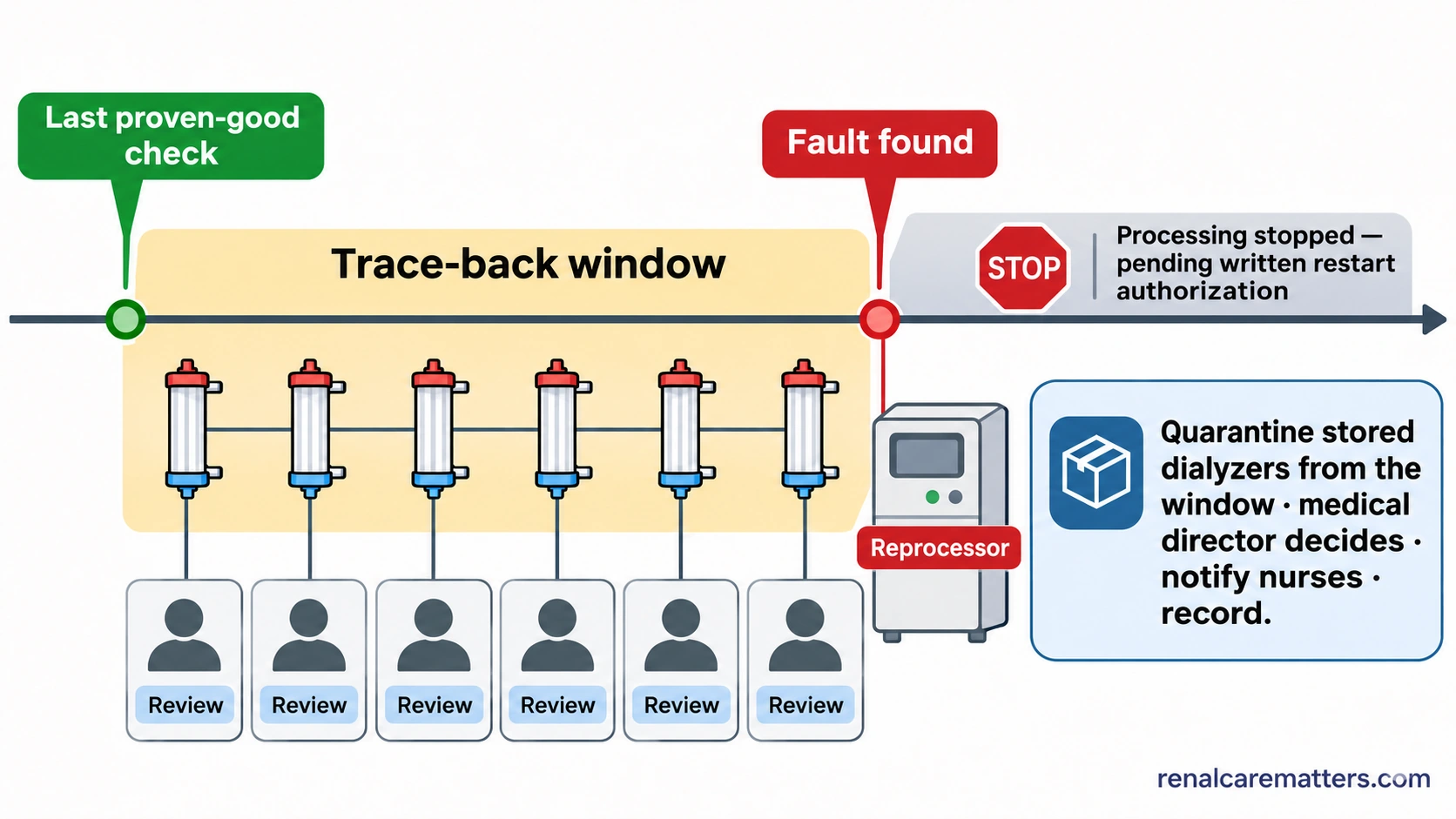
When a fault is found, find the last time the equipment was proven good: the last passed calibration or the last check that would have detected this fault. Every dialyzer processed between then and now is in question.
Figure 3 · Trace-back
- Fix the windowLast proven-good check to the time of discovery.
- ListEvery dialyzer processed on that equipment in the window, with patient, date and use.
- QuarantineStored dialyzers from the window are held.
- AssessThe medical director decides, with the biomedical and infection prevention leads, whether to reprocess, retest, or discard, and whether patients need review.
- NotifyNurses caring for affected patients; the medical director informs patients as the program and ethics require.
- RecordThe fault, the window, the list, the decisions.
When patients react
Fever, chills or rigors during dialysis, especially in the first hour and in more than one patient, may be a pyrogenic reaction from bacterial products in the water, the dialysis fluid or the dialyzer. Outbreak investigations have traced such clusters to reprocessing and water failures many times.2,3,4 Bloodstream infection can look the same at first.
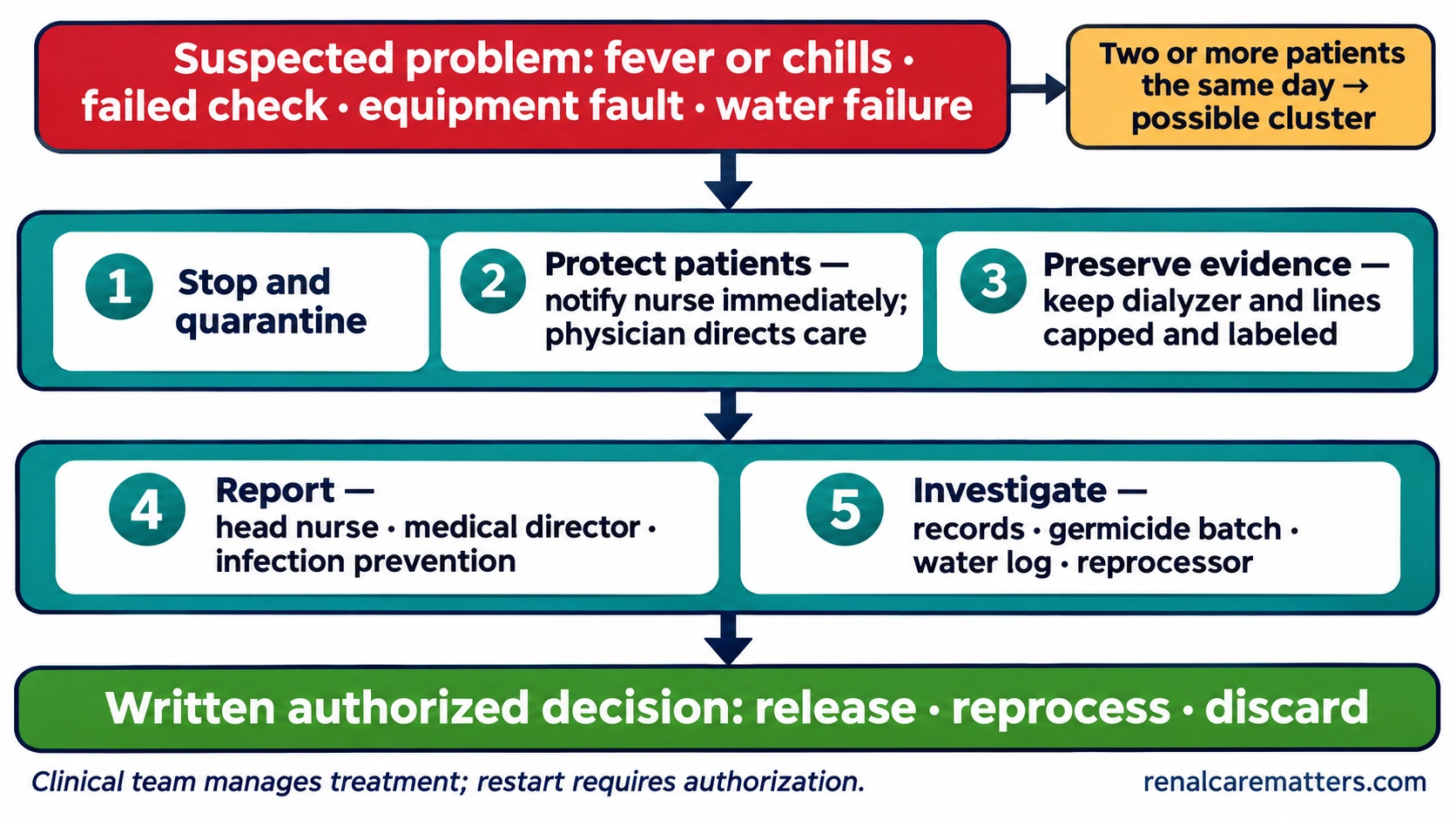
Figure 5 · What the reuse room does when patients react
When the power, water or reprocessor fails
Typhoons, floods and power interruptions are part of Philippine practice. The FDA advises that dialyzers should not be reused when reprocessing or required refrigeration facilities are not functioning.5
| Failure | First actions in the reuse room | Before restarting |
|---|---|---|
| Power interruption during a run | Note the time; dialyzers in an interrupted cycle are unproven and held | Reprocessor self-test and the checks the manual requires; consider whether the event could have shifted calibration |
| Water treatment failure or a failed water result | Stop processing; refrigerate used dialyzers within their limit, or discard per procedure | Water cleared in writing by the person responsible (Module 5) |
| Refrigeration failure | Note the time and temperature; used dialyzers past their limit are not processed | Refrigerator repaired and logging again |
| Reprocessor failure | Tag it out; patients receive new dialyzers | Return to service in writing; trace-back if the fault may predate discovery |
A unit continues to dialyze patients through these events, with new dialyzers. The continuity plan should say where extra dialyzers come from and who decides when reuse resumes.
Back to the case: A week out of calibration
What does a high-reading pressure sensor mean? In a pressure-hold test, a leak shows as pressure falling. A sensor that reads high may make a leaking dialyzer appear to hold pressure. Integrity results from the past week cannot be trusted. The daily “OK” entries did not test the sensor against a reference, so they could not catch this fault.
Which dialyzers? All 84 processed since the last proven-good check, from the previous Thursday’s power event, or from the last calibration if the start is uncertain. Stored ones are quarantined. The medical director decides, with the biomedical and infection prevention leads, whether to retest on a verified machine or discard, and whether patients treated with them need review.
The Tuesday chills? Two patients with chills in the first hour, both with reprocessed dialyzers, during a week when integrity results were unreliable, is a possible link. If their dialyzers were kept, they can be examined. The head nurse, the medical director and the infection prevention lead must know today, and the water and germicide records for the same days are checked. The reprocessor returns to service only after Mr. Villanueva documents its repair and performance.
Skills checklist: Fault, trace-back and continuity drill
A tabletop exercise with synthetic logs, then a walk-through at the reprocessor with the biomedical technician. Your preceptor rates each step as satisfactory, needs practice, or not observed. Steps marked Critical must all be satisfactory before sign-off. This checklist supports supervised learning; your unit’s own procedure and competency form are the authority. A printable version of every checklist is on the trainer page.
- CriticalPerforms and records the reprocessor’s daily user checks with actual readings.
- CriticalTags out a faulty reprocessor and refuses to use it until written return to service.
- CriticalIdentifies the trace-back window from a set of logs.
- CriticalLists and quarantines the dialyzers processed in the window.
- CriticalKeeps the dialyzer and lines from a patient with a pyrogenic reaction.
- Checks the processing, germicide, water and reprocessor records for a cluster.
- CriticalStates the first actions for power, water, refrigeration and reprocessor failures.
- CriticalDistinguishes equipment return to service from dialyzer release.
Check your understanding
Each visit draws 5 questions at random from this module’s 12-question bank. Choose the single best answer for each, then select Check answers; an explanation appears under the best answer. Select New set of questions for a different mix. A good target is 4 of 5 on two different sets. Nothing you select is sent anywhere; scoring happens in your browser.
Read next on this site
- Hemodialysis ComplicationsProblems during dialysis, including fever and chills.
- Typhoon and Disaster Preparedness in DialysisKeeping dialysis going through typhoons and floods.