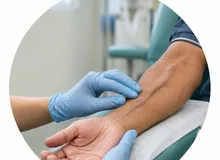
A nonclinical track that works alongside nursing
This track is for the people who keep a hemodialysis unit clean, safe and moving: orderlies, environmental service (EVS) aides, utility workers, porters and contracted cleaners. It sits in the Ancillary Staff Track and links closely to the Nephrology Nursing course, because nurses direct the patient care that your work supports. That link does not make you a nurse or a nursing assistant, and nothing here authorizes nursing, machine or water-system work.
The 15 modules explain the reason behind every task before the task itself. Why does dried blood matter if you cannot see it? Why does a disinfectant need to stay wet? Why does a patient faint after dialysis, and why should you never lift a person alone? Each module opens with a plain picture, then explains what is really happening, then says how strong the evidence is, then shows exactly what you do and what you leave to others. Every module has a fictional case set in a Philippine unit, a debrief, a harder second round, a 15-question knowledge check with a reason for every answer, and a checklist to practice with your preceptor.
What this track is, and is not
It is education and practice preparation. Finishing it does not prove competence, grant permission for any task, or carry Department of Health (DOH), Philippine Health Insurance Corporation (PhilHealth), Philippine Society of Nephrology (PSN) or Professional Regulation Commission continuing professional development (CPD) recognition, or basic life support certification. Your employer authorizes tasks after observed practice. Hours and pass marks are Academy proposals, not national minimums. Draft for clinical, infection prevention and regulatory review.
Who can hold this role
Dialysis Unit Support Staff (orderly, environmental services aide): qualifications at a glance
- No specific requirement in the DOH or PSN hemodialysis rules. PSN groups housekeeping with the other nonmedical staff and expects written unit policies on infection control, waste, emergencies, and the environment. PSN
- Your scope is your employer’s written task list plus the tasks you have been trained and signed off on. DOH, PSN
Sources: DOH Administrative Order No. 2012-0001, Sec. V.B.2.a; Philippine Society of Nephrology (2024), Guidelines for nephrologists in the operation of hemodialysis clinics, Sec. III.A; Republic Act No. 10862. A summary for orientation, not legal advice: check the current issuances, and your unit’s license and PhilHealth accreditation. The full table for every role is on the Academy home.
A day in the San Isidro Dialysis Unit
Before the modules, here is what the job looks like. The day below is fictional, and so is everyone in it, but every moment happens in Philippine dialysis units every week. Each moment points to the module that prepares you for it. You will meet the same small team throughout: Ate Lorna, the EVS supervisor who has cleaned dialysis units for twenty years; Kuya Ramon, the senior orderly; and Nurse Jessa, the charge nurse of the San Isidro Dialysis Unit, an 18-station unit in a provincial hospital that runs three shifts a day.
5:40 a.m. · before the first shift
- What happens
- A new aide fills a spray bottle from a big jug of concentrate “by feel,” the way he did at his last job in a mall.
- What you do
- Read the label’s dilution, measure with the marked jug, label the bottle with the product and date, and check its wet contact time. Module 6.
10:05 a.m. · shift change
- What happens
- The next patient is waiting. The patient at Station 7 is still connected, with ten minutes left. Someone asks you to “start wiping the chair so we save time.”
- What you do
- Wait for clinical clearance and for the patient to leave. Then clean, keep the surfaces wet for the full contact time, and hand over the station as “environmental work complete.” Module 7.
11:30 a.m. · waste room
- What happens
- A yellow bag is heavy and lumpy at the bottom. Something pokes against the plastic.
- What you do
- Do not press, squeeze or reach in. Hold the bag by the neck away from your body, set it in a rigid bin, and report a sharp in the wrong container. Modules 9 and 10.
2:50 p.m. · after the session
- What happens
- Mang Celso, 74, has just finished dialysis. Three liters of fluid were removed. He stands up quickly to go home and sways.
- What you do
- Help him sit, keep him safe, call the nurse, and stay. Move him only by wheelchair and only when the nurse says he is ready. Modules 11 and 12.
4:15 p.m. · isolation station
- What happens
- You are cleaning the hepatitis B isolation station. The clean-supply cart from the main floor is parked just inside the door.
- What you do
- Use only the isolation station’s dedicated tools, and tell the nurse the cart must leave without anything being taken from it. Module 5.
7:45 p.m. · end of day
- What happens
- You missed the wall-mounted handrub dispenser at Station 3 during terminal cleaning. Nobody would ever know.
- What you do
- Go back, clean it, and record the correction truthfully. Honest records are what make the next audit useful. Module 15.
None of these moments asks you to make a clinical decision. Every one depends on you noticing, doing your own task exactly, and telling the right person in time. That is what this subtrack trains.
Environmental service aide or orderly
Neither pathway includes needles, catheters, dressings, medicines, blood or bloodlines, vital signs or weighing for treatment decisions, machine controls or alarms, dialyzer reprocessing, concentrate preparation, or water-room work. Prior experience allows a diagnostic check, not exemption from critical observed skills. Contracted staff receive the same unit induction and sign-offs as directly hired staff. Module 1 has the full duty and scope matrix.
Entry and readiness
Before practical work, complete your employer’s induction, an occupational health review that fits your actual duties (including your hepatitis B vaccination record), and chemical, protective-equipment and manual-handling orientation. Covered workers also need the occupational safety and health seminar required by Philippine law; this track does not replace it. Recommended readiness: you can understand safety instructions and labels in English or Filipino with help, tell someone about an urgent problem, and take part in hands-on practice. Ask for reasonable accommodations if you need them.
Delivery. About 30 hours of guided learning and 28 hours of practice or simulation, 58 hours in all. At eight scheduled hours a day (excluding breaks) this fits about eight days, followed by observed practice at work until each assigned skill is demonstrated. Never shorten a wet contact time, a patient’s recovery or your own rest breaks to meet a timetable.
15 modules
When you have finished: take the end-of-course knowledge check, 15 questions, one from each module, drawn at random. The pass mark is 12 of 15.
What you will be able to do
| Code | The learner can | Evidence |
|---|---|---|
| S1 | Explain the support role, name the supervisors, and decline clinical or technical work that is not on the written task list. | Task-list teach-back; scope decisions in every station |
| S2 | Protect dignity and privacy and report an observation clearly with Stop, Tell, Stay. | Observed handoff; transport station |
| S3 | Perform hand hygiene at the right moments, choose and remove protective equipment safely, and keep clean and dirty apart. | Hand hygiene and doffing station with fluorescent feedback |
| S4 | Read a product label and task card, achieve wet contact time, and complete environmental cleaning without claiming technical readiness. | Station turnover with fluorescent-marker audit |
| S5 | Make a spill or sharps hazard safe, and start the exposure response without delay. | Spill and exposure simulation |
| S6 | Segregate, contain, move and store waste and linen within the facility plan. | Waste and linen station |
| S7 | Support patient escort and transfers only within the nurse’s plan, using equipment instead of solo lifting. | Transport and transfer station (orderly pathway) |
| S8 | Respond to emergencies, protect your own health, and keep truthful records that drive improvement. | Emergency drill; accurate log; capstone |
Syllabus and hours
| Day | Module | Guided | Practice | Total | Pathway | Required learner work |
|---|---|---|---|---|---|---|
| 1 | DUSS-15 Your Role in the Dialysis Unit | 2 | 1 | 3 | Both pathways | Task-list teach-back naming core, conditional and excluded tasks for your pathway; one observed polite refusal with redirection. |
| 1 | DUSS-15 Dignity, Privacy and Clear Communication | 2 | 1 | 3 | Both pathways | Observed Stop, Tell, Stay report in a role-play; privacy teach-back naming five protected habits. |
| 2 | DUSS-15 How Germs and Blood Travel in a Dialysis Unit | 2 | 1 | 3 | Both pathways | Teach-back of the chain of infection and the five hand-transmission steps; fluorescent-lotion exercise completed with debrief. |
| 2 | DUSS-15 Hand Hygiene and Protective Equipment | 2 | 2 | 4 | Both pathways | Observed handrub and handwash technique; glove removal and full personal protective equipment (PPE) doffing under ultraviolet feedback with no skin contamination. |
| 3 | DUSS-15 Aseptic Habits: Clean to Dirty, and Never Back | 2 | 1 | 3 | Both pathways | Observed station clean in the correct direction with no double-dipping; trolley set up with clean and dirty separated; isolation-area teach-back. |
| 3 | DUSS-15 Cleaning Products, Tools and Zones | 2 | 2 | 4 | Both pathways | Correct dilution by measurement with a complete label; safety data sheet (SDS) teach-back for two products; chemical incident role-play. |
| 4 | DUSS-15 Safe Turnover of a Dialysis Station | 2 | 3 | 5 | Both; practice only if assigned | Two satisfactory observed station turnovers on separate occasions (if assigned), each with fluorescent-marker check and timed contact. |
| 4 | DUSS-15 Routine and Terminal Cleaning, Restricted Areas and Linen | 2 | 2 | 4 | Both pathways | Observed terminal clean of one area against the written schedule; soiled-linen bagging without agitation; teach-back on restricted rooms. |
| 5 | DUSS-15 Blood Spills, Sharps and Exposure Response | 2 | 2 | 4 | Both pathways | Spill-kit simulation with a harmless substitute and mock sharp; exposure role-play stating wash, tell, go and the after-hours route. |
| 5 | DUSS-15 Health Care Waste: From Segregation to Storage | 2 | 3 | 5 | Both pathways | Observed collection of three waste categories with correct closing, labeling, lifting and route; local color chart completed on the worksheet. |
| 6 | DUSS-15 Patient Escort and Transport | 2 | 2 | 4 | Orderly practice; EVS awareness | Two observed escorts (orderly pathway) with device and route checks, fistula protection and named handoff; EVS aides: route preparation and calling for help in simulation. |
| 6 | DUSS-15 Transfers, Falls and Protecting Your Back | 2 | 2 | 4 | Orderly practice; EVS awareness | Observed use of the transfer aids available in your unit within a nurse’s plan (orderly pathway); controlled-lowering simulation; one lifting-index calculation for a real supply task. |
| 7 | DUSS-15 Supplies, Equipment and Technical Boundaries | 2 | 1 | 3 | Both pathways | Observed first in, first out (FIFO) restocking and quarantine labeling; fault-report role-play for one urgent and one routine fault. |
| 7 | DUSS-15 Emergencies and Worker Safety | 2 | 2 | 4 | Both pathways | Emergency drill with role card: alarm, equipment, route, crowd and handoff; Rescue, Alarm, Contain, Extinguish (RACE) and Pull, Aim, Squeeze, Sweep (PASS) teach-back per unit training. |
| 8 | DUSS-15 Honest Records, Improvement and the Capstone | 2 | 3 | 5 | Both pathways | Six capstone stations passed with no critical failure; one correctly calculated audit; truthful log maintained during supervised shifts. |
| Total | 30 | 28 | 58 |
Hours are Academy design proposals. They are not a promise that anyone is competent after a fixed time, and they do not equal any statutory training requirement.
Two separate records
| Record | Requirement | Recorded by |
|---|---|---|
| Academy self-study completion | All modules read and the end-of-course knowledge check passed (12 of 15 or better). | The learner, here (optionally saved in this browser only) |
| Employer-verified task competence | The six capstone stations passed with no critical failure, and each authorized high-risk task observed as satisfactory on at least two separate occasions (more if performance varies). | The employer, on signed printable forms in its own records |
Critical failures are never averaged away. A failed action leads to explanation, demonstration, practice and reassessment with an equivalent scenario; until then the task stays under direct supervision or outside authorization. Repeated difficulty leads to a tailored plan, not automatic dismissal. This website cannot check identity or observe your hands, so nothing you do online records workplace competence.
Localize before teaching
The lessons use generic workflows on purpose. Before teaching, gather your unit’s map, the approved task cards and safety data sheets, the product list with dilution and wet contact time, the waste color chart and route, the linen procedure, the exposure hotline and after-hours route, the emergency codes and exits, the transport aids actually available, and the written task list for each worker. Use them in every simulation. Use training props: a harmless spill substitute, mock sharps, empty sample containers and fluorescent marker gel. Never use real blood or real sharps for teaching.
The Support Staff Toolkit
Built for this track. It has four tools: a label dilution and contact-time planner that uses only the numbers printed on your product’s label; a station turnover time budget that shows whether the gap between shifts leaves time for full wet contact; a safe lift check using the revised NIOSH (National Institute for Occupational Safety and Health) lifting equation for boxes, jugs and bins; and an audit tally for fluorescent-marker cleaning checks and hand hygiene observations.
Sources behind this track
Desk review dated 24 November 2026. Before publication or workplace use, the unit’s clinical head, nurse educator, infection prevention and control (IPC), EVS, waste, safety and transport leads should review the wording, and the current DOH licensing circular and assessment tool, current PSN infection-control updates and current PhilHealth provisions should be obtained and reconciled. Local product cards and waste plans always govern.1,2,3,4,5,6,7,8,9,10,11,12,13,14,15,16,17