After this module you should be able to
- Explain in simple terms why blood pressure can fall when a patient stands after dialysis, and why that causes falls.
- Move a patient only after the nurse says they are ready and the plan (wheelchair, walking, stretcher, helpers) is clear.
- Check the wheelchair or stretcher and the route before every escort.
- Protect the fistula arm, the needle sites and any catheter during transport.
- Recognize warning signs during transport, and hand over to a named person with belongings and information complete.
A water tower with a low tank
A town gets water pressure from a tank on a high tower. When the tank is full, water reaches every faucet, even upstairs. If someone drains a lot of water from the tank quickly, pressure drops, and the upstairs faucets sputter first. The patient’s blood vessels are the pipes, the heart is the pump, and the brain is the upstairs faucet. Dialysis drains water from the tank.
The picture has a limit. A real tank refills from the main line. The body refills its blood from water stored in the tissues, but slowly, over hours. Right after dialysis the tank is low, and the moment the patient stands up, gravity pulls blood down to the legs, the brain gets less, and the patient becomes dizzy, sees spots, or faints.
Why patients faint and fall after dialysis
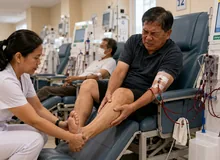
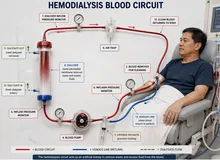
During a session the machine removes the extra water a patient gained since the last treatment, often two to three liters. That water is taken from the blood. Blood volume falls faster than the tissues can refill it. Normally, when we stand, the body tightens blood vessels and speeds up the heart within seconds to keep blood flowing to the brain. In many dialysis patients these reflexes are weaker: diabetes can damage the nerves that control them, blood vessels are stiff, and some patients take blood pressure medicines. So when they stand, blood pressure drops further and more slowly recovers. This is called orthostatic (standing) hypotension.
Add muscle weakness, cramps, poor eyesight, foot numbness from diabetes, fatigue and sometimes low blood sugar, and falls become common. In a prospective study of 162 hemodialysis patients aged 65 and older in a Canadian academic unit, there were 305 falls in about 190 person-years, a rate of 1.60 falls per person each year; 47 percent of patients fell at least once, and 19 percent of falls caused injury. Falls were linked with older age, more illnesses, pre-dialysis blood pressure and a history of falls.1 That was one unit and an older group; younger patients fall less, but the timing risk after treatment applies to everyone.
| What you see | What may be happening | What you do |
|---|---|---|
| Sways, grabs the chair, says “nahihilo ako” (I’m dizzy) | Low blood pressure on standing | Help them sit at once; call the nurse; stay |
| Pale, sweaty, confused, shaky | Low blood pressure, or low blood sugar in a diabetic patient | Sit or lie them down safely; call the nurse now; do not give food or drink unless the nurse says |
| Fresh blood on the arm bandage | Needle site bleeding again | Stop moving; call the nurse; keep the arm still and raised if she asks |
| Leg cramps, cannot put weight on a leg | Fluid and salt shifts | Stop; seat them; tell the nurse |

After fluid removal, standing drops blood pressure and brain blood flow, which causes dizziness and falls.
Before you move anyone
Moving a patient is the nurse’s decision. The nurse assesses whether the patient is ready, how they should move (walk with help, wheelchair, stretcher), how many helpers are needed, and where they are going. You carry out that plan.
- ClearanceThe nurse has said this patient is ready to move now, and how.
- IdentityConfirm the patient’s name with the patient and the nurse, using two identifiers your unit uses (for example, full name and date of birth). Many patients look alike in a busy unit.
- DeviceWheelchair: brakes hold, footrests present and working, tires firm, armrests secure, seat clean and dry, seatbelt if your unit uses one. Stretcher: brakes, side rails, wheels, clean linen.
- RouteClear corridor, dry floors, elevator working, ramps safe, doors held. Know where the destination is and who is receiving.
- Patient readySitting for a few minutes before standing if the nurse advises; shoes or non-slip slippers on; belongings gathered; fistula arm and bandage checked.

Before any escort: nurse clearance, identity, equipment, route and patient readiness.
Protecting the lifeline
For a dialysis patient, the fistula or catheter is a lifeline: without it, they cannot be dialyzed. Fistulas can clot, and needle sites can bleed again in the first hour.
- Never let anyone put a blood pressure cuff, tight sleeve, bag strap, watch or handcuff-tight grip on the fistula arm. Do not lift or pull the patient by that arm.
- Rest the fistula arm on the patient’s lap or a pillow during transport, not hanging over the wheelchair side where it can hit a door frame.
- Watch the bandage. If it becomes red and wet, stop and call the nurse.
- If the patient has a neck or chest catheter, never pull on it or its dressing, keep it covered, and keep the patient’s clothing from snagging it. If a catheter dressing is loose or the catheter looks pulled out, stop, keep the patient still, and call the nurse at once.
The nurses’ course explains access care in depth; your part is to protect it while the patient is moving.

Rest the fistula arm on a pillow and never put pressure on it or pull it; report bleeding at once.
During the escort and at the handoff
Push wheelchairs forward on level ground at walking pace. Go backward through doors, into elevators and down ramps so the patient does not slide forward. Set the brakes every time you stop. Talk to the patient: tell them when you will move, turn or stop. Watch their face; a patient who goes quiet or pale needs you to stop and call for help.
Hand over to a named person. At the destination (ward, emergency room, laboratory, waiting area for family, transport vehicle) give the patient to a named person, not to an empty room or a chair in the corridor. Say the patient’s name, where they came from, anything the nurse told you to pass on, and anything you noticed on the way. Hand over belongings and papers. Record the time and the receiving person if your unit requires it.
Kuya Ramon wheels Mang Celso to the entrance where his grandson is supposed to pick him up. The grandson is not there yet. Ramon does not leave Mang Celso alone in the wheelchair by the road. He brings him back into the waiting area, tells the receptionist, and stays until the grandson arrives twenty minutes later, then helps him into the tricycle with the nurse’s permission.
What this shows. A handoff is to a person, not a place. If nobody is there to receive the patient, the escort is not finished.

Go backward through doors, into elevators and down ramps, and set the brakes every time you stop.
Moving patients without moving germs
The patient’s infection status does not change how kindly you move them; it changes what you do with the equipment. The nurse tells you which precautions apply. A wheelchair or stretcher used for a patient on isolation is cleaned and disinfected before anyone else uses it, and if your unit dedicates a wheelchair to the isolation area it stays there. A patient with a cough may be asked to wear a mask during transport. Do hand hygiene before and after every patient contact (Module 4). Never tell anyone along the route why a patient is on precautions (Module 2).
Case: Mang Celso stands up too fast
Wednesday, 2:50 p.m. Mang Celso, 74, has finished his session; three liters were removed. The nurse has just removed his needles and is writing her notes. He wants to catch the 3:00 p.m. jeepney and stands up quickly, reaching for his bag with his fistula arm. He sways and grips the chair. Kuya Ramon is two stations away with an empty wheelchair. The floor near the exit has just been mopped.
Before reading on, decide what you would notice, whom you would tell and what you would say, what you would do within your role, and what would make you call for help at once. Then compare with the debrief below.
Notice
Communicate
Do
Escalate
Mang Celso sat down; the nurse checked his blood pressure, laid the chair back for ten minutes and gave him water. When she cleared him, Ramon wheeled him to the entrance with his fistula arm on a pillow, backed down the ramp, and handed him to his daughter with his bag and the nurse’s reminder to sit before standing at home. He missed the 3:00 jeepney and caught the 3:20.
Submit: How you respond respectfully, whom you involve, and why the decision is the nurse’s.
Check your understanding
Each visit draws 5 questions at random from this module’s 15-question bank, in a shuffled order. Choose the single best answer for each, then select Check answers; a rationale appears under every option. Select New set of questions for a different mix. Nothing you select is sent anywhere; scoring happens in your browser and records self-study only.
What this module builds
| Code | The learner can | Course evidence |
|---|---|---|
| S2 | Protect dignity and privacy and report an observation clearly with Stop, Tell, Stay. | Observed handoff; transport station |
| S7 | Support patient escort and transfers only within the nurse’s plan, using equipment instead of solo lifting. | Transport and transfer station (orderly pathway) |
Performance evidence for this module: Two observed escorts (orderly pathway) with device and route checks, fistula protection and named handoff; EVS aides: route preparation and calling for help in simulation.
With your preceptor
Practice with colleagues as patients before escorting real patients. These are prompts for supervised learning, not a procedure. Use your center’s own protocols, contacts and forms; your preceptor observes and signs off each item on the facility’s competency record.
- Check a wheelchair and a stretcher with your preceptor and report one fault you find.
- Escort a colleague in a wheelchair: forward on level ground, backward through doors, into an elevator and down a ramp.
- Position a “fistula arm” safely for transport and name four things that must never be done to it.
- Hand over a “patient” to a named person with name, origin, message, belongings and time.
- Walk the route to the exit and list hazards to report.
Read next on this site
- Managing Complications of HemodialysisLow blood pressure, cramps and other problems during and after dialysis.
- Dialysis Access Care: Your LifelineHow patients protect their fistula or catheter.
Back to the Support Staff course home · the Nephrology Nursing course · the infection prevention lesson nurses study, Nephrology Nursing Module 7.