After this module you should be able to
- Separate fixed, variable and step costs, and compute cost per treatment at different volumes.
- Calculate contribution margin and break-even volume.
- Explain the difference between billed revenue, recognized revenue and cash collected.
- Build a budget case that includes safe staffing, maintenance and realistic collection timing.
The big picture, in plain words
The picture has a limit. A household's bills are simple; a unit's are not. Some costs stay flat, some rise with every session, and some jump all at once when you add a shift. And the "income" a unit books is not the cash in its account. A unit can look profitable on paper and still be unable to make payroll, because Philippine Health Insurance Corporation (PhilHealth) has not paid yet for sessions delivered in September.
You do not need to be an accountant. You need to know three numbers for your unit, what drives them, and how to defend safe staffing when someone proposes saving money by cutting it.
Figure 1 · Key terms for this module
Case: Profitable but broke
It is the 10th of the month at a 15-station freestanding unit in Santa Rosa, Laguna. The monthly report shows a healthy operating margin for the third month running. Payroll is due on the 15th. The accountant, Ms. Gemma Rivera, calls the manager, Mr. Allan Navarro: "We are short by 640,000 pesos for payroll."
The owner's first reaction is to propose cutting two nurse positions "until things stabilize." Mr. Navarro asks for one day before anyone decides. He pulls the aging report. Receivables older than 90 days have doubled in four months.
Before reading on, decide:
- How can a unit be profitable and short of cash at the same time?
- Where would you look first for the missing money?
- What should Mr. Navarro say about the proposal to cut two nurses?
Keep your answers in mind. The lesson gives you what you need, and the case review near the end shows one sound response.
The model: three kinds of cost
Fixed costs do not change with session volume, within a range: rent, the base salaries of the core team, insurance, depreciation of machines and the water system, licenses, and subscriptions.
Variable costs rise with each session: the dialyzer (or the reprocessing cost per use), bloodlines, needles, concentrates, saline, heparin, ESAs, gloves and dressings, water and electricity per session, and laundry.
Step costs jump at thresholds. Adding a third shift needs another nurse team. Adding stations beyond the physician-on-duty ratio needs another physician.
Contribution margin per session = net revenue per session − variable cost per session.
Break-even volume = fixed costs ÷ contribution margin per session.
Because fixed costs spread over more sessions as volume rises, cost per treatment falls, until you hit a step and it jumps.
What the evidence shows
Published cost data for Philippine units are scarce and quickly outdated by price changes, so use your own ledger. Two general findings still hold.
Staffing is the largest controllable cost, and the one most tied to outcomes. Facilities with heavier staffing burden show higher death and hospitalization rates.1 The data are observational, but a budget that balances by cutting below safe staffing is not a saving. It moves the cost to patients, and eventually to hospital admissions and the unit's reputation.
Missed sessions cost the unit as well as the patient. A missed session loses its revenue while fixed costs continue, and it is associated with more hospitalization (Module 4). Improving attendance is both a quality project and a financial one.
Calculator CALC-08: cost per treatment and break-even
You need: monthly fixed costs, variable cost per session, sessions delivered per month, net facility revenue per session (the payer rate minus any professional-fee portion, deductions, or discounts that do not stay with the facility; confirm how your package is split), and the average days to collect.
Worked example (fictional). Fixed costs are 920,000 pesos a month. Variable cost is 2,100 pesos a session. Net facility revenue, for illustration only, is 6,350 pesos a session.
| Sessions per month | Total cost (pesos) | Cost per treatment (pesos) | Operating margin (pesos) |
|---|---|---|---|
| 400 | 1,760,000 | 4,400 | 780,000 |
| 350 | 1,655,000 | 4,729 | 567,500 |
| 217 (break-even) | 1,375,700 | 6,340 | about 0 |
- Contribution margin = 6,350 − 2,100 = 4,250 pesos per session
- Break-even = 920,000 ÷ 4,250 = 216.5, so 217 sessions a month
The cash view. At 400 sessions a month, net revenue is about 2.54 million pesos, or about 84,700 pesos a day over 30 days. If claims take an average of 75 days to pay, about 84,700 × 75 = 6.35 million pesos is tied up in receivables at any moment. That is the working capital the unit must finance, even when the income statement looks healthy.
The step test. Opening a fourth shift to add 45 sessions a month brings in 45 × 4,250 = 191,250 pesos of contribution. If the new nurse team costs more than that, the extra volume loses money. Run the step before you promise the volume.
Revenue, recognition, and cash
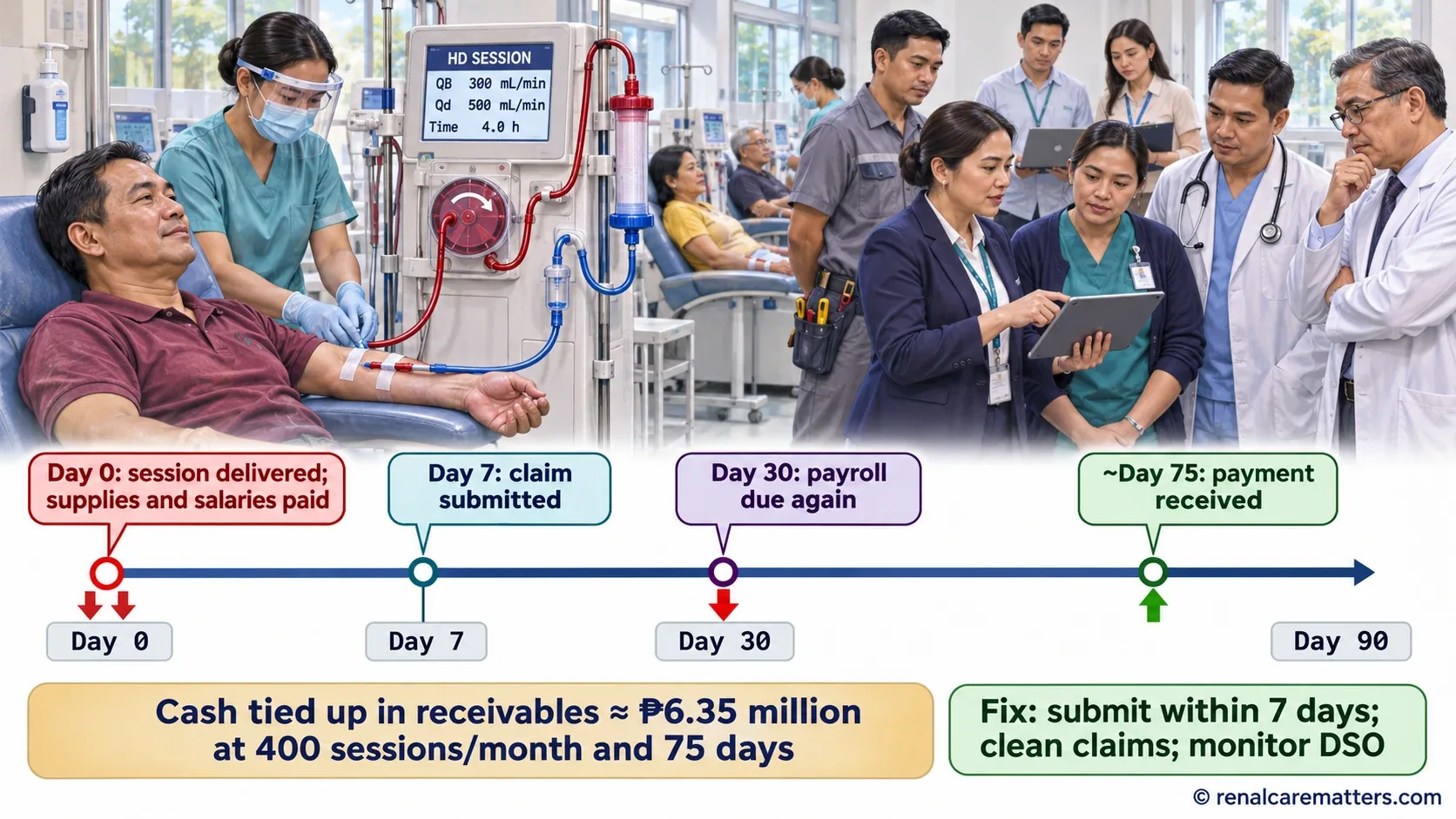
- Billed: what the unit claims for the session.
- Recognized revenue: what accounting books as earned under the approved policy, often net of expected denials.
- Cash collected: what reaches the bank.
Track all three by month of service. A widening gap between recognized revenue and cash, or receivables aging past 90 days, is an early warning. Module 16 builds the aging report.
Example. A hospital unit in Baguio books 2.4 million pesos of dialysis revenue in July. By the end of September, 2.1 million has been collected. Another 180,000 is in returned claims, and 120,000 is in claims that were never filed because two patients' PhilHealth Dialysis Database registrations were incomplete. The income statement for July never showed the 300,000-peso problem. The vintage report did.
Building a budget case
Figure 3 · A budget that can be defended
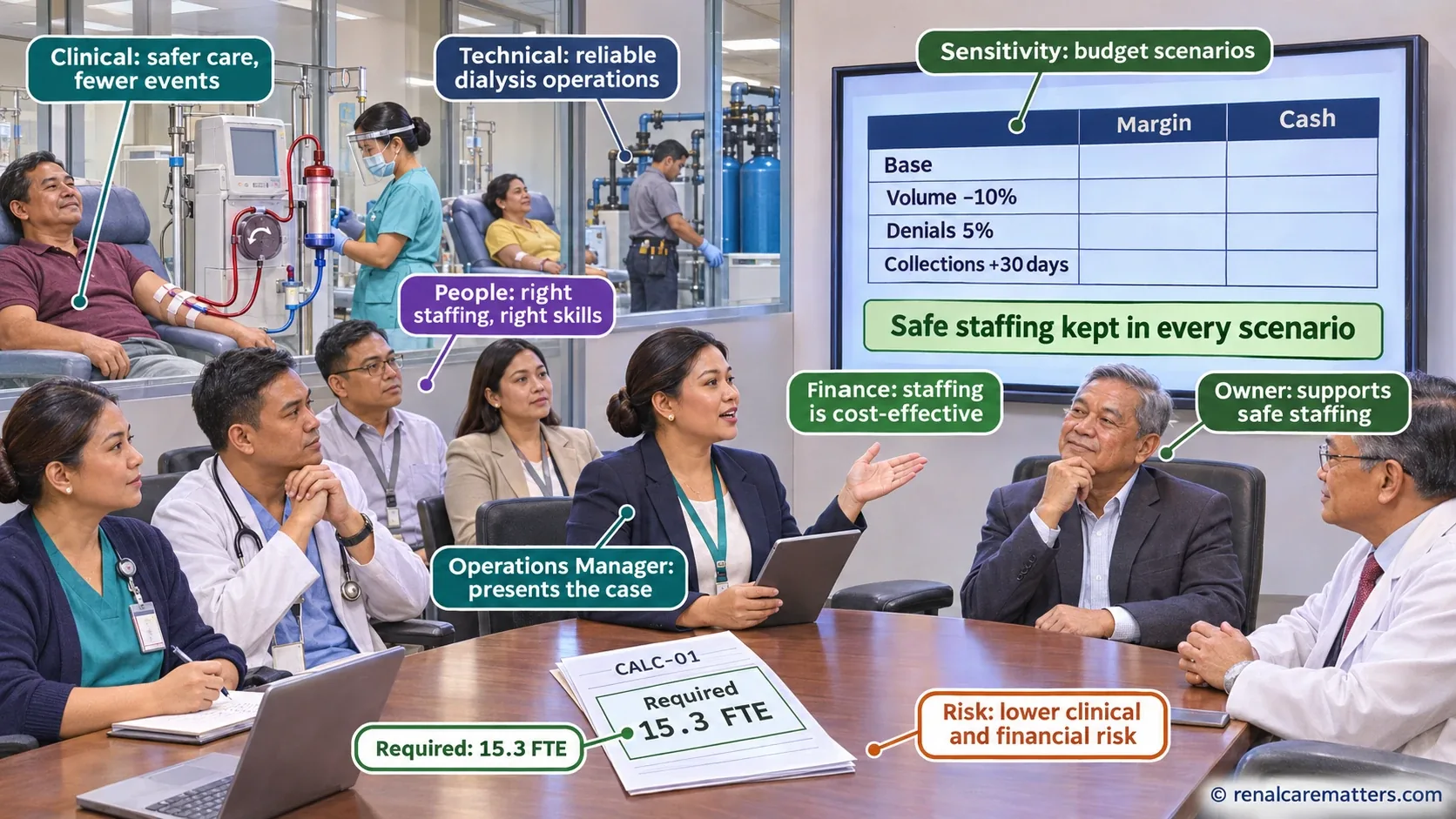
- Clinical requirementsStations, shifts, staffing from CALC-01, maintenance from the asset register.
- VolumeA conservative case and an expected case.
- Collection timingFrom actual remittance history, not hope.
- ContingencyA failing machine, a reverse osmosis membrane, generator fuel.
- SensitivityWhat happens to margin and cash if volume drops 10%, denials rise to 5%, or collections slow by 30 days.
- Trade-offsNever balance by removing a safety control. State the trade-off and let governance decide.
Common failure modes
- Price mistaken for cost. Knowing what PhilHealth pays but not what a session costs.
- Cost without depreciation. A machine bought five years ago still costs money every month.
- The 30-day fantasy. Budgets that assume every session is paid within a month.
- Growth without steps. Volume planned without the staffing cost of the next shift.
- Cutting the wrong line. Nurses cut to fix a billing problem.
Back to the case: Profitable but broke
Profit is not cash. The income statement counts revenue when the session is delivered. The bank account counts it when PhilHealth pays. If claims slow down, the profit stays the same and the cash disappears.
Where the money went. Mr. Navarro reconciles claims by month of service. Two months of claims were submitted late, because the billing encoder resigned and was not replaced for six weeks. One month's batch was returned for documentation errors (Module 10). About 1.9 million pesos is sitting in claims that are late, returned, or not yet filed.
The plan. He presents a recovery plan the next morning: resubmit the corrected claims within two weeks, hire a backup billing encoder, track "claims submitted within seven days of service" as a key indicator, and ask the owner to approve a short-term credit line to cover two payrolls until collections recover.
The nurses. He shows that cutting two nurses would drop the unit below its required staffing (Module 3) and would save about 70,000 pesos a month, far less than the cash gap, while raising risk for patients. The owner approves the credit line. Staffing is not cut. By the third month, receivables older than 90 days are back below 15%.
Skills checklist: Supervised practice
Complete these with your preceptor at your own unit, using fictional or de-identified data. Your preceptor rates each step as satisfactory, needs practice, or not observed. Steps marked Critical must all be satisfactory before sign-off. This checklist supports supervised learning; your unit’s own procedure and competency form are the authority. A printable version of every checklist is on the trainer page.
- Classify last month's expenses as fixed, variable or step.
- Run CALC-08 at actual volume and at volume minus 15%.
- Compute cash tied up in receivables using your unit's actual average collection days.
- Draft a one-page budget case for one safety-related investment.
Check your understanding
Each visit draws 5 questions at random from this module’s 15-question bank. Choose the single best answer for each, then select Check answers; an explanation appears under the best answer. Select New set of questions for a different mix. A good target is 4 of 5 on two different sets. Nothing you select is sent anywhere; scoring happens in your browser.
Read next on this site
- "Zero Balance" Doesn't Mean Zero WorriesHow PhilHealth rules shape the money side of a unit.