After this module you should be able to
- Trace the pathways by which bacteria and bloodborne viruses reach dialysis patients.
- Implement and audit the Centers for Disease Control and Prevention (CDC) Core Interventions for bloodstream infection (BSI) prevention.
- Calculate BSI rates per 100 patient-months and hand-hygiene compliance, and interpret a change.
- Organize serologic screening, vaccination and isolation so that results are acted on, not just filed.
The big picture, in plain words
The picture has a limit. Bridges are visible; bacteria and viruses are not. Hepatitis B can travel on an amount of blood too small to see, and a catheter hub that looks clean can carry skin bacteria straight into the heart. You cannot inspect your way to safety by looking around the room. You need systems that work even when no one can see the danger: audits, rates, results that someone reads, and rules that do not bend on busy days.
Infection is the second leading cause of death in dialysis patients, after cardiovascular disease. Most dialysis infections are preventable, and most of prevention is a management system: supplies in the right place, audits that happen, and results that someone acts on.
Figure 1 · Key terms for this module
Case: The unread result
At a 20-station unit in Quezon City, the monthly laboratory results arrive by email on the 3rd. On the 12th, the head nurse, Ms. Liza Bernardo, is looking for a different report when she opens the file for Mr. Ernesto Dela Paz, 58. His hepatitis B surface antigen, negative for three years, is now positive.
The report has sat in the shared inbox for nine days. During those nine days, Mr. Dela Paz dialyzed four times at station 7 in the general area, on a machine that three other patients also use across the week. No one was assigned to read the monthly results. Everyone assumed someone else did.
Before reading on, decide:
- What must happen in the next hour, and who decides it?
- Who else may have been exposed, and how would you find them?
- What system failed, and how would you fix it so this cannot recur?
Keep your answers in mind. The lesson gives you what you need, and the case review near the end shows one sound response.
The mechanism: how infections reach the patient
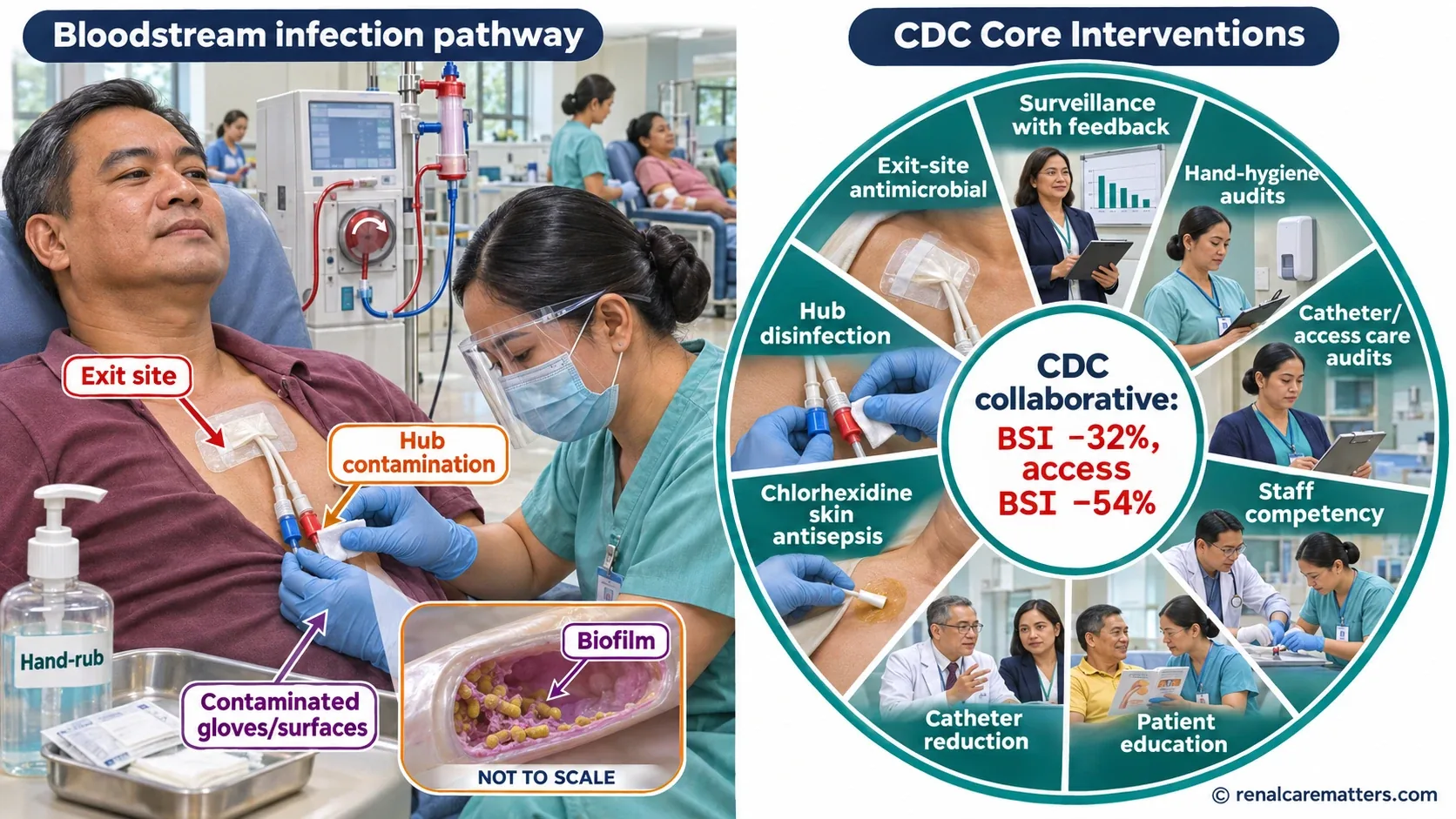
Bacteria through the access. Skin bacteria, especially Staphylococcus aureus, enter at the needle site or the catheter hub. A central venous catheter is a plastic highway into the bloodstream. Its hub is touched at every connection, and a slimy film of bacteria, called biofilm, forms on its inner surface within days. That is why patients who depend on a catheter have far higher bloodstream infection rates than patients with an arteriovenous fistula.
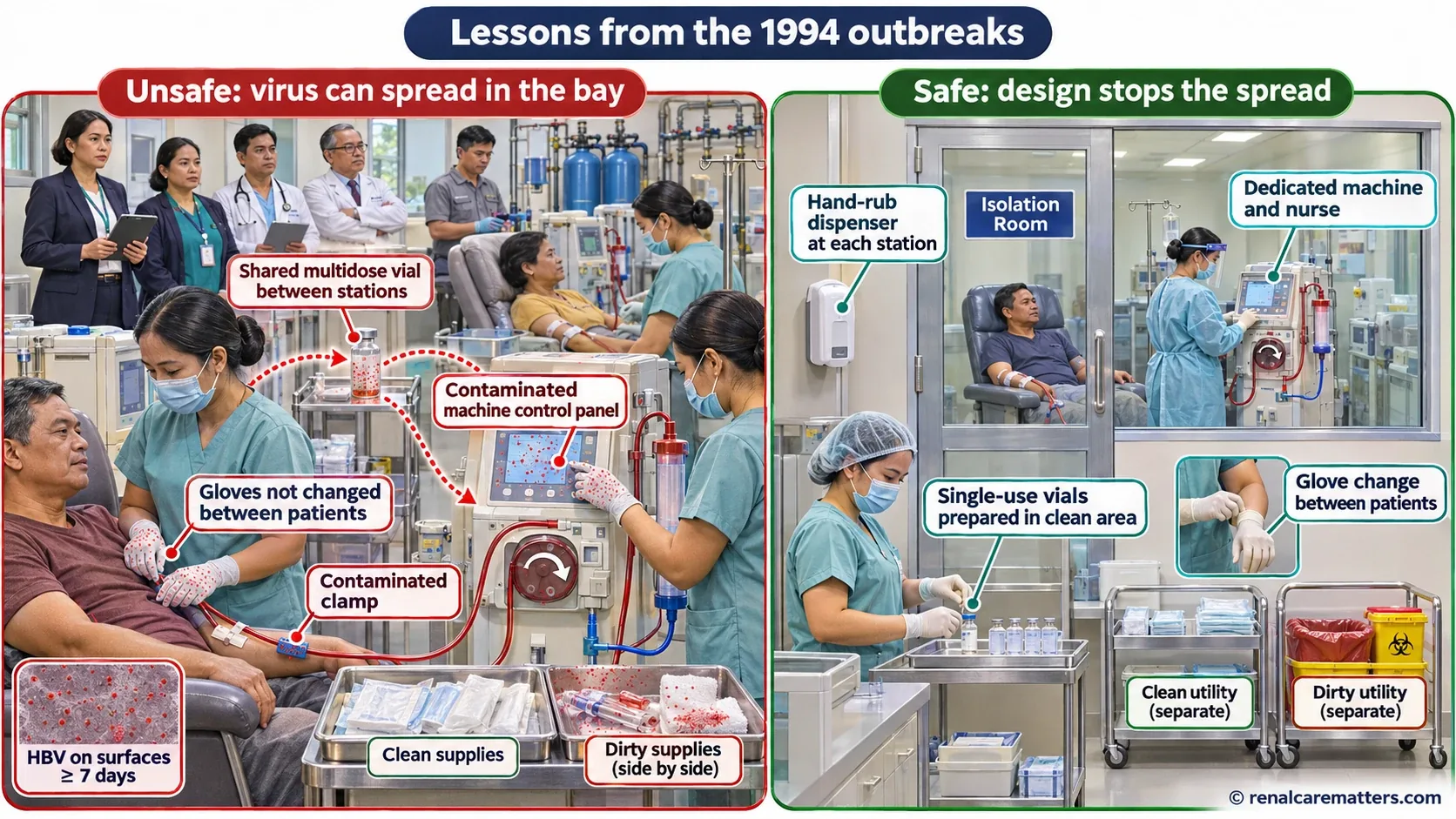
Bloodborne viruses through the environment. Hepatitis B virus (HBV) survives on surfaces for at least seven days and spreads through invisible amounts of blood. Contaminated gloves, shared multidose vials, clamps, tourniquets, and machine surfaces can carry it from one station to the next. Hepatitis C virus (HCV) spreads the same way, though less efficiently.
The lesson from outbreaks. CDC investigations of hepatitis B outbreaks in five United States dialysis centers in 1994 found the same failures again and again: infected patients not identified or not isolated, staff and supplies shared between infected and susceptible patients, monthly screening results that nobody reviewed, and low vaccination rates.1 In one center, a shared heparin vial was the probable route. None of those failures was a lack of medical knowledge. Every one was a system failure a manager can prevent.
What the evidence shows
The Core Interventions work. In the CDC Dialysis Bloodstream Infection Prevention Collaborative, 17 outpatient facilities that put the bundle in place saw overall bloodstream infections fall by 32% and access-related infections by 54%.2 The fall in access-related infections lasted up to four years, although overall rates drifted back toward baseline.3 Gains fade when audits and feedback stop. The design was before-and-after, without a control group, so it supports rather than proves the benefit. National United States surveillance then showed the pooled bloodstream infection ratio falling by 40% between 2014 and 2019 as the practices spread.4
Isolating patients with hepatitis B is established practice. Since CDC recommendations were introduced in 1977, hepatitis B among United States dialysis patients and staff fell sharply.5 Current standards call for patients positive for HBsAg to dialyze in a separate room or area with dedicated machines, equipment, supplies, and staff.
Hepatitis C is managed differently. Kidney Disease: Improving Global Outcomes (KDIGO) guidance on hepatitis C in chronic kidney disease (2018) emphasizes rigorous standard precautions and regular audits rather than routine isolation or dedicated machines.6 Your unit policy, the Philippine Society of Nephrology (PSN) guidelines, and Department of Health (DOH) requirements decide local practice. Know which your unit follows and why.
The CDC Core Interventions, from the manager's side
| Intervention | What you make happen |
|---|---|
| Monthly bloodstream infection surveillance with feedback | A named person counts events and reports the rate at the staff meeting |
| Hand-hygiene observations with feedback | Monthly audits, results posted by shift |
| Catheter and access care observations | Quarterly observation of connection, disconnection, and dressing change |
| Staff competency in infection control | Training at hire and every year; competency on the matrix (Module 3) |
| Patient education | Access care, hand hygiene, signs of infection |
| Catheter reduction | Track how many patients have catheters; push referrals for fistula creation |
| Chlorhexidine skin antisepsis | Stock it and make it the standard for catheter care |
| Catheter hub disinfection | One scrub technique, with the approved agent |
| Antimicrobial ointment at the catheter exit site | Where policy and product availability support it |
Example. A unit in General Santos posts its monthly hand-hygiene score on the staff room door, by shift. The afternoon shift sits at 62% for two months. The head nurse watches a shift and finds the reason in ten minutes: the alcohol rub dispensers on stations 9 to 12 are on the far wall, behind the machines. Two dispensers are moved to the bed rails. The next month, the afternoon shift reaches 88%. The audit did not change the nurses. It found the obstacle.
Calculator CALC-03: infection surveillance rates
You need: bloodstream infection events in the month (positive blood cultures meeting the definition), patient-months, hand-hygiene opportunities observed, and opportunities with correct hand hygiene.
Bloodstream infection rate = events ÷ patient-months × 100 (per 100 patient-months).
Access-related rate: the same, counting only access-related events.
Hand-hygiene compliance = correct opportunities ÷ observed opportunities × 100.
Worked example. Eighty patients counted, two bloodstream infections, one access-related: the overall rate is 2 ÷ 80 × 100 = 2.5 per 100 patient-months, and the access-related rate is 1.25. Of 120 observed hand-hygiene opportunities, 96 were correct: 80%.
Reading the number. In a small unit, one month means little; a single event can double the rate. Plot the monthly rate on a run chart (Module 9) and watch the trend. Break the rate down by access type. Most of the excess will come from patients with catheters.
Serology, vaccination, and isolation: the result must trigger an action
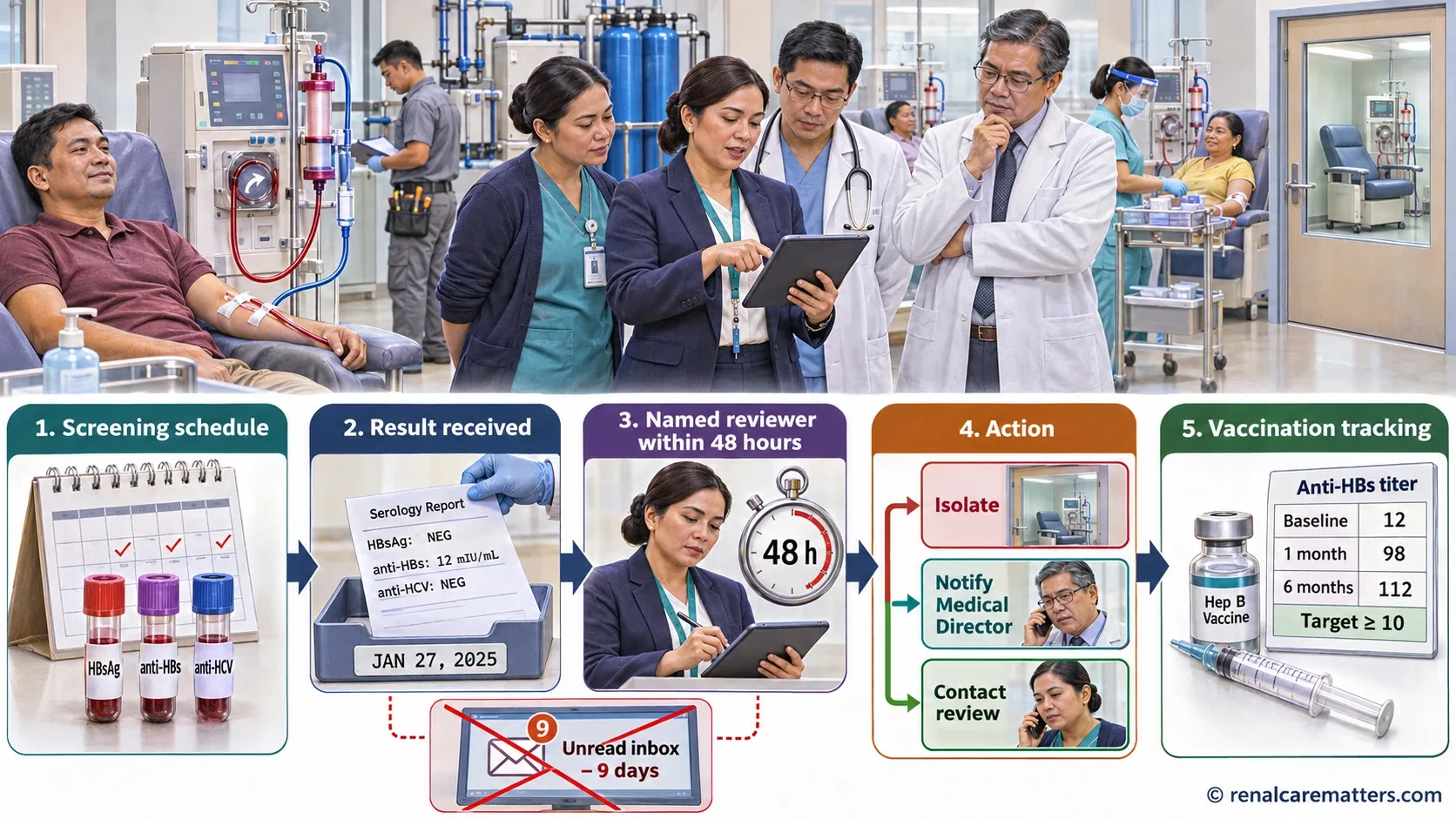
Figure 4 · From blood test to action
- ScreenFollow the Medical Director's schedule for HBsAg, anti-HBs, anti-HCV, and other tests at admission and at set intervals.
- ReviewA named reviewer and a backup read every result within 48 hours of receipt.
- ActA new positive result triggers the Medical Director's isolation decision, notification, and contact review the same day.
- VaccinateTrack hepatitis B vaccination and antibody response. Non-responders need a documented plan.
- Check visitorsTransient patients need current serology before their first session.
Example. A patient from Cagayan de Oro asks to dialyze at your unit in Makati for two weeks while visiting her daughter. Her last hepatitis B result is four months old. Your policy requires results within the last month. The intake clerk does not refuse her; she calls the home unit, which sends a result from last week through its privacy officer. The patient dialyzes on her planned date.
Common failure modes
- Audits without feedback. Data collected and filed, never shown to the people who can change it.
- Hand rub out of reach. Dispensers empty, far from the stations, or not at the point of care.
- Clean beside dirty. Clean supplies stored next to used equipment and waste.
- The traveling vial. Multidose vials carried between stations.
- "Our patients just have catheters." Catheter prevalence accepted rather than tracked and reduced.
Back to the case: The unread result
The next hour. The manager, Mr. Noel Garcia, calls the Medical Director immediately. The Medical Director confirms the result, orders isolation for Mr. Dela Paz's next session, and asks the attending to speak with him and his family. Mr. Garcia's job is to make the isolation possible today: a dedicated machine, a dedicated nurse for that shift, and the isolation room cleared.
The contacts. Using the treatment records, Mr. Garcia lists every patient who dialyzed on the same shift or on the same machine during the nine days: 14 patients. He gives the list to the Medical Director, who orders repeat testing for the susceptible ones, those without protective antibody levels, according to the physician's plan. Required reports are filed.
The system. The failure was not medical. It was that no one owned the inbox. Mr. Garcia writes a corrective and preventive action (Module 2): a named reviewer and a backup, a 48-hour rule from receipt to review, and a log showing date received, date reviewed, and action taken. He checks it each month for three months to prove it works.
Skills checklist: Supervised practice
Complete these with your preceptor at your own unit, using fictional or de-identified data. Your preceptor rates each step as satisfactory, needs practice, or not observed. Steps marked Critical must all be satisfactory before sign-off. This checklist supports supervised learning; your unit’s own procedure and competency form are the authority. A printable version of every checklist is on the trainer page.
- Calculate last quarter's bloodstream infection (BSI) rates by access type and hand-hygiene compliance with CALC-03.
- Observe three catheter connections using the Centers for Disease Control and Prevention (CDC) checklist and give feedback.
- CriticalAudit the serology log for date received, date reviewed and action for the last three months.
- Walk the unit and map clean and dirty zones, supply flow and dispenser locations.
Check your understanding
Each visit draws 5 questions at random from this module’s 15-question bank. Choose the single best answer for each, then select Check answers; an explanation appears under the best answer. Select New set of questions for a different mix. A good target is 4 of 5 on two different sets. Nothing you select is sent anywhere; scoring happens in your browser.
Read next on this site
- Dialysis Access InfectionAccess infections, from the patient side.