After this module you should be able to
- Convert stations, shifts and operating days into required positions per shift and full-time equivalents (FTEs) using a relief factor.
- Explain why the Department of Health (DOH) 1:4 nurse-to-station and 1:15 physician on duty (POD)-to-station figures are ceilings, and list the conditions that require more cover.
- Build a competency matrix that links each staff member to signed skills, restrictions and reassessment dates.
- Reallocate a roster after an absence without breaching ratio, competency or rest limits.
The big picture, in plain words
The picture has a limit. Hands are easy to count; judgment is not. The 1:4 ratio in the Department of Health (DOH) order tells you the most patients one nurse may carry. It does not tell you that four is safe for the four patients you actually have this afternoon: a man on his first week of dialysis, a woman with a fresh fistula, a man in the isolation room, and a patient whose catheter needs a dressing change.
Staffing is where operations and patient safety meet most directly. Get it right, and the clinical team has room to think. Get it wrong, and every other system in the unit starts failing because people are too stretched to follow it.
Figure 1 · Key terms for this module
Case: The competent but exhausted nurse
It is Saturday, 15:40, at a 15-station unit in Antipolo, Rizal. The evening shift starts at 17:00 with 12 patients booked, including one in the isolation room and a man in his first week of dialysis.
Nurse Mark Villanueva texts that he has a high fever. The head nurse, Ms. Annabelle Cruz, calls around. The only nurse who says yes is Ms. Rhea Domingo, a skilled dialysis nurse who has just finished a 12-hour shift at a hospital in Cainta. "I'm tired, but I can push through," she says. "The patients need us."
The manager, Mr. Jerome Aquino, knows the unit is chronically short. He has raised it twice in budget meetings and lost both times.
Before reading on, decide:
- Should Ms. Domingo work the evening shift? Whose decision is it?
- If she does not, what happens to the 12 patients?
- What should Mr. Aquino do with this evening, beyond getting through it?
Keep your answers in mind. The lesson gives you what you need, and the case review near the end shows one sound response.
The operating model: positions, people, and proof
Staffing has three layers. Most units manage only the first.
Positions are the slots the shift needs: nurses, a POD, technicians, a water operator. You derive them from the stations in use and from how sick the patients are.
People fill positions. A person counts toward a position only if they are present, rested, licensed, and competent for that position's tasks.
Proof is the competency record: a signed, dated checklist showing the person was watched doing the skill correctly. Under pressure, units fill positions with people who lack proof. That is how a nurse hired on Monday ends up cannulating a three-week-old fistula alone on Wednesday.
Why the ratio is a ceiling
DOH Administrative Order (AO) 2012-0001 sets ceilings of one nurse to four hemodialysis stations and one POD to fifteen stations.1 Those ratios assume stable patients and a unit running normally. Each of these needs more cover:
- Isolation stations, for example for patients positive for hepatitis B surface antigen (HBsAg), where staff should not move freely between isolated and non-isolated patients.
- New starts and first-week patients, who have more low blood pressure, access problems, and anxiety.
- Patients with catheters, whose connection and disconnection take more nurse time and careful aseptic technique.
- Breaks, when one nurse covers another's patients.
- Changeover, when one shift ends, the next begins, and disinfection, setup, and reprocessing overlap.
- Concurrent services, such as an acute treatment in the hospital pulling a nurse away.
Example. A unit in Lipa has 12 patients on its morning shift and three nurses: exactly 1:4. Two patients started dialysis this week, one has a catheter with a red exit site, and one is in isolation. On paper the shift is fully staffed. In practice, the isolation nurse cannot help anyone else, so the other nine patients share two nurses, nearly 1:5. The ratio was met, and the shift was still short.
What the evidence shows
Staffing burden is associated with outcomes. In a United States cohort of 236,126 patients starting in-center hemodialysis, facilities in the highest quarter of patients per patient care technician, compared with the lowest, had a 7% higher death rate, a 5% higher hospitalization rate, and an 8% higher rate of hospitalization for sepsis.2 The study was observational. Facilities with heavy staffing burden may differ in other ways, such as patient mix or resources. Heavy staffing burden is associated with worse outcomes; the study does not prove that adding staff alone fixes them.
Staffing varies, and it is a choice. United States facility surveys found registered nurse ratios 35% lower and technician ratios 16% higher in for-profit than in nonprofit units, after adjustment.3 Staffing mix is decided by management. It is not a law of nature.
Burnout is a safety variable. A 2024 meta-analysis of 85 studies and 288,581 nurses linked nurse burnout with a weaker safety climate, more healthcare-associated infections, more falls and medication errors, and lower patient satisfaction.4 This too is association, but it is consistent across countries and settings. Chronic short-staffing breeds burnout, and burnout degrades care.
Philippine rules that change the decision
| Rule | Implication | Verify |
|---|---|---|
| AO 2012-0001 | 1:4 nurse and 1:15 POD ceilings; POD present during operating hours | Center for Health Development interpretation for mixed or acute services |
| Labor Code Art. 835 | Health personnel in cities of at least one million people, or in hospitals and clinics of at least 100 beds, work 40 hours a week (generally five days of eight hours). Elsewhere the normal workday is eight hours | Human resources classification of your facility and each worker |
| Labor Code rest-day rules | At least 24 consecutive hours of rest after six consecutive workdays | Employer policy, collective agreement |
| Philippine Society of Nephrology (PSN) guidelines | Training expectations for POD and staff | Current Philippine Society of Nephrology requirements |
Calculator CALC-01: station staffing and FTE planner
The calculator turns stations into people. You need: stations in use per shift, isolation stations, shifts per day, operating days per week, paid hours per shift, contracted hours per FTE, and the non-productive fraction (leave, holidays, training, and sick time).
POD positions per shift = ceiling(stations ÷ 15).
Weekly nurse hours = positions × shifts per day × days per week × paid hours per shift.
Base FTE = weekly hours ÷ contracted hours per FTE.
Relief factor = 1 ÷ (1 − non-productive fraction).
Required FTE = base FTE × relief factor.
Worked example. The Antipolo unit has 15 stations, one isolation area with one station, three shifts a day, six days a week, six paid hours per shift, 40 contracted hours per FTE, and 12% non-productive time.
- Nurse positions = ceiling(14 ÷ 4) + 1 = 4 + 1 = 5 per shift
- Weekly hours = 5 × 3 × 6 × 6 = 540
- Base FTE = 540 ÷ 40 = 13.5
- Relief factor = 1 ÷ 0.88 = 1.136
- Required FTE = 13.5 × 1.136 = 15.3, so plan to hire 16 nurses
At 13.5 FTE, every vacation day, seminar, and fever becomes either overtime or a broken ratio. The calculator makes that visible to finance before the first bad weekend, not after the third.
The competency matrix
One table, kept current, visible to the person making the roster.
| Staff | Role | License expiry | Fistula cannulation | Catheter care | Isolation | Machine setup | Emergency response | Restrictions | Reassess |
|---|---|---|---|---|---|---|---|---|---|
| RN A | Staff nurse | 2027-06 | Signed | Signed | Signed | Signed | Basic Life Support (BLS) 2026-08 | None | 2027-01 |
| RN B | New hire | 2028-02 | Supervised only | Signed | Not yet | Signed | BLS 2026-10 | No solo new fistula | 2026-12 |
The rules are simple. A skill counts only when a qualified assessor has signed and dated it. "Supervised only" means the person needs a named supervisor on that shift. Restrictions appear on the daily roster, not just in the human resources file.
Example. At a hospital unit in Cebu City, a newly hired nurse, Mr. Paul Tan, is rostered alone on the isolation room in his second week. His matrix row says "Isolation: not yet." No one checked, because the matrix lived in a folder in the nursing office. After a near miss with a shared tourniquet, the unit prints a one-line restriction next to each name on the daily roster board. The roster maker now sees it every morning.
Doing it on Monday: reallocating after an absence
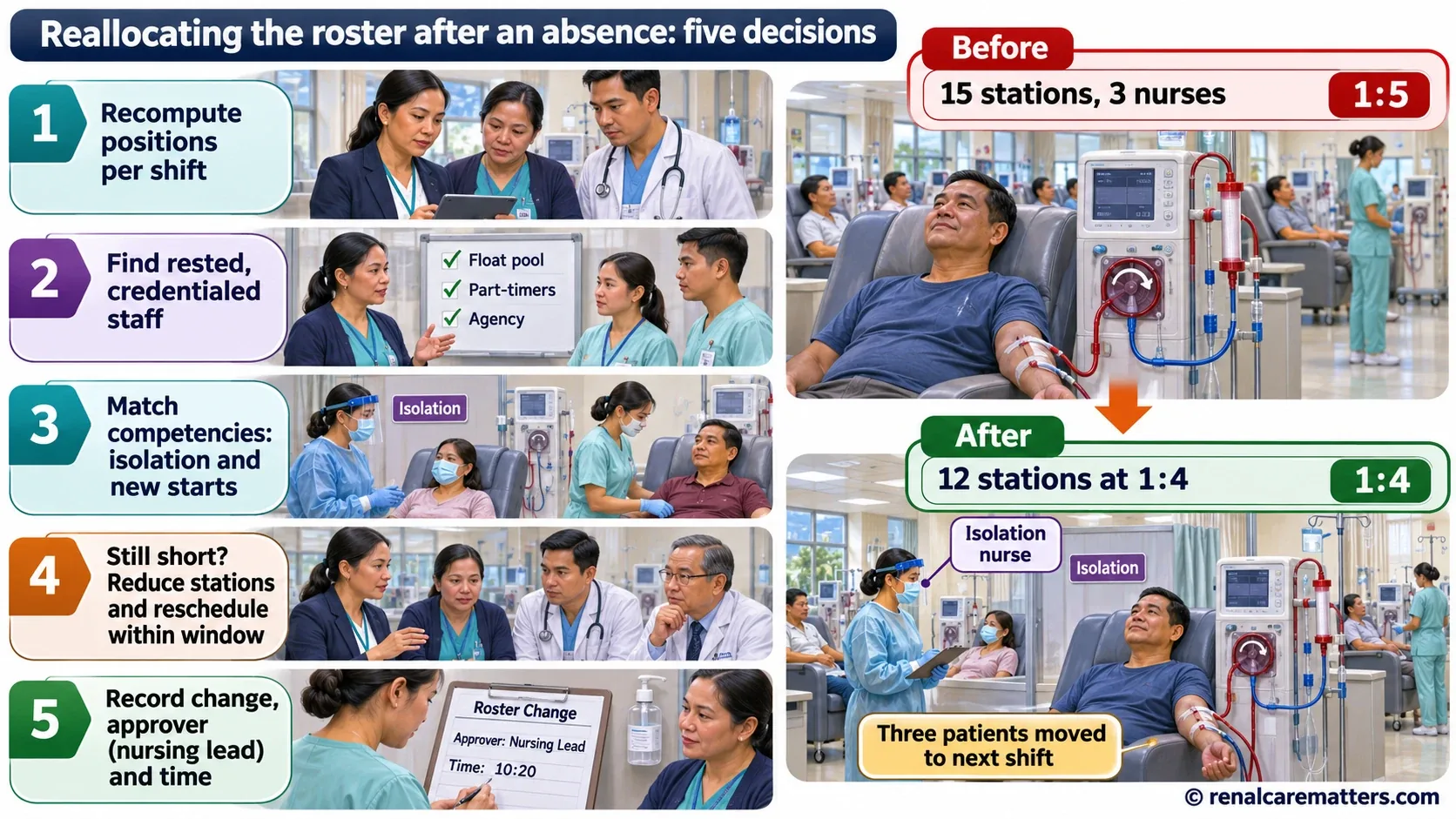
- Recount positions for each shift with the absent person removed.
- Check who is available: off-duty staff who have had enough rest, part-timers, a float pool, or an agency with verified credentials.
- Match competencies to stations. The isolation room and new patients get your strongest available people.
- If you still cannot meet the ceiling, reduce stations for that shift and reschedule patients within a safe window (Module 4). Do not stretch the ratio.
- Record the change, the approver (the nursing lead), and the time.
Common failure modes
- Bodies instead of hands. Counting a person as staff because they are in the building, not because they are competent for that station.
- No relief factor. Planning FTEs as if no one ever takes leave, which guarantees chronic overtime.
- Invisible restrictions. Competency records kept in human resources and never seen on the floor.
- Ratio as goal. Treating 1:4 as the target rather than the limit.
- The hero offer. Accepting a tired colleague's offer to "push through" because it solves tonight's problem.
Back to the case: The competent but exhausted nurse
The offer. The decision belongs to the head nurse, and Ms. Cruz declines it, kindly: "Thank you, Rhea. Go home and sleep. We'll manage." Fatigue degrades vigilance in ways the tired person cannot judge for herself. A nurse 12 hours into her day who misses a falling blood pressure is not a bad nurse. She is a predictable result of a bad roster.
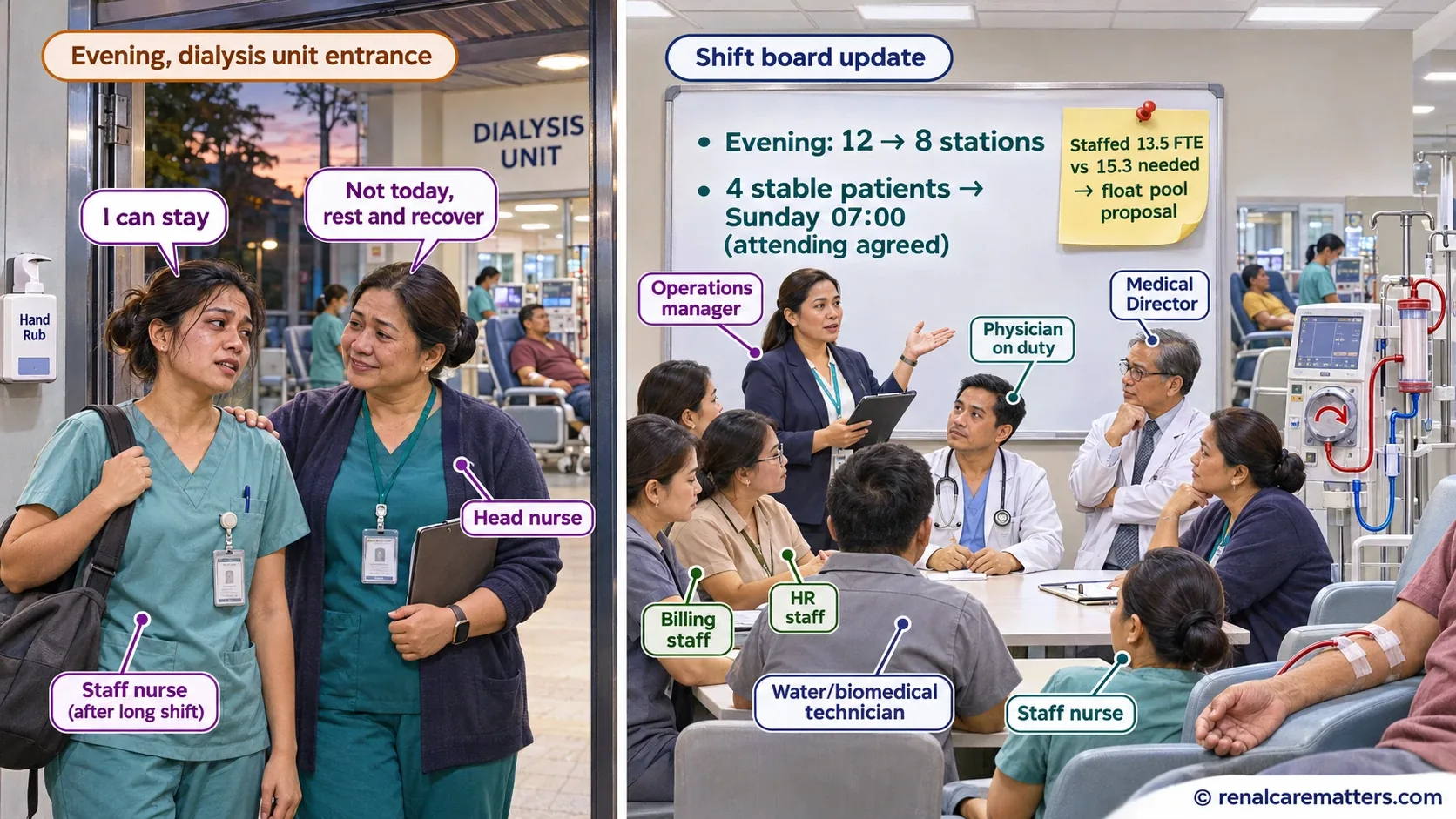
The shift. With three nurses present, Ms. Cruz can safely cover eight stations, including the isolation room with a dedicated nurse. She and the physician on duty (POD) review the 12 patients. Four stable patients who dialyzed on Thursday, with modest weight gains and normal last potassium results, are offered Sunday morning slots. The attending nephrologists agree by phone. The new-start patient and the isolation patient stay on Saturday.
What the manager does next. Mr. Aquino logs the gap and, on Monday, runs the staffing calculator below. The unit employs 13.5 nurse FTE. It needs 15.3. He brings that number, this Saturday's log, and two similar weekends to the next budget meeting, with a proposal for a three-nurse float pool. A missing number lost the earlier budget arguments. This time he has one.
Skills checklist: Supervised practice
Complete these with your preceptor at your own unit, using fictional or de-identified data. Your preceptor rates each step as satisfactory, needs practice, or not observed. Steps marked Critical must all be satisfactory before sign-off. This checklist supports supervised learning; your unit’s own procedure and competency form are the authority. A printable version of every checklist is on the trainer page.
- Run CALC-01 for your unit and compare the result with your actual headcount.
- CriticalBuild the competency matrix for every clinical staff member, with restrictions shown on the roster.
- Reallocate a fictional roster after two absences, with the nursing lead approving.
- CriticalIdentify which shifts in the past month exceeded the ratio or relied on unrested staff.
Check your understanding
Each visit draws 5 questions at random from this module’s 15-question bank. Choose the single best answer for each, then select Check answers; an explanation appears under the best answer. Select New set of questions for a different mix. A good target is 4 of 5 on two different sets. Nothing you select is sent anywhere; scoring happens in your browser.
Read next on this site
- Workforce Issues in Nephrology: Crisis or Opportunity?Workforce pressures in nephrology and what helps.