A supervised support role beside the dialysis nurse
This subtrack is for the Dialysis Nurse Assistant, also called the Patient Care Assistant (PCA): the supervised support worker who greets patients, weighs them, takes the observations the registered nurse (RN) assigns, prepares supplies, helps with comfort and movement, keeps the access in view, cleans external surfaces, carries sealed specimens and keeps honest records. It sits in the Nephrology Nursing Track under By Role. It is not a registered-nurse specialty, it is not a shortened nursing program, and it is not equivalent to a dialysis technician. In this course, PCA always means Patient Care Assistant; the United States Patient Care Technician (PCT) is a different role.
Each of the 12 modules follows the same path: a plain picture first, then the physiology behind it, then what the evidence actually shows (and does not show), then exactly what you do, what you report and what you never do. Every module has worked bedside scenarios, a full fictional case set in a Philippine unit with a debrief and a harder second round, a 10-question knowledge check with a reason under every option, and a checklist to practice with your preceptor. Three modules connect to the new Patient Care Assistant Toolkit.
What this subtrack is, and is not
It is education and practice preparation. Finishing it does not prove competence, grant permission for any task, or carry Department of Health (DOH), Philippine Society of Nephrology (PSN), Philippine Health Insurance Corporation (PhilHealth), Technical Education and Skills Development Authority (TESDA) or Professional Regulation Commission (PRC) recognition or continuing professional development (CPD) units. There is no national Philippine PCA license. Basic life support (BLS) needs its own practical course. Your employer authorizes tasks after observed practice. Hours and pass marks are Academy design proposals, not national minimums. Draft for clinical, nursing, infection prevention and regulatory review.
Who can hold this role
Dialysis Nurse Assistant / Patient Care Assistant (PCA): qualifications at a glance
- PSN describes nursing assistants as BS Nursing graduates awaiting registration, BS Nursing undergraduates who completed at least second year, or BS Midwifery graduates, working under supervision. PSN
- Not a registered nurse and not counted as one; a nursing degree without PRC registration does not authorize nursing practice. DOH, PSN
- No national assistant license or TESDA equivalence; scope is the employer’s written job description plus the tasks signed off under RN supervision.
- Ratio: DOH sets no more than 1 nurse to 4 stations; PSN discusses 1:6 patients when an assistant is present. Confirm with DOH licensing before relying on any exception. DOH, PSN
Sources: DOH Administrative Order No. 2012-0001, Sec. V.B.2.a; Philippine Society of Nephrology (2024), Guidelines for nephrologists in the operation of hemodialysis clinics, Sec. III.A; Republic Act No. 10862. A summary for orientation, not legal advice: check the current issuances, and your unit’s license and PhilHealth accreditation. The full table for every role is on the Academy home.
A day at the San Isidro Dialysis Center
Here is what the job looks like before you start the modules. The day is fictional, and so is everyone in it. Every moment in it happens in Philippine dialysis units every week. You will meet the same team in every module: Nurse Jessa Manalo, the RN in charge of Bay A; Kuya Paolo Reyes, a Dialysis Nurse Assistant with three years in the unit; and Bea Santos, a new assistant and a BS Nursing graduate waiting for her board results. The unit is the San Isidro Dialysis Center, eighteen stations, three shifts a day.
6:05 a.m. · arrival
- What happens
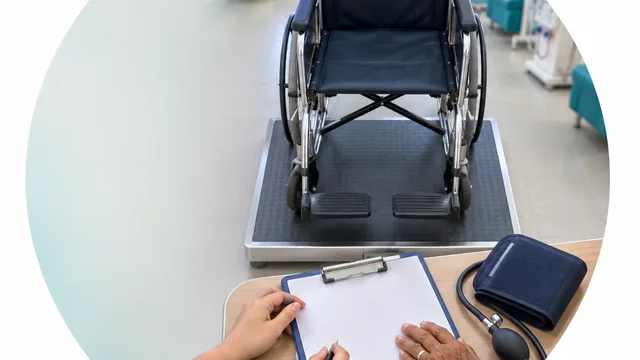
- Mang Rolando, 68, is wheeled in by his son. The wheelchair scale reads 78.6 kg. No one knows this wheelchair’s weight.
- What you do
- Do not guess the tare. Weigh the empty chair, or move him to the standing scale if the RN’s plan allows. Record both numbers and the units. Module 5.
6:20 a.m. · intake
- What happens
- His net weight is 63.4 kg. His last weight after dialysis was 58.0 kg. He is breathing fast and cannot finish a sentence.
- What you do
- Call the RN now, before you finish the form. Report the breathlessness first and the weight second. Module 5 and the toolkit.
8:40 a.m. · hour two
- What happens
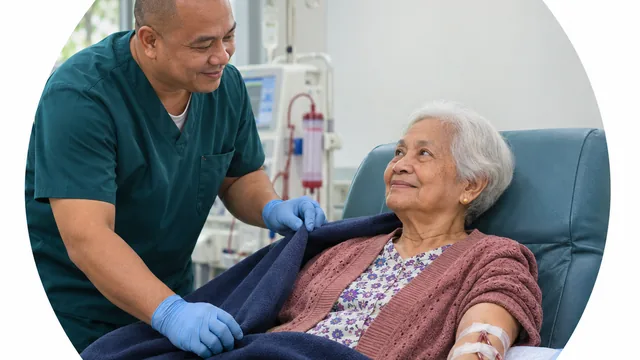
- Nanay Lorna has pulled her blanket over her fistula arm because she is cold. She is drowsy.
- What you do
- Offer a second blanket for her body and keep the access arm uncovered and in view. Tell the RN she is drowsy. Module 7.
10:10 a.m. · shift change
- What happens
- A colleague asks you to “just silence” a beeping machine at Station 4 while the RN is busy.
- What you do
- Do not touch it. Look at the patient, read the message on the screen, and tell the RN or the backup now. Modules 1 and 7.
11:00 a.m. · departure
- What happens
- Mang Rolando stands up quickly to catch his tricycle and grabs the armrest. He says the room is spinning.
- What you do
- Help him sit back down. Stay with him. Call the RN. The tricycle waits; he does not leave until the RN has seen him. Module 9 and the toolkit.
4:30 p.m. · the chart
- What happens
- A post-dialysis blood pressure is missing from a chart. Someone says, “Just write 130 over 80 so the claim goes through.”
- What you do
- Refuse, kindly and clearly. Tell the RN. A missing value is corrected through the approved process, never invented. Module 11.
None of these moments asks you to make a treatment decision. Every one asks you to notice, to measure honestly, to keep the patient safe for the next minute, and to tell the RN in time. That is the job this subtrack trains.
Observe and do, report at once, never
The RN assesses the patient, chooses which tasks to delegate, gives the instructions and reviews what you find. You accept only tasks within your verified competence and report completion or difficulty. The table below is the boundary this course teaches; your employer’s written job description may be narrower, and applicable law always governs.
| Observe and do | Report at once | Never, under this course |
|---|---|---|
| Greet, identify with two identifiers, explain the task | Chest pain, breathlessness, fainting, collapse, seizure, new confusion | Assess, triage or decide treatment |
| Weigh with the tare recorded; take assigned blood pressure, pulse, temperature, respirations and oxygen saturation | Bleeding, a wet blanket near the access, a needle or line that looks out of place | Set dry weight, fluid removal or treatment time |
| Prepare unopened supplies against the list; restock | Fever or shivering, especially in a patient with a catheter | Cannulate, touch catheter hubs or connections, connect, disconnect, return blood |
| Help with comfort, toileting, positioning and transfers within the RN’s plan | A reading far from the patient’s usual, or one you could not take reliably | Give, prepare or hand over any medicine; give blood products |
| Clean external surfaces after clinical clearance, within the product label | A machine alarm, a leak, a smell, a damaged cable, an out-of-service tag | Silence or reset alarms; change settings; prime without a separate sign-off |
| Carry sealed, labeled specimens and documents | A specimen or document that does not match | Draw blood, or relabel from memory |
| Write what you measured, when, and whom you told | A missed treatment, a fall, a threat to safety, a request outside your role | Enter or copy a number you did not obtain |
Conditional tasks. Machine preparation assistance, point-of-care testing, and carrying medicines or blood products need a separate written local endorsement, device-specific training, an observed assessment and named authorization. Carrying a medicine is not giving it; carrying blood is not transfusing it. A quiz score never unlocks any of these. Module 1 explains delegation and safe refusal.
Entry, readiness and the Philippine anchor
Anyone may read this subtrack. For the Philippine workplace pathway, the PSN guidelines describe nursing assistants as BS Nursing graduates awaiting registration, BS Nursing undergraduates who have completed at least the second year, and BS Midwifery graduates; employers verify these records.[[psn2024]] A completed nursing degree without PRC registration does not authorize registered nursing practice. Before placement, this program proposes an occupational health review (including hepatitis B vaccination and immunity, decided by occupational health), employer induction, and a current practical BLS course from a recognized provider.
Delivery. 120 proposed hours: 48 guided study, 24 simulation and skills lab, and 48 supervised workplace learning. A suggested six-week part-time sequence covers two modules a week. The workplace blocks of Modules 1 to 4 are observation only. BLS, induction and any optional local endorsements are additional. Placement extends until competence is shown; experienced assistants may have a preceptor-led gap assessment, but seniority never waives a safety demonstration.
12 modules
 Week 1Module 110 hP1
Your Role, Delegation and Safe Teamwork
What the Dialysis Nurse Assistant does and does not do, why the research says assistants must add to nurses and never replace them, how to accept a delegated task safely, how to close the loop, and how to say no without leaving the patient alone.
 Week 1Module 210 hP2
Kidney Failure and the Patient Journey
What failing kidneys stop doing, what hemodialysis replaces and what it cannot, why the long weekend gap and a missed session are dangerous, the other paths (peritoneal dialysis, transplant, supportive care), and how to answer a patient’s question without giving treatment advice.
 Week 2Module 310 hP3
Dignity, Consent, Privacy and Communication
Respect, permission and refusal; why a family member is not a safe interpreter; teach-back and what the evidence on it shows; the Data Privacy Act at the reception desk; phones, photos and group chats; and when a concern about safety cannot be kept secret.
 Week 2Module 410 hP4
Infection Prevention and Exposure Safety
Why bloodborne viruses spread between dialysis patients, how long hepatitis B survives on a dry surface, the five hand hygiene moments and why gloves lower hand hygiene, clean-to-dirty flow, sharps, and the exposure response that must start within minutes.
 Week 3Module 510 hP5
Arrival, Observations and Weights
Two identifiers every time, why the weight decides the fluid goal and therefore must be true, wheelchair tare done right, blood pressure errors that move a reading by 20 mm Hg or more, why the oximeter can miss low oxygen, and why a symptom outranks a normal-looking number.
 Week 3Module 610 hP6
Station Readiness, Supplies and Preparation Assistance
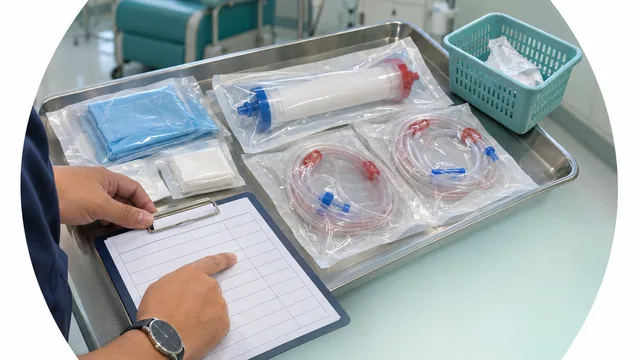
What a ready station needs, how to check supplies against the list for identity, damage, moisture and expiry, why “it fits” does not mean “it is compatible,” why machine preparation needs its own sign-off, and how to respect a quarantine tag.
 Week 4Module 710 hP7
Protect the Access and Observe During Treatment
Fistula, graft and catheter at an awareness level; why a dislodged needle can bleed a patient dangerously within minutes and why the machine may not alarm; why the access must stay visible; what to watch in the patient as well as the machine; and what you never touch.
 Week 4Module 810 hP8
Deterioration, Emergencies and BLS Teamwork
Why dialysis patients have cardiac arrests more often than other people, the early warning signs that come before collapse, how to activate help without waiting for a number, what the evidence shows about staff-started cardiopulmonary resuscitation (CPR) in dialysis clinics, your role in the team, and why reading about basic life support (BLS) is not the same as learning it.
 Week 5Module 910 hP9
Comfort, Safe Mobility and Departure
Comfort with clinical awareness, why patients are dizzy when they stand after dialysis, how often older dialysis patients fall and how badly, the consensus definition of a standing blood pressure drop with a worked check, safe transfers within the RN’s plan, and why departure is a handover, not a goodbye.
 Week 5Module 1010 hP10
Cleaning, Waste and Equipment Boundaries
Why cleaning and disinfection are different, why wet contact time is the dose, the dialysis station surfaces most often missed, waste and linen without cross-contamination, and why a clean-looking machine is not a released machine.
 Week 6Module 1110 hP11
Accurate Records, Specimens, Supplies and Benefits
Why a record is a sworn statement of what happened, how to correct an error honestly, why a mislabeled tube is so dangerous, how to carry specimens, medicines and documents without changing anything, and how to help with PhilHealth questions without promising anything.
 Week 6Module 1210 hP1–P12
Quality, Disasters and the Integrated Capstone
The whole shift as one chain, near-miss reporting without blame, a small audit you can run with the run chart, what the evidence teaches about kidney patients in disasters, your role in typhoons, floods, earthquakes, fires and outages, and the six capstone stations.
When you have finished: take the end-of-course knowledge check: 24 questions, two from each module, drawn from a pool of 48. The pass mark is 20 of 24 with no safety-critical question missed.
What you will be able to do
| Code | The learner can | Evidence |
|---|---|---|
| P1 | Work inside the role: name the supervising RN, accept only delegated tasks within sign-off, decline safely and close the loop. | Repeat-back, safe refusal and handback in every station |
| P2 | Explain dialysis in plain words and route treatment, diet, medicine and money questions to the right person. | Plain-language explanation; missed-treatment relay |
| P3 | Protect dignity and privacy, respect refusal, use interpreters and teach-back, and escalate safeguarding concerns. | Confidentiality and refusal scenario |
| P4 | Perform hand hygiene and glove changes at the right moments, keep clean and dirty apart, and start the exposure response at once. | Hand hygiene and exposure station |
| P5 | Identify with two identifiers, obtain trustworthy weights and assigned observations, and report the reading and the symptom. | Weight, tare and observation station |
| P6 | Prepare a station from the approved list, spot mismatched, damaged or expired supplies, and respect quarantine. | Station readiness with a planted mismatch |
| P7 | Keep the access visible and protected, notice bleeding and symptom change, and report without touching the circuit. | Access concern simulation |
| P8 | Recognize deterioration, activate the emergency response, and perform the role learned in a practical BLS course. | Emergency activation drill; BLS card |
| P9 | Give comfort and mobility help within the RN’s plan, prevent falls, and never let an unwell patient leave unreviewed. | Transfer and departure station |
| P10 | Clean external surfaces with full wet contact time after clinical clearance, segregate waste, and report faults. | Cleaning cycle and fault report |
| P11 | Keep truthful records, carry sealed specimens with identity checks, and route benefits questions without promises. | Factual entry and mismatch response |
| P12 | Integrate the role across a shift, report near misses, and act within the plan during disasters and outages. | Capstone; workplace portfolio |
Syllabus and proposed hours
| Week | Module | Study | Simulation | Workplace | Total | Observable evidence |
|---|---|---|---|---|---|---|
| 1 | DNA-12 Your Role, Delegation and Safe Teamwork | 4 | 2 | 4 | 10 | Repeat-back of a delegated task; a safe refusal with an alternative action; a factual handback, observed by the preceptor. |
| 1 | DNA-12 Kidney Failure and the Patient Journey | 4 | 2 | 4 | 10 | Plain-language explanation of hemodialysis (HD) observed by the preceptor; a missed-treatment relay without blame; correct routing of three patient questions. |
| 2 | DNA-12 Dignity, Consent, Privacy and Communication | 4 | 2 | 4 | 10 | Respectful introduction and permission; a refusal handled without pressure; protected printed records and screens; correct use of the interpreter route. |
| 2 | DNA-12 Infection Prevention and Exposure Safety | 4 | 2 | 4 | 10 | Observed hand hygiene and glove changes across a simulated workflow; correct donning and removal of personal protective equipment (PPE); separation of clean and dirty items; exposure response rehearsal. |
| 3 | DNA-12 Arrival, Observations and Weights | 4 | 2 | 4 | 10 | Two identifiers; equipment check; weight with units and tare; assigned observations by the approved technique; escalation of a symptom with closed-loop confirmation. |
| 3 | DNA-12 Station Readiness, Supplies and Preparation Assistance | 4 | 2 | 4 | 10 | Station check (brakes, call access, layout); supplies matched to the list; expiry and packaging inspection; recognition of out-of-service status; handback of exceptions. |
| 4 | DNA-12 Protect the Access and Observe During Treatment | 4 | 2 | 4 | 10 | Detection of simulated bleeding under a blanket and an immediate RN call; correct positioning and covering that keep the access visible; factual recording of observations. |
| 4 | DNA-12 Deterioration, Emergencies and BLS Teamwork | 4 | 2 | 4 | 10 | Emergency activation drill with location and concern; correct team role; current practical BLS card (separate course); factual post-event record. |
| 5 | DNA-12 Comfort, Safe Mobility and Departure | 4 | 2 | 4 | 10 | Safe transfer within a plan with correct aid and helpers; standing blood pressure check and report; departure handover with RN review. |
| 5 | DNA-12 Cleaning, Waste and Equipment Boundaries | 4 | 2 | 4 | 10 | A full station cleaning cycle with correct order and contact time, checked with fluorescent marker; correct waste and linen routes; a fault report. |
| 6 | DNA-12 Accurate Records, Specimens, Supplies and Benefits | 4 | 2 | 4 | 10 | Factual entries with units and notification; an approved error correction; a specimen mismatch stopped and returned; a benefits question routed correctly. |
| 6 | DNA-12 Quality, Disasters and the Integrated Capstone | 4 | 2 | 4 | 10 | Six capstone stations passed with no critical failure; a near-miss report; one audit cycle plotted on a run chart; a workplace portfolio. |
| Total | 48 | 24 | 48 | 120 | BLS is additional |
Hours are teaching allocations, not a claim that every skill takes the same time to master, and not a statutory training requirement.
Three separate records
| Label | Requirement | Recorded by |
|---|---|---|
| Self-study complete | All modules read; the end-of-course knowledge check passed (20 of 24, no safety-critical item missed). Module checks: 4 of 5 with every safety-critical item right; 120 module items in all. | The learner, here (optionally saved in this browser only) |
| Simulation requirements met | The six capstone stations in Module 12, every critical criterion met without a prompt | Faculty, on an offline record |
| Workplace competencies verified for listed tasks | At least three satisfactory observations of each applicable skill across at least two shifts; more if performance varies | The employer, on its own signed records |
Never describe a browser score as “certified PCA,” “PSN-accredited,” “DOH-approved” or “competent to practice independently.” Critical failures are never averaged away: they lead to feedback, practice and reassessment with an equivalent scenario.
Staffing rules, and a discrepancy to keep visible
The DOH licensing rules require dialysis nurses to be PRC-registered with renal-care training and BLS, with at least one nurse per shift holding current advanced cardiovascular life support (ACLS), and set a maximum of one nurse to four HD stations.[[doh2012]] The PSN guidelines discuss one nurse to six patients when a nursing assistant is present.[[psn2024]] The two use different denominators and come from different authorities. This course does not offer a staffing calculator and does not treat the PSN wording as permission to staff above the DOH limit; written confirmation from the DOH licensing authority would be needed before relying on any exception. An assistant never counts as a registered nurse.
Evidence from hospital wards supports keeping that line: in 243 European hospitals, replacing one professional nurse with one nursing assistant per 25 patients was associated with 21% higher odds of surgical death (observational data).[[aiken2017]] PhilHealth’s hemodialysis circulars set coverage and quality standards; they are financing and quality policies, not a scope or credential for assistants.[[phic2024_23]][[phic2024_29]]
Three systems, and why nothing transfers automatically
| Country | Role and source | What transfers | What does not |
|---|---|---|---|
| United States | Dialysis Patient Care Technician (PCT): high-school diploma, RN-directed approved training, state rules, certification within 18 months for new hires (42 Code of Federal Regulations §494.140)[[cfr494]] | Competency-based training, structured supervision | PCT duties such as cannulation, United States certification and its 18-month rule |
| United Kingdom | National Health Service (NHS) employer job descriptions for dialysis healthcare assistants (HCA): observations, weights, movement help, preparation, cleaning; some trained posts do more | Dignity, delegated care, escalation, local competency records | NHS bands, advanced procedural duties, employment eligibility |
| Singapore | Government healthcare-assistant framework: basic care and monitoring under trained nurses | Basic care, teamwork, quality participation | Dialysis-specific authorization or cross-border recognition |
Localize before teaching, and keep a printable record
The lessons use generic workflows on purpose. Before teaching, gather the unit’s written job description and competency record for assistants, its escalation contacts and emergency codes, the identification policy, the scales and their tare labels, the observation devices and cuff sizes, the approved disinfectants with dilution and contact time, the waste chart, the specimen procedure, the documentation and correction policy, and the disaster and outage plans. Use them in every simulation. Use training props: moulage blood, mock sharps, empty specimen tubes, fluorescent gel. Never use real blood or real sharps for teaching.
| Skill | Procedure and version | Date 1 · O/S/P · assessor | Date 2 · O/S/P · assessor | Date 3 · O/S/P · assessor | Authorized / restricted / not assigned |
|---|---|---|---|---|---|
| Identification and weight with tare | |||||
| Assigned observations and escalation | |||||
| Station readiness and supply check | |||||
| Access observation and alarm relay | |||||
| Transfer and departure handover | |||||
| Station cleaning and waste | |||||
| Records and specimen transport |
Refresh at least yearly, and immediately after an incident, a new device or procedure, a long absence or a poor audit. Medical director, head nurse, infection prevention lead and compliance officer each sign off their part of the content before local use.
The Patient Care Assistant Toolkit
Built for this subtrack. Three tools check the numbers an assistant is asked to measure: a weight and tare check (net weight, pounds to kilograms, gain since the last session and your unit’s report threshold); a standing blood pressure check against the consensus definition of orthostatic hypotension; and a timed count and temperature converter. Every tool ends in a report to the RN; none suggests a treatment change.
Sources behind this subtrack
Evidence checked 25 November 2026 (Blueprint v2). Peer-reviewed studies were retrieved through PubMed; each module cites its own. Before publication or workplace use, the unit’s medical director, head nurse, infection prevention lead and compliance officer should review the wording, and the current Health Facilities and Services Regulatory Bureau (HFSRB) assessment tool and staffing interpretation, current PhilHealth circulars and any PSN revision of the assistant role should be obtained and reconciled. Local procedures and device instructions always govern.1,2,3,4,5,6,7,8,9,10,11,12,13,14