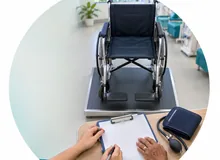
- Weight and tare: enter the scale reading, its unit, the weighed tare of the wheelchair or device, any clothing allowance your unit uses, and the last post-dialysis weight. Add your unit’s written report threshold if it has one.
- Standing blood pressure: enter the lying or sitting reading and the standing readings the nurse asked for. Help a dizzy patient sit first; complete numbers only when the patient is safe.
- Counts and temperature: enter how many beats or breaths you counted and for how long; or a temperature to convert.
- Nothing you enter is stored or sent. Never enter a patient’s name.
When to Use
Use these tools while training (Modules 5 and 9 of the subtrack) and at work when your unit allows a check of your arithmetic. They catch the common errors: a guessed tare, pounds read as kilograms, a timed count multiplied wrongly, a standing drop calculated from the wrong pair of readings.
When NOT to rely on it
These tools never decide anything about treatment. They do not set a dry weight, a fluid goal, a treatment time or a medicine. A symptom (breathlessness, chest pain, dizziness, confusion) is reported to the nurse at once, before any calculation. The thresholds shown are descriptions from published sources or your own unit’s written threshold, not targets.
Weight and tare check
Results stay in your browser. Nothing is stored or sent.
⚕ Net weight = (scale − tare − allowance), converted to kilograms. Gain = net weight − last post-dialysis weight. Report both, with the tare and how it was obtained, to the nurse.
Standing blood pressure check
For a lying-or-sitting to standing check the nurse asked for. Uses the consensus definition: a fall of at least 20 mm Hg systolic or at least 10 mm Hg diastolic within 3 minutes of standing.
⚕ A description used by clinicians, not a decision for you. If the patient is dizzy, help them sit and call the nurse first; record whichever readings you safely obtained.
Timed count and temperature converter
⚕ Count a full 60 seconds when the pulse or breathing is irregular. Report a new fever, shivering, or a rate far from the patient’s usual at once.
Evidence & References
Formula & Equations
| Quantity | Equation or rule |
|---|---|
| Pounds to kilograms | lb × 0.4536 |
| Net weight | Scale reading − tare − clothing allowance (then converted to kg) |
| Weight gain | Net weight − last post-dialysis weight |
| Gain as a percent | Gain ÷ last post-dialysis weight × 100 |
| Standing fall | Lying or sitting value − lowest standing value (systolic and diastolic separately) |
| Consensus definition of orthostatic hypotension | Systolic fall ≥ 20 mm Hg or diastolic fall ≥ 10 mm Hg within 3 minutes of standing |
| Rate per minute | Count × (60 ÷ seconds counted) |
| Temperature | °C = (°F − 32) × 5/9; °F = °C × 9/5 + 32 |
Evidence
Weight gained between sessions is almost entirely water, and the pre-dialysis weight is a main input to the fluid the prescription removes, so an error in tare or units becomes an error in treatment. In 34,107 United States hemodialysis patients, an average interdialytic gain of 4.0 kg or more was associated with higher cardiovascular death than a gain of 1.5 to 2.0 kg after adjustment (hazard ratio 1.25), an association rather than a target. Excessive gain was also associated with higher mortality in the international DOPPS cohort. The consensus statement of the American Autonomic Society and European Federation of Autonomic Societies defines orthostatic hypotension as a sustained fall of at least 20 mm Hg systolic or 10 mm Hg diastolic within 3 minutes of standing. A systematic review of 328 studies found that single sources of error can move a blood pressure reading by tens of mm Hg, so an unexpected value should be repeated. Pulse oximetry can miss low oxygen, more often in patients with darker skin, so a symptom outranks a reassuring number.