Nephrology Nursing Track · By Role · Module 10 of 13
From the Chart to the PhilHealth Claim
Why documentation is a clinical act, the current PhilHealth hemodialysis rules, the claims tracer, and correcting a record.
PublishedNailathalaGipatikPepalwal:ReferencesMga SanggunianMga TinubdanReng Reperensya:6Audience: Head nurses and charge nurses in hemodialysis units · senior dialysis nurses preparing to lead · medical directors and nursing administrators who orient themRead timeOras ng pagbasaOras sa pagbasaOras ning pamamasa:
This module is study material for head nurses in hemodialysis units. It explains the reasoning behind common decisions; it is not a protocol. On the floor, follow your unit’s protocol and ask the attending nephrologist for guidance. Doses, limits, and cut-off values are set by your unit. Every case is fictional.
Learning objectives
After this module you should be able to
Explain why a session note is a clinical record first and a billing record second.
State the current Philippine Health Insurance Corporation (PhilHealth) rules for maintenance hemodialysis: who is covered, how many sessions, and at what rate.
Separate accreditation, coverage, and quality assurance, and name the evidence each needs.
Trace one claim back through every record that supports it.
Project when a patient will use up the year’s sessions, and plan before it happens.
Correct a record by amendment, never by erasing.
Pre-testBefore you read, answer the 8 self-assessment questions and note your score. After the module, select New set of questions and compare. The difference is what you learned; the questions you still miss are what to reread.
Start here
The big picture, in plain words
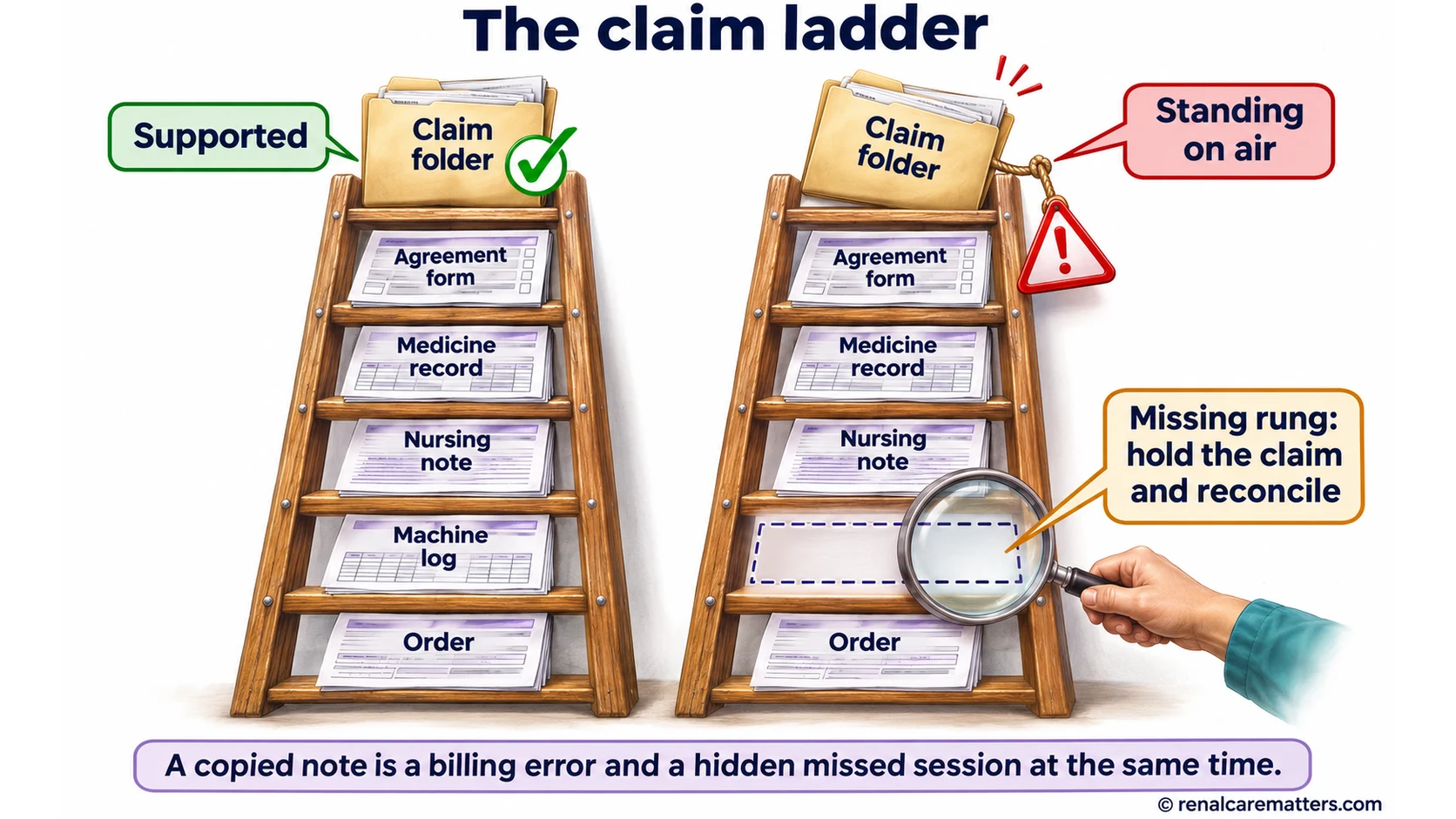
In plain wordsA claim is a promise that a session happened, to a named patient, on a stated date, as described. The chart is the evidence for that promise. Picture the claim at the top of a ladder whose rungs are the order, the machine log, the nursing note, the medicine record, and the signed agreement form.
If any rung is missing, the claim is standing on air, however tidy the paperwork above it looks. The picture has a limit: a ladder fails from the bottom, but a claim fails wherever a reviewer looks first.
Figure 1. A claim stands on its evidence. If one rung is missing, the claim is standing on air.
Figure 2 · Key terms for this module
PhilHealth Dialysis Database (PDD)The registry a patient with chronic kidney disease (CKD) stage 5 must be enrolled in to claim the hemodialysis benefit.
Package rateThe fixed amount PhilHealth pays per session, covering facility and professional fees and the listed services.
Balance billingCharging the patient for a covered service above the package rate.
AccreditationPhilHealth’s recognition that a facility may claim at all.
AmendmentA correction that keeps the original visible and records who changed it and when.
Claims tracerFollowing one claim back through every supporting record.
Opening case · fictional
Case: Monday that did not happen
On Thursday, the billing officer, Ms. Rowena Garcia, brings you a claim prepared for Mr. Felix Bautista, 63, for Monday’s session. The signed nursing summary for Monday reads “Session completed, 4 hours, ultrafiltration (UF) 2.5 L, tolerated well.”
The machine log for station 11 shows no treatment on Monday morning. The charge nurse that day, Ms. Lea Vergara, remembers that Mr. Bautista was sent to the hospital emergency room with chest pain before he was connected.
Before reading on, decide:
What happens to the claim, and what happens to the records?
What clinical problem is hiding inside this billing problem?
How did a completed note appear for a session that never happened, and how will you stop it?
Keep your answers in mind. The lesson gives you what you need, and the case review near the end shows one sound response.
Lesson · part 1
Documentation is a clinical act first
The session note is how the next nurse, the physician, and the patient’s next unit find out what happened. A copied note does two kinds of harm at once. It invents a session that a reviewer will pay for, and it hides a missed session from the team caring for the patient. Module 2 showed that missed sessions carry a mortality signal.1,2 The billing error and the clinical error are the same error.
What a session note must carry: the current order version, consent, the pre-treatment assessment, the access, actual start and end times, fluid removed, any interruption and its reason, medicines given, the response, teaching, the condition at discharge, and the handoff.
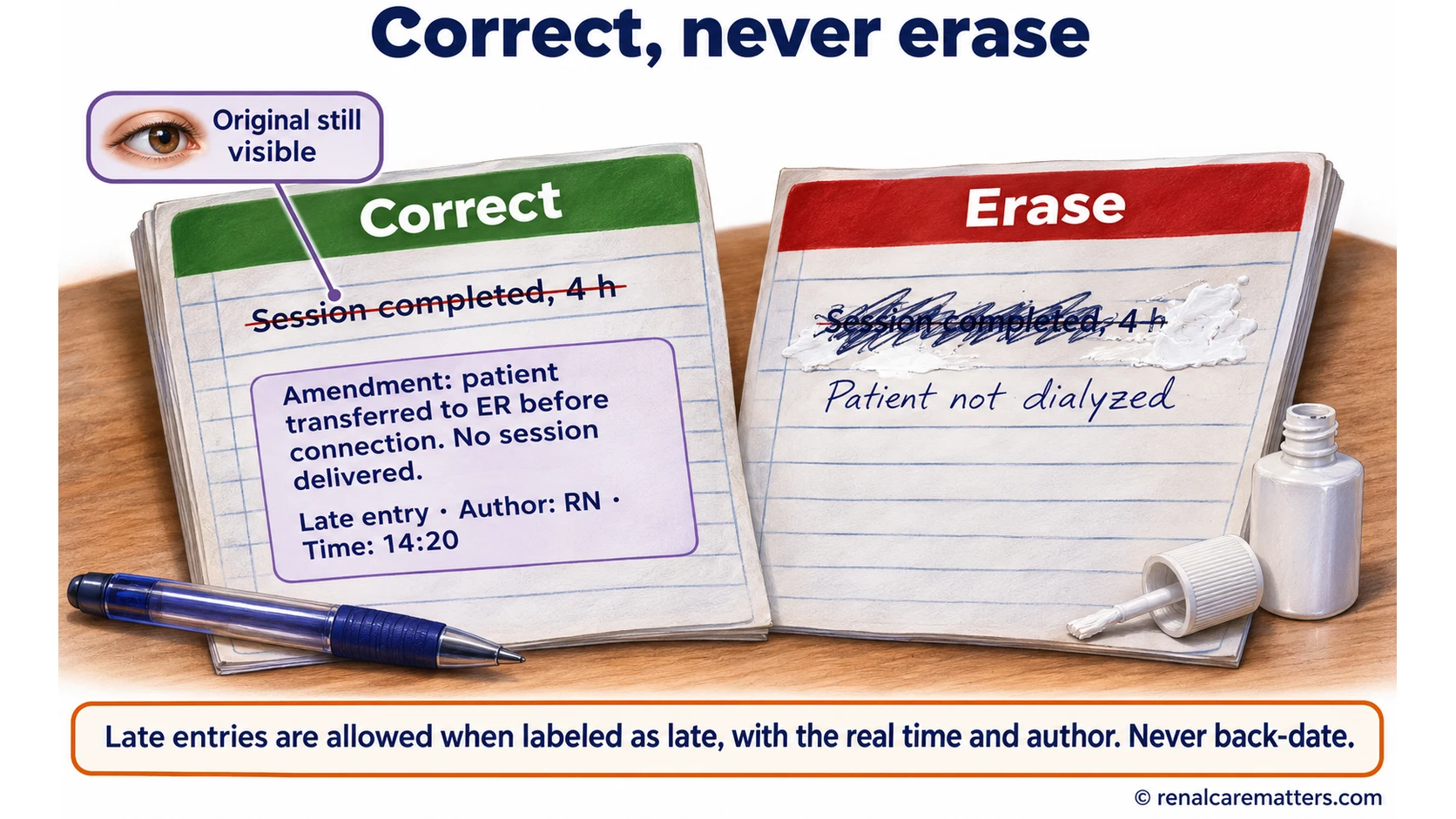
Write it during or right after the session. A late entry is allowed when it is labeled as late, with the real time and the real author. Never back-date.
On the floor · The note the next unit trusted
Mrs. Perla Ignacio transfers to a unit near her daughter’s home. Her last three session notes from your unit read “Session completed, 4 hours, UF 2.5 L, tolerated well.” The notes were copied from a template. In fact, she cramped badly in each session and stopped at about three hours with less than 2 liters removed.
The receiving unit reads the notes and keeps her prescription unchanged, believing it works. She arrives at her second session there short of breath. The copied notes did not only misstate three sessions. They told the next team that a failing plan was succeeding. A note that said “Stopped at 3 hours 5 minutes for cramps, UF 1.8 L” would have told them what they needed to know on the first day.
Illustrative scenario. Names and details are invented.
Lesson · part 2
What PhilHealth covers, as verified on November 23, 2026
Element
Current position
Who is covered
Members and dependents with CKD stage 5 registered in the PhilHealth Dialysis Database3
Sessions per year
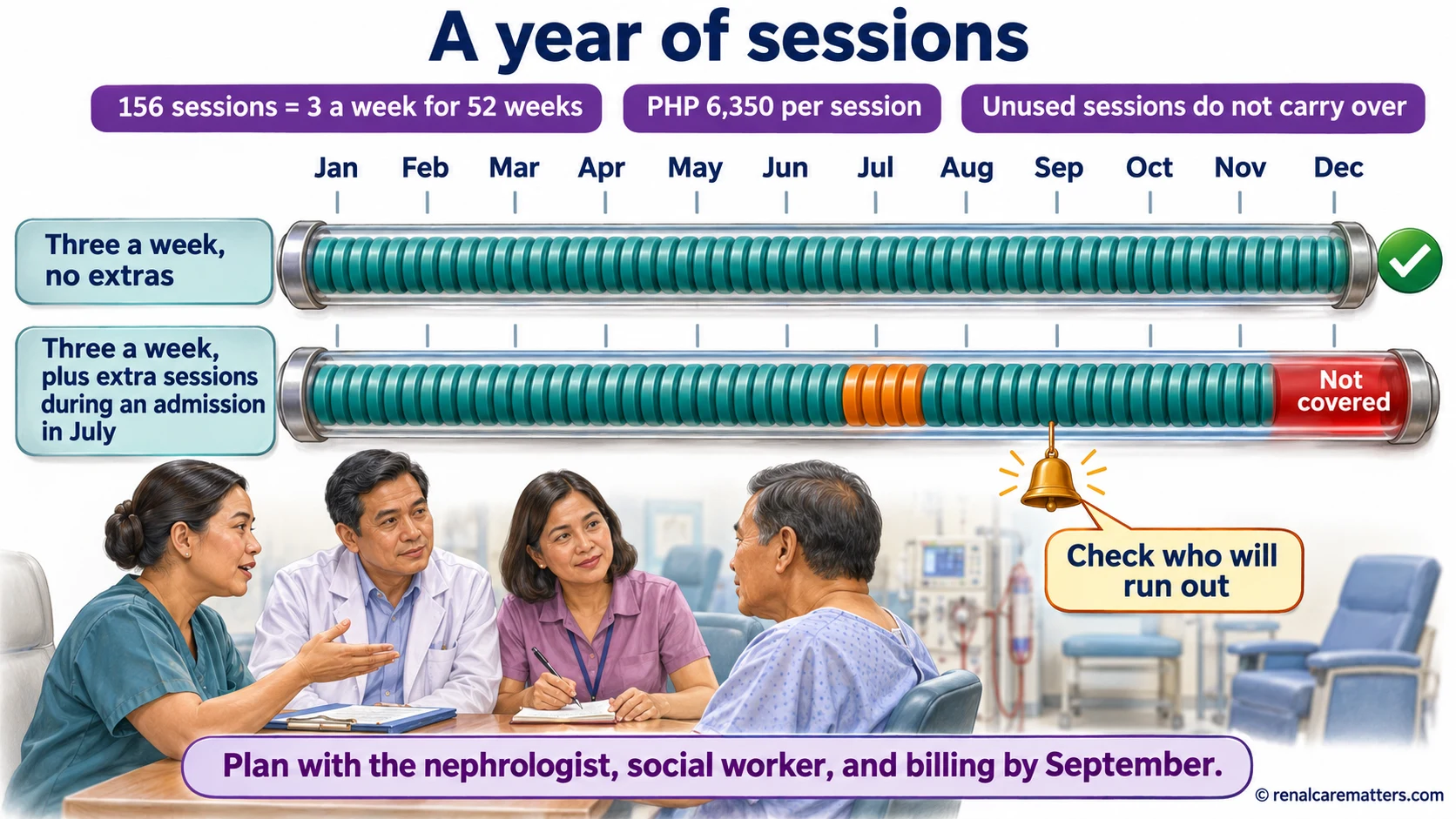
Up to 156 per calendar year, three a week for 52 weeks. Raised from 90 effective June 22, 2023. Unused sessions do not carry over to the next year4
Rate
PHP 6,350 per session, effective October 9, 2024, up from PHP 2,600 and then PHP 4,000 earlier in 2024. Up to PHP 990,600 a year5
What the rate covers
Facility and professional fees and the services and supplies listed in Table 2 of Circular 2024-0023. No balance billing or co-payment for those covered services3
Services on demand?
No. Services are given when clinically indicated for that session, not at the patient’s request
Agreement form
Records the session number and date, and the patient’s acknowledgment of the rules5
Quality
Circular 2024-0029 sets the quality expectations for maintenance hemodialysis6
Three different questions sit inside these rules. Accreditation asks whether the facility may claim at all. Coverage asks whether this patient and this session qualify. Quality assurance asks whether care met the standard. A unit can pass one and fail another.
Rules change. Billing and compliance confirm current forms and exceptions. Check the PhilHealth circulars page before every annual review.
Lesson · part 3
Tracing a claim, rung by rung
Each month, pick five claims at random. Follow each one, using the patient, the date, and the session number, down every rung.
Figure 3 · Five rungs
Agreement formSigned, with the right session number and date.
OrderCurrent on the date of the session.
Machine logA treatment on that station, at that time, for about that length.
Nursing noteAssessment, times, fluid removed, condition at discharge.
Medicine recordEvery medicine claimed was ordered and given.
Tracer completeness = rungs verified ÷ rungs checked. 5 claims × 5 rungs = 25. If 23 are verified, completeness is 92%. Report the two failures by rung, not by patient.
Route every missing or disagreeing rung to billing or compliance, with an owner. Use synthetic identifiers in any training material.
On the floor · The medicine that was claimed but not given
In the September tracer, the fourth claim passes the first four rungs. The agreement form, the order, the machine log, and the nursing note all match. On the fifth rung, the claim lists an injection of an erythropoiesis-stimulating agent. The medicine record shows it was ordered but not given, because the unit had run out that week, and the nurse wrote “out of stock.”
The claim was built from the order, not from what was given. That is a system problem, not one person’s dishonesty: the billing template pulls from the order list. You route it to billing and compliance with an owner. The claim is corrected before submission, and the template is changed so that a medicine is claimed only when the medicine record shows it was given.
Illustrative scenario. Names and details are invented.
Stop and callStop the claim and call billing, compliance, and the clinical head when a prepared claim does not match the clinical record. Never submit a claim that the records do not support. Follow your unit’s protocol while you reconcile.
Lesson · part 4
Know who will run out before December
A patient who dialyzes three times a week all year, plus any extra sessions, can use up 156 before December. Know who is at risk by the third quarter, so the nephrologist, the social worker, and the patient can plan.
Arithmetic illustration. 140 sessions used by November 1, at three a week. 156 − 140 = 16 left. 16 ÷ 3 = about 5.3 weeks. The allocation runs out around December 8, more than three weeks before the year ends. Remaining value: 16 × PHP 6,350 = PHP 101,600.
Figure 4. A year of sessions. 156 cover three a week for 52 weeks, unused sessions do not carry over, and extra sessions can exhaust the year early.
The calculator does this for each patient. Bring the list to the monthly review in September, October, and November.
On the floor · Planning in September, not December
In September, the ledger shows that Mr. Victor Santos will use up his sessions around the second week of December. At the monthly review, the nurse brings his name, the projected date, and the number of sessions he will still need before the year ends.
Because it is September, there is time. The social worker helps the family look into other sources of help, and the nephrologist reviews whether any extra sessions earlier in the year can be avoided by better fluid control. Mr. Santos is not told in December that his coverage has run out. He is told in September, with a plan already in progress.
Illustrative scenario. Names and details are invented.
Lesson · part 5
Correcting a record
Figure 5. Correct, never erase. An amendment shows the original, the correction, who made it, and when.
Correct an error by an authenticated addendum that shows the original, the correction, who made it, and when. Deleting or overwriting is what turns an error into misconduct.
Ask why the error was possible. Copy functions, templates that pre-fill “session completed,” and notes written before the session ends are common sources. Each is a system problem that Module 11 can fix.
On the floor · 2.0, not 3.0
On Wednesday, a nurse notices that her Monday note for Mrs. Rosalinda Uy records 3.0 liters removed. The machine log shows 2.0. She typed the wrong number.
The wrong way to fix it is to open the note and overwrite 3.0 with 2.0, or to cover it with correction fluid on paper. Either way, the record now hides that it was ever wrong. The right way is an addendum: “Correction to the note of [date]: fluid removed was 2.0 L, not 3.0 L, per the machine log. Entered [date and time] by [name].” The original stays visible. Anyone reading the record later sees the error, the correction, and who made it. That is exactly what an honest record looks like.
Illustrative scenario. Names and details are invented.
RememberAn error corrected openly is a record of honesty. An error erased is a record of something else.
On the floor
Real situations: problems and solutions
These are fictional but typical. For each one, cover the answer, decide what you would do, then compare. Where a step depends on local rules, your unit’s procedure and your supervisor’s direction come first.
The pre-filled note
What you see
The electronic note opens with “session completed, tolerated well” already filled in.
What is likely going on
A template default.
What to do
Report it and ask for the default to be removed.
Why it matters
A record should not say completed until the times and fluid are entered.
Session 157
What you see
A patient arrives for what billing says would be session 157 this year.
What is likely going on
The allocation is used up.
What to do
Dialyze as ordered. Involve billing, the social worker, and the nephrologist about funding. Start tracking at-risk patients earlier next year.
Why it matters
Coverage rules never decide whether a patient is dialyzed today.
The overwritten time
What you see
A nurse overwrote a start time to match the order.
What is likely going on
She thought she was correcting an error.
What to do
Restore the original and enter an authenticated amendment. Teach the difference.
Why it matters
Correct, never erase.
Field notes
Write the note during or right after the session.
Run the five-claim tracer every month.
Check the PhilHealth circulars page before every annual review.
Case review
Back to the case: Monday that did not happen
The claim and the records. Hold the claim. Preserve every record exactly as it is: the nursing summary, the machine log, the roster, any transfer note. Ask Ms. Vergara and the nurse who signed the summary for written accounts. Correct the nursing record by authenticated amendment, keeping the original visible, and document what actually happened: transfer before connection. Billing and compliance withdraw or correct the claim through their process.
The hidden clinical problem. Mr. Bautista missed a session and went to the emergency room with chest pain. Who knows what happened to him? Was he admitted? Did he dialyze in the hospital, or did he go home undialyzed until Wednesday? Call the physician on duty and the attending nephrologist today, and make sure someone has spoken to him or his family.
How it happened. Find out whether the summary came from a template or a copy function that pre-fills a completed session, or whether a note was written in advance. Either way, the system allowed a completed-session note without a delivered treatment. Fix the system, so the record cannot say “completed” until the times and fluid removed are entered. Then run the tracer on the same shift for the past month.
Skills lab · with your preceptor
Skills checklist: Claims tracer
Trace three synthetic claims against their records while your facilitator observes. Your preceptor rates each step as satisfactory, needs practice, or not observed. Steps marked Critical must all be satisfactory before sign-off. This checklist supports supervised learning; your unit’s own procedure and competency form are the authority. A printable version of every checklist is on the trainer page.
CriticalMatches patient identity, date, and session number on every rung.
Confirms the order was current on the date of the session.
CriticalCompares the machine log with the nursing note for time and fluid removed.
Identifies any covered item claimed without a supporting record.
CriticalHolds a claim that the records do not support.
CriticalCorrects a record by amendment, keeping the original visible.
CriticalIdentifies the clinical follow-up needed for a session that did not happen.
Reports completeness by rung, without patient identifiers.
Projects the year’s session use for one patient.
Placement activity. Run the five-claim tracer each month for three months. Present the completeness, the failing rungs, and one system fix to your facilitator.
Self-assessment
Check your understanding
Each visit draws 8 questions at random from this module’s 15-question bank. Choose the single best answer for each, then select Check answers; an explanation appears under the best answer. Select New set of questions for a different mix. A good target is 7 of 8 on two different sets. Nothing you select is sent anywhere; scoring happens in your browser.
Foley, R. N., Gilbertson, D. T., Murray, T., & Collins, A. J. (2011). Long interdialytic interval and mortality among patients receiving hemodialysis. New England Journal of Medicine, 365(12), 1099–1107. https://doi.org/10.1056/NEJMoa1103313
Al Salmi, I., Larkina, M., Wang, M., Subramanian, L., Morgenstern, H., Jacobson, S. H., Hakim, R., Tentori, F., Saran, R., Akiba, T., Tomilina, N. A., Port, F. K., Robinson, B. M., & Pisoni, R. L. (2018). Missed hemodialysis treatments: International variation, predictors, and outcomes in the dialysis outcomes and Practice patterns study (DOPPS). American Journal of Kidney Diseases, 72(5), 634–643. https://doi.org/10.1053/j.ajkd.2018.04.019
Philippine Health Insurance Corporation. (2024). PhilHealth Circular No. 2024-0023: Institutionalization of 156 hemodialysis sessions and coverage expansion (Revision 2).
Philippine Health Insurance Corporation. (2023). PhilHealth Circular No. 2023-0009: Institutionalization of 156 hemodialysis sessions.
Philippine Health Insurance Corporation. (n.d.). PhilHealth hemodialysis benefits package agreement form. Retrieved November 23, 2026, from https://www.philhealth.gov.ph/downloads/claim/HemodialysisBenefitsAgreementForm.pdf
Philippine Health Insurance Corporation. (2024). PhilHealth Circular No. 2024-0029: Quality standards on maintenance hemodialysis procedure as reference of the Corporation.
Educational study material for nurses. Does not replace the attending nephrologist’s orders, the unit’s protocols, required training and certification, or supervised practice.