Nephrology Nursing Track · By Role · Module 1 of 13
Your Role on the Dialysis Floor
What a head nurse decides and what belongs to others, the five gates before opening, and the evidence a unit must keep.
PublishedNailathalaGipatikPepalwal:ReferencesMga SanggunianMga TinubdanReng Reperensya:11Audience: Head nurses and charge nurses in hemodialysis units · senior dialysis nurses preparing to lead · medical directors and nursing administrators who orient themRead timeOras ng pagbasaOras sa pagbasaOras ning pamamasa:
This module is study material for head nurses in hemodialysis units. It explains the reasoning behind common decisions; it is not a protocol. On the floor, follow your unit’s protocol and ask the attending nephrologist for guidance. Doses, limits, and cut-off values are set by your unit. Every case is fictional.
Learning objectives
After this module you should be able to
Describe what a head nurse decides, and what belongs to the attending nephrologist, the clinical head, and the technical staff.
Explain why a small process failure becomes a clinical event faster in a dialysis unit than on a general ward.
Check the five gates before a shift opens, and hold the stations that fail one.
Match each qualification on the roster to the rule that requires it.
Summarize what the research shows about nurse staffing and experience, and how strong that evidence is.
Build an evidence register that an inspector or a payer can follow.
Pre-testBefore you read, answer the 8 self-assessment questions and note your score. After the module, select New set of questions and compare. The difference is what you learned; the questions you still miss are what to reread.
Start here
The big picture, in plain words
In plain wordsThink of the unit as a machine with a control loop. Policies are the limits. Staff observations are the sensors. You are the part that compares the two every shift and acts when a reading crosses a limit.
The picture has a limit. A machine acts on its own. A person acts only with the authority, the information, and the willingness to stop the line. This module is about giving you all three.
Figure 1 · Key terms for this module
Head nurseThe registered nurse who plans, organizes, and evaluates nursing care across the shifts of a dialysis unit.
Attending nephrologistThe kidney specialist responsible for each patient’s dialysis prescription and long-term care.
Clinical headThe physician who authorizes the unit’s clinical policies and leads its quality program with the head nurse.
Independent nurseA nurse with site competency sign-off to care for patients without direct supervision. Only independent nurses count toward the staffing rule.
Advanced Cardiovascular Life Support (ACLS)Advanced cardiovascular life support. Department of Health (DOH) expects at least one nurse with a current certificate on every shift.
Technical releaseA signed record that water or a machine passed its tests and may be used.
Evidence registerA list of every requirement, the document that proves it, who owns it, and when it expires.
Figure 2 · Three habits this module teaches
Check before you openFive gates, every shift, before the first connection.
Hold, do not hopeA failed gate becomes a named hold with an owner.
Call the right personThe decision belongs to whoever owns it. Your job is to make sure they know.
Opening case · fictional
Case: Two problems before six
It is 5:40 on a Monday morning at a twelve-station freestanding unit. You are the head nurse. Three nurses are rostered. While checking the roster, you see that the ACLS certificate of Mr. Carlo Reyes, the only nurse on the shift with one, expired last week. The technician, Mr. Dante Flores, tells you that machine 7 was repaired on Saturday, but the release sheet is not signed.
The administrator, Ms. Liza Ramos, arrives at 5:50. “Twelve patients are outside. Some came by tricycle from two towns away. Can we just start and sort the paperwork later?”
Before reading on, decide:
What do you say at the huddle at 5:55?
Who can resolve each of the two problems, and who decides which patients wait?
What will you write down, and where?
Keep your answers in mind. The lesson gives you what you need, and the case review near the end shows one sound response.
Lesson · part 1
Why small failures become clinical events here
Every session, a patient sends their blood through a circuit outside the body several times over, across a thin membrane bathed in about 120 liters of fluid your unit prepared. The patient cannot excrete potassium, cannot shed two days of water, and often cannot hold their blood pressure when fluid comes off quickly. Module 2 explains each of these.
That is why a missing check matters more here than on a ward. An untested water system, an unreleased machine, a needle under a blanket, or a shift with no one trained in advanced life support each removes one layer between a fragile physiology and harm.
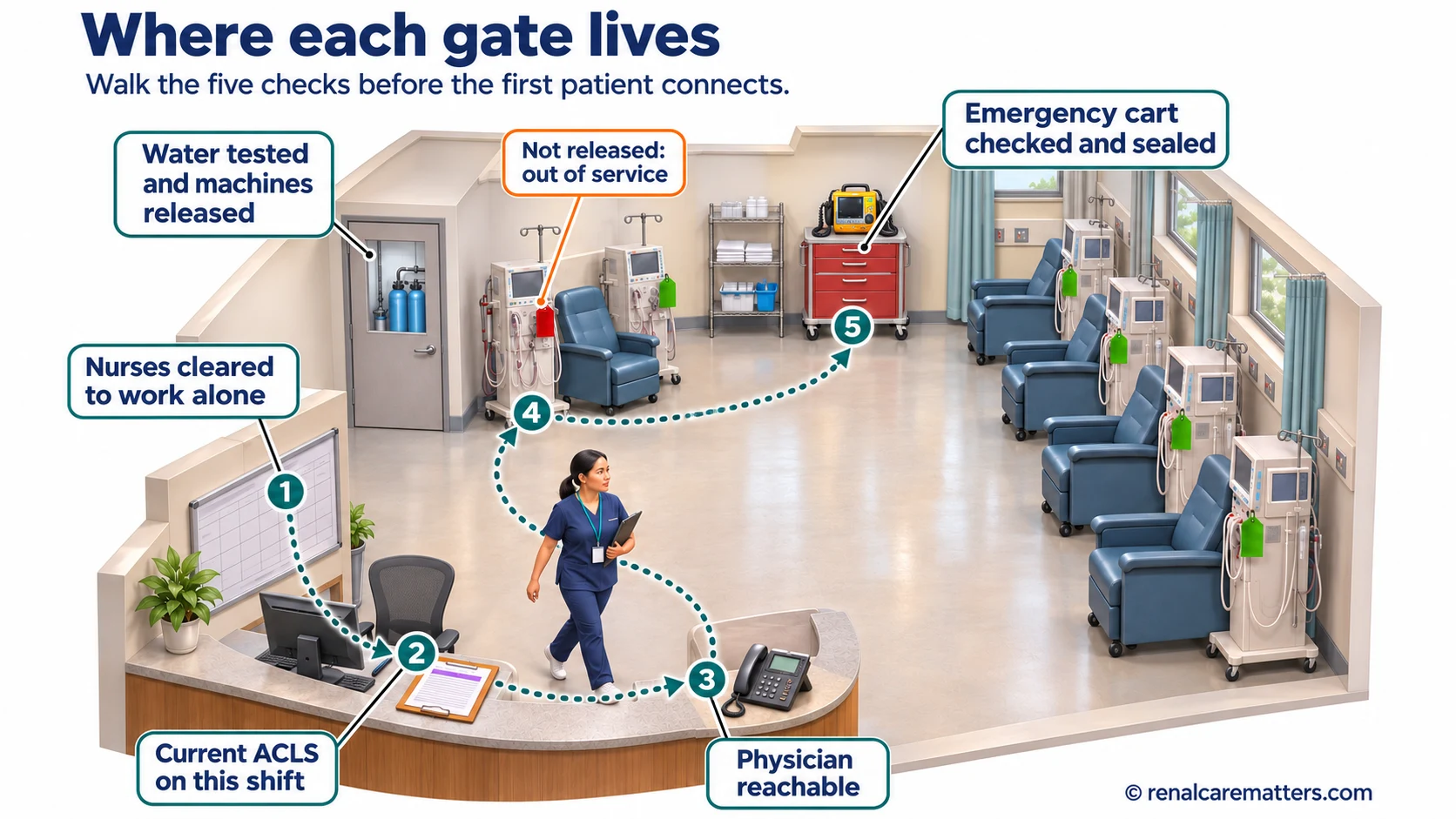
Figure 3. Where each gate lives. The head nurse walks to each of the five checks before the first patient connects.
The workload is growing. Press reports citing national registry figures put 64,845 Filipinos on dialysis in 2024, up 22% from 53,296 in 2023. Press reports also quoted Philippine Health Insurance Corporation (PhilHealth) as paying about PHP 27 billion for more than 2 million hemodialysis claims in the first half of 2025. More chairs, more new staff, and more payer review all land on the nurse who runs the floor. These figures come from news reports, not from the registry itself.
On the floor · Three small things on one Tuesday
On a Tuesday morning, three things go slightly wrong. A reliever nurse from another unit is used to a different machine model. The morning chlorine test was done but not signed, because the technician was called away. And Mr. Ramil Garcia, 69, asks for a blanket because the room is cold.
None of these alone would hurt anyone. Together they remove three layers at once. If the reliever misreads an alarm, if the water was out of limit, and if the blanket hides a needle, there is nothing left between Mr. Garcia and harm. The head nurse who notices all three at 6:10 asks the senior nurse to pair with the reliever, sends the technician back to sign the test before the first connection, and tucks the blanket below Mr. Garcia’s elbow. None of these steps takes more than two minutes.
Illustrative scenario. Names and details are invented.
RememberA dialysis unit is safe because many small checks hold at once. Your job is to know, every morning, which ones are holding.
Lesson · part 2
What the research shows about nurses and outcomes
No trial has tested what happens when a unit has a good head nurse. What exists is a set of observational studies that link the things a head nurse controls to how patients fare.
What was studied
What was found
Strength and limits
Experience mix, Korea
Units where every nurse had at least two years of dialysis experience met more targets for dose, blood pressure, and albumin than units where fewer than half did1
Cross-sectional. Better-resourced units may both keep nurses and have healthier patients
Trained staff hours, 7 countries
A higher share of highly trained staff hours was associated with fewer skipped sessions. Skipping was associated with 30% higher mortality2
Cohort
Workload, United States
More patients per nurse and more care left undone were associated with more adverse events reported by nurses3,4
Cross-sectional. Events were reported by the nurses, not measured
Staffing and transplant, United States
Among 54,141 young patients, units with the most patients per nurse had 14% lower incidence of transplant5
Large cohort
Philippine data on staffing and outcomes were not found. Taken together, these studies support a reasonable inference: the mix of experience and the workload on the floor are patient-safety variables. They do not prove that any particular ratio is correct.
On the floor · When the administrator asks for proof
Ms. Liza Ramos, the administrator, is planning next year’s budget. “Is there proof that we need experienced nurses? New graduates cost less.”
A weak answer is “Studies prove experienced nurses save lives.” No study proves that. A stronger answer keeps to what was found: “Units with more experienced nurses met more treatment targets, and units with more trained staff hours had fewer skipped sessions. Skipping is linked to higher mortality. These are associations, not trials, so we cannot say exactly how many experienced nurses we need. What we can say is that experience and workload are patient-safety variables, so I would rather not cut both at once.” Ms. Ramos is more likely to trust the head nurse who does not overclaim.
Illustrative scenario. Names and details are invented.
Lesson · part 3
Which rule governs what
Your unit answers to several authorities at once. Each governs a different question. Keep them apart, because a document that satisfies one does not satisfy another.
Renal dialysis training certificates, basic life support for all, at least one nurse per shift with current ACLS, a roster showing one nurse per four stations
Dialysis database registration, agreement forms, session counts, the quality tracer
Older PhilHealth circulars listed head nurse credentials for freestanding clinics. Whether those clauses still apply could not be confirmed from public documents. Ask your regional office in writing and file the answer.
A certificate proves that someone attended a course. It does not prove they can do the task in your unit. Competence is shown by watching the nurse work, giving feedback, and recording a date to check again. Keep certificates and competency sign-offs in separate columns.
Lesson · part 4
What is yours to decide, and what is not
You will be asked to decide things that are not yours. The answer is never to refuse to help. It is to get the decision to the person who owns it, quickly, with the facts.
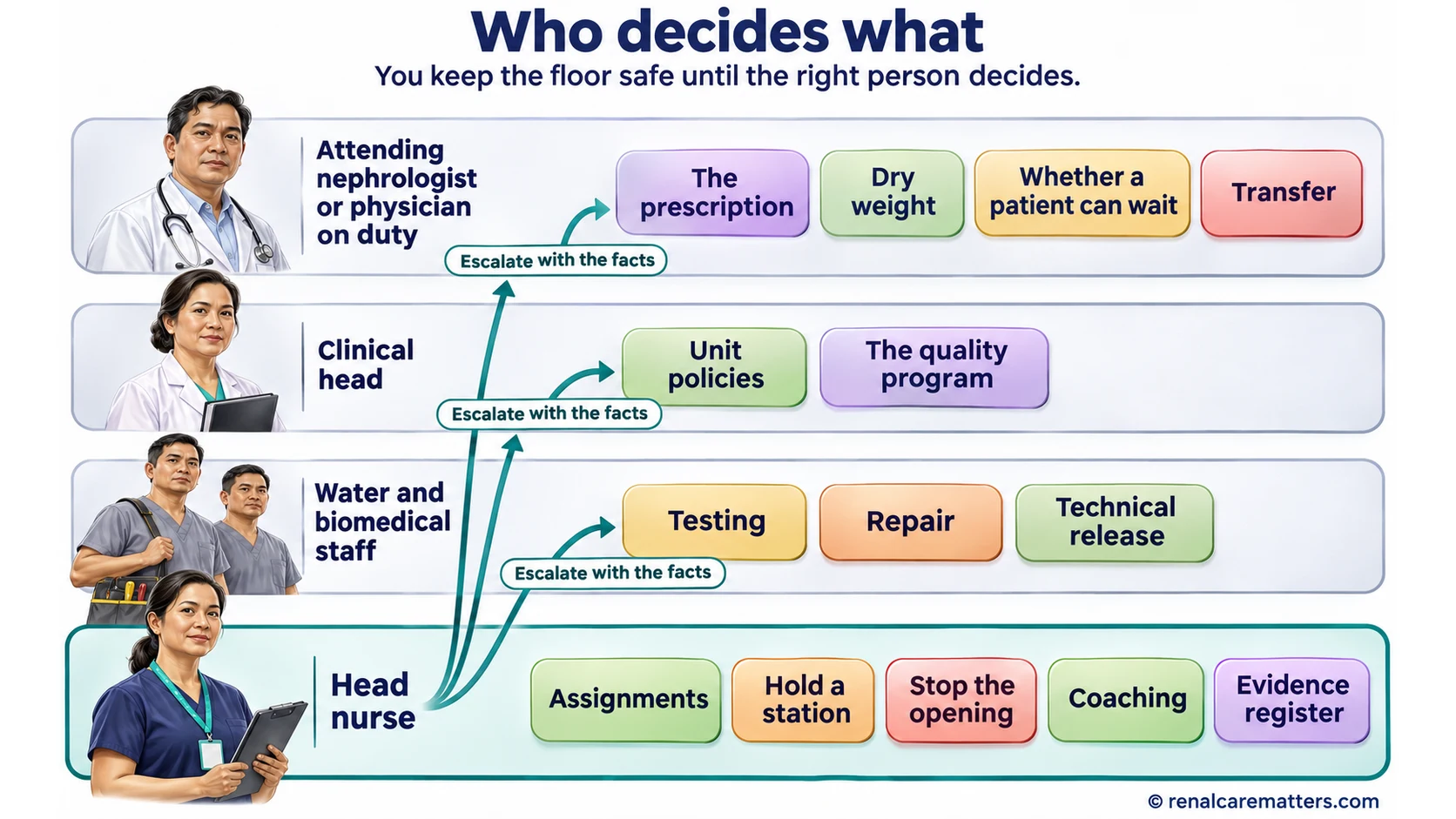
Figure 4. Who decides what. The head nurse does not write prescriptions or release machines. The head nurse makes sure nothing starts until the people who do have done so.
Who
Decides
Your part
Attending nephrologist or physician on duty
Anything about one patient: the prescription, the dry weight, whether a patient can safely wait, transfer
Give the facts, ask for a decision, record it
Clinical head
Unit policies and protocols, the quality program
Bring problems that affect several patients or the whole unit
Water and biomedical staff
Testing, repair, and technical release
Confirm that the signed release exists before a station is used
Nursing administration and HR
Hiring, rosters, relievers, discipline
Escalate gaps you cannot fill
Head nurse
Nursing assignments, holding a station, stopping the opening, coaching, the evidence register
—
The rule for this series is the same in every module. Follow your unit’s protocol, and ask the attending nephrologist for guidance. Where a limit is not written down, do not invent one. Ask.
On the floor · The wedding on Saturday
Mrs. Rosario Lim’s daughter is getting married on Saturday. At 6:30 on Friday, Mrs. Lim asks her nurse to “just do three hours today” so that she can go home and help cook. The nurse asks you.
Shortening the session is a change to the prescription, so it is not yours or the nurse’s to grant. It is also not yours to refuse flatly. You call the attending nephrologist, give the facts (Mrs. Lim’s weight gain, her last potassium, the reason for the request), and ask for a decision. The nephrologist suggests a full session today and an earlier start time, which the unit can arrange. You write down the call, the time, and the decision. If the nephrologist had agreed to three hours, you would record that order in the same way.
Illustrative scenario. Names and details are invented.
RememberYou cannot release a machine, change a prescription, or decide that a patient can wait. You can, and must, stop anything from starting until the people who can have done so.
Lesson · part 5
Five gates before the first connection
Every shift, before the first patient connects, check five gates. Do it in the same order each time, so that nothing is skipped on a busy morning.
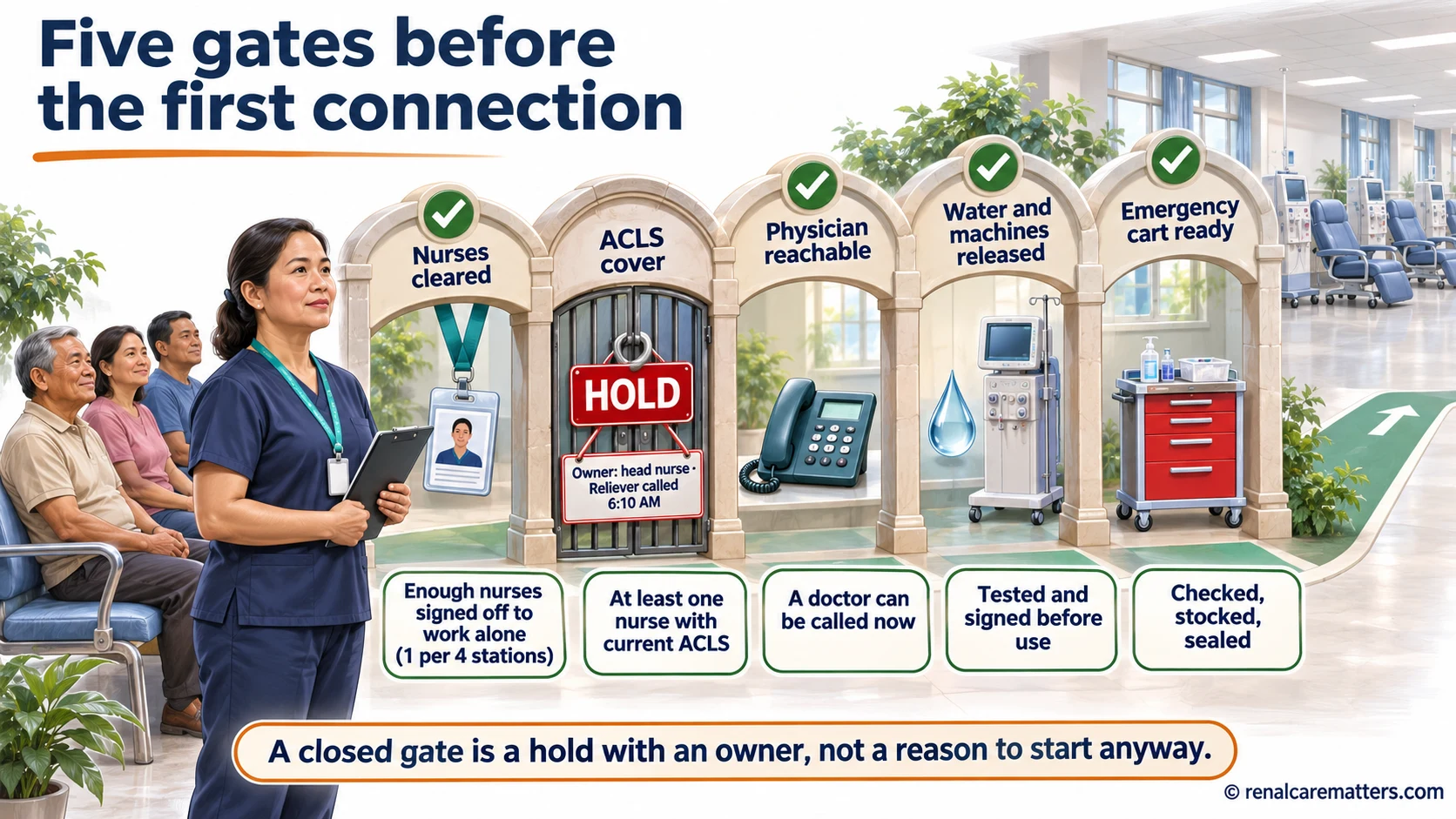
Figure 5. Five gates before the first connection. A closed gate is a hold with an owner, not a reason to start anyway.
Figure 6 · The five gates
Nurses clearedCount only nurses with site sign-off to work alone. Stations planned divided by four, rounded up, is the minimum.
ACLS coverAt least one nurse on the shift with a current certificate.
Physician reachableThe physician on duty is present, or the attending nephrologist answers.
Water and machines releasedToday’s water tests are within limit and signed. Every machine back from repair has a signed release.
Emergency cart readyChecked, stocked, sealed, and the defibrillator tested.
When a gate fails, the stations that depend on it stay closed. Say it aloud at the huddle, name the owner, and write down the time. A hold is temporary. Hoping is not a plan.
Arithmetic illustration. 12 stations ÷ 4 = 3 nurses with sign-off. With 2, you may open 8 stations on nursing grounds. A missing ACLS nurse is a separate gate that the third nurse may or may not fill.
On the floor · The defibrillator that did not pass
At 5:45 the defibrillator self-test on the emergency cart fails. The battery will not hold a charge. Everything else on the cart is complete.
The fifth gate is closed, and it guards every station, not only one. At the huddle you say: “Gate five failed at 5:45. The defibrillator battery will not charge. No one connects until we have a working defibrillator. Dante is calling biomedical, and I am asking the emergency room next door for a loaner.” The loaner arrives at 6:05 and passes its test. You record both times and the loaner’s serial number. The first patients connect fifteen minutes late, and the reason is written down rather than hidden.
Illustrative scenario. Names and details are invented.
Stop and callStop and call nursing administration and the clinical head when a gate cannot be closed before the scheduled start. Ask the attending nephrologist or physician on duty which waiting patients cannot safely be delayed. Follow your unit’s protocol while you call.
Lesson · part 6
The evidence register
An inspector, a payer, or a lawyer will ask the same question in different words: show me. The evidence register is how you answer without a scramble.
Column
Example
Requirement
At least one nurse with current ACLS per shift
Source and version
DOH licensing order and the current assessment tool
Owner
Head nurse
Where the evidence is
Personnel file, roster folder
Date checked
2026-11-23
Expiry
Certificate dates, by nurse
Follow-up
Renewal booked for two nurses in January
Start with personnel files, roster cover, emergency and referral documents, approved policies, water records, and quality meeting minutes. Review the register monthly, and look ahead ninety days for anything about to expire.
On the floor · Two minutes or two hours
A DOH inspector asks to see the corrective action for a high bacterial count in the product water last March. In one unit, the head nurse opens the register, finds the row for water testing, follows the link to the water folder, and shows the out-of-limit result, the disinfection record, the repeat test that passed, and the signed release. It takes two minutes.
In another unit, the same request starts a search through three binders and a technician’s phone. The corrective action may have happened, but no one can show it. To an inspector, an action that cannot be shown did not happen.
Illustrative scenario. Names and details are invented.
On the floor
Real situations: problems and solutions
These are fictional but typical. For each one, cover the answer, decide what you would do, then compare. Where a step depends on local rules, your unit’s procedure and your supervisor’s direction come first.
The certificate in the drawer
What you see
During an inspection, a nurse says her renal dialysis training certificate is at home.
What is likely going on
The personnel file was never completed after hiring.
What to do
Record the gap in the evidence register with a date to close it. Do not count her toward the rule until the file is complete, if your licensing office requires the document on site.
Why it matters
The register exists so that “show me” never becomes a scramble.
“We have always opened at six”
What you see
The water test result is not yet signed at 5:55 and the team wants to start on time.
What is likely going on
Habit is stronger than the check.
What to do
Hold until the result is signed. Tell waiting patients why and roughly how long.
Why it matters
A missing result is an abnormal result.
The physician asks you to change the dry weight
What you see
The physician on duty asks you to enter a new dry weight in the system on his verbal word.
What is likely going on
He is busy, and the order system is slow.
What to do
Ask him to write or enter the order himself, or follow your unit’s verbal-order procedure with read-back.
Why it matters
The prescription belongs to the prescriber, and the record must show who decided.
Field notes
Run the five-gate check in the same order every morning, so a busy day cannot skip one.
Look ninety days ahead in the evidence register every month.
Keep certificates and competency sign-offs in separate columns.
Case review
Back to the case: Two problems before six
What do you say at the huddle? Name both problems in plain words. “We have no nurse with current ACLS this morning, and machine 7 has no signed release. We will not open the stations that depend on either until they are fixed.” Then give each a name and a time. Machine 7 is tagged out of service. You are calling a reliever with a current certificate.
Who resolves what? Mr. Flores or the biomedical lead signs the release after the checks, or the machine stays out. Nursing administration or the reliever list fills ACLS cover. You cannot do either yourself. Which of the twelve patients can wait, and for how long, is a medical decision. Mrs. Ramos is right that patients have travelled far, which is why you call the physician on duty now. Monday patients are at their highest risk of the week (Module 2), so the physician may want some of them to start first once cover is secured.
What do you write? The time each problem was found, who was called and when, the decision made, and when each gate closed. Update the evidence register: the expired certificate is a gap in the personnel file that should have been caught by the ninety-day look-ahead. Tell the waiting patients what is happening and roughly how long it will take. If the reliever declines, the decision about capacity moves up the escalation list. It does not turn into “start anyway.”
Skills lab · with your preceptor
Skills checklist: Opening-gate check and huddle
Lead the pre-opening check and huddle on a real or simulated morning while your facilitator observes. Your preceptor rates each step as satisfactory, needs practice, or not observed. Steps marked Critical must all be satisfactory before sign-off. This checklist supports supervised learning; your unit’s own procedure and competency form are the authority. A printable version of every checklist is on the trainer page.
CriticalCounts only nurses with site sign-off and calculates the minimum for the stations planned.
CriticalConfirms at least one nurse on the shift holds a current ACLS certificate.
Confirms the physician on duty is present or the attending nephrologist is reachable.
CriticalSees the signed water results for today and the release for every machine returned from repair.
Checks the emergency cart seal and defibrillator test log.
CriticalStates each failed gate aloud at the huddle, with an owner and a time.
CriticalKeeps affected stations closed until the gate is closed.
CriticalAsks the physician which waiting patients cannot safely be delayed, without deciding it herself.
Calls the reliever and nursing administration and records each call.
Tells waiting patients what is happening and when to expect a start.
Updates the evidence register with the gap found and the follow-up.
Placement activity. For two weeks, run the five-gate check at every opening on your shifts. Record any gate that failed, the cause, and the time it closed. Review the list with your facilitator and pick one recurring failure to fix.
Self-assessment
Check your understanding
Each visit draws 8 questions at random from this module’s 15-question bank. Choose the single best answer for each, then select Check answers; an explanation appears under the best answer. Select New set of questions for a different mix. A good target is 7 of 8 on two different sets. Nothing you select is sent anywhere; scoring happens in your browser.
Jeong, E. (2023). Impact on health outcomes of hemodialysis patients based on the experience level of registered nurses in the hemodialysis department: a cross-sectional analysis. Frontiers in Health Services, 3, 1154989. https://doi.org/10.3389/frhs.2023.1154989
Saran, R., Bragg-Gresham, J. L., Rayner, H. C., Goodkin, D. A., Keen, M. L., Van Dijk, P. C., Kurokawa, K., Piera, L., Saito, A., Fukuhara, S., Young, E. W., Held, P. J., & Port, F. K. (2003). Nonadherence in hemodialysis: associations with mortality, hospitalization, and practice patterns in the DOPPS. Kidney International, 64(1), 254–262. https://doi.org/10.1046/j.1523-1755.2003.00064.x
Thomas-Hawkins, C., Flynn, L., & Clarke, S. P. (2008). Relationships between registered nurse staffing, processes of nursing care, and nurse-reported patient outcomes in chronic hemodialysis units. Nephrology Nursing Journal, 35(2), 123–130, 145; quiz 131.
Thomas-Hawkins, C., Flynn, L., & Dillon, J. (2020). Registered nurse staffing, workload, and nursing care left undone, and their relationships to patient safety in hemodialysis units. Nephrology Nursing Journal, 47(2), 133–142.
Bicki, A. C., Grimes, B., McCulloch, C. E., Copeland, T. P., & Ku, E. (2024). Dialysis facility staffing ratios and kidney transplant access among adolescents and young adults. JAMA, 332(23), 2003–2013. https://doi.org/10.1001/jama.2024.18210
Republic Act No. 9173: Philippine Nursing Act of 2002. (2002). Congress of the Philippines.
Department of Health. (2013). Administrative Order No. 2013-0003: Implementing guidelines in the analysis, monitoring and maintenance of water used in dialysis facilities. Republic of the Philippines.
Philippine Health Insurance Corporation. (2024). PhilHealth Circular No. 2024-0023: Institutionalization of 156 hemodialysis sessions and coverage expansion (Revision 2).
Philippine Health Insurance Corporation. (2024). PhilHealth Circular No. 2024-0029: Quality standards on maintenance hemodialysis procedure as reference of the Corporation.
Educational study material for nurses. Does not replace the attending nephrologist’s orders, the unit’s protocols, required training and certification, or supervised practice.