What a clinical head owns, the authority matrix, the questions to settle with the owner, and when to refuse an appointment.
PublishedNailathalaGipatikPepalwal:ReferencesMga SanggunianMga TinubdanReng Reperensya:11Audience: Physician heads of adult maintenance hemodialysis units · nephrologists preparing to take an appointment · head nurses, operations managers, and quality leads who share the leadership tableRead timeOras ng pagbasaOras sa pagbasaOras ning pamamasa:
Training track for physician heads of hemodialysis services
This module is study material for physician heads of adult maintenance hemodialysis services. It explains the reasoning behind common decisions; it is not a protocol and not legal advice. Regulations change: confirm every rule against the current text and your regional office before you rely on it. Clinical limits are set by your unit’s approved protocols and the attending nephrologist. Every case and record is fictional.
Learning objectives
After this module you should be able to
Describe what a clinical head owns, and what belongs to the owner, the attending nephrologist, the head nurse, and the technical leads.
Explain why the reach of one physician across several sites is a patient-safety question, not only a contract question.
Build an authority matrix that names, for each decision, the owner, the alternate, and the escalation route.
Trace each qualification and coverage requirement to the rule that sets it, and record which ones are still unconfirmed.
Settle three questions with the owner before you sign: who stops an unsafe operation, who pays to fix it, and who restarts it.
Decline or defer an appointment whose scope you cannot oversee, and say why in writing.
Pre-testBefore you read, answer the 8 self-assessment questions and note your score. After the module, select New set of questions and compare. The difference is what you learned; the questions you still miss are what to reread.
Start here
The big picture, in plain words
In plain wordsAn appointment letter is like the keys to a car you have not driven. Before you take it on the highway, you check the brakes, ask who else has a key, and find out who pays when it breaks down.
The picture has a limit. A car has one driver. A dialysis unit has many: the owner who funds it, the nephrologists who prescribe, the nurses who treat, and the technicians who release the water and the machines. Your job is not to drive every one of them. It is to make sure the system they work in is safe, and to stop it when it is not.
Figure 1 · Key terms for this module
Clinical headThe physician appointed to oversee the clinical system of a dialysis unit: policies, competency arrangements, the quality program, and the decision to hold or restart a service. The Philippine Society of Nephrology (PSN) describes a Dialysis Clinical Head for freestanding units and a Dialysis Unit Head in hospitals.
Owner or governing bodyThe person or board that funds the unit, assigns authority in writing, and receives risks the unit cannot manage on its own.
Attending nephrologistThe physician responsible for each patient’s prescription and care plan.
Authority matrixA table listing each recurring decision, who makes it, who covers when that person is away, and where it escalates.
LTOLicense to Operate, the Department of Health (DOH) authority for a non-hospital dialysis clinic to operate.
RLEDRegulatory, Licensing and Enforcement Division of the DOH Center for Health Development in your region.
AlternateThe named person who holds a decision when its owner is unreachable.
Figure 2 · Three habits this module teaches
Map before you signEvery site, every decision, every alternate.
Ask in writingUnclear rules go to the regulator, and the answer goes in the file.
Hold what you cannot overseeAn appointment can wait. A patient harmed by a gap cannot.
Opening case · fictional
Case: Four sites by Monday
Bayani Dialysis, a growing freestanding group, offers Dr. Ramon Castillo the clinical head appointment for all its sites, starting Monday. The owner, Mr. Arnel Uy, hands over a two-page letter. It names “the company’s dialysis units” without listing them. Over coffee, Mr. Uy explains there are four: two in Quezon City, one in Bulacan, and one opening in Pampanga next month. The Pampanga site is two hours away in traffic.
“The last clinical head visited the far sites once a month and answered calls the rest of the time,” Mr. Uy says. He shows a printed licensing assessment tool, marked Revision 03, April 2015, that he says allows up to three clinics per head. “We are a bit over, but the fourth is not open yet. Can you sign today?”
Before reading on, decide:
Would you sign today? What would you need to see first?
Which questions belong to the DOH, which to PSN, and which only to Mr. Uy?
Who covers the existing units while you check?
Keep your answers in mind. The lesson gives you what you need, and the case review near the end shows one sound response.
Lesson · part 1
Why the appointment is a safety question
Patients on maintenance hemodialysis live close to the edge. Without kidney function, potassium and water accumulate between sessions, and the risk of death is highest after the longest gap of the week. In a United States cohort, all-cause mortality was 22.1 per 100 person-years on the day after the two-day weekend gap, compared with 18.0 on other days, and admissions for heart failure nearly doubled.1 A unit that cannot deliver a scheduled session, or cannot act when a session goes wrong, removes the margin these patients depend on.
That is why the appointment matters. If you sign for four sites you cannot reach, or for authority you do not have, the gap does not disappear. It moves to the night a nurse calls about a water alarm and nobody with authority answers.
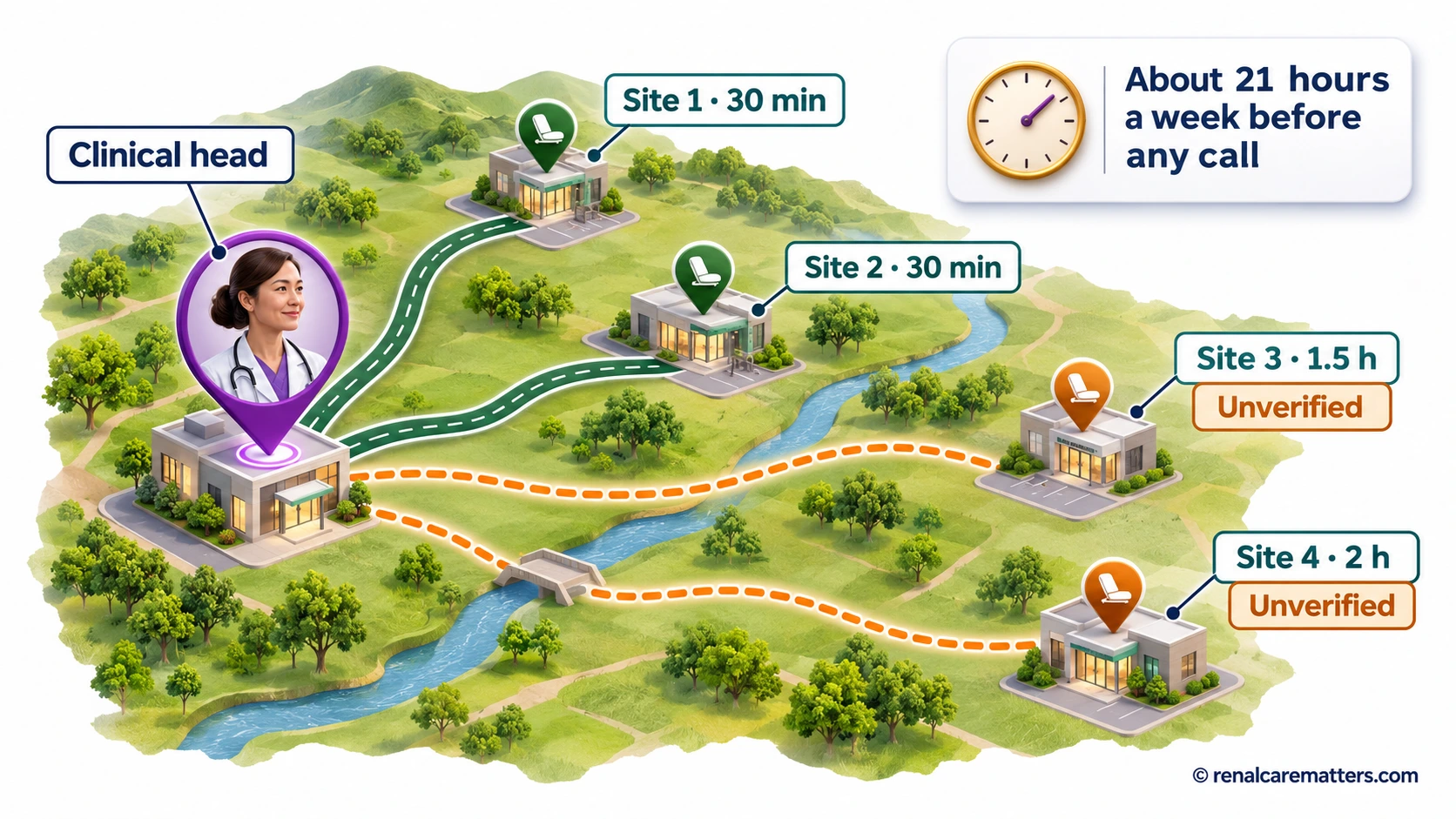
Figure 3. The reach of one physician. Oversight that depends on a two-hour drive or a phone that may not be answered is oversight on paper.
The workload is growing. Press reports citing the Philippine Renal Disease Registry put 64,845 Filipinos on dialysis in 2024, up 22% from 53,296 in 2023. These figures come from news reports, not the registry itself. More units, more sites per group, and more payer review all land on the physician who signs as clinical head.
RememberYou are signing for a system. Ask to see the system before you sign.
Lesson · part 2
Who owns each decision
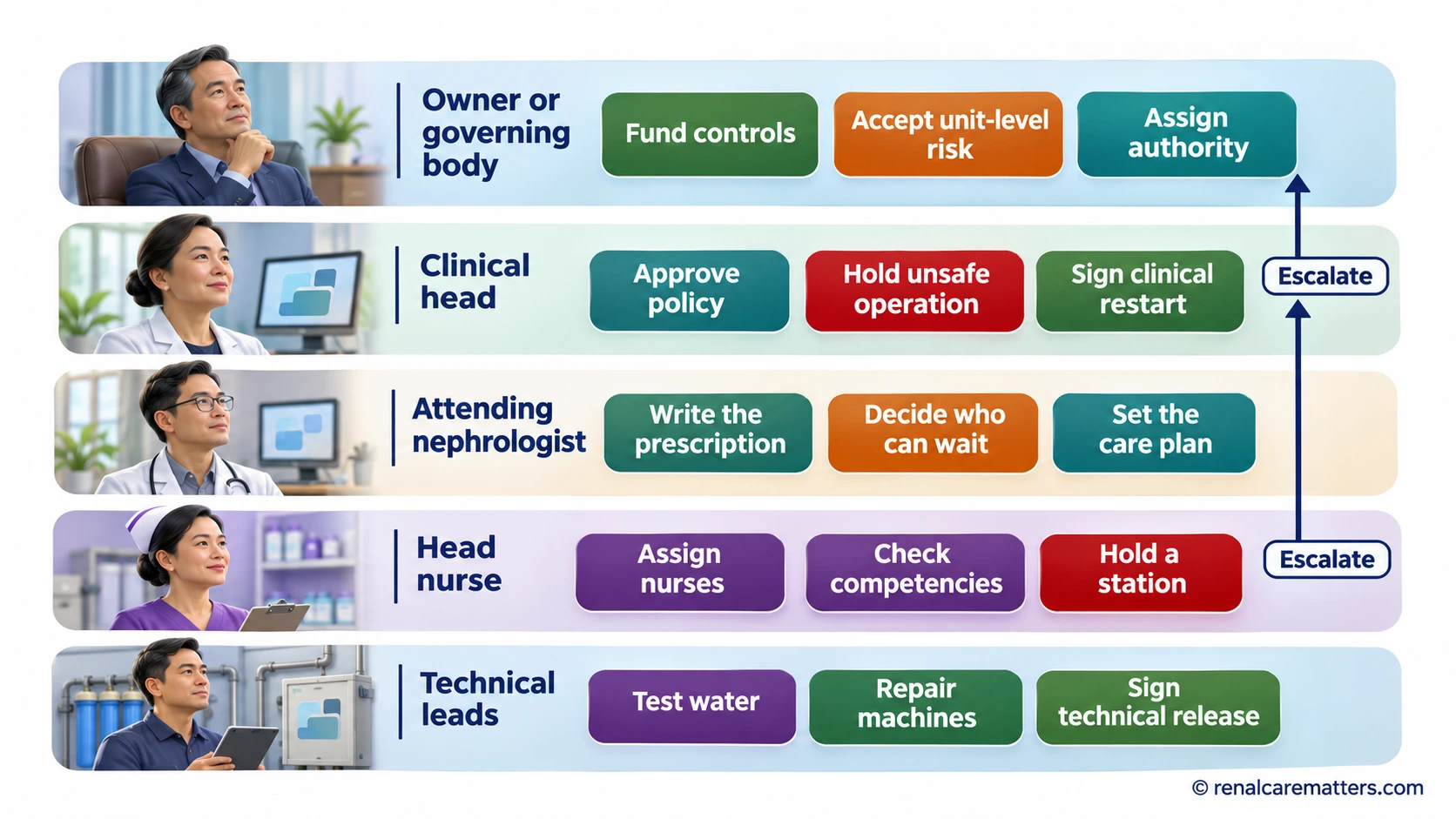
Most failures of governance are failures of ownership. A decision that belongs to two people belongs to no one. Before you sign, draw the lanes.
Figure 4. Who owns what. Every decision in a dialysis unit belongs to one lane. The clinical head owns the clinical system, not every decision in it.
Lane
Owns
Your part as clinical head
Owner or governing body
Funding, contracts, assigning authority in writing, accepting risks the unit cannot manage
Bring risks with their consequences and a request; record the owner’s decision
Clinical head
Clinical policies, competency arrangements, the quality program, holding or restricting unsafe operation, signing clinical restart
Yours
Attending nephrologist
Each patient’s prescription, care plan, and whether that patient can safely wait
Make sure the system lets them order, monitor, and be reached safely
Support the head nurse’s holds; review the competency program
Technical leads
Water testing, machine maintenance, technical release
Never sign a technical release; always require one before clinical restart
Operations and claims
Staffing logistics, procurement, claims submission and reconciliation
Set the clinical standards those processes must meet
If the title “head of facility” legally belongs to someone else, such as a hospital director, record that separately. Your appointment should say which decisions you hold and which you only advise on.
Lesson · part 3
Which rule answers which question
Several authorities speak to the clinical head’s role, and each answers a different question. Keep a separate evidence item for each, because one document cannot satisfy another’s requirement.
Question
Source
What to keep in the file
May this facility operate, and what must its head do?
DOH licensing order for dialysis facilities2 and the current regional assessment tool
LTO and its scope, signed appointment and job description, credentials, visit logs
Has the licensing rule changed?
DOH Department Circular 2026-0112, interim guidelines on licensing hemodialysis clinics3
The full circular and annexes, and the regional office’s written reading of how it applies to you
What does the profession expect of a clinical head?
PSN hemodialysis guidelines4 and its attestation checklist5
Licensure, nephrology certification, contract with decision rights, evidence of oversight, training, and surveillance
Will the facility be paid?
Philippine Health Insurance Corporation (PhilHealth) accreditation and performance commitment6,7
Provider data record, signed commitment, validity dates, authorized signatories
The printed tool Mr. Uy shows is a real historical document. A regional office posted a 2015 assessment tool, Revision 03, that lists credential evidence for nephrologist and non-nephrologist heads, documented weekly visits, and up to three clinics per head.8 On the number of units it matches the rule in force. The DOH licensing order for dialysis facilities states that the medical director “shall handle a maximum of only three (3)” hemodialysis clinics and must visit each one at least once a week, with every visit documented.2 PhilHealth applies the same ceiling to the head of an accredited dialysis unit: no more than three units, counting hemodialysis and peritoneal dialysis units together.9 PSN holds its members to the same limit of three. The count includes every unit you already head, under any owner. A fourth unit is not a gray area; it is outside the rule. A newer interim circular on licensing hemodialysis clinics appears on a regional issuance index in 2026; this course confirmed its title, not its text.3 Where an old form and the PSN guideline disagree, neither one settles it. Ask the RLED and PSN in writing, and keep both answers.
RememberNever sign as head of a fourth dialysis unit. DOH, PhilHealth, and PSN all cap a nephrologist at three units, counting every unit you already head and counting hemodialysis and peritoneal dialysis units together.
Stop and callStop and ask the RLED in writing when eligibility, the visit schedule, or a non-nephrologist pathway is unclear. Ask PSN about its current attestation process. Do not sign for a site until the answer for that site is in your file.
Other systems handle the same problem in instructive ways. United States rules require the medical director of a dialysis facility to be board-certified with approved nephrology training and at least 12 months of dialysis experience, and assign the director quality assessment, staff education, and policy oversight.10 Singapore requires a named clinical governance officer with specialist registration in renal medicine for each licensed outpatient dialysis service.11 The common thread is a named person, a defined scope, and written accountability to the governing body.
Lesson · part 4
What goes in the appointment file
Figure 5. The appointment file. If a tab is empty, that question is still open, and the appointment should wait.
Build the file before you start, not after the first inspection. It answers one question: what can I decide, where, and with what support?
Figure 6 · The appointment file
1. CredentialsProfessional license, specialty certification, life support certificates, and their expiry dates.
2. Contract and scopeTerm, the sites and stations covered, and anything excluded.
3. Presence and coverageVisit cadence per site, how you are reached, and response times you can actually meet.
4. Delegated authorityThe decisions you hold alone, the ones you share, and the ones you advise on.
5. AlternatesA named physician who holds your decisions at each site when you are away.
6. EscalationWho in the governing body receives a risk you cannot manage, and how fast.
7. ResourcesWhat the owner commits to fund when a control fails.
At the first meeting with the owner, rehearse three scenarios aloud: an unsafe roster, an unresolved water result, and a refusal to fund a repair. For each, record who stops the affected activity, who tells the patients, who verifies the fix, and who authorizes restart. If the owner will not agree that you can hold an unsafe operation, you do not yet have the authority the role requires.
Reach check, illustration only. Even within the limit of three, reach decides whether oversight is real. Picture the four sites Mr. Uy offers, one physician, a weekly visit of three hours each, plus travel of 0.5, 0.5, 1.5, and 2 hours each way: 12 hours on site plus 9 hours of travel, about 21 hours a week before any call or emergency. Ask whether that leaves time for your own patients, and who covers when you are at the far site. Four sites is also one more than any physician may head.
Lesson · part 5
When to defer or decline
Declining an appointment is not a failure of service. It protects the patients who would be relying on oversight that does not exist. You can defer a site rather than refuse the whole appointment.
Situation
A reasonable response
Scope unnamed
Sign only for a listed schedule of sites and stations
More than three units in total, counting those you already head
Choose at most three you can visit weekly; decline the rest in writing
Visit schedule unconfirmed
Sign for the confirmed sites; defer the rest until the RLED answers
No authority to hold unsafe operation
Do not sign until it is written in
No alternate for a site
Defer that site until one is named and has accepted
A site opening before its approvals
Decline to be named as its head until licensing is complete
RememberAn appointment can wait a week. A gap in oversight waits for the worst night of the year.
On the floor
Real situations: problems and solutions
These are fictional but typical. For each one, cover the answer, decide what you would do, then compare. Where a step depends on local rules, your unit’s procedure and your supervisor’s direction come first.
The letter with no sites
What you see
The appointment letter names you clinical head of “the company’s dialysis units.”
What is likely going on
A scope that can grow without your consent.
What to do
Ask for a schedule listing each site, its stations, and its license. Add any unit you already head; if the total passes three, decline the excess. Sign only for what is listed.
Why it matters
You cannot oversee a unit you do not know exists.
“Just phone in”
What you see
The owner proposes telephone-only coverage for a site two hours away.
What is likely going on
A coverage model that falls short of the DOH rule, which requires the medical director to visit each clinic at least once a week and document the visit.
What to do
Decline telephone-only coverage. Agree a weekly visit schedule you can keep, with a named physician on duty for every shift.
Why it matters
Coverage you cannot deliver becomes a gap with your name on it.
The predecessor’s signature
What you see
Policies on file are signed by the previous clinical head, who left eight months ago.
What is likely going on
Orphaned approvals.
What to do
List them, review the critical ones first, and re-approve or revise each with a date.
Why it matters
An inspector will ask who owns each policy today.
Field notes
Write down the three decisions you will make alone, and the three you will never make alone.
Name an alternate for every site before you start.
Keep the appointment file separate from your personal credentials folder.
Case review
Back to the case: Four sites by Monday
Would you sign today? Not for all four sites. DOH, PhilHealth, and PSN cap a nephrologist at three units, and Dr. Castillo must first count any unit he already heads elsewhere. Ask for a written schedule naming each site, its stations, its LTO, and its current head. Ask to see the assessment tool the regional office uses now, and the text of any new interim circular. Offer to sign for the two Quezon City sites if the scope, coverage, and authority are clear, and defer Bulacan and Pampanga until the RLED answers.
Which questions belong to whom? The number of units is already settled: three at most, under DOH, PhilHealth, and PSN rules. Eligibility and the visit schedule are licensing questions for the RLED. Certification and attestation are questions for PSN. Funding, contracts, and the authority to hold an unsafe operation are questions for Mr. Uy, and his answers go into the contract. The 2015 tool happens to state the three-unit cap correctly, but cite the administrative order itself, not an old form.
Who covers while you check? The current arrangements stay in place, with a named physician for each existing site, until the transfer of responsibility is signed. Record the date you asked each question and the person you asked.
Skills lab · with your preceptor
Skills checklist: Authority matrix and pre-appointment meeting
Build an authority matrix for a real or simulated unit, then hold a five-minute pre-appointment meeting with a preceptor playing the owner. Your preceptor rates each step as satisfactory, needs practice, or not observed. Steps marked Critical must all be satisfactory before sign-off. This checklist supports supervised learning; your unit’s own procedure and competency form are the authority. A printable version of every checklist is on the trainer page.
Lists every site, its stations, license status, and current head.
CriticalTraces each qualification and coverage requirement to its source and version.
Marks each unconfirmed requirement and names who will be asked, and by when.
CriticalNames an alternate physician for every site.
Writes who stops, who tells patients, who verifies, and who restarts for an unsafe roster.
Writes the same for an unresolved water result and a refused repair.
CriticalSecures written authority to hold or restrict an unsafe operation.
CriticalDeclines or defers any site whose eligibility or coverage is unsupported.
Keeps the appointment, the professional credentials, and the accreditation records as separate evidence items.
Records the meeting outcome with dates and owners.
Placement activity. Draw the authority matrix for your own unit. Show it to your head nurse and your owner, and ask each to mark one decision they believe belongs in a different lane. Resolve each disagreement in writing.
Self-assessment
Check your understanding
Each visit draws 8 questions at random from this module’s 15-question bank. Choose the single best answer for each, then select Check answers; an explanation appears under the best answer. Select New set of questions for a different mix. A good target is 7 of 8 on two different sets. Nothing you select is sent anywhere; scoring happens in your browser.
Foley, R. N., Gilbertson, D. T., Murray, T., & Collins, A. J. (2011). Long interdialytic interval and mortality among patients receiving hemodialysis. New England Journal of Medicine, 365(12), 1099–1107. https://doi.org/10.1056/NEJMoa1103313
Department of Health. (2026). Department Circular No. 2026-0112: Interim guidelines on the licensing of hemodialysis clinics. Republic of the Philippines. [Title confirmed from a regional DOH issuance index; full text not reviewed for this course.]
Philippine Society of Nephrology. (2020). Certificate of attestation requirements for hemodialysis and peritoneal dialysis units. https://psn.org.ph/wp-content/uploads/2020/02/PSN-HD-PD-Certificate-of-Attestation-requirements_final-2020_edited.pdf
Philippine Health Insurance Corporation. (2023). PhilHealth Circular No. 2023-0012 [Accreditation of health care providers and performance commitment]. [Bracketed description; confirm the official title against the circular.]
Philippine Health Insurance Corporation. (2025). PhilHealth Advisory No. 2025-0055 [Filing of applications for renewal of accreditation of health facilities]. https://www.philhealth.gov.ph/advisories/2025/PA2025-0055.pdf
Department of Health, Cordillera Administrative Region. (2015). Assessment tool for licensing a dialysis clinic (Revision 03). Retrieved November 23, 2026, from https://caro.doh.gov.ph/wp-content/uploads/2022/08/LICENSING-A-DIALYSIS-CLINIC-8-31-2022.pdf
Philippine Health Insurance Corporation. (2015). PhilHealth Circular No. 021, s. 2015: Revised accreditation requirements for dialysis clinics. https://www.philhealth.gov.ph/circulars/2015/circ021-2015.pdf
Conditions for coverage for end-stage renal disease facilities, 42 C.F.R. § 494 (2025).
Ministry of Health Singapore. (n.d.). Outpatient renal dialysis service: Service requirements. Retrieved November 23, 2026, from https://www.hcsa.gov.sg/outpatient-services/outpatient-renal-dialysis-service/
Educational material for physicians and unit leaders. Completing it is an Academy learning record only. It does not confer CPD units, PSN attestation, DOH eligibility, PhilHealth accreditation, or appointment authority, and it does not replace current regulations, your facility’s bylaws and protocols, or legal advice.