Nephrology Nursing Track · By Role · Module 4 of 18
The Live Board: Rounding, Huddles, and Interruptions
Three levels of awareness, a board the whole team can read, rounds by the clock, three-minute huddles, and tasks protected from interruption.
PublishedNailathalaGipatikPepalwal:ReferencesMga SanggunianMga TinubdanReng Reperensya:2Audience: Experienced hemodialysis nurses who take charge of a shift · nurses being prepared for charge duty · head nurses and educators who orient themRead timeOras ng pagbasaOras sa pagbasaOras ning pamamasa:
This module is study material for charge nurses in hemodialysis units. It explains the reasoning behind common decisions; it is not a protocol. On the floor, follow your unit’s protocol and always ask the attending nephrologist for guidance. Doses, limits, and cut-off values are set by your unit. Every case is fictional.
Learning objectives
After this module you should be able to
Describe the three levels of situational awareness and give a dialysis example of each.
Keep a live board that the whole team can read from the center of the floor.
Round the floor at set times and look at the patient before the machine.
Run a three-minute safety huddle at opening and at mid-shift.
Protect high-risk tasks from interruption, and close every flag with an owner and a time.
Pre-testBefore you read, answer the 8 self-assessment questions and note your score. After the module, select New set of questions and compare. The difference is what you learned; the questions you still miss are what to reread.
Start here
The big picture, in plain words
In plain wordsA basketball point guard dribbles with one hand and keeps his head up. He knows where the other nine players are without staring at any one of them. If he looks down at the ball, the defense steals it.
The point guard is a fair picture of situational awareness: noticing what is happening, understanding what it means, and expecting what comes next. A charge nurse doing her own difficult cannulation is looking at the ball. The board, the timed rounds, and the huddle are how she keeps her head up when her hands are busy.
The picture has a limit. A point guard sees the whole court at once. A dialysis floor hides its trouble: under a blanket, behind a curtain, inside a patient who is quietly drowsy. Awareness on a dialysis floor has to be built on purpose, with tools and habits, because the eye alone will miss things.
Figure 1 · Key terms for this module
Situational awarenessKnowing what is happening around you, what it means, and what is likely to happen next.
Live boardA whiteboard with one line per chair, readable at a glance by the whole team.
FlagGreen steady, amber watch with a timed recheck, red act now.
RoundA timed walk past every chair, looking at the patient first.
HuddleA three-minute standing meeting about what could hurt someone in the next hours.
Protected taskA task nobody interrupts except for an emergency.
Opening case · fictional
Case: “Nobody told me Bed 7 was dropping”
At 7:40 in the morning, Nurse Lea Santos, in charge of a 14-station unit, is placing needles in a difficult fistula at Bed 2. At Bed 7, the patient’s pressure has fallen from 150 to 102 over forty minutes. The assigned nurse is at Bed 11, where a venous pressure alarm keeps sounding.
At 7:52 the man in Bed 7 says he feels faint. Lea hears about it at 7:55. There is no board on the wall; the assignment is on a sheet of paper on the desk.
Before reading on, decide:
What failed: a person, or the way information moved?
What would a board and a mid-shift huddle have shown?
What should Lea change tomorrow?
Keep your answers in mind. The lesson gives you what you need, and the case review near the end shows one sound response.
Lesson · part 1
Seeing, understanding, predicting
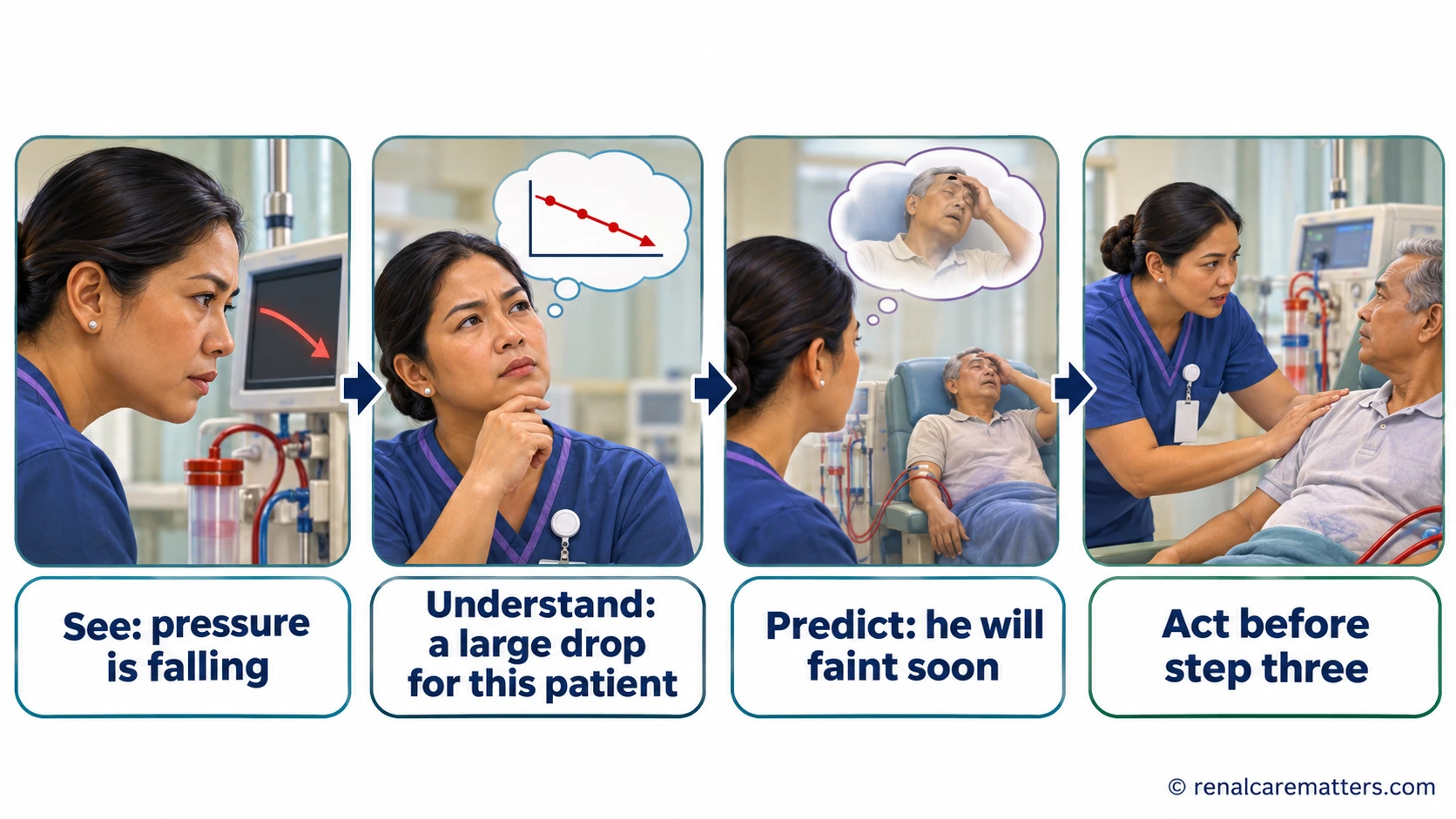
Situational awareness has three levels. Seeing: the pressure at Bed 7 is 102. Understanding: that is a 48-point drop for a man who usually tolerates fluid removal poorly. Predicting: unless fluid removal is reduced, he will faint in the next ten minutes.
Figure 2. Seeing, understanding, predicting. Most floor emergencies were visible at the first level long before anyone reached the third.
Most floor emergencies were visible at the first level long before anyone reached the third. The reading was on the screen; nobody with the time to think about it was looking. A charge nurse’s job is to put the first-level information where someone will reach the second and third levels in time.
Lesson · part 2
The live board
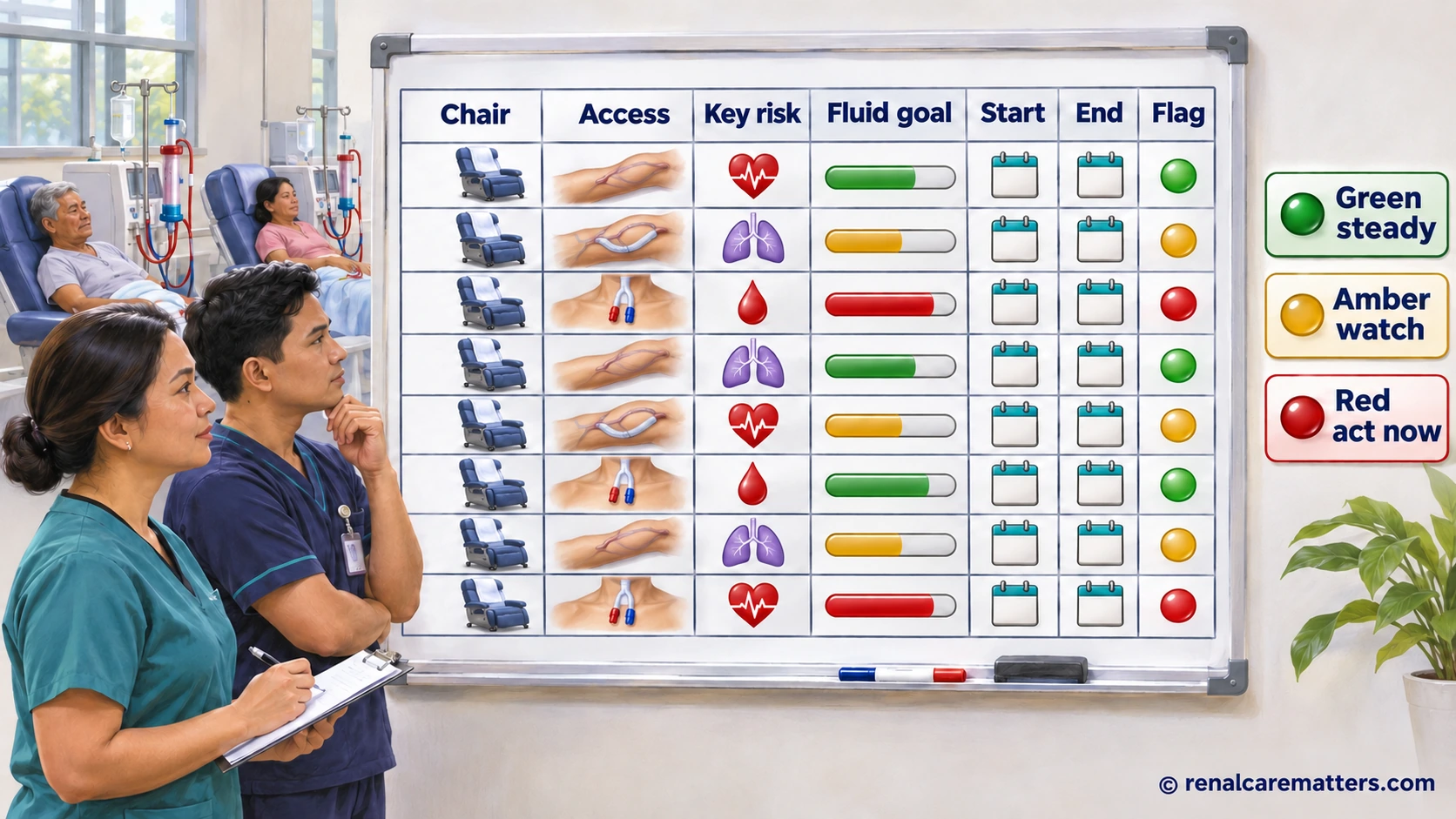
Give each chair one line: bed number, access type, the one key risk, fluid goal, start time, end time, and a flag column. Green means steady. Amber means watch, with a timed recheck by a named nurse. Red means act now. Use bed numbers or initials, not full names, if patients and visitors can see the board.
Figure 3. The live board. One line per chair, readable from the center of the floor, with a flag for steady, watch, or act now.
The board is not a chart. It does not replace the treatment record. It is a picture the whole team can read from the center of the room in five seconds, so that the nurse walking past Bed 7 on the way to Bed 11 knows that Bed 7 is amber.
On the floor · The board that paid for itself
At a 20-station unit in Pampanga, the head nurse introduced a board after a month of near misses at shift change. Within a week, nurses began glancing at it on their way past. On the second Monday, an assistant noticed that Bed 15 was red (“potassium result pending, physician to call”) and that the patient was being walked to the scale for disconnection. She told the nurse. The result came back high, and the physician ordered a repeat before the patient left. Nobody had to remember; the board remembered for them.
Illustrative scenario. Names and details are invented.
Lesson · part 3
Rounds by the clock
Walk the floor at set times: about fifteen minutes after the last connection, every hour after that, and thirty minutes before the first disconnection. Recheck amber chairs every fifteen minutes, or more often if your unit’s protocol says so.
At each chair, look at the patient before the machine. Color, breathing, speech, sweat, the access uncovered and dry. Ask one question: “How are you feeling?” The machine shows numbers. The patient shows trouble first. A patient who is drowsy, sweaty, or silent may have low pressure, low blood sugar, or something worse (Module 7).
RememberPatient before machine. The screen tells you what was measured; the patient tells you what is happening.
Lesson · part 4
Three-minute huddles
A huddle is a short standing meeting with one question: what could hurt someone in the next hours, and who owns it? Run one at opening (assignment, flagged patients, closed gates, breaks) and one at mid-shift (amber and red flags, breaks still due, the second shift’s first chairs).
How strong is the evidence? A systematic review of twelve studies found mostly positive effects of huddles on teamwork, engagement, and job satisfaction, but the studies were small and low in rigor.1 That is an honest picture: huddles are cheap, rarely harmful, and probably helpful, but they have not been shown to reduce adverse events. Keep them short, standing, and focused, so they stay cheap.
On the floor · When a huddle becomes a complaint session
The mid-shift huddle at a Bulacan unit drifts into the broken air conditioner and the canteen schedule. At minute four, the charge nurse says, “Let’s park those for the staff meeting. What could hurt someone before noon?” Kris answers: Bed 9’s catheter dressing is wet. Arnel: Bed 3’s potassium result has not come back. Two owners, two times, back to the floor at minute five.
Illustrative scenario. Names and details are invented.
Lesson · part 5
Interruptions are a hazard
In an observational study of nurses giving medicines on hospital wards, each interruption was associated with a 12.7% increase in clinical errors, and the most experienced nurses were not protected.2 The study was not in dialysis, but the dialysis floor is full of interruptions: alarms, phone calls, patients asking for blankets.
Protect three tasks from interruption: medicine preparation (especially heparin and intravenous iron), the order-to-machine check before connection, and catheter connection. Agree on a signal your unit will use, such as a colored apron or a sign on the trolley, that means “interrupt me only for an emergency.” The charge nurse enforces it, including on physicians and visitors, politely.
Lesson · part 6
Every flag gets an owner and a time
An amber or red flag without a name is a wish. Every flag on the board has an owner (“Kris”) and a time (“recheck 7:45”). At the end of the shift, the board becomes the handoff: every open flag is either closed or passed to a named person on the next shift (Module 14).
On the floor
Real situations: problems and solutions
These are fictional but typical. For each one, cover the answer, decide what you would do, then compare. Where a step depends on local rules, your unit’s procedure and your supervisor’s direction come first.
The board stopped at 6:30
What you see
By 9:00 the board still shows the opening plan.
What is likely going on
Nobody owns updating it.
What to do
Assign one nurse per pod to update the board at each round.
Why it matters
An old board is worse than no board: it misleads.
Interrupted at the cart
What you see
A physician starts talking to you while you prepare heparin.
What is likely going on
He does not know the task is protected.
What to do
Finish the step, then give him your full attention. Explain the apron or sign politely.
Why it matters
Interruptions during preparation are associated with errors.
The huddle that became a complaint session
What you see
The mid-shift huddle drifts to the air conditioner.
What is likely going on
Real frustrations are crowding out safety.
What to do
Park the topics for the staff meeting and ask, “What could hurt someone before noon?”
Why it matters
Short huddles stay useful.
Field notes
Patient before machine.
Three minutes, standing.
Every flag gets a name and a time.
Case review
Back to the case: “Nobody told me Bed 7 was dropping”
What failed. Nobody was careless. Information did not move, because there was no board, no timed round, and no rule for rechecking a patient known to drop his pressure. The assigned nurse was pulled to a noisy alarm, and nobody else knew Bed 7 needed watching.
What a board and a huddle would have shown. At the 7:20 round, the board would have shown Bed 7 amber: “drops after hour 1; fluid goal 3.2 L; started 6:20; recheck every 15 minutes, Kris.” The 7:35 reading of 108 would have reached a nurse with time to act. A 7:30 mid-shift huddle would have handed Bed 11’s recurring alarm to the technician, freeing the assigned nurse.
What Lea changes. She puts up a board. She takes no difficult cannulation of her own after the first connections. Amber chairs get a named nurse and a fifteen-minute recheck. These are system changes, not instructions to try harder.
Skills lab · with your preceptor
Skills checklist: Keeping the floor in view
On a supervised shift, build and keep the board, run both huddles, and do timed rounds. Your preceptor rates each step as satisfactory, needs practice, or not observed. Steps marked Critical must all be satisfactory before sign-off. This checklist supports supervised learning; your unit’s own procedure and competency form are the authority. A printable version of every checklist is on the trainer page.
Builds a board line for each chair with access, key risk, fluid goal, times, and flag.
CriticalGives every amber and red flag an owner and a recheck time.
CriticalRounds at the set times and looks at each patient before the machine.
Runs an opening huddle in three minutes, standing, ending with owners.
Runs a mid-shift huddle and parks non-safety topics.
CriticalNames three tasks protected from interruption and enforces the signal.
CriticalCloses or hands over every open flag at the end of the shift.
Placement activity. For one week, note each time you learned of a patient problem later than you should have, and what on the board or in the rounds would have shown it sooner.
Self-assessment
Check your understanding
Each visit draws 8 questions at random from this module’s 15-question bank. Choose the single best answer for each, then select Check answers; an explanation appears under the best answer. Select New set of questions for a different mix. A good target is 7 of 8 on two different sets. Nothing you select is sent anywhere; scoring happens in your browser.
Rowan, B. L., Anjara, S., De Brún, A., MacDonald, S., Kearns, E. C., Marnane, M., & McAuliffe, E. (2022). The impact of huddles on a multidisciplinary healthcare teams' work engagement, teamwork and job satisfaction: A systematic review. Journal of Evaluation in Clinical Practice, 28(3), 382–393. https://doi.org/10.1111/jep.13648
Westbrook, J. I., Woods, A., Rob, M. I., Dunsmuir, W. T., & Day, R. O. (2010). Association of interruptions with an increased risk and severity of medication administration errors. Archives of Internal Medicine, 170(8), 683–690. https://doi.org/10.1001/archinternmed.2010.65
Educational study material for nurses. Does not replace the attending nephrologist’s orders, the unit’s protocols, required training and certification, or supervised practice.