The roller pump and why displayed flow can be untrue, the pressure sensors, the heparin syringe pump, and their checks.
PublishedNailathalaGipatikPepalwal:Audience: Biomedical equipment technicians working in or for hemodialysis centers · chief technicians, head nurses, and medical directorsRead timeOras ng pagbasaOras sa pagbasaOras ning pamamasa:
This module is study material for biomedical technicians in dialysis. It explains how machines work and why maintenance steps exist; it is not a service manual. Repairs, calibrations, and safety tests are done only by people trained and authorized for that machine model, using the manufacturer’s service manual, approved parts, and calibrated test equipment. Every case is fictional.
Learning objectives
After this module you should be able to
Explain how the roller pump moves blood, and what makes displayed flow differ from true flow.
Interpret arterial, venous, and transmembrane pressures, and verify the sensors.
Describe how the heparin syringe pump works and how its delivery is checked.
Carry out blood-side checks at maintenance and troubleshoot common faults.
Pre-testBefore you read, answer the 5 self-assessment questions and note your score. After the module, select New set of questions and compare. The difference is what you learned; the questions you still miss are what to reread.
Start here
The big picture, in plain words
In plain wordsThink of a taxi meter. It does not measure the road. It counts the turns of the wheels and multiplies by the size of the tire. Put on a smaller tire, and the meter runs wrong while looking perfectly normal. The blood side of the machine works the same way. It looks simple: a pump, some tubing, and a few pressure readings. But the number the nurse trusts most, blood flow, is calculated, not measured, and it is only as true as the pump’s adjustment and the tubing size it was told to use.
The picture has a limit. A passenger can check a taxi fare against a map. Nobody at the chair can check blood flow by looking at it. The error shows up weeks later as a lower dialysis dose, if anyone thinks to compare machines. This module covers the pump, the pressures, and the small syringe pump that delivers blood thinner. Module 7 covers the safety systems.
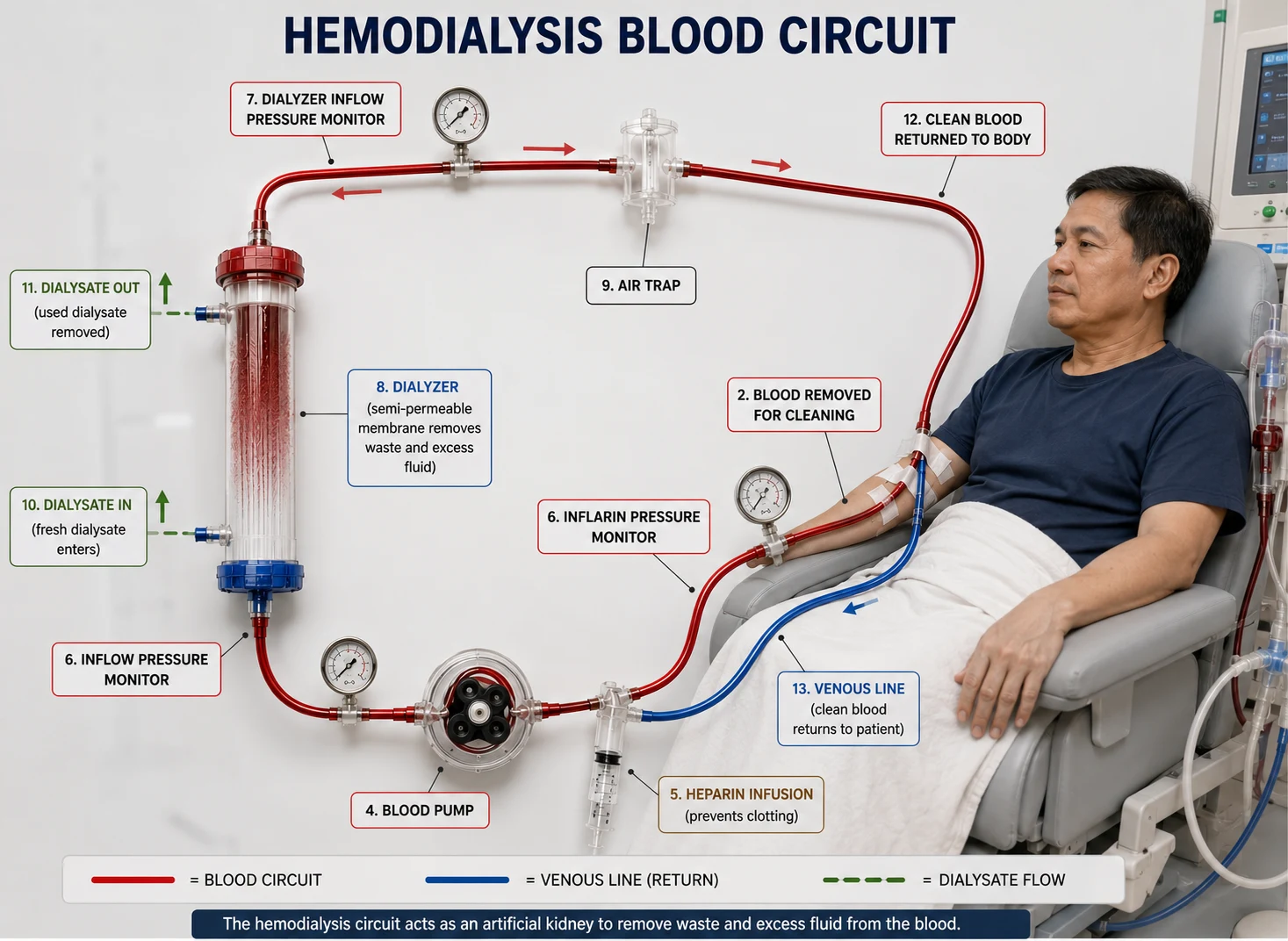
Figure 1. The blood circuit. This module follows the pump, the pressure monitoring points, and the heparin line.
OcclusionHow firmly the rollers squeeze the tubing.
Pump segmentThe section of tubing inside the pump.
Arterial pressurePressure before the pump; normally negative.
Venous pressurePressure on the return side; normally positive.
Transducer protectorA filter that keeps blood out of the pressure sensor.
Syringe pumpA motor that pushes a syringe plunger at a set rate.
Opening case · fictional
Case: Adequacy falling on one machine
At the quarterly quality meeting, the attending nephrologist, Dr. Celia Navarro, raises a pattern she has followed for three months. Patients dialyzed on machine 5 have lower adequacy results than the same patients have on other machines. Their prescriptions, dialyzers, and treatment times are the same.
Machine 5 shows the prescribed blood flow on its screen at every session. The biomedical technician, Mr. Efren Dizon, checks the service log. Machine 5 had its blood pump rotor replaced four months ago.
Before reading on, decide:
Why might true blood flow differ from the displayed value?
What do you check on machine 5?
What would you say to the nephrologist while you investigate?
Keep your answers in mind. The lesson gives you what you need, and the case review near the end shows one sound response.
Lesson · part 1
The blood pump
The blood pump never touches blood. Its rollers press a thick section of tubing, the pump segment, against a curved track and push the blood ahead of them, the way you push toothpaste along a tube with your thumb. The flow shown on the screen is calculated from the pump speed and the tubing size. It is not measured directly.
Figure 3. The blood circuit and its monitoring points. Hemodialysis blood circuit with pressure monitoring points, air trap, and venous clamp.Figure 4. Inside the roller pump. Roller blood pump cutaway with correct, loose, and tight occlusion.
That calculation is only as true as its inputs. Anything that changes how much blood each turn of the rollers really moves makes the display wrong, and the screen will not show the difference.
Figure 5 · What makes displayed blood flow untrue
Wrong tubing size selectedThe machine calculates flow for a different diameter.
Occlusion too looseBlood slips back past the rollers, so the real flow is lower than shown.
Occlusion too tightRed cells are crushed and the tubing wears.
Very negative arterial pressureThe pump segment partly collapses and delivers less than calculated.
Checking pump speed and occlusion by the service manual is a standard maintenance task. So is checking the pump cover switch, which must stop the pump if the cover is opened.
Lesson · part 2
Checking the blood pump
Each check below tests one input to the flow calculation, or one part that changes how much blood each turn of the rotor really moves.
Check
Method, in outline
Why
Tubing size configuration
Compare the setting with the pump segment actually used in the unit
Flow is calculated from speed and tubing size
Occlusion
By the manual: commonly a pressure-holding or fluid-column test with the rotor stationary
Too loose lowers real flow; too tight damages blood and tubing
Rotor speed
Count revolutions against a timer, or use service mode, at set speeds
Confirms that the motor does what the display says
Flow delivery
Where the manual provides it, collect the fluid pumped in a set time
The direct test of displayed against true flow
Rollers, springs, tubing guides
Inspect for wear, flat spots, and weak springs
Worn parts change occlusion
Cover switch
Open the cover with the pump running
The pump must stop
Hand crank
Present, fits, and turns freely
Needed to return blood if power fails
Illustration. The display shows 300 mL/min. In a delivery test you collect 1,350 mL of fluid in 5 minutes: 1,350 ÷ 5 = 270 mL/min, which is 10 percent below the display. Over a four-hour treatment that is roughly 7 liters less blood processed than the record shows.
Real flow also falls when the arterial pressure before the pump is very negative. The tubing partly collapses between roller passes, so each pass carries less. The cause is a clinical matter for the nurse, but it explains why a correctly calibrated pump can still deliver less than displayed when the access is poor.
Lesson · part 3
Reading the pressures
Each pressure reading tells you about one stretch of the circuit. Read it by asking where it is measured and which way it has moved.
Figure 6. Reading the pressures. Three pressure gauges with what a change in each may mean.
Pressure
Where it is measured
Usual sign
What a change can mean
Arterial (pre-pump)
Between the patient and the blood pump
Negative
More negative: poor flow from the access, a kink, or a clotting needle
Venous
At the venous chamber, after the dialyzer
Positive
Higher: an obstruction on the return side. Lower: a disconnection, or the needle is out
Transmembrane
Calculated from the blood-side and dialysate-side pressures
Varies
Rising: membrane clotting or high fluid removal
The pressure sensors sit inside the machine. They connect to the blood tubing through small filters called transducer protectors, which keep blood out. A wet or blocked protector gives a false reading. Blood that gets past one contaminates the inside of the machine, and the machine then needs decontamination by the manual’s method.
Stop and reportA venous pressure alarm does not reliably detect a needle that has slipped out, because the needle itself provides most of the resistance. Machines cannot replace a visible access. Never suggest that alarm limits make watching unnecessary.
Lesson · part 4
Verifying the pressure sensors
A pressure sensor can be wrong in two ways: at zero, or at the top of its range. A good verification checks both, in both directions.
Figure 7 · A pressure verification
ReferenceA calibrated pressure meter with a valid certificate.
ZeroWith the port open to air, the display should read zero.
Apply pressureConnect the reference and a syringe or hand pump to the port, by the manual.
CompareAt several points across the range, positive and negative.
DecideWithin tolerance, record. Outside, calibrate by the manual and repeat.
Prove alarmsShow that readings beyond the limits alarm and stop the pump.
Finding
Meaning
Does not read zero when open to air
Zero drift; recalibrate
Correct at zero, wrong at higher pressures
Gain error; recalibrate or replace
Slow to respond
A blocked or wet internal protector or line
Reading drifts while pressure is held
A leak in the line to the sensor
Lesson · part 5
The heparin syringe pump
Many treatments use a small continuous dose of heparin to keep blood from clotting in the circuit. The machine’s syringe pump pushes a syringe plunger at a rate the nurse sets. The rate on the display is calculated from how far the plunger travels and from the syringe’s diameter. A wider syringe pushes out more for the same travel. So the pump must know exactly which syringe is fitted.
Check
Why
The configured syringe brand and size match the syringes the unit buys
A different syringe diameter delivers a different volume for the same plunger travel
Delivery accuracy: run at a set rate for a set time, and measure the volume delivered
Confirms the drive
The holder and clamp grip the syringe firmly
A loose syringe is not driven reliably
End-of-syringe and blockage detection, by the manual
The pump should alarm, not push silently against a blockage
Stop time function
The pump should stop before the end of treatment when set to
Stop and reportIf the unit changes syringe supplier, tell the nurses and check the pump configuration on every machine before the new syringes are used. This is a medication delivery device.
Lesson · part 6
Troubleshooting the blood side
Start with what the operators can see and what you can check without opening the machine. Move inward only when the simple checks pass.
Symptom
Check first
Then
Lower adequacy on one machine
Tubing size setting; occlusion
Rotor speed; delivery test; rollers and springs
Pump noisy, or tubing walks out of the track
Tubing loaded correctly; the correct segment
Guides, rollers, rotor seating
Pressure reading stuck or sluggish
External transducer protector wet
Internal protector and line; sensor
Frequent arterial or venous alarms on many patients on one machine
Pressure verification
Sensor; leaks in the sensor lines
Circuits clotting more often on one machine
Heparin pump syringe configuration and delivery
Syringe holder; tell the nurse, as clinical causes are common
Pump does not stop when the cover is opened
Out of service immediately
Switch, magnet, wiring
On the floor
Real situations: problems and solutions
These are fictional but typical. For each one, cover the answer, decide what you would do, then compare. Where a step depends on local rules, your unit’s procedure and your supervisor’s direction come first.
Adequacy falling on one machine
What you see
At the monthly review, the nephrologist notes that patients dialyzed on machine 5 have lower adequacy results than patients on the other machines.
What is likely going on
The real blood flow may be lower than the display shows. Look for a wrong tubing size setting, loose occlusion, or worn rollers.
What to do
Check the tubing size configuration, the pump occlusion, and the pump speed calibration, by the manual.
Why it matters
Displayed blood flow is a calculation. If its inputs are wrong, every treatment on that machine falls short.
Circuits clotting on one machine
What you see
Over one month, nurses report more clotted dialyzers on machine 9 than on any other machine.
What is likely going on
Clinical causes are common. The heparin pump may also be delivering less than its setting, because the wrong syringe type is configured or the drive is slipping.
What to do
Check the configured syringe against the syringes actually in use, and test delivery by the manual. Report the result to the nurse.
Why it matters
A syringe pump is a medication device. Its accuracy is part of the treatment.
A pressure line that fills with blood
What you see
Three times this week, blood has risen up to the transducer protector on the venous line of the same machine.
What is likely going on
A small leak in the internal pressure line or sensor lets air escape, so blood rises to take its place.
What to do
Leak-test the line by the manual and repair it. Decontaminate if a protector was breached.
Why it matters
Operators blamed for wetting protectors are sometimes working with a faulty machine.
Field notes
Displayed blood flow is calculated, not measured. Check its inputs.
After any pump work, set the occlusion and record it.
Verify pressures at zero and across the range, both positive and negative.
When the syringe supplier changes, check the configuration of every machine.
Case review
Back to the case: Adequacy falling on one machine
Why might true flow differ from the display? Displayed blood flow is calculated from pump speed and tubing size. After a rotor replacement, the occlusion may have been left too loose, the rollers or springs may be the wrong ones, or the tubing size setting may have been changed. Any of these lowers the true flow while the screen still shows the prescribed value. Lower blood flow means less cleaning, which is what Dr. Navarro’s results show.
What to check on machine 5. Check the configured tubing size. Test occlusion by the manual. Verify the rotor speed, and do a delivery test if the manual provides one. Then read the service record from four months ago, to see whether occlusion was set and recorded after the rotor change.
What to tell the nephrologist. Tell Dr. Navarro that the pattern points to the machine and that machine 5 is out of service while you check. When you finish, report what you found, including the as-found figures, so that the clinical team can review the affected treatments. Reviewing the patients is her decision. Giving her accurate numbers is yours.
Skills lab · with your preceptor
Skills checklist: Pump occlusion and pressure verification
Materials: an out-of-service machine, its service manual, the unit’s tubing set, a calibrated pressure meter, a measuring cylinder, a timer, and the unit’s heparin syringes. Your preceptor rates each step as satisfactory, needs practice, or not observed. Steps marked Critical must all be satisfactory before sign-off. This checklist supports supervised learning; your unit’s own procedure and competency form are the authority. A printable version of every checklist is on the trainer page.
CriticalConfirms the tubing size setting matches the unit’s tubing set.
CriticalPerforms the occlusion test by the manual and adjusts if required.
Verifies rotor speed or flow delivery at the points the manual specifies.
Inspects rollers, springs, and guides for wear.
CriticalConfirms the cover switch stops the pump.
CriticalVerifies arterial and venous pressure readings against the reference at zero and across the range.
CriticalConfirms the heparin pump’s syringe configuration and checks delivery accuracy.
Confirms the hand crank is present and works.
Records as-found and as-left values with instrument identities.
Placement activity. Ask the nephrologist or head nurse whether adequacy results are ever reviewed by machine, and offer the machine list to make that possible.
Self-assessment
Check your understanding
Each visit draws 5 questions at random from this module’s 8-question bank. Choose the single best answer for each, then select Check answers; an explanation appears under the best answer. Select New set of questions for a different mix. A good target is 4 of 5 on two different sets. Nothing you select is sent anywhere; scoring happens in your browser.
Educational study material for biomedical technicians. Does not replace the manufacturer’s service manual and training, approved facility procedures, applicable electrical and medical device regulations, or supervised practice.