Prescribe maintenance and replacement fluids that do not cause hyponatremia, and correct sodium and acid-base disorders at a safe speed.
PublishedNailathalaGipatikPepalwal:ReferencesMga SanggunianMga TinubdanReng Reperensya:8Audience: Pediatric nephrologists · pediatric nephrology fellows · adult nephrologists, intensivists and neonatologists who share kidney care for children in the clinic, ward, NICU, PICU, dialysis unit and homeRead timeOras ng pagbasaOras sa pagbasaOras ning pamamasa:
Training track for attending pediatric nephrologists
This module is study material for attending pediatric nephrologists and fellows. It explains the reasoning behind common decisions; it is not a protocol and it gives no doses. Doses, fill volumes and thresholds must come from current pediatric guidelines, product labels, your institution’s approved pediatric protocols and a pediatric pharmacist. Benefit rules change: confirm them on the date of service. Every case is fictional.
Learning objectives
After this module you should be able to
Explain why hypotonic maintenance fluids cause hospital-acquired hyponatremia, and apply the American Academy of Pediatrics (AAP) 2018 recommendation for isotonic maintenance fluids within its stated scope.
Recognize hyponatremic encephalopathy and hypernatremia in infants and correct sodium at a speed the brain can tolerate, using the unit’s protocol for the actual order.
Manage fluids through the phases of dengue and classify metabolic acidosis with anion-gap logic.
Pre-testBefore you read, answer the 5 self-assessment questions and note your score. After the module, select New set of questions and compare. The difference is what you learned; the questions you still miss are what to reread.
Start here
The big picture, in plain words
Your role · the fluid consultant for the pediatric wardResidents write most of the fluid orders in a Philippine pediatric ward, often at night and often from a template. You are called when the sodium has already moved or the child has already swollen. Your duty is to fix the template as well as the child.
In plain wordsThink of the body’s sodium and water as salt dissolved in a pot of soup. The cook can make it too salty by adding salt or by boiling off water, and too bland by adding water or by scooping out salt. Taste alone does not tell you which happened.
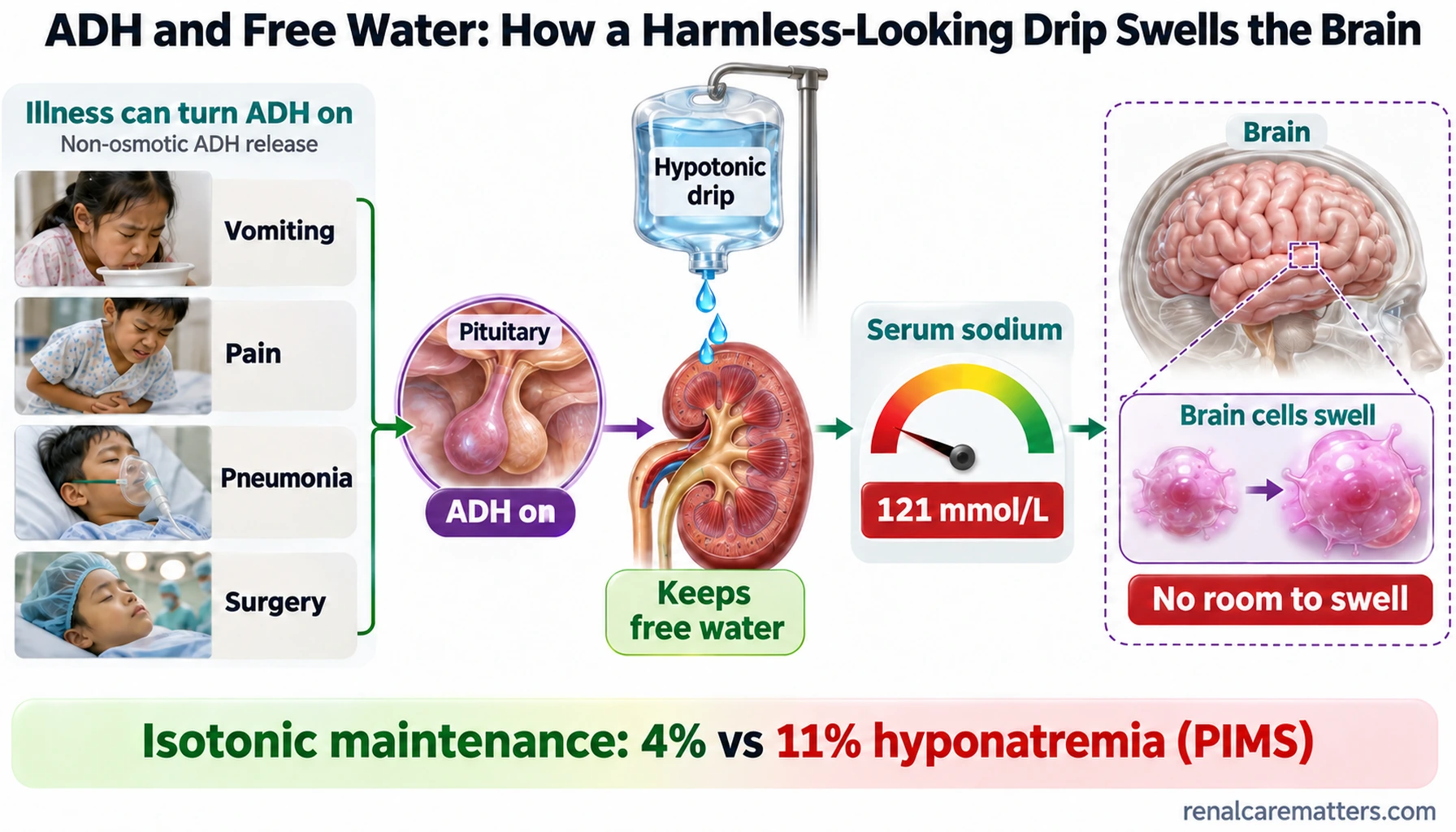
The picture has a limit. A pot has no thirst and no kidney. A child does: antidiuretic hormone (ADH, arginine vasopressin) decides how much water the kidney keeps, and in a sick child it is often switched on by things that have nothing to do with sodium — vomiting, pain, fear, low volume, lung or brain disease, surgery. When ADH is on, the kidney keeps free water, and any free water you infuse stays in the pot. And the brain is not soup. Its cells swell when sodium falls fast and shrink when it rises fast, inside a skull that cannot stretch.
Figure 1 · Key numbers
AAP 2018 maintenance fluidsIsotonic solutions for ages 28 days to 18 years (evidence quality A; strong recommendation)
PIMS trial, hyponatremia4% with sodium 140 mmol/L versus 11% with 77 mmol/L
Hyponatremia defined (European guideline)Serum sodium below 135 mmol/L; acute if documented to exist less than 48 hours
Correction limit, chronic hyponatremia (European guideline)No more than 10 mmol/L in the first 24 hours and 8 mmol/L in each 24 hours thereafter
Dengue critical phaseAround defervescence, usually days 3–7, lasting about 24–48 hours
Most children on intravenous fluids do well on any reasonable order. A few, with ADH switched on, drown their brain cells in free water from a fluid that looked harmless on the chart. Your work is to choose maintenance fluid that does not cause hyponatremia, to treat brain swelling fast and chronic hyponatremia slowly, and to watch the volume as closely as the sodium.
Opening case · fictional
Case: The seizure at 3 a.m.
It is 3:20 a.m. at a district hospital in Cabanatuan, Nueva Ecija. The pediatric resident calls you. Andrea Dela Cruz, 18 months old and 10 kg, was admitted 18 hours ago with gastroenteritis and moderate dehydration. Her admission sodium was 134 mmol/L. After a saline bolus she was started on 5% dextrose with 0.3% sodium chloride at the full Holliday–Segar rate, plus replacement for ongoing losses. She kept vomiting. At 3 a.m. she had a generalized seizure lasting four minutes, stopped by the resident with a benzodiazepine. She is now drowsy, with a heart rate of 150 and a capillary refill under 2 seconds.
A point-of-care sodium is 121 mmol/L. The resident plans to “restrict fluids to two-thirds and recheck in the morning.” The ward has no premixed hypertonic saline; the pharmacy can prepare it from stock if someone writes the order. The nearest pediatric intensive care unit is two hours away in Manila. Her grandmother asks whether the dextrose drip caused the seizure.
Before reading on, decide:
Why did Andrea’s sodium fall, and why is fluid restriction alone the wrong answer tonight?
What happens in the next hour, and how fast should sodium rise after that?
What maintenance fluid should she have from now on, and what do you change on the ward?
Keep your answers in mind. The lesson gives you what you need, and the case review near the end shows one sound response.
Lesson · part 1
Water follows ADH, and the brain follows water
Maintenance fluid replaces what a child loses through skin, breath, urine and stool. Holliday and Segar linked that water need to the calories a child spends, scaled by weight.1 Their 1957 estimate is still the basis of most ward calculators. It tells you how much water a healthy child needs. It says nothing about how much a sick child, with ADH switched on, can excrete.
That is the trap. Gastroenteritis, pneumonia, meningitis, surgery, pain and nausea all release ADH regardless of the serum sodium. With ADH on, the kidney returns free water to the blood. A hypotonic infusion supplies that free water; the sodium falls. Moritz and Ayus reviewed reports of death and permanent neurological injury from hospital-acquired hyponatremia in children and adults and found that virtually all of it followed hypotonic fluids, while prospective studies showed that 0.9% sodium chloride prevents it.2 Their reviews are observational and expert in nature, but the mechanism is established physiology and the trial evidence below agrees.
Children are especially vulnerable. The brain occupies a large share of the skull, so there is little room for swelling. Hypoxia and central nervous system disease lower the sodium at which encephalopathy appears.3 Symptoms can begin with headache, vomiting and lethargy, which are easy to blame on the illness itself.
Stimulus
Why ADH rises
What you see on the ward
Volume depletion (gastroenteritis, dengue leak)
Baroreceptors override osmotic control
Concentrated urine despite falling sodium
Nausea, vomiting, pain
Non-osmotic release
Sodium falls after admission, not before
Pneumonia, bronchiolitis, meningitis
Lung and brain disease
Low sodium with normal or high volume
Surgery, opioids
Stress response and drugs
Post-operative fall in sodium on hypotonic fluid
Water moves across cell membranes in seconds; brain cells defend their volume over hours to days by exporting solutes. That adaptation decides treatment. In acute hyponatremia (documented for less than 48 hours, as the European guideline defines it),4 the brain has not adapted, swelling is the danger, and a prompt rise in sodium is protective. In chronic hyponatremia, the brain has adapted, and a fast rise shrinks cells that have lost their solutes, the setting for osmotic demyelination.
RememberA fluid that is safe for a healthy child can be dangerous for a sick one. In hospital, assume ADH is on until the urine proves otherwise.
Figure 2. How a harmless-looking drip swells the brain. Non-osmotic ADH release turns infused free water into hyponatremia; isotonic maintenance fluid removes the free water.
Lesson · part 2
What the evidence shows
Isotonic maintenance fluid. The American Academy of Pediatrics (AAP) 2018 guideline recommends that patients aged 28 days to 18 years who need maintenance intravenous fluids receive isotonic solutions with appropriate potassium chloride and dextrose, because they significantly decrease the risk of hyponatremia (evidence quality A; recommendation strength strong).5 Note the scope. The guideline excludes neonates younger than 28 days or in the neonatal intensive care unit, and children with neurosurgical disorders, cardiac disease, hepatic disease, cancer, renal dysfunction, diabetes insipidus, voluminous watery diarrhea or severe burns.5 Many of your patients sit in those exclusions, where the fluid must be built from the child’s actual losses and kidney function.
PIMS. The PIMS randomized controlled trial (RCT) randomized 690 children in a Melbourne children’s hospital to maintenance fluid with sodium 140 mmol/L or 77 mmol/L in a double-blind design; primary outcome data were available for 641. Hyponatremia occurred in 12 of 319 children (4%) on sodium 140 and 35 of 322 (11%) on sodium 77 (odds ratio 0.31), an absolute difference of about 7 percentage points, or roughly one case prevented for every 14 children treated. No clinically apparent cerebral edema occurred in either group. One child on sodium 140 had seizures, compared with seven on sodium 77.6 Hyponatremia is a laboratory outcome; the seizure difference was small in numbers and not the primary outcome, but it points the same way.
Treating encephalopathy. Moritz and Ayus argue that hyponatremic encephalopathy is a medical emergency to be treated with hypertonic saline, never with fluid restriction alone, and propose intermittent bolus therapy to reverse symptoms quickly while avoiding overcorrection.3,7 The European guideline, written for adults and widely borrowed by pediatric protocols, aims for a rise of about 5 mmol/L in the first hour for severe symptoms and then limits the increase to 10 mmol/L in the first 24 hours and 8 mmol/L in every 24 hours thereafter.4 These are expert-consensus limits, not trial-derived targets, and the volume and concentration of the actual order come from your unit’s pediatric protocol.
Hypernatremia. Hospital-acquired hypernatremia occurs when a child with ongoing free-water losses cannot drink. Outside hospital, the breastfed infant whose mother’s milk supply is failing is a high-risk group for neurological damage, which lactation support and close weight monitoring largely prevent.7
Claim
Evidence
What it does not show
Isotonic maintenance fluid prevents hyponatremia
AAP 2018 (quality A, strong); PIMS RCT (4% vs 11%)
Benefit in excluded groups (renal dysfunction, neonates, cardiac disease)
Hypertonic saline reverses encephalopathy
Physiology, case series, expert review
A randomized comparison of regimens in children
Correction limits prevent demyelination
Consensus guideline
An exact safe rate for every child
RememberIsotonic is the default for maintenance in hospital. Hypertonic saline treats brain swelling. Restriction alone treats neither.
Lesson · part 3
Dengue on the Philippine ward, and acid-base by anion gap
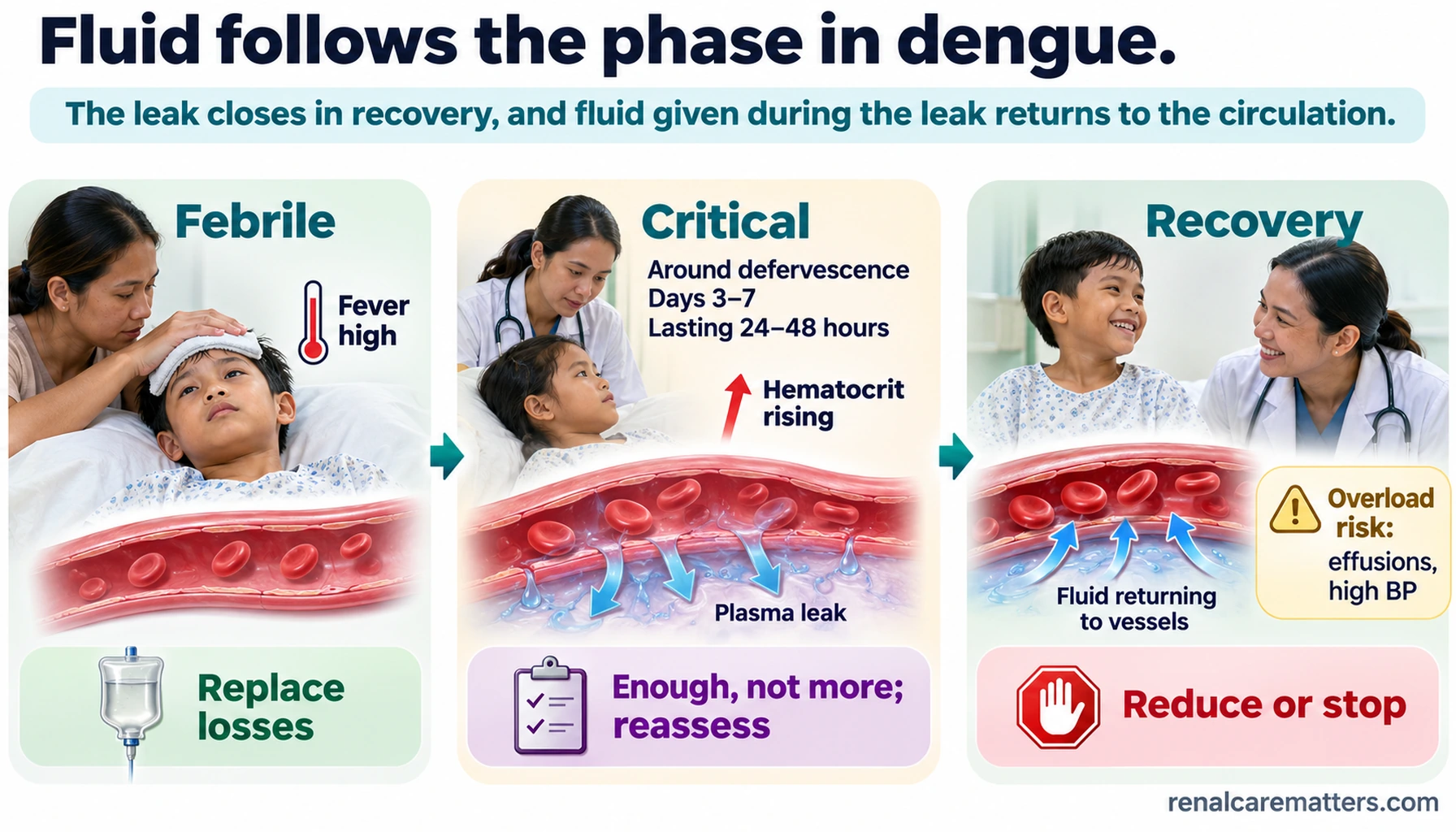
Dengue. The World Health Organization (WHO) 2009 guideline describes three phases: febrile, critical and recovery. The critical phase begins around defervescence, usually on days 3 to 7, when capillary permeability rises and plasma leaks; it lasts about 24 to 48 hours. In the recovery phase the leaked fluid returns to the circulation.8 Children who were given generous fluid to cover the leak can then become overloaded, with pleural effusions, ascites and respiratory distress, at the moment the team relaxes. The nephrologist is often called at exactly this point, for a child who is “not peeing” after days of fluid.
Falling hematocrit, rising blood pressure, diuresis or overload
Reduce or stop; watch for overload and hyponatremia
Module 15 covers dengue acute kidney injury. Here the point is that the fluid plan must change with the phase, and the sodium and the weight should be measured often enough to see the turn.
Metabolic acidosis. Start with the anion gap: sodium minus chloride and bicarbonate. A raised gap means an unmeasured acid has been added: lactate from poor perfusion, ketones in diabetic ketoacidosis or starvation, retained acids in kidney failure, or a toxin. A normal gap means bicarbonate has been lost (diarrhea, proximal tubular loss) or not regenerated (distal renal tubular acidosis), or chloride has been added, as with large volumes of 0.9% saline. Correct the gap for a low albumin, which is common in sick children and hides a raised gap. In a normal-gap acidosis, the urine anion gap helps separate gut losses, where the kidney excretes ammonium and the urine gap is negative, from distal tubular failure, where it cannot.
Pattern
Mechanism
Common pediatric causes
Raised anion gap
Acid added
Shock (lactate), diabetic ketoacidosis, starvation ketosis, kidney failure, salicylate or other toxins
Normal gap, negative urine gap
Bicarbonate lost in stool; kidney responding
Gastroenteritis, ileostomy
Normal gap, positive urine gap
Kidney cannot excrete acid
Distal renal tubular acidosis (Module 8)
Normal gap after resuscitation
Chloride load
Large volumes of 0.9% saline
RememberIn dengue, watch the phase, not only the platelets. In acidosis, compute the gap before you treat the number.
Figure 3. Fluid follows the phase in dengue. The leak closes in recovery, and fluid given during the leak returns to the circulation.
Lesson · part 4
What the attending does
Fix the order and the template. For maintenance fluid in a ward child outside the AAP exclusions, choose an isotonic solution with dextrose and potassium as the unit protocol sets. For a child in an excluded group, such as one with kidney failure or polyuric tubular disease, write the fluid from the child’s measured losses and urine. Then ask the ward to change the template that produced the hypotonic order.
Measure. Weigh the child daily, or twice daily in an infant. Check sodium before starting maintenance fluid and again within the first day, sooner if the child is vomiting, has lung or brain disease, or is post-operative. A urine sodium and osmolality, sent before treatment, help tell you whether ADH is on.
Treat symptoms, then slow down. A seizing or obtunded child with acute hyponatremia needs hypertonic saline now, as the unit protocol and a pediatric formulary set, with sodium checked frequently. Once symptoms resolve, stop the hypertonic infusion and keep the subsequent rise within the limits above, more cautiously in a child whose hyponatremia was chronic or unknown in duration. Watch for a sudden water diuresis as ADH switches off, which can overcorrect the sodium quickly.
Hypernatremia. Replace the free-water deficit over a period long enough for brain cells that have gained solutes to lose them, as the unit protocol sets, and rule out diabetes insipidus in a child with dilute urine despite a high sodium.
Figure 4 · A falling sodium in a ward child
Is the child symptomaticHeadache, vomiting, lethargy, seizure, low consciousness. If yes, treat as an emergency now.
Acute or chronicDocumented for less than 48 hours, or after hospital fluids, is acute; unknown duration is treated as chronic for the speed of correction.
What fluid is runningStop any hypotonic infusion; change to isotonic.
What is ADH doingUrine osmolality and sodium, sent before treatment if possible.
Set the limitsWrite the target rise for the first hour and the ceiling for 24 hours, and how often sodium is checked.
Watch the turnUrine output and sodium every few hours; act early on a water diuresis.
Stop and call
Any seizure, reduced consciousness or vomiting with headache in a child whose sodium is falling
Sodium rising faster than the written ceiling
A sudden large urine output after hyponatremia
Dengue in the recovery phase with effusions, rising blood pressure or oxygen need
After surgery · fictional
Jun-jun, 7, had an appendectomy yesterday and is on a hypotonic template. His sodium has gone from 138 to 129 mmol/L, and he complains of a headache. The surgeon writes “observe.”
You change the fluid to an isotonic solution, ask for a sodium every four to six hours, and explain to the surgical resident why pain and opioids switch on ADH.
What this shows. Headache with a falling sodium after surgery is encephalopathy until proven otherwise.
RememberWrite the sodium plan as three numbers: the target for the first hour, the ceiling for 24 hours, and how often you check.
On the floor
Real situations: problems and solutions
These are fictional but typical. For each one, cover the answer, decide what you would do, then compare. Where a step depends on local rules, your unit’s procedure and your supervisor’s direction come first.
The bronchiolitis infant on a hypotonic template
What you see
A 4-month-old with bronchiolitis on a hypotonic maintenance drip has a sodium of 128 mmol/L and is feeding poorly and irritable.
What is likely going on
Lung disease has switched on ADH; the free water in the drip is lowering the sodium.
What to do
Stop the hypotonic fluid, switch to isotonic maintenance per protocol, check sodium within hours, and assess for encephalopathy. Note that neonates under 28 days fall outside the AAP guideline’s scope.
Why it matters
Lung disease is one of the commonest silent drivers of hospital hyponatremia in infants.
The dengue child who “stopped peeing”
What you see
A 9-year-old on day 7 of dengue, afebrile since day 5, has bilateral effusions, rising blood pressure and low urine output after 48 hours of generous fluid.
What is likely going on
Recovery-phase reabsorption with fluid overload; low urine output may reflect congestion as well as kidney injury.
What to do
Reduce or stop intravenous fluid, review the hematocrit trend and weight, examine for overload, and discuss diuresis or kidney support with the team (Module 15).
Why it matters
More fluid at this point worsens the lungs without helping the kidney.
The overcorrection overnight
What you see
A child treated for chronic hyponatremia (sodium 118 mmol/L, unknown duration) has a sodium of 131 mmol/L twelve hours later after a large dilute urine output.
What is likely going on
A water diuresis as ADH switched off; the rise has passed the 24-hour ceiling.
What to do
Call the attending now. The unit protocol may advise re-lowering the sodium; record urine output hourly and check sodium frequently.
Why it matters
Overcorrection of chronic hyponatremia risks osmotic demyelination, which can appear days later.
Hypernatremia in a breastfed newborn
What you see
A 9-day-old exclusively breastfed baby has lost 14% of birth weight, is lethargic, and has a sodium of 158 mmol/L.
What is likely going on
Insufficient lactation leading to hypernatremic dehydration.
What to do
Restore volume, then correct the free-water deficit slowly per protocol; arrange lactation support and close weight follow-up.
Why it matters
This is preventable with early weight checks and support for the mother.
Field notes
Ask to see the fluid bag, not just the order sheet; templates and stock bags differ.
Send urine sodium and osmolality before you treat a low sodium; afterward they mean little.
Write the sodium ceiling on the bedside chart where the night nurse can see it.
In dengue, write the day of illness at the top of every progress note.
Case review
Back to the case: The seizure at 3 a.m.
Why it fell. Gastroenteritis, vomiting and volume depletion switched on ADH. Andrea then received free water in a hypotonic maintenance fluid plus replacement, and her kidneys kept it. Her sodium fell 13 mmol/L in under a day: acute hyponatremia with encephalopathy. Fluid restriction lowers future free-water intake but does nothing to shrink a swollen brain tonight. Moritz and Ayus are explicit that hyponatremic encephalopathy should never be managed with fluid restriction alone.
The next hour and after. Stop the hypotonic fluid. Ask the resident to give hypertonic saline now, prepared by the pharmacy from stock according to the hospital’s pediatric protocol and formulary, aiming for a rise of about 5 mmol/L and resolution of symptoms, with sodium rechecked frequently and a blood glucose checked. Because her hyponatremia is acute, the brain has not adapted, and the risk of osmotic demyelination is lower than in a chronic case; still, write the ceiling of 10 mmol/L for the first 24 hours and watch for a water diuresis as her volume is restored. Discuss transfer with the pediatric intensive care unit (PICU) two hours away if she does not wake fully or seizes again.
From now on. Once she is stable, maintenance fluid should be isotonic with dextrose and potassium, as the AAP recommends for her age group, with ongoing losses replaced measure for measure and daily weights. Tell her grandmother, plainly, that the type of drip contributed and that it has been changed. Then ask the ward to replace the hypotonic template so the next child does not need a 3 a.m. call.
Skills lab · with your preceptor
Skills checklist: Fluids, sodium and acid-base in children
Complete with a preceptor, in simulation or at your own unit. Sign-off is local. Your preceptor rates each step as satisfactory, needs practice, or not observed. Steps marked Critical must all be satisfactory before sign-off. This checklist supports supervised learning; your unit’s own procedure and competency form are the authority. A printable version of every checklist is on the trainer page.
Identifies ADH-stimulating conditions and selects isotonic maintenance fluid within the AAP 2018 scope
Leads the first hour of hyponatremic encephalopathy using the unit protocol, with written correction limits
Adjusts fluid through the febrile, critical and recovery phases of dengue
Classifies metabolic acidosis using the albumin-corrected anion gap and the urine anion gap
Placement activity. Pediatric ward, emergency department or simulation
Self-assessment
Check your understanding
Each visit draws 5 questions at random from this module’s 5-question bank. Choose the single best answer for each, then select Check answers; an explanation appears under the best answer. Select New set of questions for a different mix. A good target is 4 of 5 on two different sets. Nothing you select is sent anywhere; scoring happens in your browser.
Holliday, M. A., & Segar, W. E. (1957). The maintenance need for water in parenteral fluid therapy. Pediatrics, 19(5), 823–832.
Moritz, M. L., & Ayus, J. C. (2007). Hospital-acquired hyponatremia—why are hypotonic parenteral fluids still being used? Nature Clinical Practice Nephrology, 3(7), 374–382. https://doi.org/10.1038/ncpneph0526
Moritz, M. L., & Ayus, J. C. (2010). New aspects in the pathogenesis, prevention, and treatment of hyponatremic encephalopathy in children. Pediatric Nephrology, 25(7), 1225–1238. https://doi.org/10.1007/s00467-009-1323-6
Spasovski, G., Vanholder, R., Allolio, B., Annane, D., Ball, S., Bichet, D., Decaux, G., Fenske, W., Hoorn, E. J., Ichai, C., Joannidis, M., Soupart, A., Zietse, R., Haller, M., van der Veer, S., Van Biesen, W., Nagler, E., & Hyponatraemia Guideline Development Group. (2014). Clinical practice guideline on diagnosis and treatment of hyponatraemia. European Journal of Endocrinology, 170(3), G1–G47. https://doi.org/10.1530/EJE-13-1020
Feld, L. G., Neuspiel, D. R., Foster, B. A., Leu, M. G., Garber, M. D., Austin, K., Basu, R. K., Conway, E. E., Fehr, J. J., Hawkins, C., Kaplan, R. L., Rowe, E. V., Waseem, M., Moritz, M. L., & Subcommittee on Fluid and Electrolyte Therapy. (2018). Clinical practice guideline: Maintenance intravenous fluids in children. Pediatrics, 142(6), e20183083. https://doi.org/10.1542/peds.2018-3083
McNab, S., Duke, T., South, M., Babl, F. E., Lee, K. J., Arnup, S. J., Young, S., Turner, H., & Davidson, A. (2015). 140 mmol/L of sodium versus 77 mmol/L of sodium in maintenance intravenous fluid therapy for children in hospital (PIMS): A randomised controlled double-blind trial. The Lancet, 385(9974), 1190–1197. https://doi.org/10.1016/S0140-6736(14)61459-8
Moritz, M. L., & Ayus, J. C. (2005). Preventing neurological complications from dysnatremias in children. Pediatric Nephrology, 20(12), 1687–1700. https://doi.org/10.1007/s00467-005-1933-6
Educational material for physicians. Completing it is an Academy learning record only. It does not confer CPD units, PNSP or board certification, privileges, or PhilHealth accreditation, and it does not replace current guidelines, regulations, your institution’s pediatric protocols and formulary, or clinical judgment.