PublishedNailathalaGipatikPepalwal:ReferencesMga SanggunianMga TinubdanReng Reperensya:5Audience: Practicing nephrologists · senior nephrology fellows · internists who share longitudinal kidney care in the clinic, ward, ICU, dialysis unit, and homeRead timeOras ng pagbasaOras sa pagbasaOras ning pamamasa:
Training track for attending nephrologists in adult practice
This module is study material for attending nephrologists and senior fellows in adult practice. It explains the reasoning behind common decisions; it is not a protocol. Doses and thresholds must be checked against current product labels, guidelines, and your institution’s approved protocols. Regulatory and benefit rules change: confirm them on the date of service. Every case is fictional.
Learning objectives
After this module you should be able to
Create a patient-specific access life-plan.
Recognize and escalate access emergencies and catheter-related bloodstream infection.
Lead catheter-reduction and infection-surveillance practice.
Pre-testBefore you read, answer the 5 self-assessment questions and note your score. After the module, select New set of questions and compare. The difference is what you learned; the questions you still miss are what to reread.
Start here
The big picture, in plain words
Your duty · Section 1.2, 2024 hemodialysis guidelinesUnder the Philippine Society of Nephrology (PSN) guidelines: Coordinate with a vascular surgeon or a trained general surgeon on access provision and care (b3), and coordinate in emergencies (b8).
In plain wordsThe vascular access is the patient’s lifeline and also the most common route for infection. Catheters are bridges, not homes, and every catheter-day carries a small, cumulative risk.
Figure 1 · Key numbers
LOCK IT-100 catheter-related bloodstream infection (CRBSI) rate0.13 vs 0.46 per 1,000 catheter-days; hazard ratio (HR) 0.29
Infection surveillance metricBloodstream infections per 1,000 catheter-days (or per 100 patient-months)
Opening case · fictional
Case: Rigors at 30 minutes
Mr. Domingo, 49, has dialyzed through a tunneled jugular catheter for seven months. His fistula surgery was postponed twice. Thirty minutes into his Friday session he starts shaking uncontrollably. His temperature is 39.2 °C and his blood pressure falls to 82/50 mm Hg.
Dr. Salonga, the physician on duty, calls you. “He had the same thing last month. Blood culture grew Staphylococcus aureus, and they gave him antibiotics through the catheter. Should I give paracetamol and finish the session?” Your head nurse adds that this is the unit’s third catheter bloodstream infection this quarter.
Before reading on, decide:
What should Dr. Salonga do now?
Should the catheter stay?
What does the third infection this quarter tell you, and what will you do about it?
Keep your answers in mind. The lesson gives you what you need, and the case review near the end shows one sound response.
Lesson · part 1
How it works
A fistula matures as raised flow remodels the vein: shear stress dilates it and thickens its wall. Neointimal hyperplasia at the swing segment or outflow causes stenosis, which shows as high venous pressure, prolonged bleeding or poor flow. A catheter’s surface acquires a biofilm within days. Bacteria embedded there are protected from antibiotics and host defenses, so a recurrent bacteremia with the same organism points to the catheter.
At the access clinic · fictional
Mr. Domingo’s blood cultures grow Staphylococcus aureus again, four weeks after the last course. The catheter looks clean.
You explain to the fellow that a biofilm forms on the catheter surface within days. Bacteria inside it are shielded from antibiotics and white cells. When the same organism returns after treatment, the catheter is the reservoir.
What this shows. A clean exit site does not mean a clean catheter.
Lesson · part 2
What the evidence shows
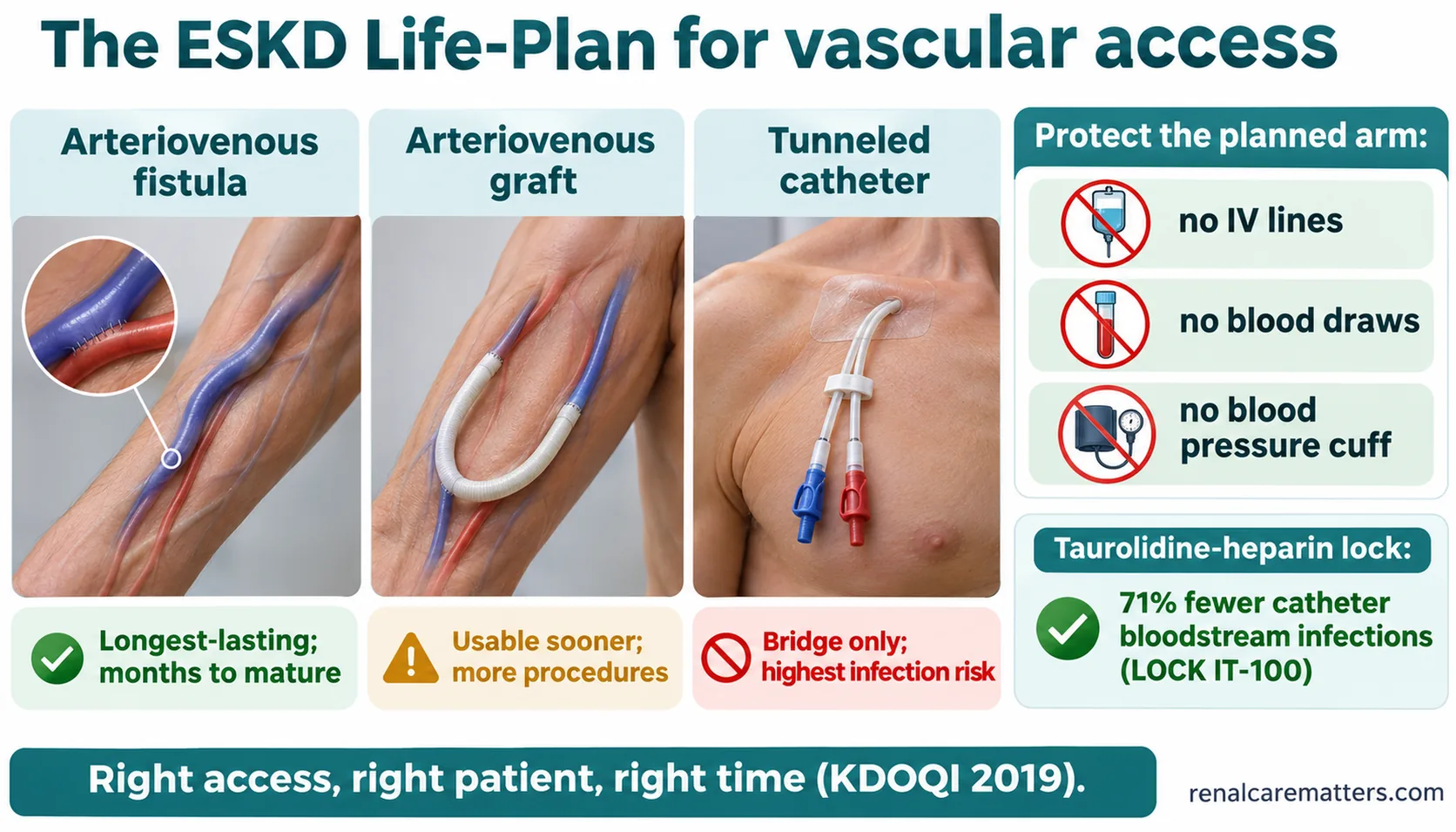
Kidney Disease Outcomes Quality Initiative (KDOQI) 2019 moved from ’fistula first’ toward an individualized end-stage kidney disease (ESKD) Life-Plan, choosing the right access for the right patient at the right time. LOCK IT-100 (randomized, double-blind; 70 US sites) found a taurolidine-heparin lock reduced catheter-related bloodstream infection by 71% versus heparin (0.13 vs 0.46 per 1,000 catheter-days; hazard ratio 0.29). Local registration and availability in the Philippines need checking. Centers for Disease Control and Prevention (CDC) Core Interventions (hand hygiene, catheter care audits, chlorhexidine skin antisepsis, staff education, surveillance) are associated with lower bloodstream infection rates in collaborative studies.
Write an access life-plan for each patient: current access, next access, vessels to protect (avoid venipuncture and PICC lines in the planned arm) and who evaluates problems. For fever or rigors in a catheter patient, take blood cultures from the circuit and a peripheral site where possible, start empiric vancomycin plus gram-negative coverage, and review the catheter. Remove it for tunnel infection, septic shock, Staphylococcus aureus, Pseudomonas or Candida. Audit catheter prevalence and infections per 1,000 catheter-days monthly.
Figure 2. The three types of dialysis access compared, with advice to protect the arm planned for a fistula.
At the monthly infection review · fictional
Eleven of your patients at the unit are on catheters. Five have no date for fistula surgery. Two have had their surgery postponed twice.
You write an access life-plan for each: current access, next access, the arm to protect, the surgeon, and the date. You ask the head nurse to bring the list to every monthly visit until the column of dates is full.
What this shows. A catheter without a removal date tends to become permanent.
Stop and call
Rigors or hypotension during hemodialysis (HD) with a catheter
Pulsatile bleeding or a ruptured aneurysm
Cold, painful hand after access creation (steal)
Swelling of the whole arm (central vein stenosis)
On the floor
Real situations: problems and solutions
These are fictional but typical. For each one, cover the answer, decide what you would do, then compare. Where a step depends on local rules, your unit’s procedure and your supervisor’s direction come first.
The arm with the IV line
What you see
A patient whose future fistula arm is marked has an intravenous line placed in that arm in the emergency room.
What is likely going on
Veins needed for access are being damaged.
What to do
Ask the team to move the line, and give the patient a card that says which arm to protect.
Why it matters
Every needle in the planned arm costs a vein.
The swollen arm
What you see
A patient’s whole access arm has become swollen over weeks.
What is likely going on
Central vein stenosis, often from previous catheters.
What to do
Refer for imaging and intervention.
Why it matters
Central stenosis can end the use of an entire limb for access.
The cold, painful hand
What you see
After fistula creation, a patient’s hand is cold and painful during dialysis.
What is likely going on
Steal syndrome: blood is diverted from the hand.
What to do
Refer urgently to the access surgeon.
Why it matters
Untreated steal can cause tissue loss.
Field notes
Every patient needs an access life-plan with a named surgeon.
Report infections per 1,000 catheter-days.
Audit hub care on every shift.
A catheter is a bridge, not a home.
Case review
Back to the case: Rigors at 30 minutes
Now. Stop the session. This is septic shock, not a fever to be treated with paracetamol. Activate the sepsis pathway and resuscitate. Take blood cultures from the catheter and from a peripheral vein, then give empiric vancomycin plus gram-negative cover according to the local antibiogram. Transfer him for monitored care and confirm who receives him.
The catheter. It has to come out. Septic shock and a previous S. aureus infection are both reasons for removal. Bacteria living in the biofilm on its surface are protected from antibiotics, and a repeat infection with the same organism points straight at the catheter. Arrange a temporary access for further dialysis, and ask the access surgeon for a firm date for his fistula. Seven months on a catheter was a plan that drifted.
The third infection. The unit’s surveillance belongs to the clinical head and the infection-control nurse, and the three patients may have three different attending nephrologists. Your part is to report this event, ask for a rate rather than a count (infections per 1,000 catheter-days, compared with last quarter), and support an audit of catheter care on every shift: hand hygiene, chlorhexidine skin preparation, and how the hubs are handled. Then look at your own panel: every patient of yours on a catheter needs an access life-plan with a named surgeon and a date.
Skills lab · with your preceptor
Skills checklist: Skills checklist
Complete with a preceptor, in simulation or at your own unit. Sign-off is local. Your preceptor rates each step as satisfactory, needs practice, or not observed. Steps marked Critical must all be satisfactory before sign-off. This checklist supports supervised learning; your unit’s own procedure and competency form are the authority. A printable version of every checklist is on the trainer page.
Examines or describes access findings
Documents urgency and the infection plan
Assigns a definitive access review
Placement activity. Simulation or supervised practice
Self-assessment
Check your understanding
Each visit draws 5 questions at random from this module’s 5-question bank. Choose the single best answer for each, then select Check answers; an explanation appears under the best answer. Select New set of questions for a different mix. A good target is 4 of 5 on two different sets. Nothing you select is sent anywhere; scoring happens in your browser.
Lok, C. E., Huber, T. S., Lee, T., Shenoy, S., Yevzlin, A. S., Abreo, K., Allon, M., Asif, A., Astor, B. C., Glickman, M. H., Graham, J., Moist, L. M., Rajan, D. K., Roberts, C., Vachharajani, T. J., Valentini, R. P., & National Kidney Foundation. (2020). KDOQI clinical practice guideline for vascular access: 2019 update. American Journal of Kidney Diseases, 75(4 Suppl 2), S1–S164. https://doi.org/10.1053/j.ajkd.2019.12.001
Agarwal, A. K., Roy-Chaudhury, P., Mounts, P., Hurlburt, E., Pfaffle, A., & Poggio, E. C. (2023). Taurolidine/Heparin lock solution and catheter-related bloodstream infection in hemodialysis: A randomized, double-blind, active-control, phase 3 study. Clinical journal of the American Society of Nephrology : CJASN, 18(11), 1446–1455. https://doi.org/10.2215/CJN.0000000000000278
Educational material for physicians. Completing it is an Academy learning record only. It does not confer CPD units, PSN certification, privileges, or PhilHealth accreditation, and it does not replace current guidelines, regulations, your institution’s protocols, or clinical judgment.