Maintenance HD prescription and delivered adequacy
Write a complete hemodialysis (HD) order within unit capability.
PublishedNailathalaGipatikPepalwal:ReferencesMga SanggunianMga TinubdanReng Reperensya:6Audience: Practicing nephrologists · senior nephrology fellows · internists who share longitudinal kidney care in the clinic, ward, ICU, dialysis unit, and homeRead timeOras ng pagbasaOras sa pagbasaOras ning pamamasa:
Training track for attending nephrologists in adult practice
This module is study material for attending nephrologists and senior fellows in adult practice. It explains the reasoning behind common decisions; it is not a protocol. Doses and thresholds must be checked against current product labels, guidelines, and your institution’s approved protocols. Regulatory and benefit rules change: confirm them on the date of service. Every case is fictional.
Learning objectives
After this module you should be able to
Write a complete hemodialysis (HD) order within unit capability.
Investigate discordance between prescribed and delivered dialysis.
Interpret Kt/V, ultrafiltration rate and hemodiafiltration evidence correctly.
Pre-testBefore you read, answer the 5 self-assessment questions and note your score. After the module, select New set of questions and compare. The difference is what you learned; the questions you still miss are what to reread.
Start here
The big picture, in plain words
Your duty · Section 1.2, 2024 hemodialysis guidelinesUnder the Philippine Society of Nephrology (PSN) guidelines: Provide the initial and maintenance dialysis prescription (b4), and review it at least monthly, face to face or by telemedicine (b6).
In plain wordsKt/V measures how many times the body’s water was cleaned of urea in one session. It is a useful dose gauge, but it says nothing about fluid, middle molecules or how the patient feels. Adequacy means the person is doing well, not just that the number passed.
Ultrafiltration rate associated with harm>10–13 mL/kg/h (observational)
Comparison of high-dose hemodiafiltration (HDF) with high-flux HD trial (CONVINCE) high-dose HDFAll-cause mortality hazard ratio (HR) about 0.77 vs high-flux HD
Opening case · fictional
Case: The Kt/V that fell
On your monthly visit, the head nurse shows you the results of Mrs. Panganiban, one of your patients. Her spKt/V has fallen from 1.45 to 1.05 over two months. Her prescription has not changed. The nurse’s notes show she cramps most sessions and has gone home 30 to 45 minutes early four times this month.
The night-shift notes say “arterial pressure alarm, BFR reduced to 250” several times a week. The physician on duty proposes a larger dialyzer. The administrator stops by and asks why her numbers are pulling the unit’s adequacy figures down just before the Philippine Health Insurance Corporation (PhilHealth) quality review.
Before reading on, decide:
Did her dose fall, or did her delivery fall?
What are the four checks before anyone changes the prescription?
What will you tell the administrator?
Keep your answers in mind. The lesson gives you what you need, and the case review near the end shows one sound response.
Lesson · part 1
How it works
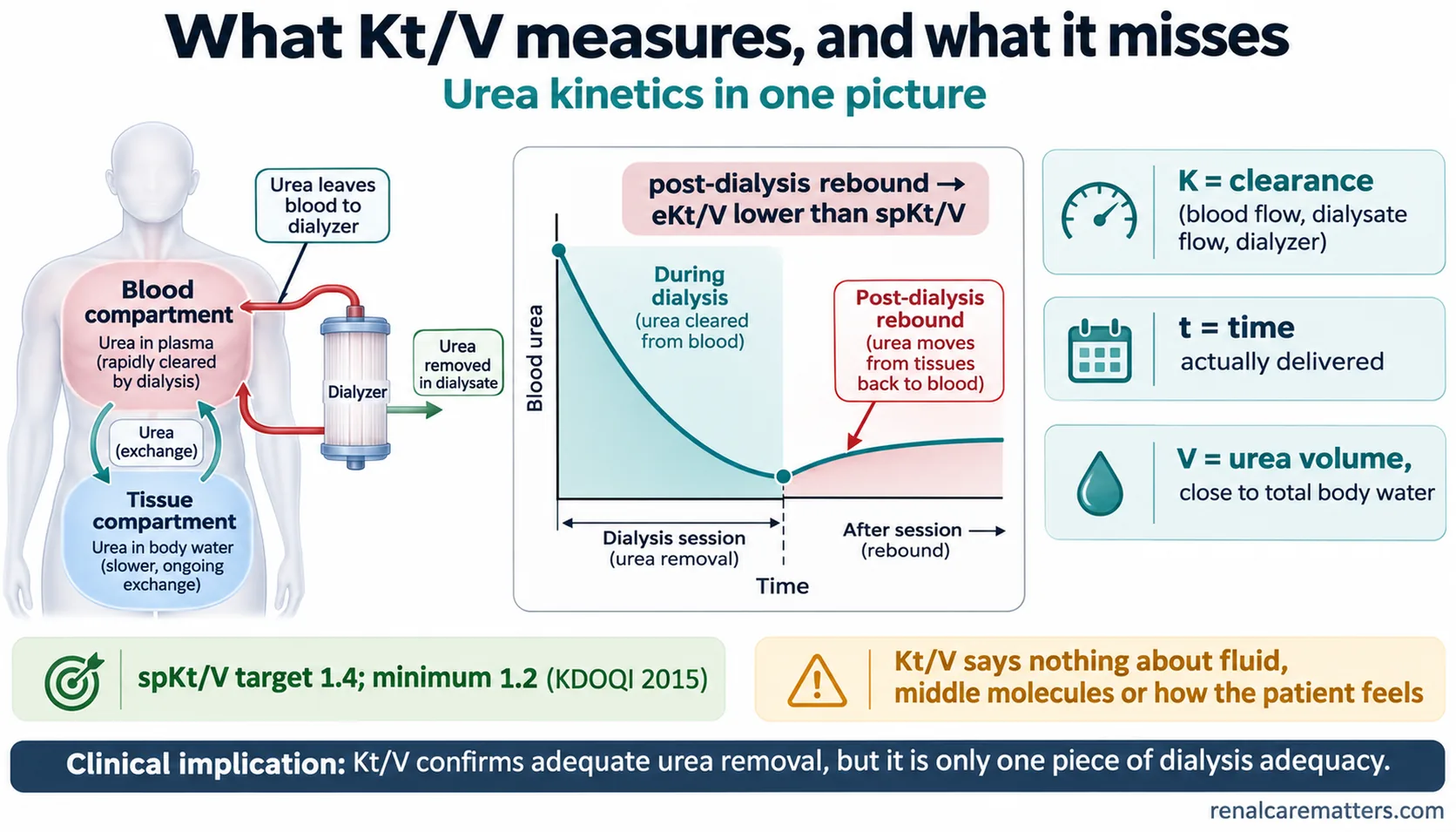
Urea clearance (K) depends on blood flow, dialysate flow and dialyzer surface area. Time (t) multiplies it, and the urea distribution volume (V, close to total body water) sets how much cleaning is needed. Urea rebounds after the session as it moves from tissues back into blood, so equilibrated Kt/V is lower than single-pool Kt/V. Clearance falls when access recirculation sends cleaned blood straight back into the arterial needle, or when high negative arterial pressure means the pump cannot draw the set flow. Fluid removed faster than the plasma can refill from tissues lowers blood volume. That causes cramps, hypotension and repeated organ stunning of the heart and brain.
On your monthly visit, the alarm that was silenced · fictional
You stay to watch Mrs. Panganiban’s session. Every few minutes the arterial pressure alarm sounds, and the nurse turns the blood pump down from 350 to 250 mL/min. The machine screen still shows the prescribed four hours.
At 250 mL/min for three and a half hours, she receives far less clearance than the order assumes. Nothing on the prescription sheet has changed.
What this shows. Kt/V falls when time or flow falls. Look at the machine, not only at the order.
Figure 2. What Kt/V measures, and what it misses. How urea is cleared during dialysis and rebounds afterward, and what each part of Kt/V means.
Lesson · part 2
What the evidence shows
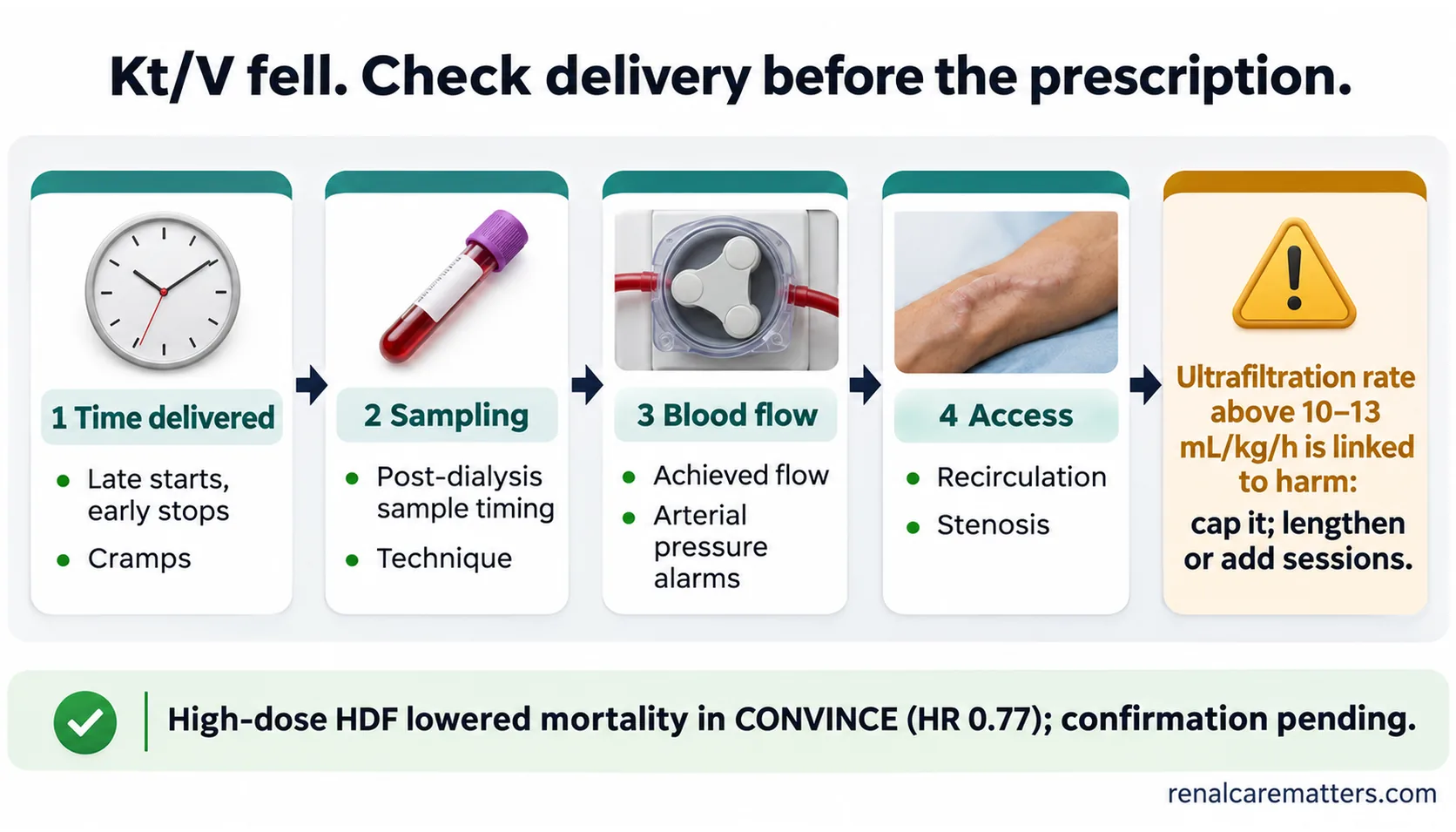
KDOQI 2015 recommends a target single-pool Kt/V of 1.4 per thrice-weekly session, with a minimum delivered value of 1.2; the HEMO trial found no benefit from higher doses. Observational data associate ultrafiltration rates above about 10–13 mL/kg/h with higher cardiovascular mortality. CONVINCE (N Engl J Med 2023; 1,360 patients) found high-dose hemodiafiltration (convection volume at least 23 L) reduced all-cause mortality compared with high-flux HD (hazard ratio about 0.77). The UK H4RT trial finished follow-up in May 2025; its results were not available in our review, so treat HDF superiority as supported by one large trial pending confirmation.
Write the order completely: schedule and duration, access and needle size, blood and dialysate flow, dialyzer, dialysate sodium, potassium, calcium and bicarbonate, anticoagulation, target weight with maximum ultrafiltration rate, and monitoring. When Kt/V falls, check four things before raising the dose: actual time delivered (late starts, early stops), sampling technique (post-dialysis sample timing), achieved blood flow and arterial pressures, and access recirculation or stenosis. Cap the ultrafiltration rate and lengthen or add sessions when interdialytic weight gains are high, rather than pulling fluid harder.
Figure 3. Kt/V fell. Check delivery before the prescription.. Four checks when dialysis dose falls, plus the ultrafiltration rate warning and the hemodiafiltration evidence.
At the quality meeting · fictional
Nurse Cabral shows you the adequacy of your patients at the unit: 82% at or above a single-pool Kt/V of 1.2. You ask a second question: how many sessions ended early because of cramps or low pressure? The answer is 14% of sessions last month.
You agree to review two measures for your patients each month: Kt/V and minutes lost per session.
What this shows. A dose that is not delivered is not a dose.
Stop and call
Kt/V falling with repeated arterial pressure alarms (access dysfunction)
Interdialytic weight gain consistently >4% of body weight
Repeated sessions shortened by cramps or hypotension
Pre-dialysis potassium >6.0 mmol/L
On the floor
Real situations: problems and solutions
These are fictional but typical. For each one, cover the answer, decide what you would do, then compare. Where a step depends on local rules, your unit’s procedure and your supervisor’s direction come first.
The post-dialysis sample drawn late
What you see
A patient’s Kt/V suddenly falls, but nothing else has changed.
What is likely going on
The post-dialysis sample may have been drawn after urea rebound.
What to do
Check the sampling technique and timing, and repeat correctly before changing the prescription.
Why it matters
A wrong sample can lead to a wrong prescription.
The interdialytic gain of 5 kilograms
What you see
A 60-kilogram patient gains 5 kilograms between sessions and cramps every time.
What is likely going on
Removing that much in four hours exceeds the rate at which plasma refills from the tissues.
What to do
Cap the ultrafiltration rate, review salt intake, and add time or an extra session rather than pulling harder.
Why it matters
Rapid fluid removal stresses the heart and brain at every session.
The patient who asks for hemodiafiltration
What you see
A patient read about hemodiafiltration and asks to switch.
What is likely going on
Evidence supports it, but it rests mainly on one large trial.
What to do
Explain that CONVINCE found lower mortality with high-dose hemodiafiltration, and that confirmation from other trials is pending. Discuss availability and cost at your unit.
Why it matters
Honest evidence lets the patient choose for himself.
Field notes
Count minutes delivered, not minutes prescribed.
Arterial alarms are an access problem until proven otherwise.
Write the maximum ultrafiltration rate in every order.
Adequacy means the patient is doing well, not only that the number passed.
Case review
Back to the case: The Kt/V that fell
Dose or delivery? Delivery. The order did not change, but she is getting less of it: shorter sessions and a slower blood pump. A larger dialyzer will not fix a pump that cannot draw blood.
The four checks. First, time: count the minutes actually delivered, not the minutes ordered. Second, the sample: confirm the post-dialysis blood was drawn correctly, at the right time and with the right technique. Third, blood flow: arterial alarms with the pump turned down point to an inflow stenosis or a needle problem. Fourth, the access: refer it for examination, access flow measurement, and imaging. Then deal with the cramps. They usually mean fluid is being pulled too fast. Reassess her target weight and cap the ultrafiltration rate.
The administrator. Tell him the truth: the number fell because the access and the fluid plan need attention, and both are fixable. Show him the plan and the date you will recheck Kt/V with a correctly timed sample. A quality number is worth something only if it describes the patient; adjusting the sampling to pass the review would hide a failing fistula until it clots.
Skills lab · with your preceptor
Skills checklist: Skills checklist
Complete with a preceptor, in simulation or at your own unit. Sign-off is local. Your preceptor rates each step as satisfactory, needs practice, or not observed. Steps marked Critical must all be satisfactory before sign-off. This checklist supports supervised learning; your unit’s own procedure and competency form are the authority. A printable version of every checklist is on the trainer page.
Reviews a complete order for safety and feasibility
Identifies a delivery discrepancy and its cause
Sets a repeat measurement plan
Placement activity. Simulation or supervised practice
Self-assessment
Check your understanding
Each visit draws 5 questions at random from this module’s 5-question bank. Choose the single best answer for each, then select Check answers; an explanation appears under the best answer. Select New set of questions for a different mix. A good target is 4 of 5 on two different sets. Nothing you select is sent anywhere; scoring happens in your browser.
National Kidney Foundation (2015). KDOQI clinical practice guideline for hemodialysis adequacy: 2015 update. American Journal of Kidney Diseases, 66(5), 884–930. https://doi.org/10.1053/j.ajkd.2015.07.015
Blankestijn, P. J., Vernooij, R. W. M., Hockham, C., Strippoli, G. F. M., Canaud, B., Hegbrant, J., Barth, C., Covic, A., Cromm, K., Cucui, A., Davenport, A., Rose, M., Török, M., Woodward, M., Bots, M. L., & CONVINCE Scientific Committee Investigators (2023). Effect of hemodiafiltration or hemodialysis on mortality in kidney failure. The New England Journal of Medicine, 389(8), 700–709. https://doi.org/10.1056/NEJMoa2304820
Educational material for physicians. Completing it is an Academy learning record only. It does not confer CPD units, PSN certification, privileges, or PhilHealth accreditation, and it does not replace current guidelines, regulations, your institution’s protocols, or clinical judgment.