Tubulointerstitial, vascular and inherited disease
Build phenotype-driven work-ups for interstitial, tubular, vascular and inherited disease.
PublishedNailathalaGipatikPepalwal:ReferencesMga SanggunianMga TinubdanReng Reperensya:4Audience: Practicing nephrologists · senior nephrology fellows · internists who share longitudinal kidney care in the clinic, ward, ICU, dialysis unit, and homeRead timeOras ng pagbasaOras sa pagbasaOras ning pamamasa:
Training track for attending nephrologists in adult practice
This module is study material for attending nephrologists and senior fellows in adult practice. It explains the reasoning behind common decisions; it is not a protocol. Doses and thresholds must be checked against current product labels, guidelines, and your institution’s approved protocols. Regulatory and benefit rules change: confirm them on the date of service. Every case is fictional.
Learning objectives
After this module you should be able to
Build phenotype-driven work-ups for interstitial, tubular, vascular and inherited disease.
Recognize thrombotic microangiopathy and other time-critical referrals.
Coordinate genetic counseling and living-donor implications.
Pre-testBefore you read, answer the 5 self-assessment questions and note your score. After the module, select New set of questions and compare. The difference is what you learned; the questions you still miss are what to reread.
Start here
The big picture, in plain words
Your duty · Section 1.2, 2024 hemodialysis guidelinesUnder the Philippine Society of Nephrology (PSN) guidelines: Discuss and carry out long-term medical planning with the patient (b9), including what the diagnosis means for the family.
In plain wordsNot all kidney disease starts in the glomerulus. The interstitium, the small vessels and the genes each leave their own fingerprint, often in the electrolytes, the blood smear or the family tree rather than in the urine protein.
Figure 1 · Key numbers
Tolvaptan candidacy (Kidney Disease: Improving Global Outcomes (KDIGO) 2025)Rapid progression risk, e.g. Mayo class 1C–1E
thrombotic thrombocytopenic purpura (TTP) diagnostic markerA disintegrin and metalloproteinase with thrombospondin motifs 13 (ADAMTS13) activity <10%
Opening case · fictional
Case: The patient who wants his sister’s kidney
Mr. Velasco, 41, has dialyzed at your unit for eight months. He has hypertension, and his intake ultrasound showed both kidneys enlarged and full of cysts. His mother started dialysis at 58; his grandfather “died of the kidneys.”
On your monthly visit, after his session, he tells you his sister, 38, has offered him a kidney. “Her ultrasound last year was normal, so she is fine, Doctor. Can you sign the referral today so we can start?” His sister is waiting in the lobby. The transplant coordinator at the referral hospital has asked you to send “everything you have.”
Before reading on, decide:
What is his likely diagnosis, and how would you confirm it?
Is his sister’s normal ultrasound enough?
What is your role, and what belongs to the transplant center?
Keep your answers in mind. The lesson gives you what you need, and the case review near the end shows one sound response.
Lesson · part 1
How it works
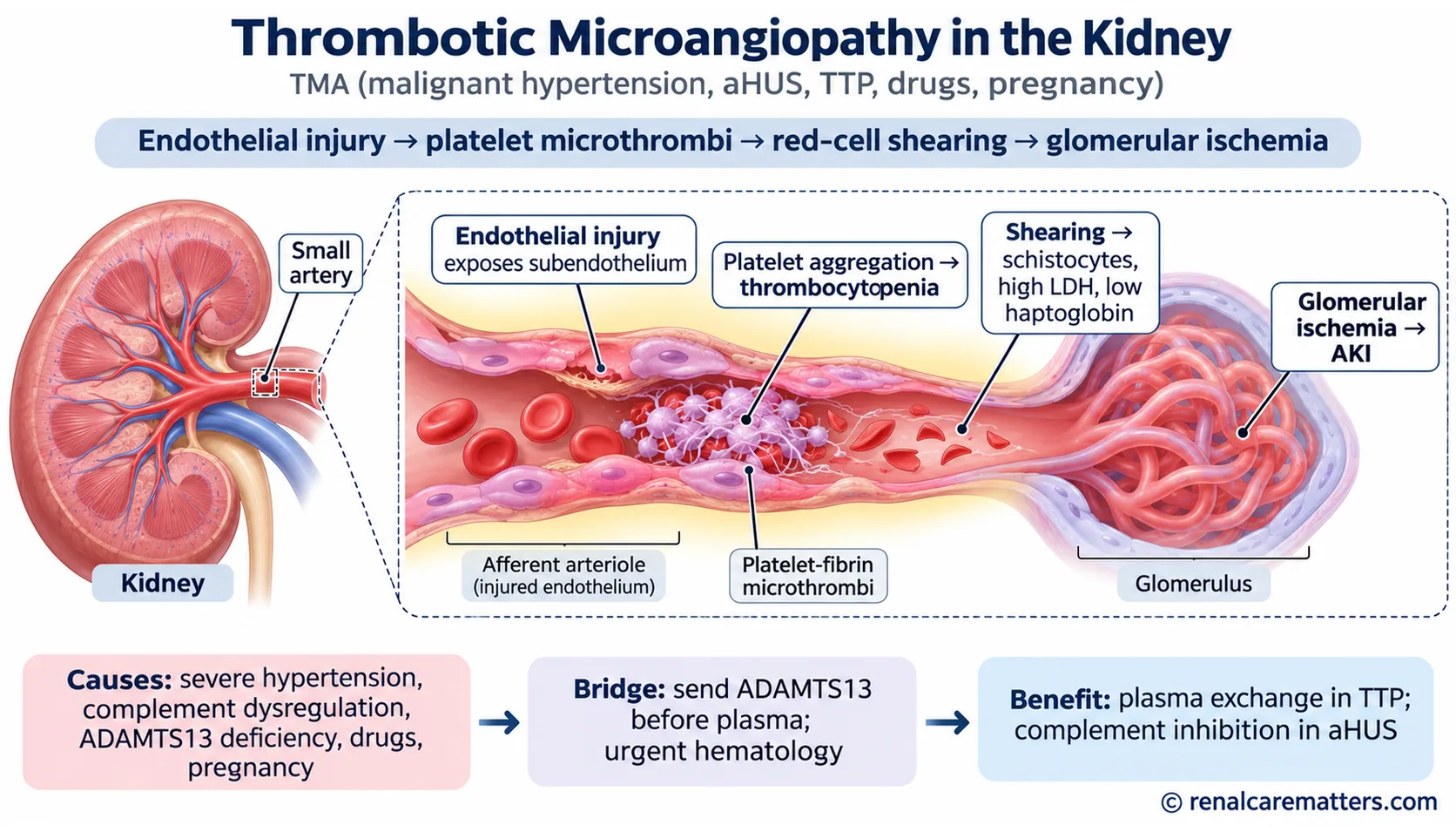
Interstitial inflammation, often drug-induced (proton pump inhibitors, nonsteroidal anti-inflammatory drugs (NSAIDs), beta-lactams), disrupts tubular transport. The result is sterile pyuria, white-cell casts, low-grade proteinuria and patterns such as non-gap acidosis or potassium wasting. In thrombotic microangiopathy (TMA), endothelial injury exposes subendothelium. Platelets aggregate in arterioles, red cells shear on fibrin strands (schistocytes), and glomeruli become ischemic. Causes include severe hypertension, complement dysregulation (atypical hemolytic uremic syndrome), ADAMTS13 deficiency (TTP), drugs and pregnancy. In ADPKD (autosomal dominant polycystic kidney disease), PKD1 or PKD2 mutations disturb ciliary calcium signaling; cyclic AMP driven by vasopressin promotes cyst growth. That is the rationale for tolvaptan, a vasopressin V2-receptor antagonist.
By phone, a blood film · fictional
Mrs. Rivera, admitted with a blood pressure of 230/130 mm Hg and acute kidney injury (AKI), is referred for urgent dialysis. Her platelets are 42,000/µL. The laboratory reports schistocytes.
You stop the plan for fresh frozen plasma that the ward has started. You ask for an ADAMTS13 sample first and call hematology. If this is thrombotic thrombocytopenic purpura, that sample makes the diagnosis, and plasma given first can blur it.
What this shows. Low platelets with broken red cells in AKI is a thrombotic microangiopathy until proven otherwise.
Figure 2. An injured kidney arteriole with tiny clots that shear red cells, explaining low platelets, anemia and kidney injury in TMA.
Lesson · part 2
What the evidence shows
KDIGO 2025 ADPKD recommends risk stratification with the Mayo imaging classification (height-adjusted total kidney volume) and suggests tolvaptan for adults at risk of rapid progression (typically Mayo classes 1C–1E) with appropriate liver monitoring. Steroids for drug-induced interstitial nephritis are supported by observational data, with conflicting results on whether early use helps recovery. Plasma exchange is life-saving in TTP, and complement inhibition has transformed outcomes in atypical hemolytic uremic syndrome, though eculizumab access in the Philippines is limited. Living-donor evaluation requires independent assessment, and imaging or genetic exclusion of ADPKD in at-risk relatives.
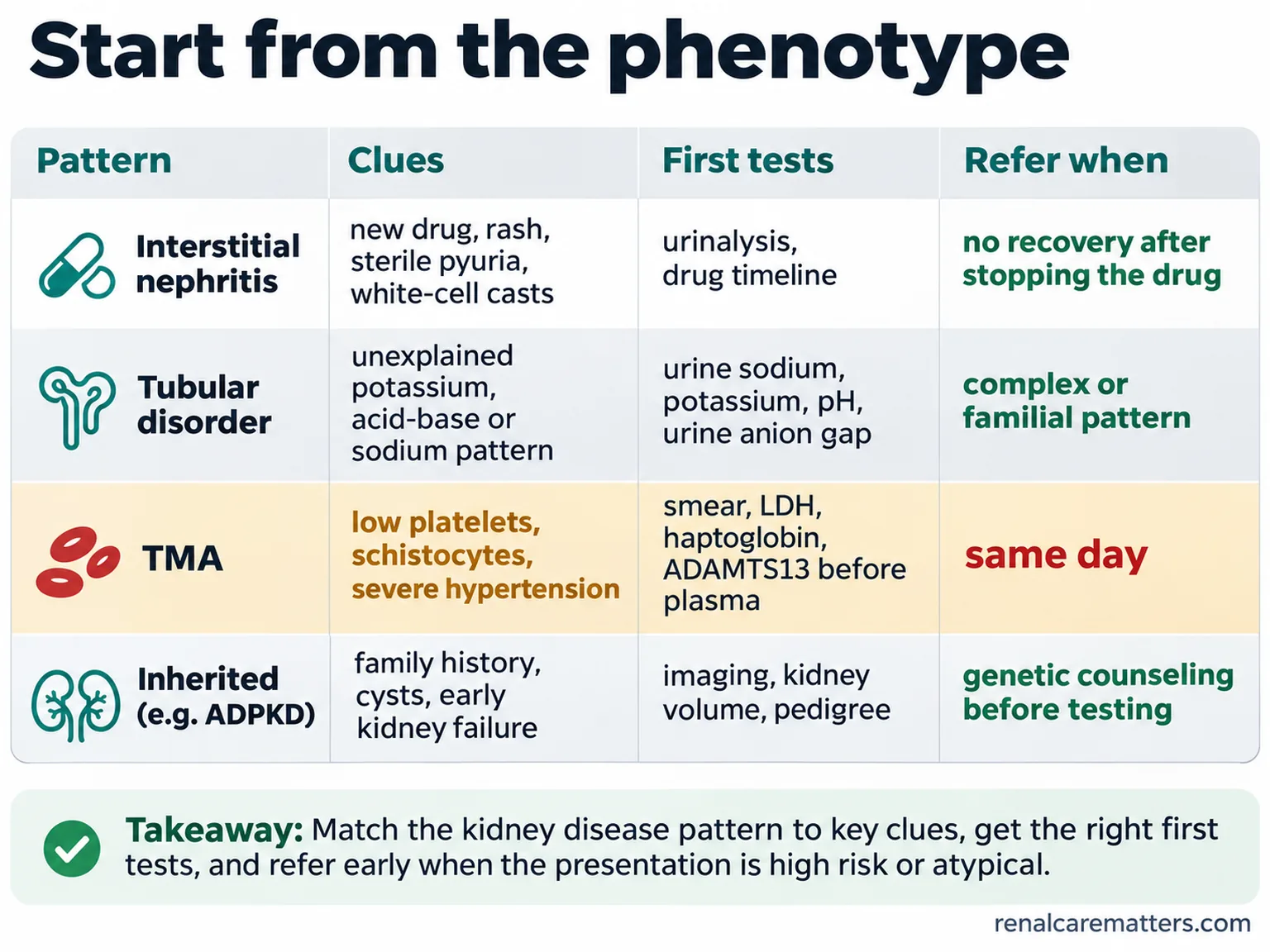
Work from phenotype: take the exposure history and timeline for interstitial nephritis, check urine sodium, potassium and pH for tubular disorders, and review the blood smear, lactate dehydrogenase (LDH), haptoglobin and platelets when TMA is possible. In severe hypertension with hemolysis or thrombocytopenia, check ADAMTS13 before any plasma product and refer urgently to hematology. In resistant hypertension, confirm adherence and screen for primary aldosteronism. For suspected inherited disease, draw a three-generation pedigree, refer for genetic counseling, and discuss implications for relatives and potential donors before testing.
Figure 3. Start from the phenotype. Reference table matching kidney disease patterns to clues, first tests and referral timing.
In the clinic, the pedigree · fictional
You draw Mr. Velasco’s family on the back of his chart: his mother on dialysis at 58, his grandfather “died of the kidneys,” two uncles with hypertension, and his sister and a cousin who want to donate.
In five minutes the drawing shows who should be offered counseling and who should not be evaluated as a donor until they are tested.
What this shows. A three-generation pedigree is the cheapest genetic test you have.
Stop and call
Thrombocytopenia with schistocytes and acute kidney injury (AKI)
Severe hypertension with retinal hemorrhage and rising creatinine
AKI with new rash and eosinophilia after a new drug
Hypokalemia with metabolic alkalosis and normal blood pressure (consider tubulopathy or diuretic use)
On the floor
Real situations: problems and solutions
These are fictional but typical. For each one, cover the answer, decide what you would do, then compare. Where a step depends on local rules, your unit’s procedure and your supervisor’s direction come first.
AKI and a rash after a new antibiotic
What you see
A patient develops AKI, fever, and a rash ten days after starting a beta-lactam antibiotic.
What is likely going on
This may be drug-induced interstitial nephritis.
What to do
Stop the drug, check the urine for white cells and casts, and consider a biopsy. Steroids are used, but the evidence is observational and conflicting.
Why it matters
Stopping the culprit is the step with the clearest benefit.
Low platelets and broken red cells
What you see
A patient with severe hypertension and AKI has low platelets and schistocytes on the blood film.
What is likely going on
This is thrombotic microangiopathy until proven otherwise.
What to do
Send ADAMTS13 before any plasma product and call hematology urgently.
Why it matters
Plasma exchange is life-saving in thrombotic thrombocytopenic purpura, and the sample taken before treatment makes the diagnosis.
Hypokalemia with normal blood pressure
What you see
A young woman has low potassium, metabolic alkalosis, and normal blood pressure.
What is likely going on
Consider a tubulopathy, or hidden diuretic or laxative use.
What to do
Check urine potassium and chloride, and ask about medicines and weight-loss products without judgment.
Why it matters
The urine electrolytes separate kidney loss from loss elsewhere.
Field notes
Draw a three-generation pedigree for every cystic kidney.
Offer genetic counseling before genetic testing.
Living donors from the same family need their own advocate.
Check the blood film when platelets are low.
Case review
Back to the case: The patient who wants his sister’s kidney
His diagnosis. Enlarged cystic kidneys, hypertension, and a dialysis history down the generations fit autosomal dominant polycystic kidney disease (ADPKD). Confirm it with imaging criteria and kidney volume, and offer genetic testing to him first. A known variant in the family makes testing his sister far more definitive.
His sister’s ultrasound. It is not enough. At 38, a normal ultrasound does not fully exclude the milder PKD2 form of the disease. If she carries the gene, giving away a kidney would put her own future at risk. She needs her own independent evaluation at the transplant center, with imaging and, where possible, genetic exclusion. That evaluation includes a donor advocate who is not your patient’s doctor.
Your role. Send the transplant team a clear summary of his cause, family history, trajectory, and serologies, and refer the family for genetic counseling before anyone is tested. Talk to Mr. Velasco without his sister in the room, and do not ask her questions on his behalf. Explain that a careful evaluation protects her, and that it is the fastest honest route to a transplant, from her or from someone else.
Skills lab · with your preceptor
Skills checklist: Skills checklist
Complete with a preceptor, in simulation or at your own unit. Sign-off is local. Your preceptor rates each step as satisfactory, needs practice, or not observed. Steps marked Critical must all be satisfactory before sign-off. This checklist supports supervised learning; your unit’s own procedure and competency form are the authority. A printable version of every checklist is on the trainer page.
Creates a focused phenotype summary
Names urgent referral scenarios
Documents a genetic counseling referral
Placement activity. Simulation or supervised practice
Self-assessment
Check your understanding
Each visit draws 5 questions at random from this module’s 5-question bank. Choose the single best answer for each, then select Check answers; an explanation appears under the best answer. Select New set of questions for a different mix. A good target is 4 of 5 on two different sets. Nothing you select is sent anywhere; scoring happens in your browser.
Kidney Disease: Improving Global Outcomes (KDIGO) ADPKD Work Group (2025). KDIGO 2025 clinical practice guideline for the evaluation, management, and treatment of autosomal dominant polycystic kidney disease (ADPKD). Kidney International, 107(2S), S1–S239. https://doi.org/10.1016/j.kint.2024.07.009
Kidney Disease: Improving Global Outcomes (KDIGO) CKD Work Group (2024). KDIGO 2024 clinical practice guideline for the evaluation and management of chronic kidney disease. Kidney International, 105(4S), S117–S314. https://doi.org/10.1016/j.kint.2023.10.018
Educational material for physicians. Completing it is an Academy learning record only. It does not confer CPD units, PSN certification, privileges, or PhilHealth accreditation, and it does not replace current guidelines, regulations, your institution’s protocols, or clinical judgment.