Classify chronic kidney disease (CKD) by cause, glomerular filtration rate (GFR) and albuminuria (CGA) and estimate kidney failure risk.
PublishedNailathalaGipatikPepalwal:ReferencesMga SanggunianMga TinubdanReng Reperensya:8Audience: Practicing nephrologists · senior nephrology fellows · internists who share longitudinal kidney care in the clinic, ward, ICU, dialysis unit, and homeRead timeOras ng pagbasaOras sa pagbasaOras ning pamamasa:
Training track for attending nephrologists in adult practice
This module is study material for attending nephrologists and senior fellows in adult practice. It explains the reasoning behind common decisions; it is not a protocol. Doses and thresholds must be checked against current product labels, guidelines, and your institution’s approved protocols. Regulatory and benefit rules change: confirm them on the date of service. Every case is fictional.
Learning objectives
After this module you should be able to
Classify chronic kidney disease (CKD) by cause, glomerular filtration rate (GFR) and albuminuria (CGA) and estimate kidney failure risk.
Build layered kidney and cardiovascular protection matched to evidence.
Plan monitoring that is feasible and affordable for the patient.
Pre-testBefore you read, answer the 5 self-assessment questions and note your score. After the module, select New set of questions and compare. The difference is what you learned; the questions you still miss are what to reread.
Start here
The big picture, in plain words
Your duty · Section 1.2, 2024 hemodialysis guidelinesUnder the Philippine Society of Nephrology (PSN) guidelines: Discuss and carry out long-term medical planning with the patient (b9). The pre-dialysis years are where that planning does the most good.
In plain wordsCKD progression is a slow leak driven by pressure: each surviving nephron works harder, and that overwork damages it. Modern therapy lowers the pressure inside the glomerulus and calms the inflammation around it, through several separate pathways that add together.
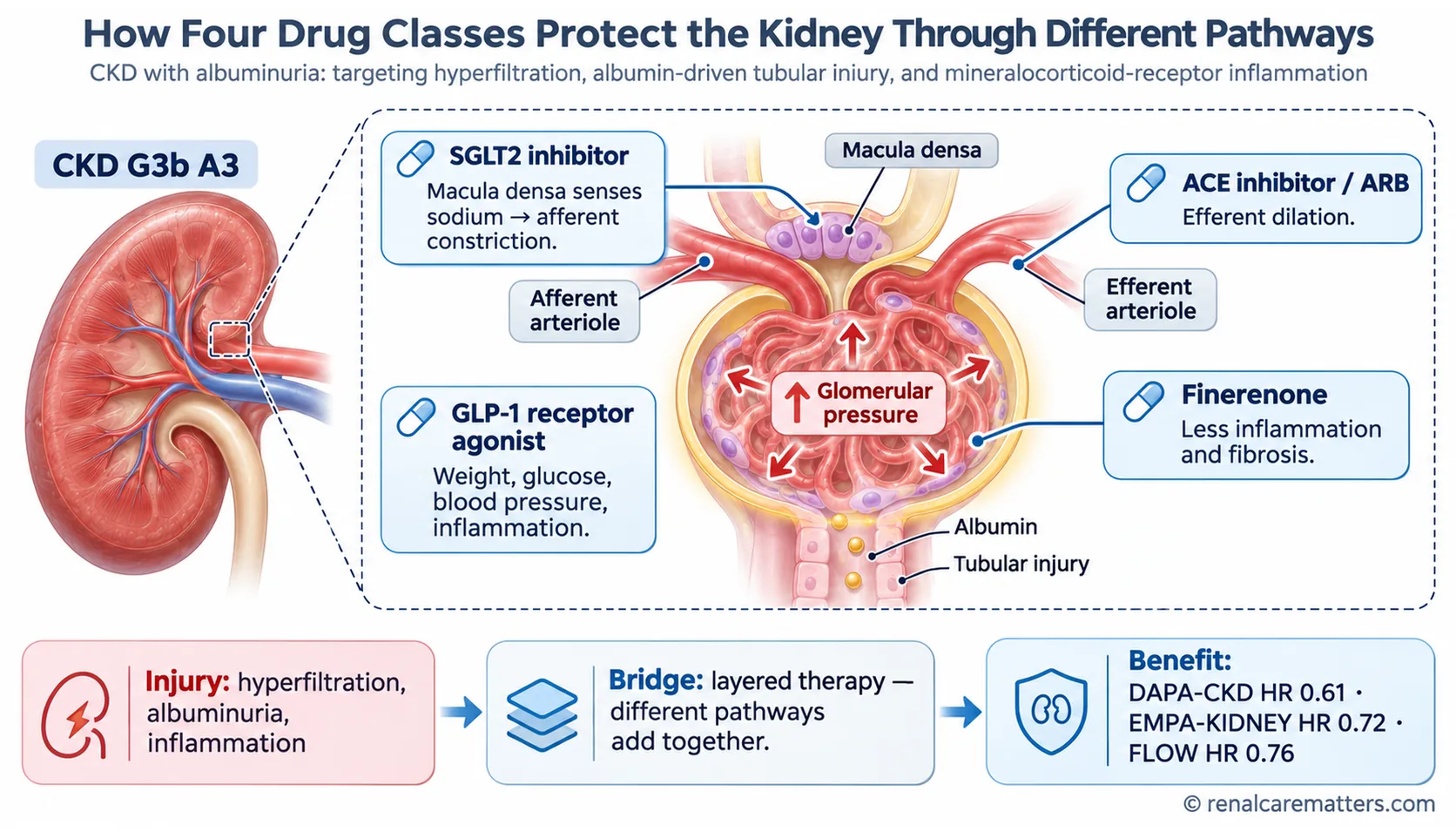
DAPA-CKD / EMPA-KIDNEYhazard ratio (HR) 0.61 / HR 0.72 for kidney progression
FLOW semaglutideMajor kidney events 18.7% vs 23.2%; HR 0.76
Opening case · fictional
Case: The patient who is not on your floor yet
Every Thursday afternoon you see pre-dialysis patients in your clinic, in a medical arts building near the hospital. Mrs. Aquino, 62, has type 2 diabetes. Her estimated glomerular filtration rate (eGFR) has been about 37 for a year, and her urine albumin-to-creatinine ratio is 850 mg/g on losartan 50 mg. Her potassium is 5.1 mmol/L and her blood pressure is 142/88 mm Hg.
Her cousin is on dialysis, and she asks, “Doctor, how long before I am in one of those chairs?” She tells you she can afford laboratory tests only every three months. Your clinic nurse whispers that the pharmacy across the street sells a generic sodium-glucose cotransporter 2 (SGLT2) inhibitor.
Before reading on, decide:
How would you answer her question with a number?
Which treatment would you add first, and why?
How do you fit a careful plan into one laboratory visit every three months?
Keep your answers in mind. The lesson gives you what you need, and the case review near the end shows one sound response.
Lesson · part 1
How it works
As nephrons are lost, the remaining ones hyperfilter. Angiotensin II constricts the efferent arteriole and raises glomerular capillary pressure, injuring podocytes and letting albumin leak. Albumin in the tubule is toxic: it triggers inflammation and fibrosis. sodium-glucose cotransporter 2 (SGLT2) inhibitors restore sodium delivery to the macula densa, which reactivates tubuloglomerular feedback and constricts the afferent arteriole. RAS (renin-angiotensin system) blockers dilate the efferent arteriole. Both lower glomerular pressure from opposite ends. Mineralocorticoid receptor overactivation drives inflammation and fibrosis that persist despite RAS blockade, which nonsteroidal antagonists such as finerenone target. GLP-1 (glucagon-like peptide-1) receptor agonists act through weight, glucose, blood pressure and likely direct anti-inflammatory effects. This is why the effects add up.
In the pre-dialysis clinic · fictional
Mr. Dela Paz, 58, asks why you are adding a “diabetes tablet” when his sugar is controlled. You draw two pipes into a small balloon on a sheet of paper.
“The pipe coming in is the afferent arteriole. Empagliflozin narrows it. The pipe going out is the efferent arteriole. Your losartan widens it. Both lower the pressure in the balloon, which is the glomerulus. Less pressure means less damage to the filters you still have.”
What this shows. Protective drugs make sense once the patient sees that they work on pressure, not on sugar.
Figure 2. A glomerulus showing where each kidney-protecting drug class acts, with the main trial results below.
Lesson · part 2
What the evidence shows
KDIGO 2024 recommends SGLT2 inhibitors for adults with CKD and type 2 diabetes with eGFR ≥20 (1A), and for CKD with urine albumin-to-creatinine ratio (UACR) ≥200 mg/g or heart failure regardless of diabetes. DAPA-CKD (hazard ratio 0.61) and EMPA-KIDNEY (hazard ratio 0.72) showed reductions in kidney progression. Finerenone is suggested in type 2 diabetes with eGFR ≥25, normal potassium and albuminuria ≥30 mg/g despite maximum tolerated RAS inhibition. FLOW (N Engl J Med 2024; 3,533 patients with type 2 diabetes and CKD) showed semaglutide reduced major kidney events by 24% (18.7% vs 23.2%; hazard ratio 0.76). CONFIDENCE (N Engl J Med 2025) found that starting finerenone and empagliflozin together lowered UACR by 52%, more than either alone. That is a surrogate endpoint; hard-outcome data for the combination are pending. The Kidney Failure Risk Equation (KFRE) is validated across more than 30 countries; Southeast Asian calibration data are limited.
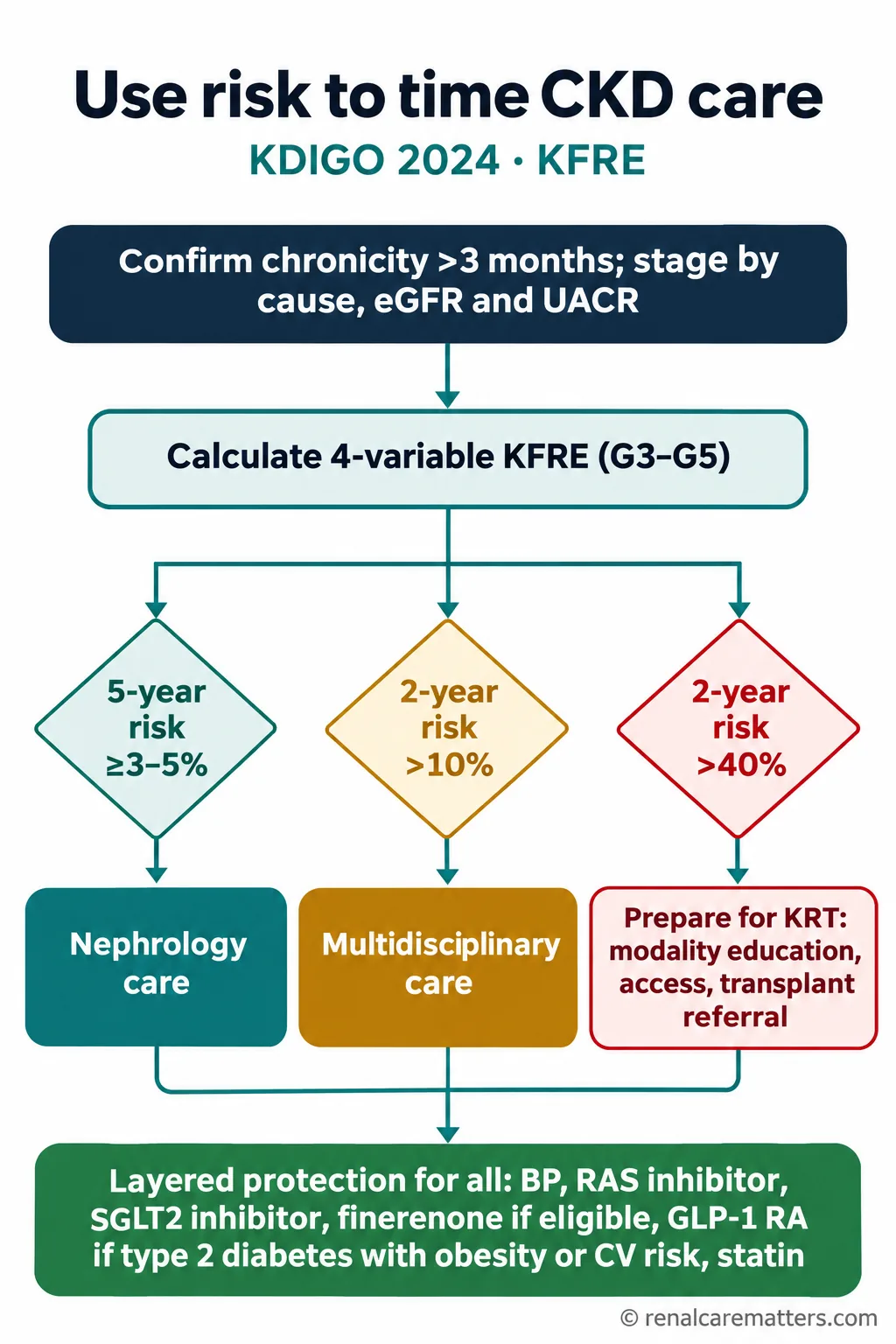
Confirm chronicity (more than 3 months) and stage by cause, eGFR (CKD-EPI 2021, adding cystatin C when creatinine misleads) and UACR. Calculate the 4-variable KFRE in G3–G5 and use it to time referral and preparation. Build the plan in layers: blood pressure (systolic <120 mmHg when tolerated, per KDIGO 2021), RAS inhibitor at maximum tolerated dose for albuminuria, SGLT2 inhibitor, finerenone where eligible, GLP-1 receptor agonist in type 2 diabetes with obesity or cardiovascular risk, and statin. Add smoking cessation, vaccination and a dietitian referral. In the Philippines, choose generics where possible, schedule potassium and creatinine checks 2–4 weeks after each RAS or finerenone change, and agree a lab plan the patient can afford.
Figure 3. Use risk to time CKD care. Flowchart using the kidney failure risk score to decide referral, team care and preparation for dialysis or transplant.
In the clinic, the same patient a month later · fictional
Mr. Dela Paz returns worried. His creatinine rose from 2.0 to 2.3 mg/dL after empagliflozin. His family wants him to stop it.
You explain that a rise of up to about 30% is expected, because the drug lowers pressure inside the filters. You keep the drug and check again in four weeks.
What this shows. An expected change is not a side effect. Stopping protection because of it takes away the benefit.
Stop and call
eGFR decline >5 mL/min/1.73 m² per year
UACR rising despite therapy
Potassium >5.5 mmol/L after starting RAS inhibitor or finerenone
eGFR fall >30% after starting RAS blockade (look for renovascular disease or volume depletion)
On the floor
Real situations: problems and solutions
These are fictional but typical. For each one, cover the answer, decide what you would do, then compare. Where a step depends on local rules, your unit’s procedure and your supervisor’s direction come first.
The creatinine rise after starting an SGLT2 inhibitor
What you see
Two weeks after starting empagliflozin, a pre-dialysis patient’s creatinine rises 15%. Her family wants to stop it.
What is likely going on
The drug lowers pressure inside the glomerulus, and an early dip in eGFR is expected.
What to do
Explain the reason and continue. Investigate only if the rise exceeds about 30% or she is dehydrated.
Why it matters
Stopping a protective drug because of an expected change takes away its benefit.
The patient who cannot afford four drugs
What you see
A patient can afford only one new medicine.
What is likely going on
Every layer of protection helps, but some give more per peso.
What to do
Choose the drug with the strongest evidence for his situation, often a generic SGLT2 inhibitor or a RAS blocker at full dose, and revisit as his finances allow.
Why it matters
A plan the patient cannot afford protects no one.
Potassium 5.8 after finerenone
What you see
Three weeks after finerenone was added, potassium is 5.8 mmol/L.
Hold finerenone, review diet and other drugs, and recheck. Consider restarting when potassium is below 5.0.
Why it matters
Planned checks after every change catch this early.
Field notes
Share the KFRE number with the patient.
Change one drug at a time and check potassium two to four weeks later.
Choose generics where possible.
Start the access plan by the time the 2-year KFRE passes 40%.
Case review
Back to the case: The patient who is not on your floor yet
Her question. She is CKD G3b A3, a very high-risk group. Calculate her Kidney Failure Risk Equation (KFRE) result and share it as a number she can understand: her chance of needing dialysis or a transplant within two and five years. A number she can see is the strongest reason she has to stay on treatment, and it tells you when to start preparing.
What first. Add an SGLT2 inhibitor now. They lower the pressure inside each glomerulus from the afferent side, which is why they protect the nephrons that are still working. In DAPA-CKD and EMPA-KIDNEY, kidney progression fell by a relative 39% and 28% (hazard ratios 0.61 and 0.72). Her absolute benefit will be larger than average, because her albuminuria puts her at high baseline risk. They also lower potassium a little. The generic is a good choice if it is affordable. Increase losartan if her blood pressure allows. Add finerenone once potassium is below 5.0 mmol/L. If she is overweight or her glucose is not controlled, a GLP-1 receptor agonist is worth discussing. In FLOW, semaglutide reduced major kidney events from 23.2% to 18.7%.
Fitting it to her budget. Change one thing at a time, and time each change so the next routine check is two to four weeks later, or arrange one extra potassium test after finerenone starts. Write the plan in a letter to her primary care doctor. The goal of this clinic is that she reaches your floor as late as possible, and with a fistula and a transplant referral if she does.
Skills lab · with your preceptor
Skills checklist: Skills checklist
Complete with a preceptor, in simulation or at your own unit. Sign-off is local. Your preceptor rates each step as satisfactory, needs practice, or not observed. Steps marked Critical must all be satisfactory before sign-off. This checklist supports supervised learning; your unit’s own procedure and competency form are the authority. A printable version of every checklist is on the trainer page.
Documents CGA classification and KFRE
Reviews eligibility for each pillar with reasons
Assigns affordable follow-up monitoring
Placement activity. Simulation or supervised practice
Self-assessment
Check your understanding
Each visit draws 5 questions at random from this module’s 5-question bank. Choose the single best answer for each, then select Check answers; an explanation appears under the best answer. Select New set of questions for a different mix. A good target is 4 of 5 on two different sets. Nothing you select is sent anywhere; scoring happens in your browser.
Kidney Disease: Improving Global Outcomes (KDIGO) CKD Work Group (2024). KDIGO 2024 clinical practice guideline for the evaluation and management of chronic kidney disease. Kidney International, 105(4S), S117–S314. https://doi.org/10.1016/j.kint.2023.10.018
Tangri, N., Grams, M. E., Levey, A. S., Coresh, J., Appel, L. J., Astor, B. C., Chodick, G., Collins, A. J., Djurdjev, O., Elley, C. R., Evans, M., Garg, A. X., Hallan, S. I., Inker, L. A., Ito, S., Jee, S. H., Kovesdy, C. P., Kronenberg, F., Heerspink, H. J., ... CKD Prognosis Consortium (2016). Multinational assessment of accuracy of equations for predicting risk of kidney failure: A meta-analysis. JAMA, 315(2), 164–174. https://doi.org/10.1001/jama.2015.18202
Inker, L. A., Eneanya, N. D., Coresh, J., Tighiouart, H., Wang, D., Sang, Y., Crews, D. C., Doria, A., Estrella, M. M., Froissart, M., Grams, M. E., Greene, T., Grubb, A., Gudnason, V., Gutiérrez, O. M., Kalil, R., Karger, A. B., Mauer, M., Navis, G., ... Chronic Kidney Disease Epidemiology Collaboration (2021). New creatinine- and cystatin C-based equations to estimate GFR without race. The New England Journal of Medicine, 385(19), 1737–1749. https://doi.org/10.1056/NEJMoa2102953
Heerspink, H. J. L., Stefánsson, B. V., Correa-Rotter, R., Chertow, G. M., Greene, T., Hou, F. F., Mann, J. F. E., McMurray, J. J. V., Lindberg, M., Rossing, P., Sjöström, C. D., Toto, R. D., Langkilde, A. M., Wheeler, D. C., & DAPA-CKD Trial Committees and Investigators (2020). Dapagliflozin in patients with chronic kidney disease. The New England Journal of Medicine, 383(15), 1436–1446. https://doi.org/10.1056/NEJMoa2024816
The EMPA-KIDNEY Collaborative Group, Herrington, W. G., Staplin, N., Wanner, C., Green, J. B., Hauske, S. J., Emberson, J. R., Preiss, D., Judge, P., Mayne, K. J., Ng, S. Y. A., Sammons, E., Zhu, D., Hill, M., Stevens, W., Wallendszus, K., Brenner, S., Cheung, A. K., Liu, Z. H., ... Haynes, R. (2023). Empagliflozin in patients with chronic kidney disease. The New England Journal of Medicine, 388(2), 117–127. https://doi.org/10.1056/NEJMoa2204233
Perkovic, V., Tuttle, K. R., Rossing, P., Mahaffey, K. W., Mann, J. F. E., Bakris, G., Baeres, F. M. M., Idorn, T., Bosch-Traberg, H., Lausvig, N. L., Pratley, R., & FLOW Trial Committees and Investigators (2024). Effects of semaglutide on chronic kidney disease in patients with type 2 diabetes. The New England Journal of Medicine, 391(2), 109–121. https://doi.org/10.1056/NEJMoa2403347
Agarwal, R., Green, J. B., Heerspink, H. J. L., Mann, J. F. E., McGill, J. B., Mottl, A. K., Rosenstock, J., Rossing, P., Vaduganathan, M., Brinker, M., Edfors, R., Li, N., Scheerer, M. F., Scott, C., Nangaku, M., & CONFIDENCE Investigators (2025). Finerenone with empagliflozin in chronic kidney disease and type 2 diabetes. The New England Journal of Medicine, 393(6), 533–543. https://doi.org/10.1056/NEJMoa2410659
Educational material for physicians. Completing it is an Academy learning record only. It does not confer CPD units, PSN certification, privileges, or PhilHealth accreditation, and it does not replace current guidelines, regulations, your institution’s protocols, or clinical judgment.