Audit prescribed versus delivered effluent dose and fluid balance.
PublishedNailathalaGipatikPepalwal:ReferencesMga SanggunianMga TinubdanReng Reperensya:6Audience: Practicing nephrologists · senior nephrology fellows · internists who share longitudinal kidney care in the clinic, ward, ICU, dialysis unit, and homeRead timeOras ng pagbasaOras sa pagbasaOras ning pamamasa:
Training track for attending nephrologists in adult practice
This module is study material for attending nephrologists and senior fellows in adult practice. It explains the reasoning behind common decisions; it is not a protocol. Doses and thresholds must be checked against current product labels, guidelines, and your institution’s approved protocols. Regulatory and benefit rules change: confirm them on the date of service. Every case is fictional.
Learning objectives
After this module you should be able to
Audit prescribed versus delivered effluent dose and fluid balance.
Adjust drug dosing and anticoagulation to delivered therapy.
Identify when toxicology, apheresis or a stopping trial is appropriate.
Pre-testBefore you read, answer the 5 self-assessment questions and note your score. After the module, select New set of questions and compare. The difference is what you learned; the questions you still miss are what to reread.
Start here
The big picture, in plain words
Your duty · Section 1.2, 2024 hemodialysis guidelinesUnder the Philippine Society of Nephrology (PSN) guidelines: Provide the dialysis prescription (b4) and stay in active management with the team that delivers it (b7).
In plain wordsA continuous kidney replacement therapy (CRRT) prescription is a plan for 24 hours of work. Clotted filters, imaging trips and bag changes quietly steal hours, so the patient often receives far less than the order says. The attending’s job is to measure what was delivered.
Figure 1 · Key numbers
Delivered effluent dose (Kidney Disease: Improving Global Outcomes (KDIGO) 2012)20–25 mL/kg/h; prescribe about 25–30
Filtration fraction ceiling≲20–25%
Citrate accumulation signalTotal-to-ionized calcium ratio >2.5
RENAL and ATN higher-intensity armsNo survival benefit
Regional citrate versus heparin trial (RICH) median filter life47 h citrate vs 26 h heparin
Opening case · fictional
Case: The filter that keeps clotting
Your unit staffs the continuous kidney replacement therapy service at a partner hospital’s intensive care unit (ICU). On your morning round, the nurse shows you the flowsheet for Mr. Lim, 70 kg, who is on continuous venovenous hemodiafiltration for acute kidney injury (AKI) after cardiac surgery.
The prescription is 2,100 mL/hour of effluent. In the last 24 hours the filter clotted three times, and with priming and a trip to Computed tomography (CT) scan he received only 12 hours of treatment. He is on systemic heparin at a low dose because of a bleeding drain. His meropenem was dosed by the ICU pharmacist “for full-time CRRT.” The nurse asks, “Doctor, should we just increase the effluent to make up for it?”
Before reading on, decide:
How much treatment did he actually receive?
Should you raise the dose to make up for lost hours?
What happens to his antibiotic when the machine stops and starts?
Keep your answers in mind. The lesson gives you what you need, and the case review near the end shows one sound response.
Lesson · part 1
How it works
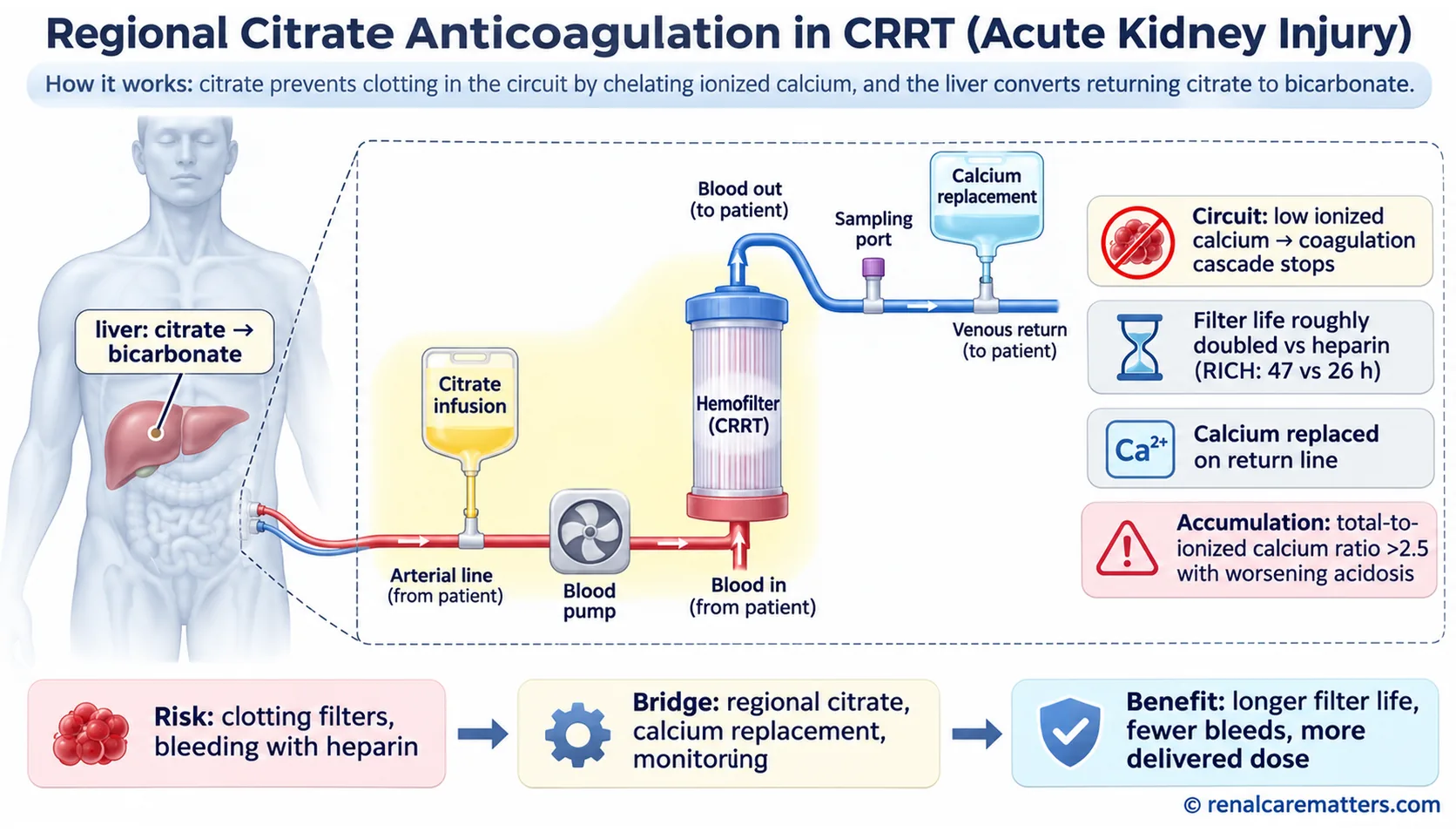
Small-solute clearance in CRRT is close to the effluent flow rate, so dose is expressed as effluent volume per kilogram per hour. Downtime cuts delivered dose in proportion. Pre-dilution replacement dilutes blood before the filter, which extends filter life but lowers clearance in proportion to the dilution fraction. Filtration fraction (ultrafiltration rate divided by plasma flow) above about 20–25% hemoconcentrates blood in the filter and promotes clotting. Regional citrate chelates ionized calcium in the circuit to stop the coagulation cascade; the liver metabolizes returning citrate to bicarbonate. When the liver cannot do this, total calcium rises while ionized calcium falls. A total-to-ionized calcium ratio above about 2.5 signals citrate accumulation.
At the CRRT machine · fictional
The night nurse shows you a filter that clotted after 7 hours. The filtration fraction on the screen is 31%.
You explain that too much plasma water is being pulled from too little blood flow, so the blood inside the filter thickens and clots. You raise the blood flow, move part of the replacement fluid before the filter, and review the anticoagulation.
What this shows. Filter life is a dose problem. Every clotted filter is lost treatment time.
Figure 2. How citrate stops clotting inside the dialysis circuit and is turned into bicarbonate by the liver, and the sign that it is building up.
Lesson · part 2
What the evidence shows
KDIGO 2012 recommends a delivered effluent volume of 20–25 mL/kg/h for CRRT (graded recommendation), which in practice requires prescribing about 25–30 to absorb downtime. The RENAL (2009) and VA/NIH ATN (2008) trials found no survival benefit from higher intensity. KDIGO suggests regional citrate rather than heparin for CRRT anticoagulation in patients without contraindications; the RICH trial (JAMA 2020) found a median filter life of 47 versus 26 hours with citrate and fewer bleeding complications, without a mortality difference. EXTRIP publishes toxin-specific recommendations for extracorporeal removal (for example lithium, salicylates, metformin-associated lactic acidosis and toxic alcohols).
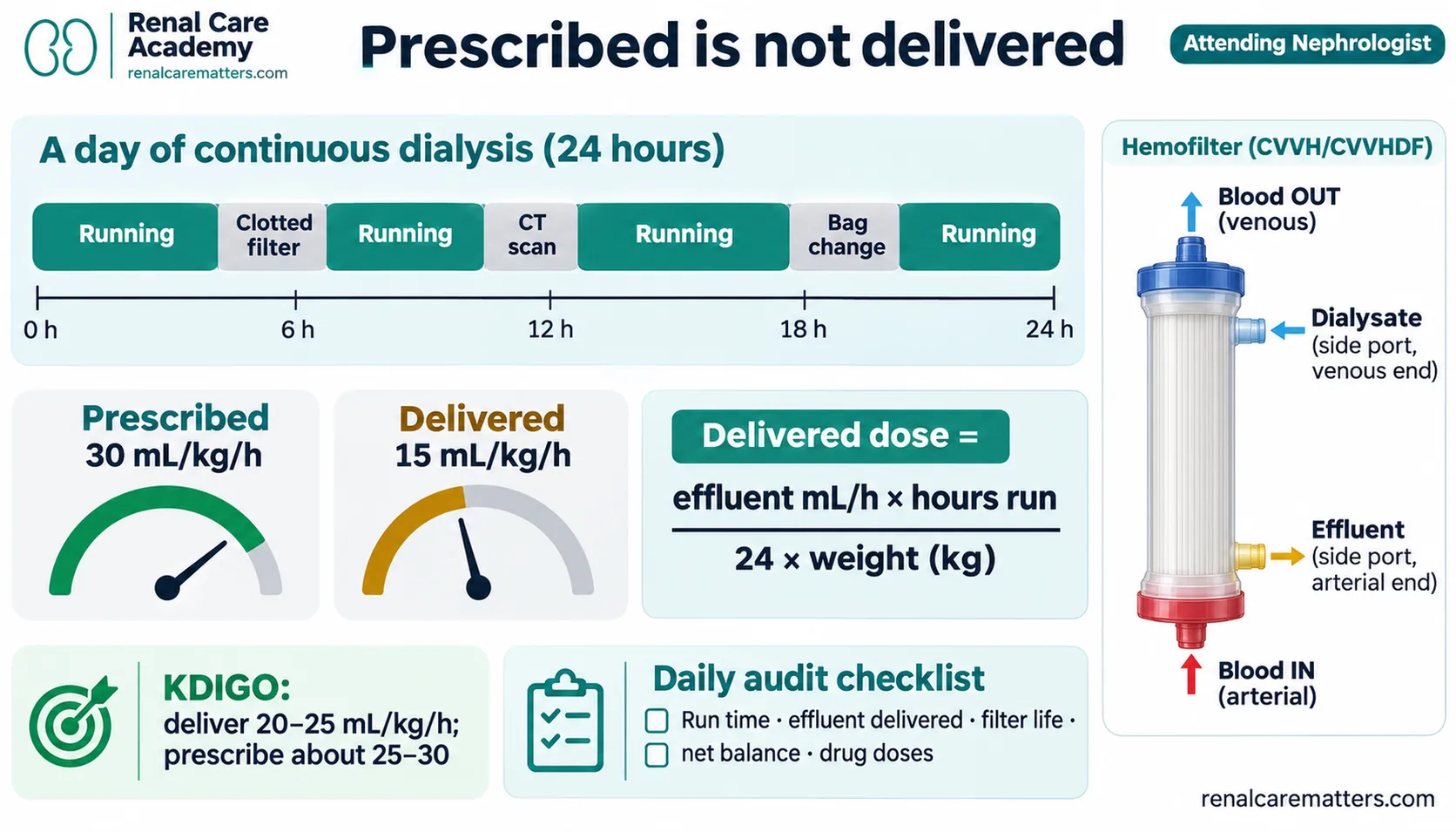
Every morning, record actual run time, effluent delivered (mL/kg/h), filter life, net fluid removed versus target, and the cause of each interruption. If the delivered dose falls below 20 mL/kg/h, fix access position, anticoagulation and filtration fraction before raising the prescription. Ask pharmacy to re-dose antibiotics to delivered clearance; underdosing beta-lactams and vancomycin is the more common error. Consult toxicology early for poisonings and refer suspected thrombotic thrombocytopenic purpura (TTP) to hematology for plasma exchange. Try stopping when urine output recovers and the indication has resolved, and plan a defined observation period with chemistry and fluid checks.
Figure 3. A day of continuous dialysis with interruptions, showing how downtime halves the delivered dose and how to audit it.
On the morning round · fictional
You write four numbers on Mr. Lim’s chart each morning: hours run, delivered effluent in mL/kg/hour, filter life, and net fluid removed against the target. On day three the delivered dose reaches 23 mL/kg/hour after citrate is started.
You also ask the pharmacist to re-dose meropenem to the clearance he is now receiving.
What this shows. What gets written down every morning gets fixed.
Stop and call
Filter life repeatedly under 12 hours
Rising total-to-ionized calcium ratio with worsening acidosis
Antibiotic doses based on an assumed, not delivered, dose
Thrombocytopenia with hemolysis on CRRT (consider TTP or heparin-induced thrombocytopenia)
On the floor
Real situations: problems and solutions
These are fictional but typical. For each one, cover the answer, decide what you would do, then compare. Where a step depends on local rules, your unit’s procedure and your supervisor’s direction come first.
The filter changed every eight hours
What you see
The ICU nurse reports four filter changes in two days.
What is likely going on
Clotting is cutting the delivered dose and wasting circuits.
What to do
Check catheter flow, filtration fraction, and anticoagulation, and consider regional citrate if there is no contraindication.
Why it matters
Delivered dose, not prescribed dose, is what the patient receives.
Rising total calcium on citrate
What you see
A patient on citrate has a rising total calcium, a falling ionized calcium, and worsening acidosis.
What is likely going on
Citrate is accumulating because the liver is not clearing it.
What to do
Check the total-to-ionized calcium ratio; above about 2.5 signals accumulation. Reduce or stop citrate and change anticoagulation.
Why it matters
Citrate is safe only when the liver can turn it into bicarbonate.
Stopping too fast
What you see
A patient’s urine output reaches 600 mL/day, and the team stops CRRT without a plan.
What is likely going on
Recovery may be starting, but it is not yet proven.
What to do
Agree on an observation period with fluid balance, chemistry checks, and clear triggers for restarting.
Why it matters
A planned trial off therapy is safer than an unplanned restart at night.
Field notes
Divide the effluent by the weight every morning.
Ask pharmacy to dose drugs to delivered clearance.
Record why each interruption happened.
Prescribe about 25 to 30 mL/kg/hour to deliver 20 to 25.
Case review
Back to the case: The filter that keeps clotting
The arithmetic. The prescribed dose is 2,100 ÷ 70 = 30 mL/kg/hour. Delivered over 24 hours, it is about 15 mL/kg/hour, half the target and below the 20 to 25 mL/kg/hour that trials support.
Raise the dose? Not first. Fix the delivery. Check the catheter position and flows, review the filtration fraction (above about 20 to 25%, blood thickens in the filter and clots), and review the anticoagulation. With a bleeding risk and repeated clotting, regional citrate is the better choice if he has no contraindication. Citrate needs a liver that can clear it, so check his liver function and watch the total-to-ionized calcium ratio. In the RICH trial, filters lasted a median 47 hours on citrate compared with 26 on heparin, with fewer bleeds. Then reassess whether the prescribed dose still covers the downtime you expect.
The antibiotic. Meropenem dosed for continuous treatment is too much while the machine is off and may be too little when it runs again. Ask the pharmacist to dose it to the clearance he is actually getting. Under-dosing in sepsis is the more common error.
Every morning. Record run time, delivered dose, filter life, net fluid removed against the target, and the reason for each interruption. Write the trigger that would make you switch to intermittent therapy or try a period off the machine.
Skills lab · with your preceptor
Skills checklist: Skills checklist
Complete with a preceptor, in simulation or at your own unit. Sign-off is local. Your preceptor rates each step as satisfactory, needs practice, or not observed. Steps marked Critical must all be satisfactory before sign-off. This checklist supports supervised learning; your unit’s own procedure and competency form are the authority. A printable version of every checklist is on the trainer page.
Calculates delivered treatment time and dose
Reviews downtime causes with the intensive care unit (ICU) team
Confirms a medication review
States stopping criteria
Placement activity. Simulation or supervised practice
Self-assessment
Check your understanding
Each visit draws 5 questions at random from this module’s 5-question bank. Choose the single best answer for each, then select Check answers; an explanation appears under the best answer. Select New set of questions for a different mix. A good target is 4 of 5 on two different sets. Nothing you select is sent anywhere; scoring happens in your browser.
Kidney Disease: Improving Global Outcomes (KDIGO) Acute Kidney Injury Work Group. (2012). KDIGO clinical practice guideline for acute kidney injury. Kidney International Supplements, 2(1), 1–138. https://doi.org/10.1038/kisup.2012.1
VA/NIH Acute Renal Failure Trial Network, Palevsky, P. M., Zhang, J. H., O'Connor, T. Z., Chertow, G. M., Crowley, S. T., Choudhury, D., Finkel, K., Kellum, J. A., Paganini, E., Schein, R. M., Smith, M. W., Swanson, K. M., Thompson, B. T., Vijayan, A., Watnick, S., Star, R. A., & Peduzzi, P. (2008). Intensity of renal support in critically ill patients with acute kidney injury. The New England Journal of Medicine, 359(1), 7–20. https://doi.org/10.1056/NEJMoa0802639
RENAL Replacement Therapy Study Investigators, Bellomo, R., Cass, A., Cole, L., Finfer, S., Gallagher, M., Lo, S., McArthur, C., McGuinness, S., Myburgh, J., Norton, R., Scheinkestel, C., & Su, S. (2009). Intensity of continuous renal-replacement therapy in critically ill patients. The New England Journal of Medicine, 361(17), 1627–1638. https://doi.org/10.1056/NEJMoa0902413
Zarbock, A., Küllmar, M., Kindgen-Milles, D., Wempe, C., Gerss, J., Brandenburger, T., Dimski, T., Tyczynski, B., Jahn, M., Mülling, N., Mehrländer, M., Rosenberger, P., Marx, G., Simon, T. P., Jaschinski, U., Deetjen, P., Putensen, C., Schewe, J. C., Kluge, S., ... RICH Investigators and the Sepnet Trial Group (2020). Effect of regional citrate anticoagulation vs systemic heparin anticoagulation during continuous kidney replacement therapy on dialysis filter life span and mortality among critically ill patients with acute kidney injury: A randomized clinical trial. JAMA, 324(16), 1629–1639. https://doi.org/10.1001/jama.2020.18618
Educational material for physicians. Completing it is an Academy learning record only. It does not confer CPD units, PSN certification, privileges, or PhilHealth accreditation, and it does not replace current guidelines, regulations, your institution’s protocols, or clinical judgment.