Start acute kidney replacement therapy (KRT) for indications and trajectory, not for a creatinine number.
PublishedNailathalaGipatikPepalwal:ReferencesMga SanggunianMga TinubdanReng Reperensya:5Audience: Practicing nephrologists · senior nephrology fellows · internists who share longitudinal kidney care in the clinic, ward, ICU, dialysis unit, and homeRead timeOras ng pagbasaOras sa pagbasaOras ning pamamasa:
Training track for attending nephrologists in adult practice
This module is study material for attending nephrologists and senior fellows in adult practice. It explains the reasoning behind common decisions; it is not a protocol. Doses and thresholds must be checked against current product labels, guidelines, and your institution’s approved protocols. Regulatory and benefit rules change: confirm them on the date of service. Every case is fictional.
Learning objectives
After this module you should be able to
Start acute kidney replacement therapy (KRT) for indications and trajectory, not for a creatinine number.
Match modality to hemodynamics, brain risk, local capability and transfer feasibility.
Write a plan that includes daily recovery review and stopping criteria.
Pre-testBefore you read, answer the 5 self-assessment questions and note your score. After the module, select New set of questions and compare. The difference is what you learned; the questions you still miss are what to reread.
Start here
The big picture, in plain words
Your duty · Section 1.2, 2024 hemodialysis guidelinesUnder the Philippine Society of Nephrology (PSN) guidelines: Coordinate during emergencies (b8), and endorse by letter or call when your patient is under another nephrologist’s care in hospital (b12).
In plain wordsDialysis in the intensive care unit (ICU) is life support for a failing organ, like a ventilator for the lungs. It earns its risks when the kidney can no longer keep the internal environment survivable, not simply because a lab value crossed a line.
Figure 1 · Key numbers
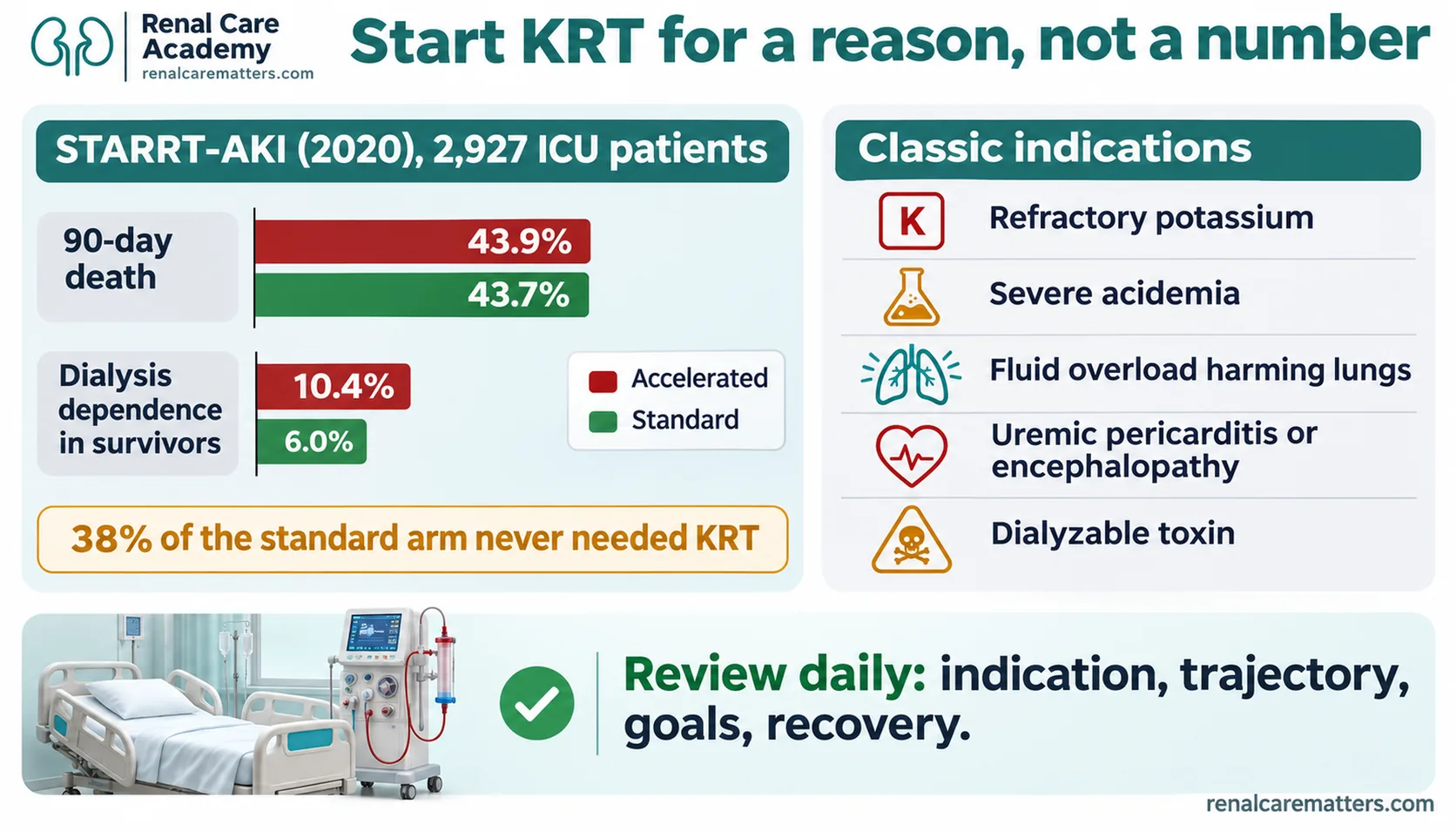
Standard versus Accelerated Initiation of Renal Replacement Therapy in Acute Kidney Injury trial (STARRT-AKI) 90-day mortality43.9% accelerated vs 43.7% standard
Standard-arm patients never dialyzedAbout 38%
Dialysis dependence at 90 days among survivors10.4% accelerated vs 6.0% standard (RR 1.74)
Spontaneous urine output suggesting recovery>400–500 mL/day without diuretics (common practice threshold; not trial-defined)
Opening case · fictional
Case: The ICU wants your machine
A hospital 20 minutes from your unit asks for help. Mrs. Bautista, 66, has septic shock from a gallbladder infection. She is on norepinephrine and high-flow oxygen. Her fluid balance is now 9 liters positive, and her oxygen requirement keeps rising despite high-dose furosemide. The hospital has no continuous kidney replacement therapy; the nearest center that does is 90 minutes away by ambulance.
The intensivist asks whether your unit’s nurses can bring a hemodialysis machine to the ICU and “pull off the fluid.” Your biomedical technician says one portable machine and a reverse-osmosis unit are free tonight. Your head nurse warns that her two nurses have never done a session in an ICU.
Before reading on, decide:
Is there an indication, or is this a number?
Should she be moved for continuous therapy, or treated where she is?
What must be agreed before your nurses connect her?
Keep your answers in mind. The lesson gives you what you need, and the case review near the end shows one sound response.
Lesson · part 1
How it works
The classic indications describe loss of homeostasis the body cannot buy back: potassium the cells can no longer buffer, acidemia that depresses myocardial contractility and blunts the vasopressor response, fluid accumulation that floods the lungs, uremic toxins that inflame the pericardium and brain, and dialyzable poisons. Timing is a trade between removing these threats earlier and exposing patients who would have recovered to catheter infection, hypotension, nutrient and drug loss and delayed recovery. Intermittent hemodialysis (HD) removes solute and fluid fast, which can drop blood pressure and, by rapidly lowering plasma osmolality, drive water into an injured brain. Continuous therapy spreads the same work over 24 hours, trading efficiency for hemodynamic and osmotic stability.
On the ICU round · fictional
The intensivist points at Mr. Ramos’s creatinine: 5.2 mg/dL. “Should we start?” You look at the rest: potassium 4.6, bicarbonate 20, oxygen improving, urine output 700 mL yesterday and rising.
No homeostasis has been lost that the body cannot buy back. You write: “No indication today. Start if potassium exceeds 6.0 despite treatment, pH falls below 7.15, or oxygen requirement rises with a positive fluid balance. Review tomorrow.”
What this shows. Dialysis earns its risks when it replaces something the kidney can no longer do, not when a number crosses a line.
Lesson · part 2
What the evidence shows
STARRT-AKI (N Engl J Med 2020; 2,927 patients) found no difference in 90-day mortality between accelerated and standard initiation (43.9% vs 43.7%; relative risk 1.00). In the standard arm, 38% never needed KRT, and accelerated initiation was associated with more dialysis dependence among survivors at 90 days (10.4% vs 6.0%) and more adverse events (23.0% vs 16.5%). AKIKI 2 (2021) suggested that delaying well beyond conventional criteria may be harmful, so ’watchful waiting’ still needs a ceiling. Randomized trials have not shown a mortality difference between continuous renal replacement therapy (CRRT) and intermittent HD. Kidney Disease: Improving Global Outcomes (KDIGO) 2012 suggests CRRT for hemodynamically unstable patients and for acute brain injury or raised intracranial pressure; both are graded suggestions. The KDIGO 2026 acute kidney injury (AKI) and acute kidney disease (AKD) draft revisits timing, modality, dosing and discontinuation; until it is final, use 2012 grades. International Society for Peritoneal Dialysis (ISPD) guidance supports acute peritoneal dialysis (PD) where extracorporeal therapy is unavailable.
Figure 2. Summary of the STARRT-AKI trial: early dialysis did not save lives and left more survivors dialysis-dependent, beside the classic reasons to start.
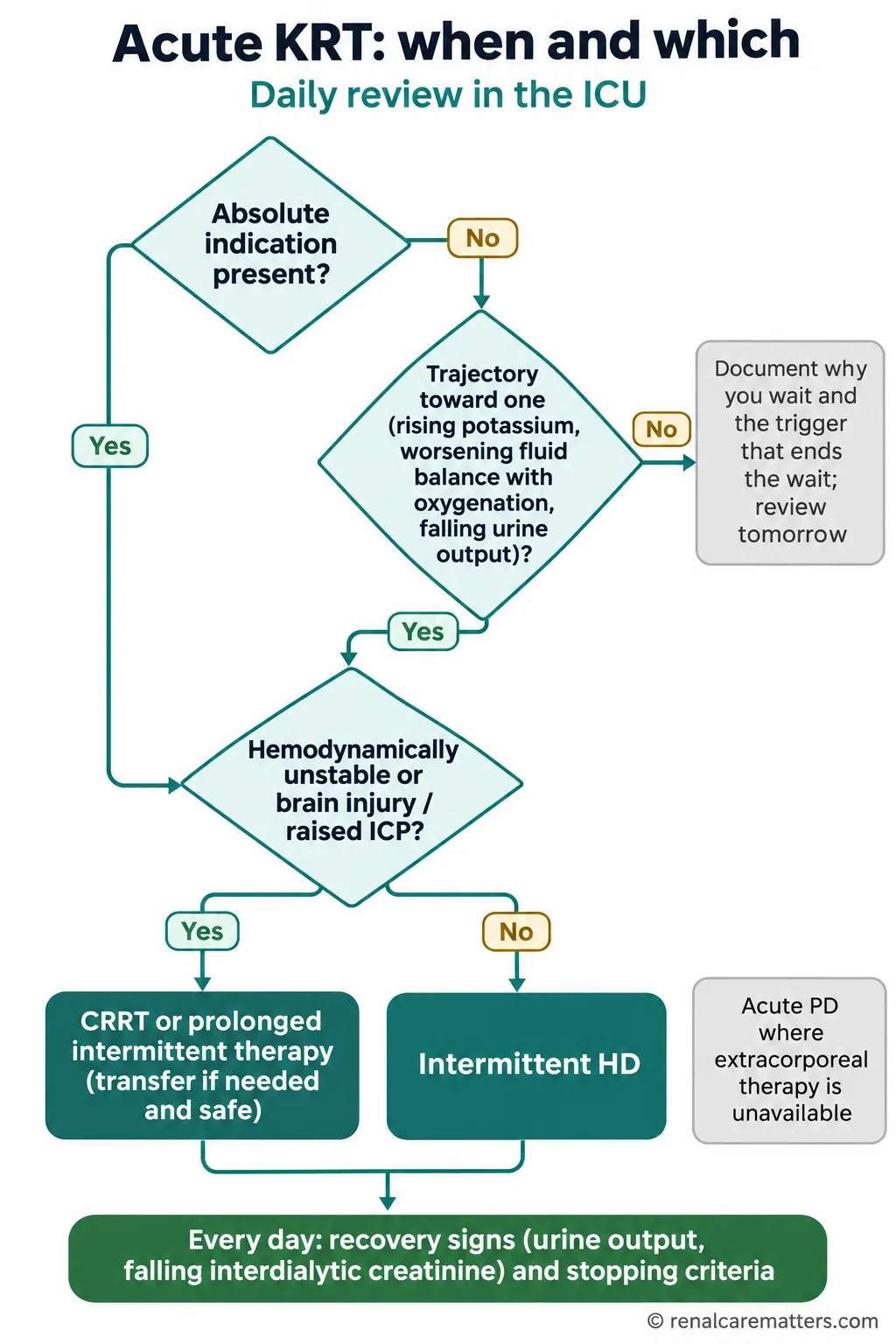
Review the patient daily for absolute indications, a trajectory toward them (rising potassium despite therapy, fluid balance climbing with worsening oxygenation, falling urine output with a high-volume drug and nutrition requirement), and goals of care. If no indication is present, document why you are waiting and the triggers that will end the wait. Choose the modality by hemodynamics, brain risk, nursing capability and transfer safety; a stable patient does not need a transfer for CRRT. Each day, look for recovery: rising urine output, falling interdialytic creatinine, and timed urine creatinine clearance when available.
Figure 3. Acute KRT: when and which. Decision flowchart for starting acute dialysis in the ICU and choosing the modality by blood pressure stability and brain risk.
By phone, the head injury · fictional
A hospital calls about a man with a subdural hematoma and AKI. They have booked a standard four-hour hemodialysis session.
You explain that a fast session lowers plasma urea quickly, and water can then move into the injured brain. You ask for continuous therapy if available, or a short, gentle session with low blood flow, and you write the reason in the order.
What this shows. Choosing the modality is part of the prescription, and the brain is one of the reasons.
Stop and call
Potassium rising despite shifting therapy
Fluid overload with escalating ventilator or oxygen requirements
Uremic pericarditis or encephalopathy
Dialyzable toxin meeting EXTRIP criteria
On the floor
Real situations: problems and solutions
These are fictional but typical. For each one, cover the answer, decide what you would do, then compare. Where a step depends on local rules, your unit’s procedure and your supervisor’s direction come first.
The creatinine of 5 and nothing else
What you see
An ICU team wants to start dialysis because the creatinine reached 5.0 mg/dL. Potassium, bicarbonate, and oxygenation are stable, and urine output is rising.
What is likely going on
A number has crossed a line, but no indication is present.
What to do
Advise waiting, write the triggers that would change your mind, and review the patient daily.
Why it matters
In STARRT-AKI, accelerated starts did not save lives, and 38% of the standard group never needed dialysis.
Intermittent hemodialysis after head injury
What you see
A patient with a recent brain injury and AKI is booked for a standard four-hour session.
What is likely going on
Rapid solute removal lowers plasma osmolality and can drive water into an injured brain.
What to do
Ask for continuous or slow, low-efficiency therapy, or at least a gentle session with low blood flow and a short duration.
Why it matters
KDIGO suggests continuous therapy for acute brain injury, a graded suggestion grounded in physiology.
Waiting with no end
What you see
A patient has been “watched” for four days with rising potassium and climbing fluid balance.
What is likely going on
Watchful waiting has drifted into delay.
What to do
Decide today. AKIKI 2 suggested that delaying well beyond conventional criteria may be harmful.
Why it matters
Waiting needs a ceiling written in advance.
Field notes
Write why you are waiting, not only that you are waiting.
Choose modality by hemodynamics, brain risk, and the team at the bedside.
Look for recovery every day.
Do not transfer a stable patient only for a machine.
Case review
Back to the case: The ICU wants your machine
The indication. Fluid overload that threatens her lungs and does not respond to diuretics is a true indication. This is not a creatinine decision.
Move her or treat her there? Weigh how unstable she is to move against how gently your team can dialyze where she is. A 90-minute ambulance ride on norepinephrine is a real risk. If your unit can run slow, prolonged therapy (sustained low-efficiency dialysis, or isolated ultrafiltration at a low rate), she may be safer staying. If her vasopressor dose climbs or ultrafiltration fails, transfer becomes the better choice. Write that trigger down in advance.
Before connecting. Agree in writing on who is responsible for what: the intensivist runs the resuscitation, you write the dialysis prescription, and your nurses run the machine with an ICU nurse at the bedside. Set a net fluid-removal goal per hour, a blood pressure floor at which ultrafiltration stops, and the water and machine checks your technician has signed. If your nurses are not trained for this, say so. A safe plan may be one experienced nurse with your senior technician, or no session tonight and a transfer instead. Document the indication, the modality and why you chose it, and the goals of care discussed with her family.
Skills lab · with your preceptor
Skills checklist: Skills checklist
Complete with a preceptor, in simulation or at your own unit. Sign-off is local. Your preceptor rates each step as satisfactory, needs practice, or not observed. Steps marked Critical must all be satisfactory before sign-off. This checklist supports supervised learning; your unit’s own procedure and competency form are the authority. A printable version of every checklist is on the trainer page.
Justifies the indication by physiology
Chooses a modality using hemodynamics and capability
Confirms access site and location
Sets daily recovery and reassessment criteria
Placement activity. Simulation or supervised practice
Self-assessment
Check your understanding
Each visit draws 5 questions at random from this module’s 5-question bank. Choose the single best answer for each, then select Check answers; an explanation appears under the best answer. Select New set of questions for a different mix. A good target is 4 of 5 on two different sets. Nothing you select is sent anywhere; scoring happens in your browser.
STARRT-AKI Investigators, Canadian Critical Care Trials Group, Australian and New Zealand Intensive Care Society Clinical Trials Group, United Kingdom Critical Care Research Group, Canadian Nephrology Trials Network, Irish Critical Care Trials Group, Bagshaw, S. M., Wald, R., Adhikari, N. K. J., Bellomo, R., da Costa, B. R., Dreyfuss, D., Du, B., Gallagher, M. P., Gaudry, S., Hoste, E. A., Lamontagne, F., Joannidis, M., Landoni, G., ... Zarbock, A. (2020). Timing of initiation of renal-replacement therapy in acute kidney injury. The New England Journal of Medicine, 383(3), 240–251. https://doi.org/10.1056/NEJMoa2000741
International Society for Peritoneal Dialysis. (n.d.). ISPD guidelines and recommendations. https://ispd.org/guidelines/
ABIM nephrology certification policy and cohort requirements. https://www.abim.org/certification/policies/internal-medicine-subspecialty-policies/nephrology/
Educational material for physicians. Completing it is an Academy learning record only. It does not confer CPD units, PSN certification, privileges, or PhilHealth accreditation, and it does not replace current guidelines, regulations, your institution’s protocols, or clinical judgment.