Give and receive a closed-loop escalation using a structured format.
PublishedNailathalaGipatikPepalwal:ReferencesMga SanggunianMga TinubdanReng Reperensya:4Audience: Practicing nephrologists · senior nephrology fellows · internists who share longitudinal kidney care in the clinic, ward, ICU, dialysis unit, and homeRead timeOras ng pagbasaOras sa pagbasaOras ning pamamasa:
Training track for attending nephrologists in adult practice
This module is study material for attending nephrologists and senior fellows in adult practice. It explains the reasoning behind common decisions; it is not a protocol. Doses and thresholds must be checked against current product labels, guidelines, and your institution’s approved protocols. Regulatory and benefit rules change: confirm them on the date of service. Every case is fictional.
Learning objectives
After this module you should be able to
Give and receive a closed-loop escalation using a structured format.
Document contact, decision, responsible clinician and reassessment time.
Share the minimum necessary data through privacy-compliant channels.
Pre-testBefore you read, answer the 5 self-assessment questions and note your score. After the module, select New set of questions and compare. The difference is what you learned; the questions you still miss are what to reread.
Start here
The big picture, in plain words
Your duty · Section 1.2, 2024 hemodialysis guidelinesUnder the Philippine Society of Nephrology (PSN) guidelines: Stay in active management with the physician on duty and the nurse on duty (b7). When a patient travels, moves, or changes nephrologist, provide the endorsement documents and coordinate with the receiving unit (b10). When your patient is admitted under another nephrologist, endorse by letter or call (b12).
In plain wordsA phone call is a handoff of risk. If the person who called does not leave knowing exactly what to do, by when, and what to do if it fails, the risk was never transferred. It was only described.
Structured handoff effect (I-PASS, before-and-after)Medical errors down 23%; preventable adverse events down 30%
Opening case · fictional
Case: The call from the 8 p.m. shift
You are at home when the physician on duty at your unit, Dr. Ilagan, calls. “Doctor, Mrs. Dizon is dizzy. Can I let her go home?”
You ask for more. Mrs. Dizon, 67, finished her hemodialysis (HD) session twenty minutes ago. She gained 3.8 kilograms over the weekend, and the nurse removed all of it in four hours. She nearly fainted twice when she stood up. Her blood pressure is 88/54 mm Hg sitting. She has not eaten since breakfast. Her son is waiting outside with a tricycle, and she is insisting on leaving because it is getting late. Dr. Ilagan has been a physician on duty for two weeks.
Before reading on, decide:
What do you need to know before you give an instruction?
What exactly will you ask Dr. Ilagan to do, by when, and what happens if it does not work?
What should change before her next session?
Keep your answers in mind. The lesson gives you what you need, and the case review near the end shows one sound response.
Lesson · part 1
How it works
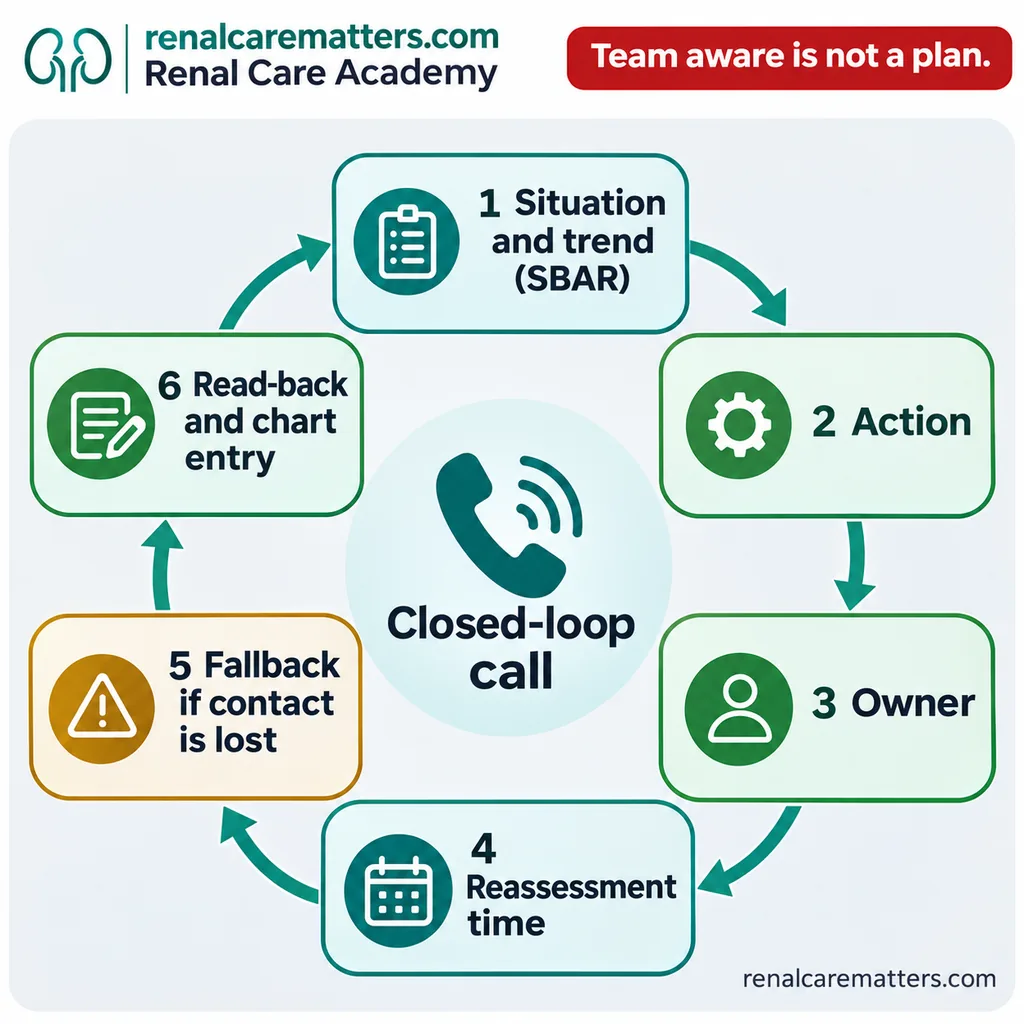
Think of escalation as a feedback loop with three components: a sensor (the Physician on duty (POD) or nurse), a controller (you) and an effector (whoever acts). The loop fails at predictable points. The sensor sends incomplete data, such as ’the patient is hypotensive’ without the trend, the time on treatment or the ultrafiltration given. The controller gives an ambiguous instruction (’watch closely’). Or nobody confirms the effector received it. Read-back closes the loop by making the receiver restate the instruction, which exposes mishearing at the moment it can still be fixed. SBAR (situation, background, assessment, recommendation) or ISBAR structures the data so the controller hears the trend, not just the latest value.
By phone, two versions of the same call · fictional
Version one: “Doctor, bed 6 is hypotensive.” “Okay, watch closely.” Nobody knows what “closely” means or what happens if it gets worse.
Version two: “Bed 6, Mr. Cruz, third hour, 2.5 liters off. Pressure fell from 130 to 86 over 20 minutes; he is yawning. Ultrafiltration is stopped and he is flat.” You answer: “Give 200 mL of saline now, recheck in 15 minutes, and call me back. If he is still below 90, end the session and send him to the emergency room. Read that back.”
What this shows. The second call carries a trend, an action, an owner, a deadline, and a fallback. That is a closed loop.
Figure 2. A loop of six steps that closes a phone escalation: trend, action, owner, recheck time, fallback, and read-back with a chart entry.
Lesson · part 2
What the evidence shows
Structured handoff programs (for example, I-PASS in a multicenter pediatric residency study published in 2014) were associated with a 23% relative reduction in medical errors and a 30% reduction in preventable adverse events in a before-and-after comparison. That is observational evidence, but consistent across settings. Telephone read-back is standard in the Joint Commission patient safety goals. The Philippine Data Privacy Act of 2012 requires proportionality: share only what the receiver needs, through channels the facility has approved.
Your patients do not stay in one place. They travel for a family wedding, move to another province, change nephrologist, or are admitted to a hospital where another nephrologist takes over. Each move is a handoff, and the PSN guidelines name your part in it.1
When a patient travels, moves residence, or changes nephrologist, you provide the documents the receiving hemodialysis center needs, including the PSN Hemodialysis Patient’s Endorsement Form (HPEF), and you coordinate with that center directly. When your patient is admitted under another nephrologist, you give a proper endorsement by letter, by call, or both.1
By message, a Thursday evening · fictional
Nurse Cabral messages you: Mrs. Dizon is flying to Iloilo in nine days for her granddaughter’s wedding and will dialyze there three times. She has already booked her flight.
You call the Iloilo unit the next morning. They will accept her with a completed endorsement form, a current abstract with her prescription and medicines, and hepatitis serologies from the last three months. Hers are five months old. Nurse Cabral draws them on Monday, and the papers go out by Wednesday through the unit’s approved channel. On Saturday the Iloilo nurse texts that Mrs. Dizon has started her first session.
What this shows. Ask the receiving unit what it needs before the patient leaves. A missing test found at the door costs a session.
Figure 3 · A safe endorsement
Ask firstCall the receiving unit and ask what it needs. Requirements differ from unit to unit.
Write itComplete the endorsement form and a current abstract with the prescription and medicines.
Hand it overGive a copy to the patient and send one to the receiving unit or nephrologist through an approved channel.
Close the loopConfirm the first session or the admission was received, and record who accepted the patient.
RememberA patient who leaves without an endorsement arrives at the next unit as a stranger.
Lesson · part 4
What the attending does
When called, ask for timing on treatment, vital-sign trends, symptoms, access status, interventions already given and the response to them. State the immediate action, who performs it, the reassessment deadline and the fallback if contact is lost. Have the caller read it back. Document in the chart, not only in a messaging app. For transfers, confirm acceptance by a named receiving clinician and send the minimum data set through the approved channel.
On your monthly visit · fictional
You find a note in the chart from a night two weeks ago: “attending nephrologist (AN) aware.” Nothing else. You ask Dr. Ilagan what you were made aware of and what you said. Neither of you is certain.
You agree a rule with Nurse Cabral: every call ends with a chart entry that has the instruction, the reassessment time, and the name of the person who gave it.
What this shows. If the next shift cannot read the plan, the plan did not happen.
Stop and call
’Team aware’ as the only documentation
Orders given by text with no chart entry
Patient leaving against advice with no capacity assessment
Instructions with no reassessment time
On the floor
Real situations: problems and solutions
These are fictional but typical. For each one, cover the answer, decide what you would do, then compare. Where a step depends on local rules, your unit’s procedure and your supervisor’s direction come first.
“Team aware”
What you see
A chart entry after a hypotensive episode reads only “AN aware.”
What is likely going on
The call happened, but the plan was never written down.
What to do
Ask the physician on duty to add the instruction, the reassessment time, and the fallback, and to read instructions back on every call from now on.
Why it matters
If the next shift cannot read the plan, the plan does not exist.
The order sent by chat
What you see
You gave a dose change by message at 10 p.m. The next morning the nurse says she did not see it.
What is likely going on
Messaging apps are not the medical record, and messages get buried.
What to do
Write the order in the chart the next morning, and agree with the head nurse that urgent orders are given by voice with read-back.
Why it matters
Chat is useful for alerts but unsafe as the only record of an order.
The patient who wants to leave against advice
What you see
A patient with chest discomfort after dialysis insists on going home before the electrocardiogram.
What is likely going on
He may have capacity and still be making a risky choice, or he may not understand the risk.
What to do
Ask the physician on duty to explain the risk, assess and document capacity, and record what was offered. If he has capacity, he can refuse; give him written warning signs and the number to call.
Why it matters
Respecting a decision and documenting it carefully protect the patient and the unit.
Field notes
End every call with “read that back to me.”
Every instruction needs an owner, a time, and a fallback.
Thank the physician on duty for calling, even when the call was not needed.
Share only what the receiver needs, through approved channels.
Case review
Back to the case: The call from the 8 p.m. shift
What you need first. Ask for the full picture: her post-dialysis weight compared with her target, blood pressure lying and standing, pulse, blood glucose, any chest discomfort (and an electrocardiogram if there is), and whether the access is still bleeding. “Dizzy” can be volume, sugar, rhythm, or blood loss, and each has a different answer.
The instruction, closed-loop. Lay her flat, give a small saline bolus within the unit protocol if she is still hypotensive, and recheck her blood pressure and symptoms in 15 minutes. If she is still symptomatic, or if Dr. Ilagan is not sure she understands the risk of leaving, she goes to the emergency department, and he calls you with the name of the receiving doctor. Ask him to read the plan back to you. If she still wants to leave, he assesses and documents her decision-making capacity. Then he writes the plan in the chart, not only in your message thread.
Before Thursday. Removing 3.8 kilograms in four hours was the trigger. Review her target weight, cap the ultrafiltration rate, and talk with her about fluid between sessions. Then tell Dr. Ilagan what he did well: he called. New physicians on duty learn from the attending’s tone whether calling is welcome.
Skills lab · with your preceptor
Skills checklist: Skills checklist
Complete with a preceptor, in simulation or at your own unit. Sign-off is local. Your preceptor rates each step as satisfactory, needs practice, or not observed. Steps marked Critical must all be satisfactory before sign-off. This checklist supports supervised learning; your unit’s own procedure and competency form are the authority. A printable version of every checklist is on the trainer page.
Uses SBAR or ISBAR and read-back
Names the reassessment time and fallback
Documents the receiving clinician
Uses an approved, privacy-compliant channel
Placement activity. Simulation or supervised practice
Self-assessment
Check your understanding
Each visit draws 5 questions at random from this module’s 5-question bank. Choose the single best answer for each, then select Check answers; an explanation appears under the best answer. Select New set of questions for a different mix. A good target is 4 of 5 on two different sets. Nothing you select is sent anywhere; scoring happens in your browser.
Starmer, A. J., Spector, N. D., Srivastava, R., West, D. C., Rosenbluth, G., Allen, A. D., Noble, E. L., Tse, L. L., Dalal, A. K., Keohane, C. A., Lipsitz, S. R., Rothschild, J. M., Wien, M. F., Yoon, C. S., Zigmont, K. R., Wilson, K. M., O'Toole, J. K., Solan, L. G., Aylor, M., ... I-PASS Study Group (2014). Changes in medical errors after implementation of a handoff program. The New England Journal of Medicine, 371(19), 1803–1812. https://doi.org/10.1056/NEJMsa1405556
Educational material for physicians. Completing it is an Academy learning record only. It does not confer CPD units, PSN certification, privileges, or PhilHealth accreditation, and it does not replace current guidelines, regulations, your institution’s protocols, or clinical judgment.