Consent, prescribing and medication reconciliation
Use teach-back to confirm understanding and document an informed choice.
PublishedNailathalaGipatikPepalwal:ReferencesMga SanggunianMga TinubdanReng Reperensya:3Audience: Practicing nephrologists · senior nephrology fellows · internists who share longitudinal kidney care in the clinic, ward, ICU, dialysis unit, and homeRead timeOras ng pagbasaOras sa pagbasaOras ning pamamasa:
Training track for attending nephrologists in adult practice
This module is study material for attending nephrologists and senior fellows in adult practice. It explains the reasoning behind common decisions; it is not a protocol. Doses and thresholds must be checked against current product labels, guidelines, and your institution’s approved protocols. Regulatory and benefit rules change: confirm them on the date of service. Every case is fictional.
Learning objectives
After this module you should be able to
Use teach-back to confirm understanding and document an informed choice.
Reconcile medicines across changes in kidney function and modality.
Record hold and restart criteria with a named reviewer.
Pre-testBefore you read, answer the 5 self-assessment questions and note your score. After the module, select New set of questions and compare. The difference is what you learned; the questions you still miss are what to reread.
Start here
The big picture, in plain words
Your duty · Section 1.2, 2024 hemodialysis guidelinesUnder the Philippine Society of Nephrology (PSN) guidelines: Explain every option for end-stage kidney disease, and document the informed consent, preferably witnessed by two people (b1). Keep the current medicines ready for the clinical abstract (b5).
In plain wordsA drug dose is a contract written for one particular kidney. When kidney function changes (acute kidney injury (AKI), recovery, dialysis start), every contract must be reread. Medication errors cluster at exactly these transitions.
Figure 1 · Key numbers
Acceptable creatinine rise after starting renin-angiotensin system (RAS) inhibitor or sodium-glucose cotransporter 2 (SGLT2) inhibitorUp to about 30% from baseline without stopping
Metformin (Kidney Disease: Improving Global Outcomes (KDIGO) 2024)Reduce dose at estimated glomerular filtration rate (eGFR) <45; stop at eGFR <30
Opening case · fictional
Case: Two lists in one plastic bag
Mr. Navarro, 58, comes to your clinic at the dialysis center a week after a hospital stay for gastroenteritis that pushed his kidney function down. He has diabetes and chronic kidney disease (CKD) G3a, and he is not on dialysis. He hands you a plastic bag with every box of medicine he owns and two discharge sheets, one from the ward and one from the emergency room.
One sheet says “stop losartan, empagliflozin, and metformin.” The other says “continue all home medicines.” He has been taking only his amlodipine “to be safe.” His creatinine today is 1.4 mg/dL; his baseline before the illness was 1.3. He is eating and drinking normally. His daughter, who manages his medicines, asks, “Doctor, which list is right?”
Before reading on, decide:
Which list is right?
How will you make sure the family does not end up with a third version?
What should happen the next time he has vomiting or diarrhea?
Keep your answers in mind. The lesson gives you what you need, and the case review near the end shows one sound response.
Lesson · part 1
How it works
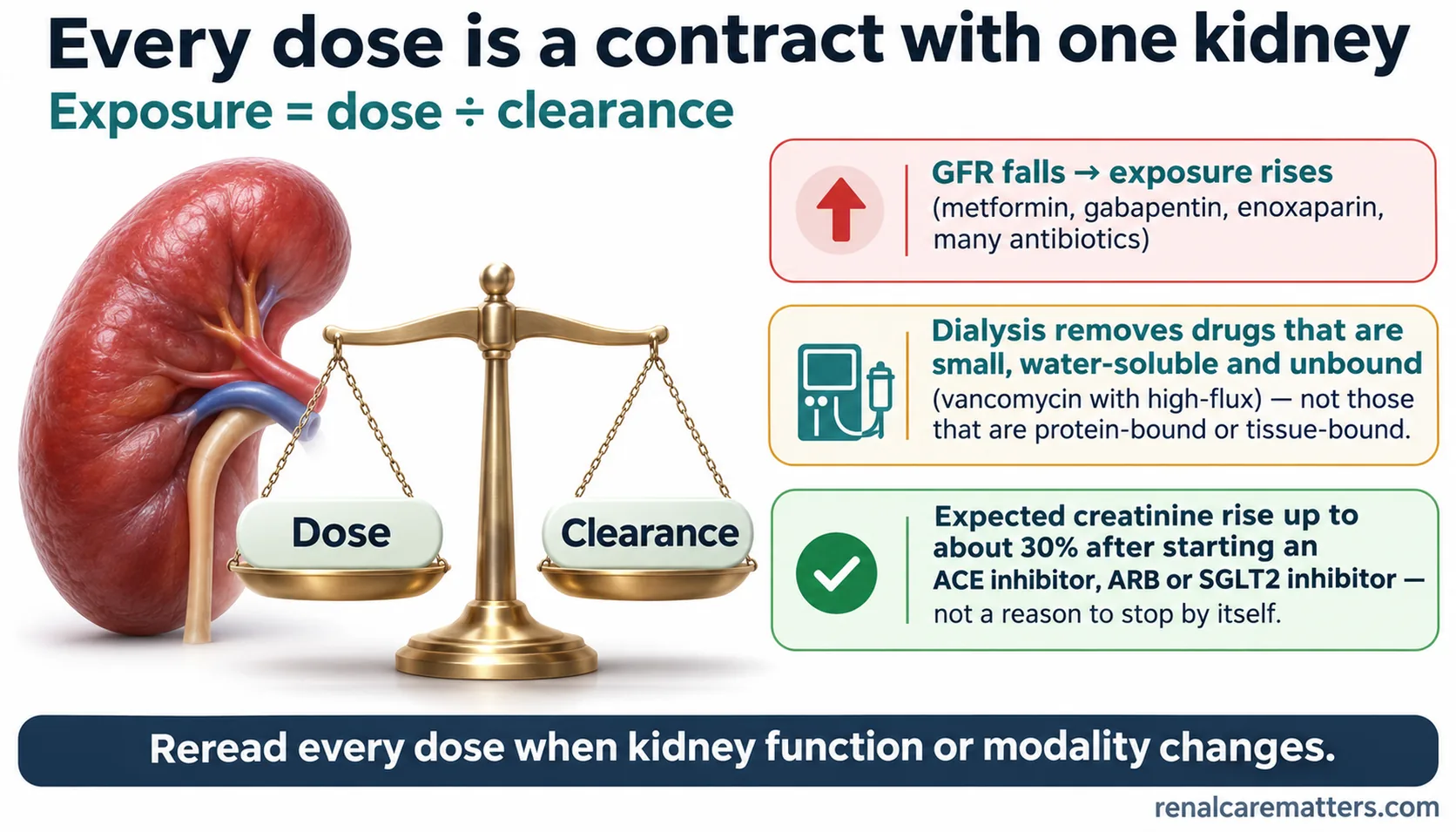
Drug exposure equals dose divided by clearance. For renally cleared drugs or active metabolites (metformin, gabapentinoids, enoxaparin, many antibiotics, direct oral anticoagulants, morphine’s metabolite morphine-6-glucuronide), falling glomerular filtration rate (GFR) raises exposure. Dialysis then adds intermittent clearance that depends on molecular size, protein binding and volume of distribution. A small, water-soluble, unbound drug such as vancomycin with high-flux membranes is removed substantially. A highly protein-bound or lipophilic drug is barely touched. Some drugs change kidney hemodynamics directly. angiotensin-converting enzyme (ACE) inhibitors, ARBs (angiotensin receptor blockers) and SGLT2 (sodium-glucose cotransporter 2) inhibitors reduce intraglomerular pressure and cause an expected early creatinine rise. nonsteroidal anti-inflammatory drugs (NSAIDs) remove prostaglandin-mediated afferent dilation. Hence the ’sick day’ rule for volume-depleting illness.
By phone · fictional
Mr. Tolentino, on hemodialysis, was given vancomycin in hospital and told to “have a dose after dialysis.” On Wednesday the nurse calls to ask whether to give it. You ask what membrane he dialyzes on. It is high-flux.
Vancomycin is small, water-soluble, and mostly unbound, so a high-flux session removes a large share of it. You ask for a level and dose to it, instead of guessing.
What this shows. Drug exposure is dose divided by clearance. Dialysis adds clearance that depends on the drug and the membrane.
Figure 2. Every dose is a contract with one kidney. A balance of dose against clearance, showing why kidney changes and dialysis change drug exposure.
Lesson · part 2
What the evidence shows
KDIGO 2024 advises using eGFR (with cystatin C when needed) for drug dosing. It notes that an acute eGFR decline of up to about 30% after starting an ACE inhibitor, Angiotensin receptor blocker (ARB) or SGLT2 inhibitor is expected and should not prompt discontinuation by itself. Teach-back improves comprehension and recall in randomized and quasi-experimental studies across chronic-disease populations. Sick-day guidance has limited trial evidence; it is mechanistically sound but should not lead to indefinite omission.
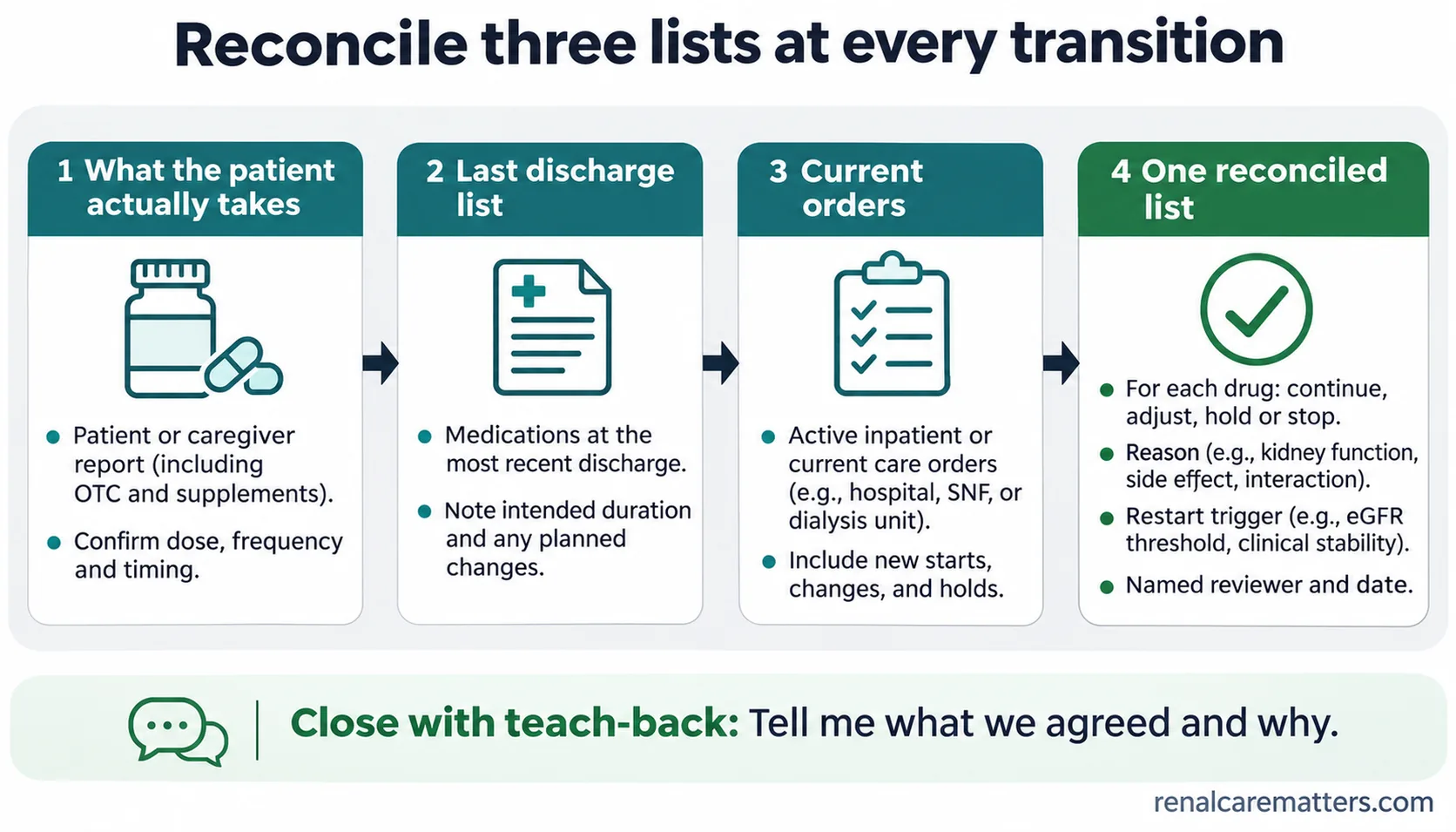
At every transition, compare three lists: what the patient actually takes, the last discharge list and the current orders. For each discrepancy, decide continue, adjust, hold or stop. Write the reason, the restart trigger (for example, ’restart losartan when creatinine is within 20% of baseline and systolic Blood pressure (BP) >110’) and the named reviewer with a date. Discuss consent in plain language: benefits, burdens, alternatives including doing nothing. Close with teach-back: ’Tell me in your own words what we agreed and why.’
Figure 3. Reconcile three lists at every transition. Three medication lists combined into one reconciled list with reasons, restart triggers and a named reviewer.
In the clinic, teach-back · fictional
You finish explaining Mr. Navarro’s new list and ask his daughter, “Tell me in your own words what he takes tomorrow.” She lists the tablets correctly, then adds, “And if he has diarrhea, he stops all of them.”
You correct it: only losartan, empagliflozin, and metformin pause, and they restart once he is eating and drinking again. Amlodipine continues unless his pressure is low. She writes it on the list herself.
What this shows. Teach-back finds the misunderstanding while you can still fix it.
Stop and call
Two conflicting discharge lists
’Resume all when well’
Renally cleared drug at full dose after AKI
Held cardioprotective therapy with no restart plan
On the floor
Real situations: problems and solutions
These are fictional but typical. For each one, cover the answer, decide what you would do, then compare. Where a step depends on local rules, your unit’s procedure and your supervisor’s direction come first.
Vancomycin after a high-flux session
What you see
A patient on hemodialysis is started on vancomycin in hospital, and the ward asks your unit to “give the dose after dialysis.”
What is likely going on
Vancomycin is small, water-soluble, and mostly unbound, so high-flux dialysis removes much of it.
What to do
Dose after dialysis according to levels and the pharmacist’s advice, and write who checks the level.
Why it matters
Underdosing an antibiotic in a dialysis patient is as dangerous as overdosing.
The “kidney vitamins” from the market
What you see
A patient brings a bottle of herbal “kidney cleanse” capsules she bought online.
What is likely going on
Some herbal products contain potassium, aristolochic acid, or undeclared drugs.
What to do
Ask her to stop it, record the product name in the chart, and ask about every supplement at each review.
A colleague prescribed gabapentin 300 mg three times a day for itch in a patient on hemodialysis. She is now drowsy and unsteady.
What is likely going on
Gabapentin is cleared by the kidney and accumulates when the kidneys fail.
What to do
Hold it, and restart, if needed, at a renally adjusted dose given after dialysis.
Why it matters
Every drug started outside the unit needs a kidney check.
Field notes
Ask patients to bring every medicine box to the first visit after any admission.
Write a restart trigger next to every held drug.
Use teach-back for every medication change.
Name one person who owns the reconciled list.
Case review
Back to the case: Two lists in one plastic bag
Which list is right? Neither, as written. Start from what he is actually taking, which is only amlodipine. His kidney function is back to within 10% of baseline and he is eating and drinking, so restart losartan and empagliflozin. Both protect his kidneys and heart, and the small creatinine rise they cause is expected. Restart metformin at the dose his eGFR allows.
One list. Write a single reconciled list. For each drug, record whether to continue, change, hold, or stop, and why. Arrange potassium and creatinine checks in one to two weeks and name who will call the family with the result. Ask his daughter to throw away both discharge sheets and keep yours. Then use teach-back: “Tell me in your own words which tablets he takes from tomorrow.”
Next time he is sick. Give sick-day rules in writing: when he cannot keep fluids down, he pauses losartan, empagliflozin, and metformin, and he restarts them once he is eating and drinking normally again. Add the most important line: “Call the clinic if you are not better in two days.” Sick-day rules without a restart trigger become permanent stops.
Skills lab · with your preceptor
Skills checklist: Skills checklist
Complete with a preceptor, in simulation or at your own unit. Sign-off is local. Your preceptor rates each step as satisfactory, needs practice, or not observed. Steps marked Critical must all be satisfactory before sign-off. This checklist supports supervised learning; your unit’s own procedure and competency form are the authority. A printable version of every checklist is on the trainer page.
Uses teach-back
Identifies a dose or timing concern by mechanism
Assigns each pending medication decision an owner and a date
Placement activity. Simulation or supervised practice
Self-assessment
Check your understanding
Each visit draws 5 questions at random from this module’s 5-question bank. Choose the single best answer for each, then select Check answers; an explanation appears under the best answer. Select New set of questions for a different mix. A good target is 4 of 5 on two different sets. Nothing you select is sent anywhere; scoring happens in your browser.
Kidney Disease: Improving Global Outcomes (KDIGO) CKD Work Group (2024). KDIGO 2024 clinical practice guideline for the evaluation and management of chronic kidney disease. Kidney International, 105(4S), S117–S314. https://doi.org/10.1016/j.kint.2023.10.018
Educational material for physicians. Completing it is an Academy learning record only. It does not confer CPD units, PSN certification, privileges, or PhilHealth accreditation, and it does not replace current guidelines, regulations, your institution’s protocols, or clinical judgment.