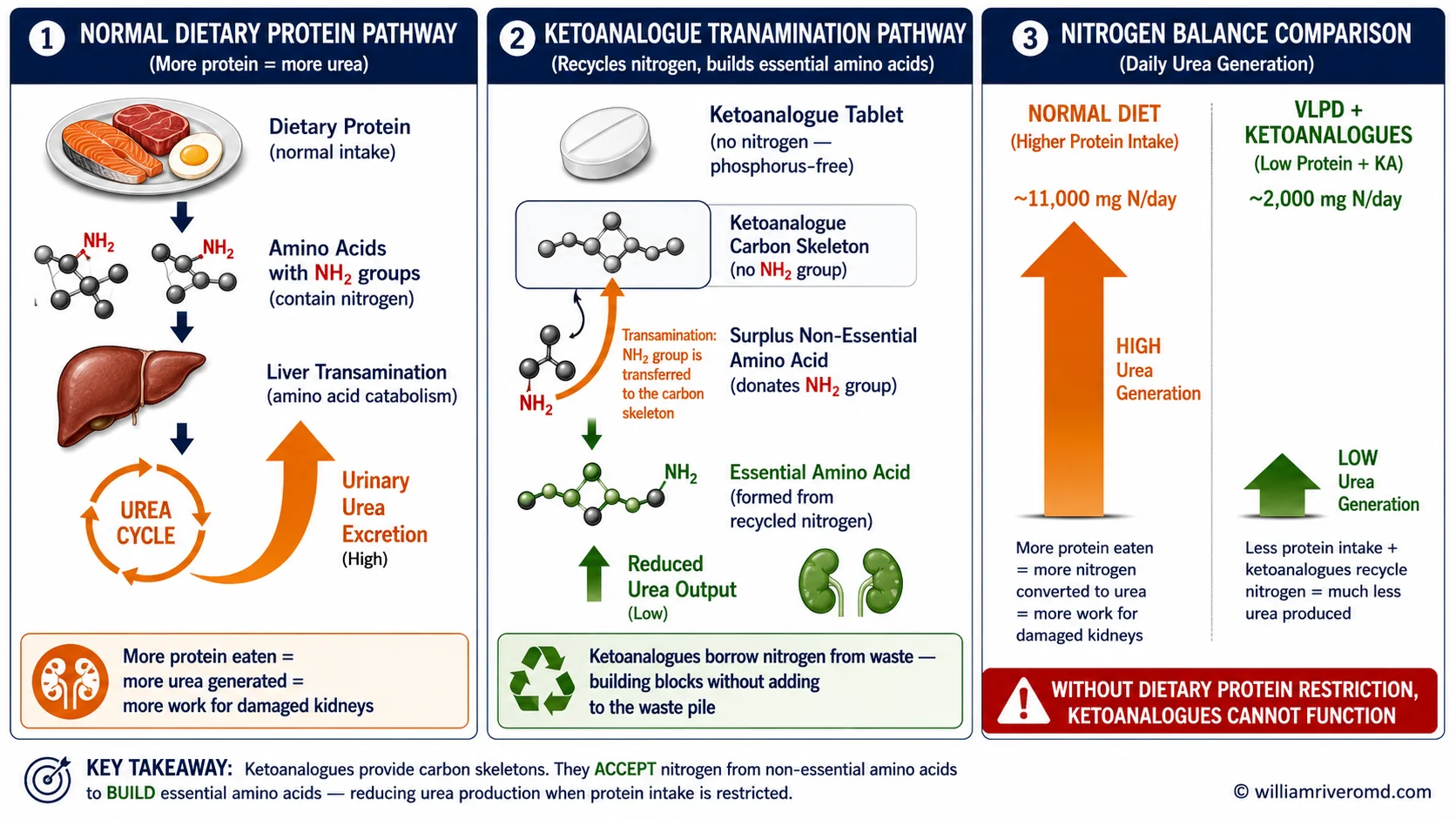
Ketoanalogues (KA) are nitrogen-free structural analogues of essential amino acids. Unlike the amino acids found in food protein, they do not carry a nitrogen atom in their backbone. This single biochemical difference is the entire basis for their clinical use in kidney disease.Ang ketoanalogues (KA) ay walang-nitrogen na istrukturang analogue ng essential amino acids. Hindi tulad ng amino acids na matatagpuan sa protina ng pagkain, wala silang dalang nitrogen atom sa kanilang backbone. Ang iisang biochemical na pagkakaibang ito ang buong batayan ng klinikal na paggamit nito sa sakit sa bato.Ang ketoanalogues (KA) mao ang walay-nitrogen nga structural analogue sa essential amino acids. Dili sama sa amino acids nga makita sa protina sa pagkaon, wala silay dala nga nitrogen atom sa ilang backbone. Kini nga usa ka biochemical nga kalainan mao ang tibuok basehan sa klinikal nga paggamit niini sa sakit sa kidney.Ing ketoanalogues (KA) ala lang-nitrogen a istrukturang analogue ning essential amino acids. Ali anti ring amino acids a makit king protina ning pengan, ala lang daralan a nitrogen atom king karelang backbone. Ining metung a biochemical a pamiyaliwa ya ing buong basehan ning klinikal a paggamit na king sakit king batu.
Nitrogen RecyclingPag-recycle ng NitrogenPag-recycle sa NitrogenPamag-recycle ning Nitrogen
KA accept a nitrogen group from non-essential amino acids through a process called transamination, forming the essential amino acid without adding new nitrogen to the body.Tumatanggap ang KA ng nitrogen group mula sa non-essential amino acids sa pamamagitan ng proseso na tinatawag na transamination, na bumubuo ng essential amino acid nang hindi nagdaragdag ng bagong nitrogen sa katawan.Ang KA modawat og nitrogen group gikan sa non-essential amino acids pinaagi sa proseso nga gitawag og transamination, nga naghimo sa essential amino acid nga walay dugang nga bag-ong nitrogen sa lawas.Tatanggap ya ing KA nitrogen group manibat king non-essential amino acids king pamilatan ning proseso a ausan dang transamination, a gagawa ning essential amino acid a alang daragdag a bayung nitrogen king katawan.
Reduced Urea LoadNabawasang Urea LoadNakunhod nga Urea LoadMikaus a Urea Load
By recycling nitrogen rather than adding it, KA help lower blood urea nitrogen (BUN) — one of the main toxins that accumulates when kidneys fail.Sa pamamagitan ng pag-recycle ng nitrogen sa halip na pagdaragdag nito, tinutulungan ng KA na ibaba ang blood urea nitrogen (BUN) — isa sa mga pangunahing lason na naiipon kapag nabibigo ang mga bato.Pinaagi sa pag-recycle sa nitrogen imbes nga idugang kini, ang KA motabang sa pagpaubos sa blood urea nitrogen (BUN) — usa sa mga panguna nga hilo nga matapok kung mapakyas ang mga kidney.King pamilatan ning pag-recycle ning nitrogen imbes a daragdagan ya, sasaupan ne ning KA a ibaba ing blood urea nitrogen (BUN) — metung karing pekamaragul a lason a mitipun nung mabigo la ring batu.
No PhosphorusWalang PhosphorusWalay PhosphorusAlang Phosphorus
Unlike dietary protein sources (meat, fish, eggs), KA are phosphorus-free. This prevents the additional phosphorus burden that worsens kidney bone disease.Hindi tulad ng mga pinagkukunan ng protina sa pagkain (karne, isda, itlog), ang KA ay walang phosphorus. Pinipigilan nito ang karagdagang pasanin ng phosphorus na nagpapalala sa sakit sa buto dulot ng bato.Dili sama sa mga tinubdan sa protina sa pagkaon (karne, isda, itlog), ang KA walay phosphorus. Kini nagpugong sa dugang nga palas-anon sa phosphorus nga nagpagrabe sa sakit sa bukog tungod sa kidney.Ali anti ring pikuanan ning protina king pengan (laman, asan, ebun), ing KA alang phosphorus. Sasawpan na ini ing karagdagan a pasan ning phosphorus a magpasama king sakit king butul a mibat king batu.
Essential AA RepletionPagpuno ng Essential AAPagpuno sa Essential AAPamanupu ning Essential AA
On a very-low-protein diet, essential amino acids become deficient. KA replenish them safely, preventing malnutrition while the diet is restricted.Sa isang napakababang-protina na diyeta, nagkukulang ang essential amino acids. Muling pinupunan ito ng KA nang ligtas, na pumipigil sa malnutrisyon habang pinaghihigpitan ang diyeta.Sa usa ka hilabihan-ka-ubos-og-protina nga diyeta, nakulangan ang essential amino acids. Ang KA nagpuno niini nga luwas, nga nagpugong sa malnutrisyon samtang gipugngan ang diyeta.King metung a masiadung-babang-protina a diyeta, magkulang la ring essential amino acids. Pupunan na lang ining pasibayu ning KA a ligtas, a sasawpan king malnutrisyon kabang pipilit ing diyeta.
The analogy: Imagine ketoanalogues as an empty container that needs to be filled with nitrogen to become useful. Your body provides that nitrogen — taken from waste amino acids that would otherwise become urea. The result: a building block your body needs, made from recycled material, without adding to the nitrogen waste pile. But this only works if you first reduce how much new nitrogen you are pouring in through your diet.Ang paghahalintulad: Isipin ang ketoanalogues bilang isang walang lamang lalagyan na kailangang punuin ng nitrogen upang maging kapaki-pakinabang. Ang inyong katawan ang nagbibigay ng nitrogen na iyon — kinuha mula sa waste amino acids na kung hindi ay magiging urea. Ang resulta: isang building block na kailangan ng inyong katawan, gawa mula sa recycled na materyal, nang hindi nadaragdagan ang tumpok ng nitrogen na basura. Ngunit gumagana lamang ito kung una ninyong babawasan kung gaano karaming bagong nitrogen ang inyong ibinubuhos sa pamamagitan ng inyong diyeta.Ang panag-ingnan: Hunahunaa ang ketoanalogues isip usa ka walay sulod nga sudlanan nga kinahanglan pun-on og nitrogen aron mahimong mapuslanon. Ang imong lawas maoy naghatag niana nga nitrogen — gikuha gikan sa waste amino acids nga kon dili mahimong urea. Ang resulta: usa ka building block nga gikinahanglan sa imong lawas, hinimo gikan sa recycled nga materyal, nga walay dugang sa tapok sa nitrogen nga basura. Apan molihok lamang kini kon una nimong pakunhoran kung pila ka bag-ong nitrogen ang imong gibubo pinaagi sa imong diyeta.Ing paghahalintulad: Isipan ye ing ketoanalogues bilang metung a alang laman a lalagyan a kailangan yang punan ning nitrogen ban maging makatabang. Ing katawan mu ing bibiye kaniang nitrogen — kinua manibat king waste amino acids a nung ali maging urea. Ing resulta: metung a building block a kailangan ning katawan mu, gawa manibat king recycled a materyal, a alang daragdag king tambak ning nitrogen a basura. Dapot gagana mu ini nung mumuna yang babawasan mu nung makananu karakal a bayung nitrogen ing ibubu mu king pamilatan ning diyeta mu.
The reference formulation studied in all major clinical trials is Ketosteril (Fresenius Kabi), which contains 10 components per tablet: five keto-acid calcium salts (ketoanalogues of isoleucine, leucine, phenylalanine, valine, and methionine) plus five essential amino acids (lysine, threonine, tryptophan, histidine, and tyrosine).[1] Each tablet delivers 36 mg of nitrogen and 0.05 g of calcium. The standard dose is 1 tablet per 5 kg body weight per day, taken with meals — never on an empty stomach.Ang reference formulation na pinag-aralan sa lahat ng malalaking clinical trial ay ang Ketosteril (Fresenius Kabi), na naglalaman ng 10 bahagi kada tableta: limang keto-acid calcium salts (ketoanalogues ng isoleucine, leucine, phenylalanine, valine, at methionine) at limang essential amino acids (lysine, threonine, tryptophan, histidine, at tyrosine).[1] Bawat tableta ay naghahatid ng 36 mg ng nitrogen at 0.05 g ng calcium. Ang standard na dosis ay 1 tableta kada 5 kg ng timbang ng katawan bawat araw, iniinom kasabay ng pagkain — hindi kailanman sa walang lamang tiyan.Ang reference formulation nga gitun-an sa tanang dagkong clinical trial mao ang Ketosteril (Fresenius Kabi), nga adunay 10 ka bahin matag tableta: lima ka keto-acid calcium salts (ketoanalogues sa isoleucine, leucine, phenylalanine, valine, ug methionine) dugang lima ka essential amino acids (lysine, threonine, tryptophan, histidine, ug tyrosine).[1] Matag tableta naghatag og 36 mg nga nitrogen ug 0.05 g nga calcium. Ang standard nga dosis mao ang 1 tableta matag 5 kg nga gibug-aton sa lawas kada adlaw, giinom uban sa pagkaon — dili gyud sa walay sulod nga tiyan.Ing reference formulation a pepag-aralan king anggang maragul a clinical trial ya ing Ketosteril (Fresenius Kabi), a atin 10 a bahagi kada tableta: limang keto-acid calcium salts (ketoanalogues ning isoleucine, leucine, phenylalanine, valine, at methionine) at limang essential amino acids (lysine, threonine, tryptophan, histidine, at tyrosine).[1] Balang tableta bibiye yang 36 mg a nitrogen at 0.05 g a calcium. Ing standard a dosis ya 1 tableta kada 5 kg a timbang ning katawan balang aldo, inuman kayabe ning pengan — e mu kapilan man king alang laman a atian.
Ketoanalogues are not appropriate for everyone with elevated creatinine. They belong to a specific, well-defined clinical scenario. Understanding the three patient personas clarifies when KA help, when they are irrelevant, and when they may cause harm.Ang ketoanalogues ay hindi angkop para sa lahat ng may mataas na creatinine. Nabibilang ang mga ito sa isang tiyak at malinaw na klinikal na sitwasyon. Ang pag-unawa sa tatlong persona ng pasyente ay naglilinaw kung kailan nakakatulong ang KA, kung kailan ito hindi kaugnay, at kung kailan maaari itong magdulot ng pinsala.Ang ketoanalogues dili angay alang sa tanan nga may taas nga creatinine. Nahisakop sila sa usa ka espisipiko ug tin-aw nga klinikal nga senaryo. Ang pagsabot sa tulo ka persona sa pasyente naghatag og kalinaw kung kanus-a makatabang ang KA, kung kanus-a dili kini kalabot, ug kung kanus-a kini makahatag og kadaot.Ing ketoanalogues ali angkop para king anggang atin matas a creatinine. Mabilang la deni king metung a tiyak at malinaw a klinikal a sitwasyon. Ing pamintindi king atlung persona ning pasyente linilinaw na nung kapilan makatabang ing KA, nung kapilan ali ya kaugnayan, at nung kapilan mangyaring magdala ng pamiyasakit.
| Patient Profile | KA Indicated? | Dietary Direction | Rationale |
|---|---|---|---|
| chronic kidney disease (CKD) Stage 3b–5 (pre-dialysis)sakit sa bato na kronik (CKD) Stage 3b–5 (bago mag-dialysis)sakit sa kidney nga kronik (CKD) Stage 3b–5 (wala pa mag-dialysis)sakit king batu a kronik (CKD) Stage 3b–5 (bayu mag-dialysis) estimated glomerular filtration rate (eGFR) <30, not yet on dialysis |
YES — PrimaryOO — PangunahinOO — PangunaWA — Pekamuna | Protein DOWN LPD 0.6 g/kg or VLPD 0.3 g/kgLPD 0.6 g/kg o VLPD 0.3 g/kgLPD 0.6 g/kg o VLPD 0.3 g/kgLPD 0.6 g/kg o VLPD 0.3 g/kg |
KA compensate for essential AA restriction while reducing nitrogen load and slowing progressionBinabayaran ng KA ang paghihigpit sa essential AA habang binabawasan ang nitrogen load at pinabababagal ang pagsulongAng KA nagbayad sa pagpugong sa essential AA samtang gikunhoran ang nitrogen load ug gipahinay ang pagsulongBabayaran ne ning KA ing pamipilit king essential AA kabang babawasan ing nitrogen load at pababagalan ing pagsulong |
| CKD5d — Well-nourished on dialysisCKD5d — Maayos ang nutrisyon sa dialysisCKD5d — Maayo ang nutrisyon sa dialysisCKD5d — Mayap ing nutrisyon king dialysis Albumin ≥3.5 g/dL, eating adequately |
NOHINDIDILIALI | Protein UP Target 1.0–1.2 g/kg/dayTarget 1.0–1.2 g/kg/arawTarget 1.0–1.2 g/kg/adlawTarget 1.0–1.2 g/kg/aldo |
Dialysis removes urea — nitrogen recycling rationale disappears. Higher protein intake is now the goal.Inaalis ng dialysis ang urea — nawawala ang dahilan para sa nitrogen recycling. Mas mataas na paginom ng protina na ang layunin ngayon.Ang dialysis nagkuha sa urea — nawala ang katarungan sa nitrogen recycling. Mas taas nga pag-inom sa protina na ang tumong karon.Aalisan ne ning dialysis ing urea — mawala ing dahilan para king nitrogen recycling. Mas matas a paginum ning protina na ing tudyu ngeni. |
| CKD5d — Malnourished on dialysisCKD5d — Malnourished sa dialysisCKD5d — Malnourished sa dialysisCKD5d — Malnourished king dialysis Albumin <3.5 g/dL, struggling with protein intake |
CONDITIONALMAY KONDISYONMAY KONDISYONATIN KONDISYON | Protein UP (KA bridges transition)Protina UP (KA ang tulay sa paglipat)Protina UP (KA ang taytayan sa paglihok)Protina UP (KA ing tulay king paglipat) | KA serve as phosphorus-free essential AA scaffold while the patient works toward dietary protein targets. Requires direct nephrologist supervision and calcium monitoring.Nagsisilbing walang-phosphorus na essential AA scaffold ang KA habang sinisikap ng pasyente na maabot ang mga target na protina sa diyeta. Nangangailangan ng direktang pangangasiwa ng nephrologist at pagsubaybay sa calcium.Ang KA nagsilbi isip walay-phosphorus nga essential AA scaffold samtang naningkamot ang pasyente nga makab-ot ang mga target nga protina sa diyeta. Nagkinahanglan og direkta nga pagdumala sa nephrologist ug pagbantay sa calcium.Magsilbi yang alang-phosphorus a essential AA scaffold ing KA kabang pipilitan ning pasyente a abutan da ring target a protina king diyeta. Kailangan na ing direktang pamaneyasa ning nephrologist at pamanyubaybay king calcium. |
| CKD Stage 1–3a (early CKD)CKD Stage 1–3a (maagang CKD)CKD Stage 1–3a (sayo nga CKD)CKD Stage 1–3a (maagang CKD) eGFR >45, elevated creatinine only |
NOHINDIDILIALI | Balanced diet; moderate proteinBalanseng diyeta; katamtamang protinaBalanse nga diyeta; kasarangan nga protinaBalanseng diyeta; katamtaman a protina | Insufficient evidence; VLPD not recommended at this stage; risk outweighs benefitKulang na ebidensiya; hindi inirerekomenda ang VLPD sa yugtong ito; mas mataas ang panganib kaysa benepisyoKulang nga ebidensiya; dili girekomendar ang VLPD niini nga hugna; mas dako ang risgo kaysa benepisyoKulang a ebidensiya; ali girerekomenda ing VLPD king yugtu a ini; mas matas ing panganib kesa benepisyu |
| Acute kidney injury (AKI)Acute kidney injury (AKI)Acute kidney injury (AKI)Acute kidney injury (AKI) | NOHINDIDILIALI | Standard nutritional supportStandard na suportang nutrisyonalStandard nga suporta sa nutrisyonStandard a suportang nutrisyonal | AKI is a catabolic state — protein restriction is actively harmful. KA have no evidence base here.Ang AKI ay isang catabolic na estado — aktibong nakakapinsala ang paghihigpit sa protina. Walang batayang ebidensiya ang KA dito.Ang AKI usa ka catabolic nga kahimtang — aktibo nga makadaot ang pagpugong sa protina. Walay basehang ebidensiya ang KA dinhi.Ing AKI ya metung a catabolic a kabilyan — aktibong makapiyasakit ing pamipilit king protina. Alang basehang ebidensiya ing KA keni. |
The eGFR threshold matters clinically. KDIGO 2024 supports KA-supplemented VLPD as a conditional recommendation for CKD stages 4–5 (eGFR <30 mL/min/1.73m²) in motivated patients with access to metabolic monitoring.[2] Below eGFR 15, the pre-dialysis window narrows; timing of KA initiation must be weighed against imminent dialysis need to avoid nutritional compromise during transition.Mahalaga sa klinikal na paraan ang eGFR threshold. Sinusuportahan ng KDIGO 2024 ang KA-supplemented VLPD bilang isang rekomendasyong may kondisyon para sa CKD stages 4–5 (eGFR <30 mL/min/1.73m²) sa mga pasyenteng motibado at may akses sa metabolic monitoring.[2] Sa ilalim ng eGFR 15, kumikitid ang pre-dialysis window; ang timing ng pagsisimula ng KA ay dapat timbangin laban sa nalalapit na pangangailangan sa dialysis upang maiwasan ang panganib sa nutrisyon habang naglilipat.Importante sa klinikal nga paagi ang eGFR threshold. Gisuportahan sa KDIGO 2024 ang KA-supplemented VLPD isip usa ka rekomendasyon nga may kondisyon alang sa CKD stages 4–5 (eGFR <30 mL/min/1.73m²) sa mga pasyente nga motibado ug may akses sa metabolic monitoring.[2] Ubos sa eGFR 15, mikitid ang pre-dialysis window; ang timing sa pagsugod sa KA kinahanglan timbangon batok sa haduol na nga panginahanglan sa dialysis aron malikayan ang risgo sa nutrisyon samtang nagbalhin.Importante king klinikal a paralan ing eGFR threshold. Susuportan ne ning KDIGO 2024 ing KA-supplemented VLPD bilang metung a rekomendasyon a atin kondisyon para king CKD stages 4–5 (eGFR <30 mL/min/1.73m²) karing pasyente a motibado at atin akses king metabolic monitoring.[2] King lalam ning eGFR 15, kukitid ing pre-dialysis window; ing timing ning pamagsimula ning KA dapat yang timbangan laban king malapit nang pangailangan king dialysis ban ali mabalu ing nutrisyon kabang maglilipat.
Prerequisites before starting KA — all must be met:Mga kinakailangan bago simulan ang KA — lahat ay dapat matugunan:Mga gikinahanglan una magsugod sa KA — tanan kinahanglan matuman:Ding kailangan bayu simulan ing KA — anggang deta dapat matupad:
These are the questions most commonly asked by patients — and the misconceptions most commonly held by prescribers outside nephrology.Ito ang mga tanong na pinakamadalas itanong ng mga pasyente — at ang mga maling akala na pinakamadalas hawakan ng mga nagrereseta na hindi nephrologist.Kini ang mga pangutana nga kasagaran gipangutana sa mga pasyente — ug ang mga sayop nga panghunahuna nga kasagaran gihuptan sa mga nagreseta nga dili nephrologist.Deni ing katanungan a pekadalas kutang da ring pasyente — at ding maling akala a pekadalas tageni da ring magreseta a ali nephrologist.
This is the most urgent issue this guide addresses. In the Philippines, ketoanalogues are legally classified as dietary supplements, not pharmaceutical drugs — which means no prescription is required to purchase them. A patient can decide on their own, based on a recommendation from a neighbor or a post seen online, to start taking them daily.Ito ang pinakaapurahang isyung tinatalakay ng gabay na ito. Sa Pilipinas, legal na inuuri ang ketoanalogues bilang dietary supplement, hindi bilang gamot na parmasyutiko — na nangangahulugang walang kinakailangang reseta upang bilhin ang mga ito. Maaaring magpasya ang isang pasyente nang mag-isa, batay sa rekomendasyon ng isang kapitbahay o isang post na nakita online, na simulang inumin ang mga ito araw-araw.Kini ang pinakadinalian nga isyu nga gihisgutan niini nga giya. Sa Pilipinas, legal nga giklasipikar ang ketoanalogues isip dietary supplement, dili isip parmasyutiko nga tambal — nga nagpasabot nga walay gikinahanglang reseta aron mapalit kini. Mahimong magdesisyon ang usa ka pasyente sa iyang kaugalingon, base sa rekomendasyon sa usa ka silingan o usa ka post nga nakita online, nga sugdan pag-inom kini adlaw-adlaw.Ini ing pekaapurang isyung tatalakayan ning gabay a ini. King Pilipinas, legal a auri ing ketoanalogues bilang dietary supplement, ali bilang gamut a parmasyutiko — a buri nang sabian alang kailangan a reseta ban maisali la. Malyaring magdesisyon ing metung a pasyente king sarili na, base king rekomendasyon ning metung a katabi bale o metung a post a ikit online, a simulan yang inuman deni aldo-aldo.
The supplement classification creates a dangerous illusion of safety. Supplements, by regulatory definition, are assumed to be low-risk products taken in addition to a normal lifestyle. Ketoanalogues are the opposite: they are biochemically active compounds that only function correctly within a framework of severe protein restriction, regular laboratory monitoring, and physician oversight. Taken outside that framework, they do not protect the kidneys — they add a daily calcium load to a patient who is receiving no benefit from the drug.Ang klasipikasyong supplement ay lumilikha ng mapanganib na ilusyon ng kaligtasan. Ang mga supplement, ayon sa depinisyong regulatoryo, ay ipinapalagay na mga produktong mababa ang panganib na iniinom kasabay ng normal na pamumuhay. Kabaligtaran ang ketoanalogues: mga biochemically active na compound ito na gumagana lamang nang tama sa loob ng balangkas ng matinding paghihigpit sa protina, regular na laboratory monitoring, at pangangasiwa ng doktor. Kapag iniinom sa labas ng balangkas na iyon, hindi nito pinoprotektahan ang mga bato — nagdaragdag ito ng araw-araw na calcium load sa isang pasyenteng walang natatanggap na benepisyo mula sa gamot.Ang klasipikasyon nga supplement nagmugna og peligroso nga ilusyon sa kaluwasan. Ang mga supplement, sumala sa regulatoryo nga depinisyon, gituohan nga mga produkto nga ubos ang risgo nga giinom dugang sa normal nga pagpuyo. Ang ketoanalogues mao ang kaatbang: mga biochemically active nga compound kini nga molihok lamang og husto sulod sa balangkas sa grabe nga pagpugong sa protina, regular nga laboratory monitoring, ug pagdumala sa doktor. Kon giinom gawas niana nga balangkas, dili niini panalipdan ang mga kidney — nagdugang kini og adlaw-adlaw nga calcium load sa usa ka pasyente nga walay nadawat nga benepisyo gikan sa tambal.Ing klasipikasyong supplement gagawa yang makarimlang ilusyon ning kaligtasan. Ding supplement, agpang king regulatoryong depinisyon, aisip lang produktu a mababa ing panganib a inuman kayabe ning normal a pamimie. Kabaligtaran ing ketoanalogues: biochemically active a compound la deni a gagana mu a tama king lalam ning balangkas ning masikan a pamipilit king protina, regular a laboratory monitoring, at pamaneyasa ning doktor. Nung inuman king kilual ning balangkas a ita, ali na pipuprotektan ing batu — magdaragdag yang aldo-aldo a calcium load king metung a pasyente a alang tatanggap a benepisyu manibat king gamut.
The three things that cannot happen with unguided OTC use:Ang tatlong bagay na hindi maaaring mangyari sa walang-gabay na paggamit ng OTC:Ang tulo ka butang nga dili mahitabo sa walay-giya nga paggamit sa OTC:Ing atlung bage a ali malyaring malyari king alang-gabay a paggamit ning OTC:
- Dietary restriction cannot self-prescribe. Most patients who self-initiate KA continue eating normally. Without a protein-restricted diet, ketoanalogues are biochemically overwhelmed and clinically inert — but the calcium keeps accumulating.Hindi maisasarili ang paghihigpit sa diyeta. Karamihan sa mga pasyenteng nagsisimula ng KA sa sarili ay patuloy na kumakain nang normal. Kung walang protina-restricted na diyeta, ang ketoanalogues ay biochemically overwhelmed at clinically inert — ngunit patuloy na naiipon ang calcium.Dili masugdan sa kaugalingon ang pagpugong sa diyeta. Kadaghanan sa mga pasyente nga nagsugod og KA sa kaugalingon nagpadayon pagkaon nga normal. Kon walay protina-restricted nga diyeta, ang ketoanalogues biochemically overwhelmed ug clinically inert — apan nagpadayon pagtapok ang calcium.Ali maisasarili ing pamipilit king diyeta. Kalakalan da ring pasyente a magsimula ning KA king sarili tuluy-tuluy lang mangan a normal. Nung alang protina-restricted a diyeta, ing ketoanalogues biochemically overwhelmed at clinically inert — dapot tuluy-tuluy yang mitipun ing calcium.
- Hypercalcemia cannot self-diagnose. Early hypercalcemia (nausea, constipation, mild confusion) is easily attributed to other causes. Without scheduled serum calcium checks, it will progress silently until it is severe.Hindi maisasariling ma-diagnose ang hypercalcemia. Ang maagang hypercalcemia (pagduduwal, tibi, banayad na pagkalito) ay madaling maiugnay sa ibang dahilan. Kung walang nakatakdang pagsusuri ng serum calcium, tahimik itong susulong hanggang sa maging malubha.Dili masuri sa kaugalingon ang hypercalcemia. Ang sayo nga hypercalcemia (kalibang, kahilis, hinay nga kalibog) sayon nga ipasangil sa ubang hinungdan. Kon walay gitakda nga pagsusi sa serum calcium, hilom kining mosulong hangtod nga mograbe.Ali maisasariling ma-diagnose ing hypercalcemia. Ing maagang hypercalcemia (panunuka, tibi, marimlang kalituhan) mayaphang me-ugne king aliwang dahilan. Nung alang nakatakdang pamanyuri ning serum calcium, tahimik yang susulong anggang maging malubha.
- CKD staging cannot self-determine. Without knowing the actual eGFR and proteinuria level, a patient cannot know whether they are in the window where KA may help, are too early (unnecessary risk), or too late (dialysis imminent, KA window has closed).Hindi maisasariling matukoy ang CKD staging. Kung hindi alam ang aktwal na eGFR at antas ng proteinuria, hindi malalaman ng pasyente kung nasa window sila kung saan maaaring makatulong ang KA, masyadong maaga (hindi kinakailangang panganib), o masyadong huli (nalalapit na ang dialysis, sarado na ang KA window).Dili matino sa kaugalingon ang CKD staging. Kon wala mahibalo sa aktwal nga eGFR ug ang-ang sa proteinuria, dili mahibalo ang pasyente kon naa sila sa window diin makatabang ang KA, sayo ra kaayo (dili kinahanglan nga risgo), o ulahi na kaayo (haduol na ang dialysis, sirado na ang KA window).Ali maisasariling atukyan ing CKD staging. Nung ali balu ing aktwal a eGFR at antas ning proteinuria, ali abalu ning pasyente nung atiu la king window nu makatabang ing KA, masiadong maaga (ali kailangan a panganib), o masiadong tauli (malapit na ing dialysis, mekasaradu na ing KA window).
If you are currently taking ketoanalogues purchased without a prescription: do not stop abruptly, but schedule a nephrology visit as soon as possible. Bring the product packaging. Ask for serum calcium, eGFR, and urine protein to be checked. A nephrologist can determine whether the indication is correct and whether a monitored diet plan should be started.Kung kasalukuyan kayong umiinom ng ketoanalogues na binili nang walang reseta: huwag itong biglang ihinto, ngunit magpa-schedule ng pagbisita sa nephrology sa lalong madaling panahon. Dalhin ang packaging ng produkto. Humiling na masuri ang serum calcium, eGFR, at urine protein. Matutukoy ng nephrologist kung tama ang indikasyon at kung dapat simulan ang isang minomonitor na plano sa diyeta.Kon karon nag-inom ka og ketoanalogues nga gipalit nga walay reseta: ayaw kini hunonga kalit, apan pag-iskedyul og pagbisita sa nephrology sa labing madali. Dad-a ang packaging sa produkto. Pangayo nga masusi ang serum calcium, eGFR, ug urine protein. Matino sa nephrologist kon husto ang indikasyon ug kon kinahanglan sugdan ang usa ka gimonitor nga plano sa diyeta.Nung kasalukuyan kang minum ning ketoanalogues a sinali a alang reseta: e me biglang patugtan, dapot magpa-schedule ka ning pamanialan king nephrology king pekadaling panaun. Dalan me ing packaging ning produktu. Manyad kang masuri ing serum calcium, eGFR, at urine protein. Atukyan ne ning nephrologist nung tama ing indikasyon at nung dapat simulan ing metung a mimonitor a plano king diyeta.
This is one of the most common and concerning misuses seen in clinical practice. An elevated creatinine alone — without confirmed CKD staging, without dietary assessment, and without a protein restriction plan — is not a valid indication for ketoanalogues.Ito ay isa sa pinakakaraniwan at nakababahalang maling paggamit na nakikita sa klinikal na praktis. Ang mataas na creatinine lamang — nang walang nakumpirmang CKD staging, walang dietary assessment, at walang plano sa paghihigpit ng protina — ay hindi wastong indikasyon para sa ketoanalogues.Kini usa sa pinakakasagaran ug makabalaka nga sayop nga paggamit nga makita sa klinikal nga praktis. Ang taas nga creatinine lamang — nga walay nakumpirma nga CKD staging, walay dietary assessment, ug walay plano sa pagpugong sa protina — dili balido nga indikasyon alang sa ketoanalogues.Ini metung karing pekakaraniwan at makabalisang maling paggamit a akakit king klinikal a praktis. Ing matas a creatinine mu — a alang nakumpirmang CKD staging, alang dietary assessment, at alang plano king pamipilit ning protina — ali ya wastong indikasyon para king ketoanalogues.
Heart patients often eat a normal or high-protein diet. In this setting, a ketoanalogue cannot overcome the nitrogen burden of three full meals a day. The transamination capacity of a standard KA dose recycles roughly 432 mg of nitrogen daily — a trivial amount compared to the 10,000–12,000 mg of nitrogen generated by a normal Filipino diet each day. The drug is biochemically overwhelmed before it can act.Ang mga pasyenteng may sakit sa puso ay kadalasang kumakain ng normal o mataas-sa-protina na diyeta. Sa ganitong sitwasyon, hindi kayang malampasan ng ketoanalogue ang nitrogen burden ng tatlong buong pagkain sa isang araw. Ang transamination capacity ng isang standard na KA dose ay nagre-recycle ng humigit-kumulang 432 mg ng nitrogen araw-araw — isang maliit na halaga kumpara sa 10,000–12,000 mg ng nitrogen na nalilikha ng normal na diyetang Pilipino kada araw. Biochemically overwhelmed ang gamot bago pa ito makakilos.Ang mga pasyente nga may sakit sa kasingkasing kasagaran mokaon og normal o taas-sa-protina nga diyeta. Niini nga kahimtang, dili malampasan sa ketoanalogue ang nitrogen burden sa tulo ka bug-os nga pagkaon sa usa ka adlaw. Ang transamination capacity sa usa ka standard nga KA dose nag-recycle og mga 432 mg nga nitrogen adlaw-adlaw — usa ka gamay nga gidaghanon kumpara sa 10,000–12,000 mg nga nitrogen nga namugna sa normal nga diyetang Pilipino kada adlaw. Biochemically overwhelmed ang tambal una pa kini molihok.Ding pasyente a atin sakit king pusu kadalasan mangan lang normal o matas-king-protina a diyeta. King anti kaniang sitwasyon, ali kaya lampasan ning ketoanalogue ing nitrogen burden ning atlung buong pengan king metung a aldo. Ing transamination capacity ning metung a standard a KA dose magre-recycle yang manga 432 mg a nitrogen aldo-aldo — metung a malating halaga kumpara king 10,000–12,000 mg a nitrogen a gagawan ning normal a diyetang Pilipino balang aldo. Biochemically overwhelmed ing gamut bayu ya makakilos.
More importantly, the calcium load from KA (0.6 g/day at full dose) added to an already calcium-loaded cardiac regimen — often including calcium-containing antacids, calcium supplements, or active vitamin D — can cause hypercalcemia, which directly worsens kidney function through renal vasoconstriction.Higit na mahalaga, ang calcium load mula sa KA (0.6 g/araw sa buong dosis) na idinagdag sa isang cardiac regimen na puno na ng calcium — na kadalasang kasama ang calcium-containing antacids, calcium supplement, o active vitamin D — ay maaaring magdulot ng hypercalcemia, na direktang nagpapalala sa paggana ng bato sa pamamagitan ng renal vasoconstriction.Labaw nga importante, ang calcium load gikan sa KA (0.6 g/adlaw sa bug-os nga dosis) nga gidugang sa usa ka cardiac regimen nga puno na og calcium — nga kasagaran naglakip og calcium-containing antacids, calcium supplement, o active vitamin D — makahatag og hypercalcemia, nga direkta nga nagpagrabe sa paglihok sa kidney pinaagi sa renal vasoconstriction.Mas mahalaga, ing calcium load manibat king KA (0.6 g/aldo king buong dosis) a midagdag king metung a cardiac regimen a mitmu nang calcium — a kadalasan kayabe ing calcium-containing antacids, calcium supplement, o active vitamin D — malyaring magdala ning hypercalcemia, a direktang magpasama king paggana ning batu king pamilatan ning renal vasoconstriction.
What to do: Ask your cardiologist to coordinate with a nephrologist before continuing KA. A nephrologist can determine whether the indication is correct and whether dietary modification should accompany the prescription.Ano ang dapat gawin: Hilingin sa inyong cardiologist na makipag-ugnayan sa isang nephrologist bago ipagpatuloy ang KA. Matutukoy ng nephrologist kung tama ang indikasyon at kung dapat may kaakibat na pagbabago sa diyeta ang reseta.Unsa ang buhaton: Hangyoa ang imong cardiologist nga makig-coordinate sa usa ka nephrologist una ipadayon ang KA. Matino sa nephrologist kon husto ang indikasyon ug kon kinahanglan may kauban nga pagbag-o sa diyeta ang reseta.Nanu ing dapat gawan: Manyad ka king cardiologist mu a makipag-ugnayan king metung a nephrologist bayu ituluy ing KA. Atukyan ne ning nephrologist nung tama ing indikasyon at nung dapat atin kayabe a pamagbayu king diyeta ing reseta.
Yes — absolutely, always, without exception. This is the single most important message in this guide.Oo — tiyak, palagi, nang walang eksepsiyon. Ito ang pinakamahalagang mensahe sa gabay na ito.Oo — sigurado, kanunay, nga walay eksepsiyon. Kini ang pinakaimportante nga mensahe niini nga giya.Wa — tiyak, pane, a alang eksepsiyon. Ini ing pekamahalagang mensahe king gabay a ini.
Ketoanalogues are not a substitute for dietary change. They are a dietary prosthetic — a tool that makes a very-low-protein diet nutritionally safe by replacing what the restricted diet removes. Without the dietary restriction, the ketoanalogue has no clinical purpose.Hindi kapalit ang ketoanalogues sa pagbabago sa diyeta. Ang mga ito ay isang dietary prosthetic — isang kasangkapan na nagpapaligtas sa nutrisyon ng isang napakababang-protina na diyeta sa pamamagitan ng pagpapalit sa inaalis ng pinaghihigpitang diyeta. Kung walang paghihigpit sa diyeta, walang klinikal na layunin ang ketoanalogue.Dili puli ang ketoanalogues sa pagbag-o sa diyeta. Sila usa ka dietary prosthetic — usa ka himan nga naghimo nga luwas sa nutrisyon ang usa ka hilabihan-ka-ubos-og-protina nga diyeta pinaagi sa pag-ilis sa gikuha sa gipugngan nga diyeta. Kon walay pagpugong sa diyeta, walay klinikal nga katuyoan ang ketoanalogue.Ali kapalit ing ketoanalogues king pamagbayu king diyeta. Deni metung a dietary prosthetic — metung a kasangkapan a magpaligtas king nutrisyon ning metung a masiadung-babang-protina a diyeta king pamilatan ning pamipalit king aalisan ning pipiget a diyeta. Nung alang pamipilit king diyeta, alang klinikal a tudyu ing ketoanalogue.
Every clinical trial that demonstrated KA benefit — including the landmark Garneata RCT (JASN 2016) showing delayed dialysis — was conducted in patients eating 0.3 g of protein per kilogram of body weight per day.[3] That is roughly 18–21 grams of protein daily for most Filipino adults — approximately the protein content of two eggs and a small piece of fish. Without this level of restriction, no benefit has been demonstrated in any published study.Bawat clinical trial na nagpakita ng benepisyo ng KA — kabilang ang makasaysayang Garneata RCT (JASN 2016) na nagpakita ng naantalang dialysis — ay isinagawa sa mga pasyenteng kumakain ng 0.3 g ng protina kada kilogramo ng timbang ng katawan bawat araw.[3] Iyon ay humigit-kumulang 18–21 gramo ng protina araw-araw para sa karamihan ng mga Pilipinong nasa hustong gulang — halos ang protina ng dalawang itlog at isang maliit na piraso ng isda. Kung walang ganitong antas ng paghihigpit, walang benepisyong naipakita sa anumang nailathalang pag-aaral.Matag clinical trial nga nagpakita og benepisyo sa KA — lakip ang makasaysayanon nga Garneata RCT (JASN 2016) nga nagpakita og nalangan nga dialysis — gihimo sa mga pasyente nga mikaon og 0.3 g nga protina matag kilo sa gibug-aton sa lawas kada adlaw.[3] Kana mga 18–21 gramo nga protina adlaw-adlaw alang sa kadaghanan sa mga Pilipino nga hamtong — hapit ang protina sa duha ka itlog ug usa ka gamay nga piraso sa isda. Kon walay ingon niini nga ang-ang sa pagpugong, walay benepisyo nga napakita sa bisan unsang gipatik nga pagtuon.Balang clinical trial a mepakit ing benepisyu ning KA — kayabe ing makasaysayang Garneata RCT (JASN 2016) a mepakit ing meantala a dialysis — mesagawa king pasyente a mangan ning 0.3 g a protina kada kilogramo ning timbang ning katawan balang aldo.[3] Ita manga 18–21 gramo a protina aldo-aldo para king kalakalan da ring Pilipinong matua — manga ing protina ning aduang ebun at metung a malating piraso ning asan. Nung alang anti kaniang antas ning pamipilit, alang benepisyung mepakit king ninumang mepalwal a pag-aral.
No. The dose of 1 tablet per 5 kg body weight per day is the studied and recommended maximum.[1,3] Exceeding this dose increases calcium intake without proportional benefit, raising the risk of hypercalcemia — a condition that itself damages kidney function.Hindi. Ang dosis na 1 tableta kada 5 kg ng timbang ng katawan bawat araw ang pinag-aralan at inirerekomendang maximum.[1,3] Ang paglampas sa dosis na ito ay nagpapataas ng calcium intake nang walang katumbas na benepisyo, na nagpapataas ng panganib sa hypercalcemia — isang kondisyon na mismo ay nakakasira sa paggana ng bato.Dili. Ang dosis nga 1 tableta matag 5 kg nga gibug-aton sa lawas kada adlaw mao ang gitun-an ug girekomendar nga maximum.[1,3] Ang paglapas niini nga dosis nagpataas sa calcium intake nga walay katimbang nga benepisyo, nga nagpataas sa risgo sa hypercalcemia — usa ka kahimtang nga sa iyang kaugalingon nagdaot sa paglihok sa kidney.Ali. Ing dosis a 1 tableta kada 5 kg a timbang ning katawan balang aldo ing pepag-aralan at girerekomendang maximum.[1,3] Ing paglampas king dosis a ini magpatas king calcium intake a alang katumbas a benepisyu, a magpatas king panganib king hypercalcemia — metung a kondisyon a sarili na magdaralan king paggana ning batu.
Some insurance systems (notably Taiwan's National Health Insurance) cap reimbursement at 6 tablets daily — approximately 1 tablet per 10 kg — raising legitimate questions about whether sub-therapeutic doses commonly used in cost-constrained settings can replicate trial results.[4]May ilang sistema ng insurance (partikular ang National Health Insurance ng Taiwan) na naglilimita ng reimbursement sa 6 na tableta araw-araw — humigit-kumulang 1 tableta kada 10 kg — na nagtataas ng makatwirang mga tanong kung ang mga sub-therapeutic na dosis na karaniwang ginagamit sa mga setting na limitado ang gastos ay maaaring gayahin ang resulta ng mga trial.[4]Adunay pipila ka sistema sa insurance (ilabi na ang National Health Insurance sa Taiwan) nga naglimite sa reimbursement sa 6 ka tableta adlaw-adlaw — mga 1 tableta matag 10 kg — nga nagpataas og makatarunganon nga mga pangutana kon ang mga sub-therapeutic nga dosis nga kasagaran gigamit sa mga setting nga limitado ang gasto makasubli sa resulta sa mga trial.[4]Ating aliwang sistema ning insurance (partikular ing National Health Insurance ning Taiwan) a maglimita king reimbursement king 6 a tableta aldo-aldo — manga 1 tableta kada 10 kg — a magpatas king makatwirang katanungan nung ding sub-therapeutic a dosis a karaniwan a gagamitan king setting a limitado ing gastos malyaring gayan ing resulta da ring trial.[4]
This is an important and unresolved question. All major clinical trials that established the clinical benefit of ketoanalogues used a single reference formulation. No published clinical trial has validated any other brand against this reference standard. When you switch to a generic brand, you are extrapolating evidence from one product to an unvalidated product.Ito ay isang mahalaga at hindi pa nalulutas na tanong. Lahat ng malalaking clinical trial na nagtatag ng klinikal na benepisyo ng ketoanalogues ay gumamit ng iisang reference formulation. Walang nailathalang clinical trial na nagpatunay ng ibang tatak laban sa reference standard na ito. Kapag lumipat kayo sa isang generic na tatak, nag-e-extrapolate kayo ng ebidensiya mula sa isang produkto tungo sa isang hindi pa napatunayang produkto.Kini usa ka importante ug wala pa masulbad nga pangutana. Ang tanang dagkong clinical trial nga nagtukod sa klinikal nga benepisyo sa ketoanalogues migamit og usa ka reference formulation. Walay gipatik nga clinical trial nga nagpamatuod sa laing tatak batok niini nga reference standard. Kon mobalhin ka sa usa ka generic nga tatak, nag-extrapolate ka og ebidensiya gikan sa usa ka produkto ngadto sa usa ka wala pa mapamatud-i nga produkto.Ini metung a mahalaga at ali pa malutas a kutang. Anggang maragul a clinical trial a mitatag king klinikal a benepisyu ning ketoanalogues ginamit lang metung a reference formulation. Alang mepalwal a clinical trial a mipatunayan king aliwang tatak laban king reference standard a ini. Nung lumipat ka king metung a generic a tatak, mag-e-extrapolate ka ning ebidensiya manibat king metung a produktu papunta king metung a ali pa mepatunayan a produktu.
There are several reasons quality may vary: differences in calcium salt formulations affecting dissolution rate, differences in API sourcing, and — critically in the Philippines — the difference between products registered as pharmaceutical drugs (requiring more rigorous quality review) versus those registered as food supplements (requiring less).May ilang dahilan kung bakit maaaring mag-iba ang kalidad: mga pagkakaiba sa calcium salt formulation na nakakaapekto sa dissolution rate, mga pagkakaiba sa API sourcing, at — mahalaga sa Pilipinas — ang pagkakaiba sa pagitan ng mga produktong nakarehistro bilang gamot na parmasyutiko (nangangailangan ng mas mahigpit na pagsusuri ng kalidad) laban sa mga nakarehistro bilang food supplement (nangangailangan ng mas kaunti).Adunay pipila ka rason nganong mahimong magkalahi ang kalidad: mga kalainan sa calcium salt formulation nga nakaapekto sa dissolution rate, mga kalainan sa API sourcing, ug — importante sa Pilipinas — ang kalainan tali sa mga produkto nga narehistro isip parmasyutiko nga tambal (nagkinahanglan og mas estrikto nga pagsusi sa kalidad) batok sa mga narehistro isip food supplement (nagkinahanglan og mas gamay).Ating aliwang dahilan nung bakit malyaring mag-iba ing kalidad: pamiyaliwa king calcium salt formulation a makaapektu king dissolution rate, pamiyaliwa king API sourcing, at — mahalaga king Pilipinas — ing pamiyaliwa king pilatan da ring produktu a mekarehistro bilang gamut a parmasyutiko (kailangan da ing mas masikan a pamanyuri king kalidad) laban karing mekarehistro bilang food supplement (kailangan da ing mas kaunti).
🔍 How to Verify Your Ketoanalogue Product — Philippine FDA🔍 Paano I-verify ang Inyong Produktong Ketoanalogue — Philippine FDA🔍 Unsaon Pag-verify sa Imong Produktong Ketoanalogue — Philippine FDA🔍 Makananung I-verify ing Produktong Ketoanalogue Mu — Philippine FDA
Visit the Philippine FDA (Food and Drug Administration) Verification Portal. Select "Drugs" → "Registered Drugs".Bisitahin ang Philippine FDA (Food and Drug Administration) Verification Portal. Piliin ang "Drugs" → "Registered Drugs".Bisitaha ang Philippine FDA (Food and Drug Administration) Verification Portal. Pilia ang "Drugs" → "Registered Drugs".Bisitan me ing Philippine FDA (Food and Drug Administration) Verification Portal. Piliin ye ing "Drugs" → "Registered Drugs".
Search the brand name. Look for a DRP number (Drug Registration Permit) — this confirms it was registered as a pharmaceutical drug, not a food supplement.Hanapin ang pangalan ng tatak. Hanapin ang isang DRP number (Drug Registration Permit) — pinapatunayan nito na nakarehistro ito bilang gamot na parmasyutiko, hindi food supplement.Pangitaa ang ngalan sa tatak. Pangitaa ang usa ka DRP number (Drug Registration Permit) — nagpamatuod kini nga narehistro kini isip parmasyutiko nga tambal, dili food supplement.Paintunan me ing lagyu ning tatak. Paintunan me ing metung a DRP number (Drug Registration Permit) — papatunayan na ini a mekarehistro ya bilang gamut a parmasyutiko, ali food supplement.
If you find only an FRS number (Food/Dietary Supplement registration), the product underwent a significantly less stringent quality review. Ask your physician before continuing.Kung isang FRS number lamang (Food/Dietary Supplement registration) ang inyong makikita, ang produkto ay sumailalim sa mas hindi gaanong mahigpit na pagsusuri ng kalidad. Kumonsulta sa inyong doktor bago magpatuloy.Kon usa lamang ka FRS number (Food/Dietary Supplement registration) ang imong makita, ang produkto miagi sa mas dili kaayo estrikto nga pagsusi sa kalidad. Pakisayod sa imong doktor una magpadayon.Nung metung a FRS number mu (Food/Dietary Supplement registration) ing akit mu, ing produktu minlub king mas ali masyadung masikan a pamanyuri king kalidad. Manyad kang doktor bayu magpatuloy.
Confirm the registration is currently active (not expired). Certificate of Product Registration (CPR) validity is 5–6 years.Tiyakin na kasalukuyang aktibo ang rehistro (hindi pa nag-e-expire). Ang bisa ng Certificate of Product Registration (CPR) ay 5–6 taon.Siguroha nga aktibo karon ang rehistro (wala pa mag-expire). Ang balido sa Certificate of Product Registration (CPR) mao ang 5–6 ka tuig.Siguraduhan mu a kasalukuyang aktibo ing rehistro (ali pa mag-expire). Ing bisa ning Certificate of Product Registration (CPR) ya 5–6 banua.
For most dialysis patients — it depends on why you were prescribed them. If you were prescribed KA before dialysis for the purpose of delaying dialysis, that indication has ended. Dialysis itself removes urea and uremic toxins — the nitrogen recycling purpose of KA no longer applies. Furthermore, dialysis patients now need more protein (1.0–1.2 g/kg/day), not less.Para sa karamihan ng mga pasyenteng nasa dialysis — nakadepende ito kung bakit ito ipinareseta sa inyo. Kung ipinareseta ang KA bago ang dialysis para sa layuning antalahin ang dialysis, natapos na ang indikasyong iyon. Inaalis mismo ng dialysis ang urea at uremic toxins — hindi na naaangkop ang layuning nitrogen recycling ng KA. Bukod dito, kailangan na ngayon ng mga pasyenteng nasa dialysis ng mas maraming protina (1.0–1.2 g/kg/araw), hindi mas kaunti.Para sa kadaghanan sa mga pasyente sa dialysis — nagdepende kini kon nganong gireseta kini kanimo. Kon gireseta ang KA una ang dialysis alang sa katuyoan sa paglangan sa dialysis, natapos na kana nga indikasyon. Ang dialysis mismo nagkuha sa urea ug uremic toxins — dili na angay ang katuyoan sa nitrogen recycling sa KA. Dugang pa, ang mga pasyente sa dialysis nagkinahanglan na karon og mas daghang protina (1.0–1.2 g/kg/adlaw), dili mas gamay.Para king kalakalan da ring pasyente a atiu king dialysis — nakadepende ini nung bakit rineseta da keka. Nung rineseta ing KA bayu ing dialysis para king tudyu a antalan ing dialysis, meyari na ita a indikasyon. Aalisan ne mismo ning dialysis ing urea at uremic toxins — ali na maangkop ing tudyu a nitrogen recycling ning KA. Bukud kaniti, kailangan da na ngeni ding pasyente a atiu king dialysis ning mas dakal a protina (1.0–1.2 g/kg/aldo), ali mas kaunti.
However, a specific subgroup of dialysis patients may benefit: those who are malnourished with low albumin and struggling to meet protein targets. In this narrow setting, KA can serve as a phosphorus-free essential amino acid bridge while dietary protein intake is being increased — but this is a very different rationale, requires nephrologist supervision, and demands close calcium monitoring. Do not self-continue or self-discontinue — consult your nephrologist.Gayunpaman, may isang tiyak na subgroup ng mga pasyente sa dialysis na maaaring makinabang: yaong mga malnourished na may mababang albumin at nahihirapang maabot ang mga target na protina. Sa makitid na sitwasyong ito, maaaring magsilbing walang-phosphorus na essential amino acid bridge ang KA habang tinataasan ang paginom ng protina sa diyeta — ngunit ito ay isang ibang-iba na katwiran, nangangailangan ng pangangasiwa ng nephrologist, at humihingi ng malapitang pagsubaybay sa calcium. Huwag ipagpatuloy o ihinto sa sarili — kumonsulta sa inyong nephrologist.Bisan pa niana, adunay usa ka espisipiko nga subgroup sa mga pasyente sa dialysis nga mahimong makabenepisyo: kadtong malnourished nga may ubos nga albumin ug naglisod pag-abot sa mga target nga protina. Niini nga pig-ot nga kahimtang, mahimong magsilbi isip walay-phosphorus nga essential amino acid bridge ang KA samtang gitaasan ang pag-inom sa protina sa diyeta — apan kini usa ka lahi kaayo nga katarungan, nagkinahanglan og pagdumala sa nephrologist, ug nangayo og suod nga pagbantay sa calcium. Ayaw ipadayon o hunonga sa kaugalingon — pakisayod sa imong nephrologist.Makanyaman pa, atin metung a tiyak a subgroup da ring pasyente king dialysis a mangyaring makinabang: deng malnourished a atin mababang albumin at mahirapan a abutan da ring target a protina. King makitid a sitwasyon a ini, mangyaring magsilbing alang-phosphorus a essential amino acid bridge ing KA kabang tataasan ing paginum ning protina king diyeta — dapot ini metung a ibat-ibang katwiran, kailangan na ing pamaneyasa ning nephrologist, at manyad king malapit a pamanyubaybay king calcium. E me ituluy o patugtan king sarili — manyad kang nephrologist mu.
Do ketoanalogues directly add to the protein load? No — and this must be stated precisely. Ketoanalogues are nitrogen-free by design; their keto-carbon skeletons carry no amino group before transamination. The nitrogen that eventually forms the essential amino acid is recycled from the body's own surplus — not added from outside. KA themselves do not increase dietary protein load in the biochemical sense.Direkta bang nagdaragdag ang ketoanalogues sa protein load? Hindi — at dapat itong sabihin nang tumpak. Ang ketoanalogues ay walang-nitrogen sa disenyo; ang kanilang keto-carbon skeleton ay walang dalang amino group bago ang transamination. Ang nitrogen na kalaunang bumubuo ng essential amino acid ay ni-recycle mula sa sariling sobra ng katawan — hindi idinagdag mula sa labas. Ang KA mismo ay hindi nagpapataas ng dietary protein load sa biochemical na kahulugan.Direkta ba nga nagdugang ang ketoanalogues sa protein load? Dili — ug kini kinahanglan isulti nga tukma. Ang ketoanalogues walay-nitrogen sa disenyo; ang ilang keto-carbon skeleton walay dala nga amino group una ang transamination. Ang nitrogen nga sa katapusan naghimo sa essential amino acid gi-recycle gikan sa kaugalingong sobra sa lawas — dili gidugang gikan sa gawas. Ang KA mismo dili nagpataas sa dietary protein load sa biochemical nga kahulugan.Direkta yang magdaragdag ing ketoanalogues king protein load? Ali — at dapat yang sabian a tumpak. Ing ketoanalogues alang-nitrogen king disenyo; ing karelang keto-carbon skeleton alang daralan a amino group bayu ing transamination. Ing nitrogen a tauli yang gagawa king essential amino acid me-recycle ya manibat king sariling sobra ning katawan — ali midagdag manibat king kilual. Ing KA mismo ali ya magpatas king dietary protein load king biochemical a kahulugan.
However, two indirect mechanisms produce net harm that is equally serious:Gayunpaman, dalawang di-tuwirang mekanismo ang gumagawa ng lubos na pinsala na pantay ang bigat:Bisan pa niana, duha ka dili-direkta nga mekanismo ang naghimo og kinatibuk-ang kadaot nga parehas ka grabe:Makanyaman pa, aduang di-direktang mekanismo ing gagawa king tuknang a pamiyasakit a pareho ing bayat:
- Therapeutic misconception — the false reassurance effect. When a patient (or their prescriber) believes ketoanalogues are actively "protecting the kidneys," dietary restriction loses urgency. Patients continue eating 1.2–1.5 g/kg/day of protein — double or triple the VLPD target — because they feel the supplement is compensating. It is not. The full nitrogen and uremic toxin burden of an unrestricted diet continues unabated, while the KA remains biochemically overwhelmed and clinically inert. The net protein load on the kidney is not just unrelieved — the false sense of protection actively removes the motivation to restrict it.Terapyutikong maling akala — ang epekto ng maling katiyakan. Kapag naniniwala ang pasyente (o ang kanilang nagrereseta) na aktibong "pinoprotektahan ng ketoanalogues ang mga bato," nawawalan ng pagkaapurahan ang paghihigpit sa diyeta. Patuloy na kumakain ang mga pasyente ng 1.2–1.5 g/kg/araw ng protina — doble o triple ang VLPD target — dahil naaakala nilang bumabawi ang supplement. Hindi ito totoo. Patuloy nang walang humpay ang buong nitrogen at uremic toxin burden ng isang di-pinipigilang diyeta, habang nananatiling biochemically overwhelmed at clinically inert ang KA. Ang net protein load sa bato ay hindi lamang hindi naibsan — aktibong inaalis ng maling pakiramdam ng proteksiyon ang motibasyong higpitan ito.Terapyutiko nga sayop nga panghunahuna — ang epekto sa sayop nga kasigurohan. Kon nagtuo ang pasyente (o ang ilang nagreseta) nga aktibo nga "gipanalipdan sa ketoanalogues ang mga kidney," nawad-an og pagkadinalian ang pagpugong sa diyeta. Nagpadayon ang mga pasyente pagkaon og 1.2–1.5 g/kg/adlaw nga protina — doble o triple sa VLPD target — tungod kay gibati nila nga nagbayad ang supplement. Dili kini tinuod. Nagpadayon nga walay hunong ang bug-os nga nitrogen ug uremic toxin burden sa usa ka dili-gipugngan nga diyeta, samtang nagpabilin nga biochemically overwhelmed ug clinically inert ang KA. Ang net protein load sa kidney dili lamang wala mahupay — aktibo nga gikuha sa sayop nga pagbati sa proteksiyon ang motibasyon sa pagpugong niini.Terapyutikong maling akala — ing epektu ning maling katiyakan. Nung maniwala ing pasyente (o ing magreseta ra) a aktibong "pipuprotektan ning ketoanalogues ing batu," mawawala ing pagkaapura ning pamipilit king diyeta. Tuluy-tuluy lang mangan ding pasyente ning 1.2–1.5 g/kg/aldo a protina — doble o triple ing VLPD target — uling aisip da a bibawian ne ning supplement. Ali ini tutu. Tuluy-tuluy a alang tuknang ing buong nitrogen at uremic toxin burden ning metung a di-pipiget a diyeta, kabang manatili yang biochemically overwhelmed at clinically inert ing KA. Ing net protein load king batu ali mu ali me-ibsan — aktibong aalisan ning maling pakiramdam ning proteksiyon ing motibasyong pigtan ya.
- Phosphorus false security. Ketoanalogues are correctly described as phosphorus-free. But this phosphorus advantage exists only in contrast to the dietary protein they are meant to replace on a VLPD — not in contrast to an unrestricted diet. A patient eating normally generates the full phosphorus burden of their diet regardless of KA use. The clinician or patient may believe phosphorus is being managed because KA carry no phosphorus — while the patient continues eating high-phosphorus meat, dairy, and processed foods. The net phosphorus burden on the kidney: completely unchanged.Maling seguridad sa phosphorus. Tama na inilalarawan ang ketoanalogues bilang walang-phosphorus. Ngunit umiiral lamang ang bentaha sa phosphorus na ito kung ihahambing sa dietary protein na dapat nitong palitan sa isang VLPD — hindi kung ihahambing sa isang di-pinipigilang diyeta. Ang isang pasyenteng kumakain nang normal ay gumagawa ng buong phosphorus burden ng kanilang diyeta anuman ang paggamit ng KA. Maaaring maniwala ang kliniko o pasyente na napapamahalaan ang phosphorus dahil walang phosphorus ang KA — habang patuloy na kumakain ang pasyente ng mataas-sa-phosphorus na karne, dairy, at mga prosesong pagkain. Ang net phosphorus burden sa bato: ganap na hindi nagbago.Sayop nga seguridad sa phosphorus. Husto nga gihulagway ang ketoanalogues isip walay-phosphorus. Apan kini nga bentaha sa phosphorus naglungtad lamang kon itandi sa dietary protein nga angay niining pulihan sa usa ka VLPD — dili kon itandi sa usa ka dili-gipugngan nga diyeta. Ang usa ka pasyente nga mokaon nga normal naghimo sa bug-os nga phosphorus burden sa ilang diyeta bisan unsa pa ang paggamit sa KA. Mahimong motuo ang kliniko o pasyente nga gidumala ang phosphorus tungod kay walay phosphorus ang KA — samtang nagpadayon ang pasyente pagkaon og taas-sa-phosphorus nga karne, dairy, ug mga proseso nga pagkaon. Ang net phosphorus burden sa kidney: hingpit nga wala mausab.Maling seguridad king phosphorus. Tama a ilalarawan ing ketoanalogues bilang alang-phosphorus. Dapot atin mu ini a bentaha king phosphorus nung ihahambing king dietary protein a dapat nang palitan king metung a VLPD — ali nung ihahambing king metung a di-pipiget a diyeta. Ing metung a pasyente a mangan a normal gagawa yang buong phosphorus burden ning diyeta ra magkang nanu ing paggamit ning KA. Malyaring maniwala ing kliniko o pasyente a napapamahalan ing phosphorus uling alang phosphorus ing KA — kabang tuluy-tuluy yang mangan ing pasyente ning matas-king-phosphorus a laman, dairy, at mga proseson a pengan. Ing net phosphorus burden king batu: lubos a ali mibayu.
These are not theoretical concerns. They represent the clinical reality of ketoanalogue use without a supervised dietary framework — which, in the Philippine OTC supplement market, describes the majority of current use.Hindi ito mga teoretikal na alalahanin. Kinakatawan nito ang klinikal na katotohanan ng paggamit ng ketoanalogue nang walang pinangangasiwaang balangkas ng diyeta — na, sa Philippine OTC supplement market, naglalarawan sa karamihan ng kasalukuyang paggamit.Dili kini mga teoretikal nga kabalaka. Girepresentar niini ang klinikal nga kamatuoran sa paggamit sa ketoanalogue nga walay gidumala nga balangkas sa diyeta — nga, sa Philippine OTC supplement market, naghulagway sa kadaghanan sa kasamtangang paggamit.Ali deni mga teoretikal a alalahanin. Kakatawanan na ini ing klinikal a katutuan ning paggamit ning ketoanalogue a alang pinangangasiwan a balangkas ning diyeta — a, king Philippine OTC supplement market, ilalarawan na ing kalakalan ning kasalukuyan a paggamit.
In the Philippines, not all ketoanalogue products on pharmacy shelves have undergone the same level of regulatory review. Some are registered as pharmaceutical drugs (with a Drug Registration Permit, or DRP number) — meaning they passed through clinical quality, safety, and manufacturing standards before reaching the market. Others are registered as food supplements (with a Food Registration Supplement number, or FRS number) — a classification that requires considerably less evidence before a product can be sold.Sa Pilipinas, hindi lahat ng produktong ketoanalogue sa istante ng botika ay sumailalim sa parehong antas ng regulatoryong pagsusuri. Ang ilan ay nakarehistro bilang gamot na parmasyutiko (may Drug Registration Permit, o DRP number) — ibig sabihin ay dumaan sa mga pamantayan ng klinikal na kalidad, kaligtasan, at pagmamanupaktura bago umabot sa merkado. Ang iba ay nakarehistro bilang food supplement (may Food Registration Supplement number, o FRS number) — isang klasipikasyon na nangangailangan ng higit na kaunting ebidensiya bago maibenta ang isang produkto.Sa Pilipinas, dili tanang produktong ketoanalogue sa estante sa botika miagi sa parehas nga ang-ang sa regulatoryo nga pagsusi. Ang uban narehistro isip parmasyutiko nga tambal (may Drug Registration Permit, o DRP number) — nagpasabot nga miagi sa mga sumbanan sa klinikal nga kalidad, kaluwasan, ug pagmanupaktura una moabot sa merkado. Ang uban narehistro isip food supplement (may Food Registration Supplement number, o FRS number) — usa ka klasipikasyon nga nagkinahanglan og labi ka gamay nga ebidensiya una mabaligya ang usa ka produkto.King Pilipinas, ali anggang produktong ketoanalogue king estante ning botika minlub king parehong antas ning regulatoryong pamanyuri. Ding aliwa mekarehistro lang bilang gamut a parmasyutiko (atin Drug Registration Permit, o DRP number) — buri nang sabian dinalan la king mga pamantayan ning klinikal a kalidad, kaligtasan, at pagmamanupaktura bayu makarating king merkado. Ding aliwa mekarehistro bilang food supplement (atin Food Registration Supplement number, o FRS number) — metung a klasipikasyon a kailangan na ing mas kaunti a ebidensiya bayu maigli ing metung a produktu.
This distinction matters far beyond product quality. It determines something more fundamental: whether a physician must be involved at all.Mahalaga ang pagkakaibang ito nang higit pa sa kalidad ng produkto. Tinutukoy nito ang isang bagay na mas pangunahin: kung kailangan bang sangkot ang isang doktor.Importante kini nga kalainan labaw pa sa kalidad sa produkto. Gitino niini ang usa ka butang nga mas sukaranon: kon kinahanglan ba nga apil ang usa ka doktor.Mahalaga ing pamiyaliwa a ini a mas atlus pa king kalidad ning produktu. Tutukyan na ini ing metung a bage a mas pangunahin: nung kailangan yang kayabe ing metung a doktor.
- Supplement-classified ketoanalogues can be purchased without a prescription. A patient who hears about ketoanalogues from a neighbor, reads about them on social media, or is told by a pharmacist that they "help the kidneys" can walk into a drugstore and buy them — no physician consultation required.Ang mga ketoanalogue na inuri bilang supplement ay mabibili nang walang reseta. Ang isang pasyenteng nakabalita tungkol sa ketoanalogues mula sa kapitbahay, nabasa ang mga ito sa social media, o sinabihan ng isang parmasyutiko na "nakakatulong sa mga bato" ay maaaring pumasok sa isang botika at bilhin ang mga ito — walang kinakailangang konsultasyon sa doktor.Ang mga ketoanalogue nga giklasipikar isip supplement mapalit nga walay reseta. Ang usa ka pasyente nga nakadungog bahin sa ketoanalogues gikan sa silingan, nakabasa niini sa social media, o gisultihan sa usa ka parmasyutiko nga sila "makatabang sa mga kidney" mahimong mosulod sa usa ka botika ug mopalit niini — walay gikinahanglan nga konsultasyon sa doktor.Ding ketoanalogue a inuri bilang supplement malyari lang saliwan a alang reseta. Ing metung a pasyente a mekabalita tungkul king ketoanalogues manibat king katabi bale, mebasa deni king social media, o pigsabian ne ning metung a parmasyutiko a "makatabang king batu" malyari yang lungub king metung a botika at saliwan la deni — alang kailangan a konsultasyon king doktor.
- There is no mandatory dietary counseling at the point of sale. Without a prescribing physician to explain that protein restriction is the co-intervention that makes KA work, the patient takes the supplement on top of a normal or even high-protein diet — and derives no benefit while absorbing the full calcium load.Walang sapilitang dietary counseling sa puntong benta. Kung walang nagrerresetang doktor na magpapaliwanag na ang paghihigpit sa protina ang co-intervention na nagpapagana sa KA, iniinom ng pasyente ang supplement bukod pa sa isang normal o kahit mataas-sa-protina na diyeta — at walang nakukuhang benepisyo habang inaabsorb ang buong calcium load.Walay pinugsanay nga dietary counseling sa punto sa baligya. Kon walay nagreseta nga doktor nga mopasabot nga ang pagpugong sa protina mao ang co-intervention nga naghimo nga molihok ang KA, giinom sa pasyente ang supplement dugang sa usa ka normal o bisan taas-sa-protina nga diyeta — ug walay makuha nga benepisyo samtang gi-absorb ang bug-os nga calcium load.Alang sapilitan a dietary counseling king puntong pamiyagli. Nung alang magrerresetang doktor a magpaliwanag a ing pamipilit king protina ing co-intervention a magpagana king KA, inuman ne ning pasyente ing supplement bukud pa king metung a normal o magkang matas-king-protina a diyeta — at alang akukua a benepisyu kabang aabsorb ne ing buong calcium load.
- Self-dosing is unpredictable. Without physician guidance on the weight-based dose (1 tablet per 5 kg body weight per day), patients may underdose (wasting money) or overdose (risking hypercalcemia), particularly when combining with calcium-containing supplements or active vitamin D they may already be taking.Hindi mahuhulaan ang self-dosing. Kung walang gabay ng doktor sa weight-based na dosis (1 tableta kada 5 kg ng timbang ng katawan bawat araw), maaaring kulang ang dosis ng mga pasyente (nasasayang ang pera) o sobra ang dosis (nanganganib sa hypercalcemia), lalo na kapag isinama sa calcium-containing supplement o active vitamin D na maaaring iniinom na nila.Dili matag-an ang self-dosing. Kon walay giya sa doktor sa weight-based nga dosis (1 tableta matag 5 kg nga gibug-aton sa lawas kada adlaw), mahimong kulang ang dosis sa mga pasyente (nausik ang kwarta) o sobra ang dosis (nameligro sa hypercalcemia), ilabi na kon gikombina sa calcium-containing supplement o active vitamin D nga tingali giinom na nila.Ali mahulan ing self-dosing. Nung alang gabay ning doktor king weight-based a dosis (1 tableta kada 5 kg a timbang ning katawan balang aldo), malyaring kulang ing dosis da ring pasyente (masasayang ing salapi) o sobra ing dosis (manganib king hypercalcemia), lalu na nung ikayabe king calcium-containing supplement o active vitamin D a mangyaring inuman da na.
- The product may not even be the correct formulation. Supplement-classified products do not require bioequivalence data. A patient buying a supplement-registered ketoanalogue may be consuming a product with a different salt form, different dissolution profile, or different component ratios than the formulation studied in clinical trials — with no way of knowing this from the label.Maaaring hindi man lamang ito ang tamang formulation. Ang mga produktong inuri bilang supplement ay hindi nangangailangan ng bioequivalence data. Ang isang pasyenteng bumibili ng ketoanalogue na nakarehistro bilang supplement ay maaaring kumakain ng produktong may ibang salt form, ibang dissolution profile, o ibang component ratio kaysa sa formulation na pinag-aralan sa mga clinical trial — nang walang paraan upang malaman ito mula sa label.Mahimong dili gani kini ang husto nga formulation. Ang mga produkto nga giklasipikar isip supplement dili nagkinahanglan og bioequivalence data. Ang usa ka pasyente nga mopalit og ketoanalogue nga narehistro isip supplement mahimong mokaon og produkto nga may lahi nga salt form, lahi nga dissolution profile, o lahi nga component ratio kaysa sa formulation nga gitun-an sa mga clinical trial — nga walay paagi sa pagkahibalo niini gikan sa label.Malyaring ali man ini ing tamang formulation. Ding produktu a inuri bilang supplement ali da kailangan ing bioequivalence data. Ing metung a pasyente a sasali ning ketoanalogue a mekarehistro bilang supplement malyari yang mangan ning produktu a atin aliwang salt form, aliwang dissolution profile, o aliwang component ratio kesa king formulation a pepag-aralan king mga clinical trial — a alang paralan ban abalu ini manibat king label.
The regulatory loophole in plain terms: A company can register a ketoanalogue product as a food supplement by labeling it as a "dietary support for kidney health" rather than a treatment for CKD — thereby bypassing the clinical evidence requirements of drug registration. The product is then legally available over the counter. Several ketoanalogue products in the Philippine market carry FRS numbers, not DRP numbers. Without active physician engagement, the patient has no way of distinguishing these from properly registered pharmaceutical-grade products.Ang butas sa regulasyon sa simpleng salita: Maaaring irehistro ng isang kompanya ang produktong ketoanalogue bilang food supplement sa pamamagitan ng paglalagay ng label na "dietary support for kidney health" sa halip na paggamot para sa CKD — sa gayon nilalampasan ang mga kinakailangang klinikal na ebidensiya ng drug registration. Ang produkto ay legal na magagamit nang walang reseta. May ilang produktong ketoanalogue sa merkado ng Pilipinas na may FRS number, hindi DRP number. Kung walang aktibong pakikilahok ng doktor, walang paraan ang pasyente upang makilala ang mga ito mula sa maayos na nakarehistrong pharmaceutical-grade na produkto.Ang lusot sa regulasyon sa yano nga pulong: Mahimong irehistro sa usa ka kompanya ang produktong ketoanalogue isip food supplement pinaagi sa pag-label niini isip "dietary support for kidney health" imbes nga tambal alang sa CKD — busa gilaktawan ang mga gikinahanglan nga klinikal nga ebidensiya sa drug registration. Ang produkto legal nga magamit nga walay reseta. Daghang produktong ketoanalogue sa merkado sa Pilipinas ang may FRS number, dili DRP number. Kon walay aktibo nga pag-apil sa doktor, walay paagi ang pasyente sa pag-ila niini gikan sa hustong narehistro nga pharmaceutical-grade nga produkto.Ing butas king regulasyon king simpleng amanu: Malyari neng irehistro ning metung a kompanya ing produktong ketoanalogue bilang food supplement king pamilatan ning paglalagay a label a "dietary support for kidney health" imbes a lunas para king CKD — kanya lalampasan da ing mga kailangan a klinikal a ebidensiya ning drug registration. Ing produktu legal yang magamit a alang reseta. Ating aliwang produktong ketoanalogue king merkado ning Pilipinas a atin FRS number, ali DRP number. Nung alang aktibong pakikilahok ning doktor, alang paralan ing pasyente ban akilala deni manibat king maayos a mekarehistrong pharmaceutical-grade a produktu.

The practical consequence of over-the-counter availability is a complete bypass of the clinical framework that makes ketoanalogues safe and effective. A drug that requires dietary restriction, calcium monitoring, eGFR staging, and concurrent medication review becomes, in the supplement aisle, just another "kidney health" product next to herbal teas and multivitamins.Ang praktikal na bunga ng pagiging available nang walang reseta ay isang lubos na paglampas sa klinikal na balangkas na nagpapaligtas at nagpapaepektibo sa ketoanalogues. Ang isang gamot na nangangailangan ng paghihigpit sa diyeta, calcium monitoring, eGFR staging, at kasabay na pagsusuri ng gamot ay nagiging, sa pasilyo ng supplement, isa na lamang "kidney health" na produkto katabi ng herbal tea at multivitamins.Ang praktikal nga sangputanan sa pagkabaton nga walay reseta usa ka hingpit nga paglaktaw sa klinikal nga balangkas nga naghimo nga luwas ug epektibo ang ketoanalogues. Ang usa ka tambal nga nagkinahanglan og pagpugong sa diyeta, calcium monitoring, eGFR staging, ug dungan nga pagsusi sa tambal mahimong, sa pasilyo sa supplement, usa na lamang ka "kidney health" nga produkto tapad sa herbal tea ug multivitamins.Ing praktikal a bunga ning pamagiging available a alang reseta ya metung a lubos a paglampas king klinikal a balangkas a magpaligtas at magpaepektibo king ketoanalogues. Ing metung a gamut a kailangan na ing pamipilit king diyeta, calcium monitoring, eGFR staging, at kayabe a pamanyuri king gamut magiging ya, king pasilyo ning supplement, metung na mu "kidney health" a produktu katabi ning herbal tea at multivitamins.
What patients should do: Before purchasing any ketoanalogue product, ask your nephrologist whether it is appropriate for your current kidney stage and whether your diet is already being restricted as required. If you already purchased a product over the counter, check its registration number at verification.fda.gov.ph and bring it to your next consultation. Do not assume that pharmacy availability equals medical safety for this drug class.Ano ang dapat gawin ng mga pasyente: Bago bumili ng anumang produktong ketoanalogue, tanungin ang inyong nephrologist kung angkop ito para sa inyong kasalukuyang kidney stage at kung pinaghihigpitan na ang inyong diyeta ayon sa kinakailangan. Kung bumili na kayo ng produkto nang walang reseta, suriin ang registration number nito sa verification.fda.gov.ph at dalhin ito sa inyong susunod na konsultasyon. Huwag ipagpalagay na ang pagiging available sa botika ay katumbas ng medikal na kaligtasan para sa uring ito ng gamot.Unsa ang buhaton sa mga pasyente: Una mopalit og bisan unsang produktong ketoanalogue, pangutana sa imong nephrologist kon angay ba kini alang sa imong kasamtangang kidney stage ug kon gipugngan na ba ang imong diyeta sumala sa gikinahanglan. Kon nakapalit ka na og produkto nga walay reseta, susiha ang registration number niini sa verification.fda.gov.ph ug dad-a kini sa imong sunod nga konsultasyon. Ayaw hunahunaa nga ang pagkabaton sa botika parehas sa medikal nga kaluwasan alang niini nga klase sa tambal.Nanu ing dapat gawan da ring pasyente: Bayu sumali ning ninumang produktong ketoanalogue, kutang me king nephrologist mu nung angkop ya para king kasalukuyan mung kidney stage at nung pipiget na ing diyeta mu agpang king kailangan. Nung mekasali na kang produktu a alang reseta, suriin me ing registration number na king verification.fda.gov.ph at dalan me king susunud mung konsultasyon. E me isipan a ing pamagiging available king botika ya katumbas ning medikal a kaligtasan para king klase a ini ning gamut.
A note on the broader pattern: The over-the-counter availability of ketoanalogues in supplement form is part of a wider problem in Philippine nephrology — the commercialization of kidney-related nutritional products without the clinical infrastructure to use them correctly. Phosphate binders, omega-3 formulations, and probiotic renal supplements face the same issue. The physician remains the only safeguard in this environment. When that safeguard is removed by supplement classification, the patient carries the entire risk alone.Isang paalala sa mas malawak na pattern: Ang pagiging available nang walang reseta ng ketoanalogues sa anyong supplement ay bahagi ng isang mas malawak na problema sa nephrology ng Pilipinas — ang komersyalisasyon ng mga produktong nutrisyonal na may kaugnayan sa bato nang walang klinikal na imprastraktura upang gamitin ang mga ito nang tama. Ang mga phosphate binder, omega-3 formulation, at probiotic renal supplement ay humaharap sa parehong isyu. Ang doktor ang nananatiling tanging pananggalang sa kapaligirang ito. Kapag inalis ang pananggalang na iyon sa pamamagitan ng klasipikasyong supplement, dinadala ng pasyente ang buong panganib nang mag-isa.Usa ka pahinumdom sa mas lapad nga pattern: Ang pagkabaton nga walay reseta sa ketoanalogues sa porma nga supplement kabahin sa usa ka mas lapad nga problema sa nephrology sa Pilipinas — ang komersyalisasyon sa mga produktong nutrisyonal nga may kalabotan sa kidney nga walay klinikal nga imprastraktura sa paggamit niini nga husto. Ang mga phosphate binder, omega-3 formulation, ug probiotic renal supplement nag-atubang sa parehas nga isyu. Ang doktor nagpabilin nga bugtong nga panalipod niini nga palibot. Kon kuhaon kana nga panalipod pinaagi sa klasipikasyon nga supplement, gidala sa pasyente ang tibuok risgo nga mag-inusara.Metung a paalala king mas malawak a pattern: Ing pamagiging available a alang reseta ning ketoanalogues king anyung supplement ya bahagi ning metung a mas malawak a problema king nephrology ning Pilipinas — ing komersyalisasyon da ring produktong nutrisyonal a atin kaugnayan king batu a alang klinikal a imprastraktura ban gamitan la deni a tama. Ding phosphate binder, omega-3 formulation, at probiotic renal supplement haharap la king parehong isyu. Ing doktor ing manatili a mumu a pananggalang king kapaligiran a ini. Nung aalis ing pananggalang a ita king pamilatan ning klasipikasyong supplement, dadalan ne ning pasyente ing buong panganib a mag-isa.
Dietary protein restriction is not a lifestyle suggestion — it is the pharmacological co-intervention that makes ketoanalogues work. The two cannot be separated. Think of it this way: ketoanalogues are the lock; dietary restriction is the key.Ang paghihigpit sa protina sa diyeta ay hindi mungkahi sa pamumuhay — ito ang parmakolohikal na co-intervention na nagpapagana sa ketoanalogues. Hindi maaaring paghiwalayin ang dalawa. Isipin ito nang ganito: ang ketoanalogues ang kandado; ang paghihigpit sa diyeta ang susi.Ang pagpugong sa protina sa diyeta dili sugyot sa pagpuyo — kini ang parmakolohikal nga co-intervention nga naghimo nga molihok ang ketoanalogues. Dili mahimong bulagon ang duha. Hunahunaa kini sa ingon: ang ketoanalogues mao ang kandado; ang pagpugong sa diyeta mao ang yawi.Ing pamipilit king protina king diyeta ali ya mungkahi king pamimie — ini ing parmakolohikal a co-intervention a magpagana king ketoanalogues. Ali malyaring pagawakan ing adua. Isipan ye anti kaniti: ing ketoanalogues ing kandado; ing pamipilit king diyeta ing susi.
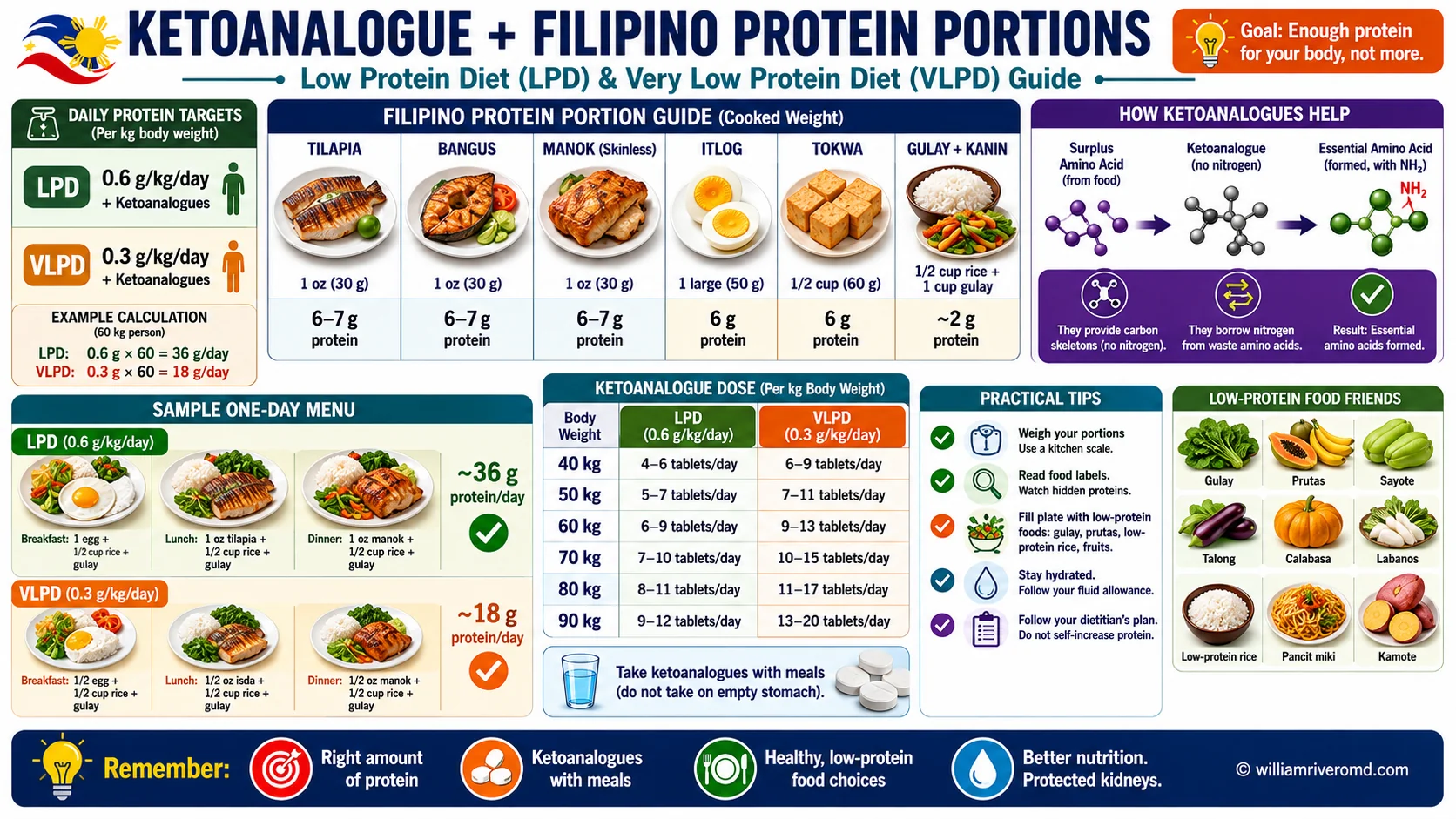
| CKD StageCKD StageCKD StageCKD Stage | Protein TargetTarget na ProtinaTarget nga ProtinaTarget a Protina | For 60 kg personPara sa taong 60 kgAlang sa tawo nga 60 kgPara king taung 60 kg | KA DoseKA DoseKA DoseKA Dose | Philippine Food GuideGabay sa Pagkaing PilipinoGiya sa Pagkaong PilipinoGabay king Pengan Pilipino |
|---|---|---|---|---|
| Stage 3b–4 eGFR 15–44 |
LPD: 0.6 g/kg/day | 36 g protein/day | Optional — monitorOpsyonal — subaybayanOpsyonal — bantayanOpsyonal — subaybayan | ~1 palm-sized fish + 1 egg + ½ cup monggo~1 palad-laking isda + 1 itlog + ½ tasang monggo~1 palad-kadako nga isda + 1 itlog + ½ tasa nga monggo~1 palad-laki a asan + 1 ebun + ½ tasang monggo |
| Stage 4–5 eGFR <25 |
VLPD: 0.3 g/kg/day | 18 g protein/day | Required (1 tab/5 kg)Kinakailangan (1 tab/5 kg)Gikinahanglan (1 tab/5 kg)Kailangan (1 tab/5 kg) | ~1 egg + ½ cup tofu daily; rice & root crops for calories~1 itlog + ½ tasang tofu araw-araw; kanin at ugat na pananim para sa calorie~1 itlog + ½ tasa nga tofu adlaw-adlaw; kan-on ug ugat nga tanom alang sa calorie~1 ebun + ½ tasang tofu aldo-aldo; nasi at ugat a tanaman para king calorie |
| CKD5d (dialysis) Well-nourishedMaayos ang nutrisyonMaayo ang nutrisyonMayap ing nutrisyon |
1.0–1.2 g/kg/day | 60–72 g protein/day | Not indicatedHindi inindikasyonDili girekomendarAli indikasyon | Fish, chicken, egg whites freely; dialysis removes ureaIsda, manok, egg whites nang malaya; inaalis ng dialysis ang ureaIsda, manok, egg whites nga gawasnon; ang dialysis nagkuha sa ureaAsan, manuk, egg whites a malaya; aalisan ne ning dialysis ing urea |
| CKD5d (malnourished) Albumin <3.5Albumin <3.5Albumin <3.5Albumin <3.5 |
Work toward 1.0–1.2 g/kgTumungo sa 1.0–1.2 g/kgPadulong sa 1.0–1.2 g/kgTumungu king 1.0–1.2 g/kg | Increase graduallyDahan-dahang taasanAnam-anam nga taasonMarimla-rimlang taasan | Bridge dose — nephrologist supervisedBridge dose — pinangangasiwaan ng nephrologistBridge dose — gidumala sa nephrologistBridge dose — pinangangasiwan ning nephrologist | Small frequent protein-containing meals; monitor serum Ca²⁺Maliliit at madalas na pagkaing may protina; subaybayan ang serum Ca²⁺Gagmay ug kanunay nga pagkaon nga may protina; bantayan ang serum Ca²⁺Malating masukal a pengan a atin protina; subaybayan ye ing serum Ca²⁺ |
✅ Safe Calorie Sources (Non-Protein)✅ Ligtas na Pinagkukunan ng Calorie (Hindi Protina)✅ Luwas nga Tinubdan sa Calorie (Dili Protina)✅ Ligtas a Pikuanan ning Calorie (Ali Protina)
- White rice, sinangagPuting kanin, sinangagPuti nga kan-on, sinangagMaputing nasi, sinangag
- Kamote (sweet potato)KamoteKamoteKamote
- Gabi, sagoGabi, sagoGabi, sagoGabi, sago
- Cassava, cornKamoteng-kahoy, maisKamoteng-kahoy, maisKamuting-dutung, mais
- Vegetable oils (coconut, canola)Mga langis ng gulay (niyog, canola)Mga lana sa utan (lubi, canola)Mga larì ning gulay (niyug, canola)
- Low-phosphorus vegetablesMga gulay na mababa sa phosphorusMga utan nga ubos sa phosphorusMga gulay a mababa king phosphorus
- Sago drinks (no milk)Mga inuming sago (walang gatas)Mga ilimnon nga sago (walay gatas)Mga inuming sago (alang gatas)
✅ Preferred Protein Sources on LPD/VLPD✅ Piniling Pinagkukunan ng Protina sa LPD/VLPD✅ Gipalabi nga Tinubdan sa Protina sa LPD/VLPD✅ Piling Pikuanan ning Protina king LPD/VLPD
- Egg whites (low phos, high bioavailability)Egg whites (mababa sa phos, mataas ang bioavailability)Egg whites (ubos sa phos, taas ang bioavailability)Egg whites (mababa king phos, matas ing bioavailability)
- Small portion bangus or tilapiaMaliit na bahagi ng bangus o tilapiaGamay nga bahin sa bangus o tilapiaMalating bahagi ning bangus o tilapia
- Tofu / tokwa (rinse to reduce K)Tofu / tokwa (banlawan upang bawasan ang K)Tofu / tokwa (hugasi aron makunhod ang K)Tofu / tokwa (banlawan ban babawasan ing K)
- Monggo (moderate portions)Monggo (katamtamang bahagi)Monggo (kasarangan nga bahin)Monggo (katamtaman a bahagi)
- Plant-based proteins preferredMas piniling protina mula sa halamanGipalabi ang protina gikan sa tanomMas piling protina manibat king tanaman
⚠ Limit on VLPD + KA⚠ Limitahan sa VLPD + KA⚠ Limitahi sa VLPD + KA⚠ Limitan king VLPD + KA
- Red meat, pork (high phos + N)Pulang karne, baboy (mataas sa phos + N)Pula nga karne, baboy (taas sa phos + N)Malutung laman, babi (matas king phos + N)
- Processed meats (tocino, longganisa)Mga prosesong karne (tocino, longganisa)Mga proseso nga karne (tocino, longganisa)Mga proseson a laman (tocino, longganisa)
- Dairy productsMga produktong dairyMga produktong dairyMga produktong dairy
- Nuts and seedsMga mani at butoMga mani ug lisoMga mani at butul
- Legumes in large amountsMga munggo/legumbre sa malaking damiMga legumbre sa dako nga gidaghanonMga legumbre king malaking dami
- Fast food and instant noodlesFast food at instant noodlesFast food ug instant noodlesFast food at instant noodles
Remember the calorie principle: The body prioritizes energy over protein synthesis. If you are not eating enough calories, your body will burn amino acids (from both diet and KA) for fuel instead of using them for tissue repair. On a very-low-protein diet, caloric intake from carbohydrates and healthy fats must be deliberately increased — not reduced. A renal dietitian consultation is strongly recommended.Tandaan ang prinsipyo ng calorie: Inuuna ng katawan ang enerhiya kaysa sa protein synthesis. Kung hindi kayo kumakain ng sapat na calorie, susunugin ng inyong katawan ang amino acids (mula sa diyeta at KA) bilang gatong sa halip na gamitin ang mga ito para sa pag-aayos ng tissue. Sa isang napakababang-protina na diyeta, ang paginom ng calorie mula sa carbohydrates at malusog na taba ay dapat sadyang taasan — hindi bawasan. Mariing inirerekomenda ang konsultasyon sa isang renal dietitian.Hinumdomi ang prinsipyo sa calorie: Giuna sa lawas ang enerhiya kaysa sa protein synthesis. Kon dili ka mokaon og igo nga calorie, sunogon sa imong lawas ang amino acids (gikan sa diyeta ug KA) isip sugnod imbes gamiton sila alang sa pag-ayo sa tissue. Sa usa ka hilabihan-ka-ubos-og-protina nga diyeta, ang pag-inom sa calorie gikan sa carbohydrates ug himsog nga tambok kinahanglan tinuyo nga taason — dili kunhoran. Kusganon nga girekomendar ang konsultasyon sa usa ka renal dietitian.Tandanan ye ing prinsipyu ning calorie: Uunan ne ning katawan ing enerhiya kesa king protein synthesis. Nung ali kang mangan ning sapat a calorie, susunugan ne ning katawan mu ing amino acids (manibat king diyeta at KA) bilang gatung imbes a gamitan la para king pag-ayus ning tissue. King metung a masiadung-babang-protina a diyeta, ing paginum ning calorie manibat king carbohydrates at malusog a taba dapat yang sadyang taasan — ali babawasan. Masikan a girerekomenda ing konsultasyon king metung a renal dietitian.
- Nausea, vomiting, constipation, excessive thirst, or confusion — these are symptoms of hypercalcemia (high calcium), the most serious side effect of KA, especially when combined with active vitamin D supplements.Pagduduwal, pagsusuka, tibi, labis na pagkauhaw, o pagkalito — ito ay mga sintomas ng hypercalcemia (mataas na calcium), ang pinakaseryosong side effect ng KA, lalo na kapag isinama sa active vitamin D supplement.Kalibang, pagsuka, kahilis, sobra nga kauhaw, o kalibog — kini mga simtomas sa hypercalcemia (taas nga calcium), ang pinakaseryoso nga side effect sa KA, ilabi na kon gikombina sa active vitamin D supplement.Panunuka, pagsuka, tibi, sobrang kaupian, o kalituhan — deni mga sintomas ning hypercalcemia (matas a calcium), ing pekaseryosong side effect ning KA, lalu na nung ikayabe king active vitamin D supplement.
- BUN or creatinine is rising despite taking KA — this almost always means the diet is not being restricted as prescribed. KA cannot compensate for an unrestricted protein intake. Review with your nephrologist urgently.Tumataas ang BUN o creatinine kahit umiinom ng KA — halos palaging nangangahulugan ito na hindi pinaghihigpitan ang diyeta ayon sa reseta. Hindi kayang bayaran ng KA ang di-pinipigilang paginom ng protina. Suriin kaagad kasama ang inyong nephrologist.Nagsaka ang BUN o creatinine bisan nag-inom og KA — hapit kanunay kini nagpasabot nga wala gipugngan ang diyeta sumala sa reseta. Dili mabayran sa KA ang wala-gipugngi nga pag-inom sa protina. Susiha dayon uban sa imong nephrologist.Tataas ing BUN o creatinine magkang minum ning KA — halos pane nang buri sabian a ali pipiget ing diyeta agpang king reseta. Ali kaya bayaran ning KA ing di-pipiget a paginum ning protina. Suriin me agad kayabe ing nephrologist mu.
- Muscle weakness, unintentional weight loss, or decreasing grip strength — possible signs of protein-calorie malnutrition developing on the low-protein diet. Caloric intake must be assessed immediately.Panghihina ng kalamnan, hindi sinasadyang pagbaba ng timbang, o humihinang lakas ng paghawak — posibleng mga palatandaan ng protein-calorie malnutrition na nagkakaroon sa low-protein na diyeta. Dapat suriin kaagad ang paginom ng calorie.Kahuyang sa kaunoran, wala-tuyoa nga pagkunhod sa timbang, o mikunhod nga kusog sa pagkupot — posible nga mga timailhan sa protein-calorie malnutrition nga naugmad sa low-protein nga diyeta. Kinahanglan susihon dayon ang pag-inom sa calorie.Kaluyan ning kalamnan, ali sinasadyang pangaus ning timbang, o mikaus a sikan ning pamanyubu — posibleng tanda ning protein-calorie malnutrition a manyari king low-protein a diyeta. Dapat suriin agad ing paginum ning calorie.
- New or worsening bone pain, fractures, or eye redness/haziness — advanced hypercalcemia can cause calcium deposits in joints, soft tissues, and the cornea (band keratopathy).Bago o lumalalang pananakit ng buto, bali, o pamumula/pagkalabo ng mata — ang advanced hypercalcemia ay maaaring magdulot ng calcium deposits sa mga kasukasuan, soft tissue, at sa cornea (band keratopathy).Bag-o o nagkalabad nga sakit sa bukog, bali, o pagkapula/pagkahanap sa mata — ang advanced hypercalcemia makahatag og calcium deposits sa mga lutahan, soft tissue, ug sa cornea (band keratopathy).Bayu o lulalang sakit ning butul, bali, o pamula/pangalablab ning mata — ing advanced hypercalcemia malyaring magdala ning calcium deposits king mga kasukasuan, soft tissue, at king cornea (band keratopathy).
- Calcium-containing antacids or supplements recently added to your regimen — total calcium intake must be recalculated. Avoid self-medicating with calcium-containing products while on KA.Calcium-containing antacids o supplement na kamakailang idinagdag sa inyong regimen — dapat muling kalkulahin ang kabuuang calcium intake. Iwasan ang pagpapa-gamot sa sarili ng calcium-containing products habang nasa KA.Calcium-containing antacids o supplement nga bag-o lang gidugang sa imong regimen — kinahanglan usbon pag-ihap ang kinatibuk-ang calcium intake. Likayi ang pagpanambal sa kaugalingon og calcium-containing products samtang naa sa KA.Calcium-containing antacids o supplement a bayu mu midagdag king regimen mu — dapat kalkulan pasibayu ing kabuuang calcium intake. Painan me ing pagpapa-gamut king sarili ning calcium-containing products kabang atiu king KA.

For prescribers from non-nephrology specialties: If you are prescribing KA for a patient with cardiorenal syndrome, diabetic nephropathy, or any elevated creatinine not formally staged by a nephrologist, please consider the following before continuing:Para sa mga nagrereseta mula sa mga espesyalidad na hindi nephrology: Kung nagrereseta kayo ng KA para sa isang pasyenteng may cardiorenal syndrome, diabetic nephropathy, o anumang mataas na creatinine na hindi pormal na na-stage ng isang nephrologist, mangyaring isaalang-alang ang mga sumusunod bago magpatuloy:Alang sa mga nagreseta gikan sa mga espesyalidad nga dili nephrology: Kon nagreseta ka og KA alang sa usa ka pasyente nga may cardiorenal syndrome, diabetic nephropathy, o bisan unsang taas nga creatinine nga wala pormal nga na-stage sa usa ka nephrologist, palihug hunahunaa ang mosunod una magpadayon:Para karing magreseta manibat karing espesyalidad a ali nephrology: Nung magreseta kang KA para king metung a pasyente a atin cardiorenal syndrome, diabetic nephropathy, o ninumang matas a creatinine a ali pormal a me-stage ning metung a nephrologist, pakisuyu isaalang-alang me ing mga tutuki bayu magpatuloy:
- Has a 24-hour urine protein or urine ACR (albumin-to-creatinine ratio) been measured? Has CKD stage been formally confirmed?Nasukat na ba ang 24-hour urine protein o urine ACR (albumin-to-creatinine ratio)? Napormal na bang nakumpirma ang CKD stage?Nasukod na ba ang 24-hour urine protein o urine ACR (albumin-to-creatinine ratio)? Napormal na ba nga nakumpirma ang CKD stage?Mesukat na ba ing 24-hour urine protein o urine ACR (albumin-to-creatinine ratio)? Mepormal na bang mekumpirma ing CKD stage?
- Has dietary protein intake been assessed? Is the patient on a protein-restricted diet?Nasuri na ba ang dietary protein intake? Nasa protein-restricted na diyeta ba ang pasyente?Nasusi na ba ang dietary protein intake? Naa ba sa protein-restricted nga diyeta ang pasyente?Mesuri na ba ing dietary protein intake? Atiu ya ba king protein-restricted a diyeta ing pasyente?
- Has baseline serum calcium been checked? Is the patient on active vitamin D, calcium supplements, or calcium-containing phosphate binders?Nasuri na ba ang baseline serum calcium? Nasa active vitamin D, calcium supplement, o calcium-containing phosphate binders ba ang pasyente?Nasusi na ba ang baseline serum calcium? Naa ba sa active vitamin D, calcium supplement, o calcium-containing phosphate binders ang pasyente?Mesuri na ba ing baseline serum calcium? Atiu ya ba king active vitamin D, calcium supplement, o calcium-containing phosphate binders ing pasyente?
- Is there a nephrology referral in place? KA initiation without a coordinated dietary plan and monitoring schedule represents incomplete prescribing.May nakalagay bang nephrology referral? Ang pagsisimula ng KA nang walang nakoordinang plano sa diyeta at iskedyul ng pagsubaybay ay kumakatawan sa hindi kumpletong pagrereseta.Aduna bay nephrology referral? Ang pagsugod sa KA nga walay gikoordinar nga plano sa diyeta ug iskedyul sa pagbantay nagrepresentar sa dili kompleto nga pagreseta.Atin ba nakalagay a nephrology referral? Ing pamagsimula ning KA a alang nakoordinang plano king diyeta at iskedyul ning pamanyubaybay kakatawanan na ing ali kumpletong pagreseta.
Co-prescribing KA without dietary restriction does not delay dialysis — but it does add daily calcium load and cost to a patient who derives no benefit.Ang pag-co-prescribe ng KA nang walang paghihigpit sa diyeta ay hindi nag-aantala ng dialysis — ngunit nagdaragdag ito ng araw-araw na calcium load at gastos sa isang pasyenteng walang nakukuhang benepisyo.Ang pag-co-prescribe sa KA nga walay pagpugong sa diyeta dili maglangan sa dialysis — apan nagdugang kini og adlaw-adlaw nga calcium load ug gasto sa usa ka pasyente nga walay makuha nga benepisyo.Ing pag-co-prescribe ning KA a alang pamipilit king diyeta ali maantala king dialysis — dapot magdaragdag yang aldo-aldo a calcium load at gastos king metung a pasyente a alang akukua a benepisyu.
Ketoanalogues are not a "start and forget" prescription. Regular monitoring is essential to confirm the intervention is working, catch complications early, and reassess the indication as kidney function changes.Ang ketoanalogues ay hindi isang "simulan at kalimutan" na reseta. Mahalaga ang regular na pagsubaybay upang kumpirmahin na gumagana ang interbensiyon, mahuli nang maaga ang mga komplikasyon, at muling suriin ang indikasyon habang nagbabago ang paggana ng bato.Ang ketoanalogues dili usa ka "sugdi ug kalimti" nga reseta. Importante ang regular nga pagbantay aron kumpirmahon nga molihok ang interbensiyon, madakpan sayo ang mga komplikasyon, ug susihon pag-usab ang indikasyon samtang nagbag-o ang paglihok sa kidney.Ing ketoanalogues ali ya metung a "simulan at kalimutan" a reseta. Mahalaga ing regular a pamanyubaybay ban kumpirman a gagana ing interbensiyon, adakap nang maaga ing mga komplikasyon, at suriin pasibayu ing indikasyon kabang mibabayu ing paggana ning batu.
| ParameterParameterParameterParameter | FrequencyDalasKasagbatDalas | Target (CKD Pre-dialysis)Target (CKD Bago-dialysis)Target (CKD Wala-pa-dialysis)Target (CKD Bayu-dialysis) | Action if AbnormalAksiyon kung AbnormalAksiyon kon AbnormalAksiyon nung Abnormal | PriorityPrayoridadPrayoridadPrayoridad |
|---|---|---|---|---|
| Serum Calcium | Monthly × 3, then every 3 monthsBuwanan × 3, pagkatapos tuwing 3 buwanBinulan × 3, dayon matag 3 ka bulanBulan-bulan × 3, kaibat balang 3 bulan | 8.4–10.2 mg/dL | Reduce KA dose; withhold active vitamin D; increase hydrationBawasan ang KA dose; ipagpaliban ang active vitamin D; dagdagan ang hydrationKunhori ang KA dose; ipahulat ang active vitamin D; dugangi ang hydrationBawasan ing KA dose; ipagpaliban ing active vitamin D; dagdagan ing hydration | URGENT |
| BUN / Urea | MonthlyBuwananBinulanBulan-bulan | Declining trendBumababang tendensyaNagkunhod nga tendensiyaKukaus a tendensya | Rising BUN = diet non-adherence; review protein intake with dietitianTumataas na BUN = hindi pagsunod sa diyeta; suriin ang paginom ng protina kasama ang dietitianNagsaka nga BUN = wala pagsunod sa diyeta; susiha ang pag-inom sa protina uban sa dietitianTataas a BUN = ali pagsunud king diyeta; suriin ing paginum ning protina kayabe ing dietitian | MONITOR |
| eGFR (CKD-EPI 2021) | Every 3 monthsTuwing 3 buwanMatag 3 ka bulanBalang 3 bulan | Stable or declining <3 mL/min/yrMatatag o bumababa nang <3 mL/min/taonLig-on o nagkunhod nga <3 mL/min/tuigMatatag o kukaus a <3 mL/min/banua | Rapid decline = reassess dietary adherence, BP control, proteinuriaMabilis na pagbaba = muling suriin ang pagsunod sa diyeta, kontrol ng BP, proteinuriaPaspas nga pagkunhod = susiha pag-usab ang pagsunod sa diyeta, kontrol sa BP, proteinuriaMabilis a pangaus = suriin pasibayu ing pagsunud king diyeta, kontrol ning BP, proteinuria | MONITOR |
| Serum Albumin | Every 3 monthsTuwing 3 buwanMatag 3 ka bulanBalang 3 bulan | ≥4.0 g/dL | <3.5 g/dL = malnutrition signal; increase caloric intake; dietitian referral<3.5 g/dL = hudyat ng malnutrisyon; dagdagan ang paginom ng calorie; referral sa dietitian<3.5 g/dL = timailhan sa malnutrisyon; dugangi ang pag-inom sa calorie; referral sa dietitian<3.5 g/dL = hudyat ning malnutrisyon; dagdagan ing paginum ning calorie; referral king dietitian | MONITOR |
| Serum Phosphorus | Every 3 monthsTuwing 3 buwanMatag 3 ka bulanBalang 3 bulan | 3.5–5.5 mg/dL | Elevated phos despite KA = hidden dietary phosphorus sources; review dietMataas na phos kahit may KA = nakatagong pinagkukunan ng phosphorus sa diyeta; suriin ang diyetaTaas nga phos bisan may KA = tinago nga tinubdan sa phosphorus sa diyeta; susiha ang diyetaMatas a phos magkang atin KA = makasalikut a pikuanan ning phosphorus king diyeta; suriin ing diyeta | MONITOR |
| Body weight & muscle mass | Every visitBawat pagbisitaMatag bisitaBalang pamanialan | Stable weight; no sarcopeniaMatatag na timbang; walang sarcopeniaLig-on nga timbang; walay sarcopeniaMatatag a timbang; alang sarcopenia | Weight loss >5% = caloric deficit; increase non-protein calorie sourcesPagbaba ng timbang >5% = kakulangan sa calorie; dagdagan ang non-protein na pinagkukunan ng caloriePagkunhod sa timbang >5% = kakulangan sa calorie; dugangi ang non-protein nga tinubdan sa caloriePangaus ning timbang >5% = kakulangan king calorie; dagdagan ing non-protein a pikuanan ning calorie | ROUTINE |
| nPCR (if available) | Every 6 monthsTuwing 6 buwanMatag 6 ka bulanBalang 6 bulan | 0.3–0.6 g/kg/day on VLPD | nPCR >0.6 = protein intake exceeds prescription; dietary counselingnPCR >0.6 = lumalampas ang paginom ng protina sa reseta; dietary counselingnPCR >0.6 = milapas ang pag-inom sa protina sa reseta; dietary counselingnPCR >0.6 = lumalampas ing paginum ning protina king reseta; dietary counseling | ROUTINE |
| Reassess KA indication | Every 6–12 monthsTuwing 6–12 buwanMatag 6–12 ka bulanBalang 6–12 bulan | — | If eGFR <10 or dialysis imminent: transition plan; if on dialysis: discontinue unless malnourishedKung eGFR <10 o nalalapit ang dialysis: transition plan; kung nasa dialysis: ihinto maliban kung malnourishedKon eGFR <10 o haduol na ang dialysis: transition plan; kon naa sa dialysis: hunonga gawas kon malnourishedNung eGFR <10 o malapit ing dialysis: transition plan; nung atiu king dialysis: patugtan liban nung malnourished | ROUTINE |
When to stop ketoanalogues: (1) When dialysis is initiated and nutritional status is adequate; (2) Persistent hypercalcemia despite dose reduction; (3) Patient cannot maintain adequate caloric intake alongside protein restriction; (4) eGFR has recovered above 30 mL/min/1.73m² (rare but possible in treated glomerulonephritis); (5) Patient non-adherence to dietary protein restriction — KA without the diet is expensive and potentially harmful.Kailan ihihinto ang ketoanalogues: (1) Kapag sinimulan ang dialysis at sapat na ang katayuan sa nutrisyon; (2) Nagpapatuloy na hypercalcemia kahit binawasan ang dosis; (3) Hindi kayang panatilihin ng pasyente ang sapat na paginom ng calorie kasabay ng paghihigpit sa protina; (4) Nakabawi ang eGFR sa itaas ng 30 mL/min/1.73m² (bihira ngunit posible sa ginamot na glomerulonephritis); (5) Hindi pagsunod ng pasyente sa paghihigpit ng protina sa diyeta — mahal at posibleng nakakapinsala ang KA nang walang diyeta.Kanus-a hunongon ang ketoanalogues: (1) Kon gisugdan ang dialysis ug igo na ang kahimtang sa nutrisyon; (2) Nagpadayon nga hypercalcemia bisan gikunhoran ang dosis; (3) Dili mahuptan sa pasyente ang igo nga pag-inom sa calorie uban sa pagpugong sa protina; (4) Nakaulhi ang eGFR labaw sa 30 mL/min/1.73m² (talagsa apan posible sa gitambalan nga glomerulonephritis); (5) Wala pagsunod sa pasyente sa pagpugong sa protina sa diyeta — mahal ug posible nga makadaot ang KA nga walay diyeta.Kapilan patugtan ing ketoanalogues: (1) Nung sinimulan ing dialysis at sapat na ing katayuan king nutrisyon; (2) Tuluy-tuluy a hypercalcemia magkang binawasan ing dosis; (3) Ali kaya panatilian ning pasyente ing sapat a paginum ning calorie kayabe ning pamipilit king protina; (4) Mekabawi ing eGFR king babo ning 30 mL/min/1.73m² (bihira dapot posible king gineramutan a glomerulonephritis); (5) Ali pagsunud ning pasyente king pamipilit ning protina king diyeta — mal at posibleng makapiyasakit ing KA a alang diyeta.