Electrolytes · Clinical Calculator · Dysnatremia

Dysnatremia Physiology Toolkit Tonicity · Water Deficit · Free-Water Clearance · Fluids · Solute

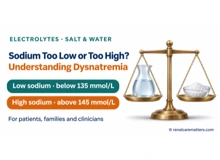
Five transparent physiology tools that sit beside the bedside decisions in hyponatremia and hypernatremia: a tonicity and glucose-corrected sodium workbench, a water-deficit and ongoing-loss planner with a total-body-water sensitivity range, an electrolyte-free water clearance and fluid-restriction workbench, a fluid sodium/potassium scenario explorer, and a solute and urea explainer. Every result shows its inputs, units, formula and assumptions.

Published: References: 9 Read time:

← All calculators & tools  ·  Related guide →

Last ReviewedHuling Na-reviewKatapusang Na-reviewKarinan Na-review:
Instructions
  1. Each tool has its own inputs; units are stated beside every field. Leave a field empty if you do not have it — missing is never treated as zero.
  2. Results keep full precision internally and round only for display.
  3. Use contemporaneous samples (plasma and urine collected together) for the clearance tool.

Everything runs in your browser; nothing is stored or sent.

Tonicity & Glucose-Corrected Sodium Workbench

Answers the first question in every low sodium: is the plasma actually hypotonic? Effective tonicity uses the measured sodium. The glucose-corrected sodium is shown with both published coefficients side by side to estimate what the sodium would be once glucose falls.

Urea in mg/dL is not BUN: BUN = urea mg/dL × 0.467.

Hypernatremia Water-Deficit & Ongoing-Loss Planner

Estimates the free-water deficit to a chosen interim target, shows how much it moves with the total body water (TBW) assumption, and adds the losses that keep happening while you replace it. Restore perfusion first in shock.

Deficit to 140 and deficit to an interim target are different quantities.
Conventional starting values 0.5–0.6; lower in older or water-depleted adults. Editable on purpose.
From tool 3. Negative values mean the kidneys are retaining free water.
Count only the free-water fraction: 0.45% saline ≈ half free water; 0.9% saline ≈ none.

Electrolyte-Free Water Clearance & Restriction-Response Workbench

Shows whether the kidneys are currently excreting or retaining water relative to sodium plus potassium — the physiology behind why fluid restriction fails in some people with the syndrome of inappropriate antidiuresis (SIAD).

Fluid Sodium & Potassium Scenario Explorer

Compares what different fluids would do to plasma sodium in a simplified closed system. Potassium counts: it enters cells in exchange for sodium and raises plasma sodium almost as much as sodium does.

Weight × chosen coefficient.

Solute & Urea Explainer

When urine concentration is fixed by vasopressin, the volume of water the kidneys can excrete is set by how many osmoles are available to carry it. This is why “tea and toast” diets and beer drinking cause hyponatremia, and why urea and protein help in SIAD.

Measured from a 24-h urine, or estimated; a typical mixed diet yields roughly 600–900.

Formulae & Evidence

Formulae (version DYSNA-K 1.0)

QuantityEquation
Calculated osmolarity2 × Na + glucose/18 + BUN/2.8 (mg/dL) · SI: 2 × Na + glucose + urea (mmol/L)
Effective tonicity2 × Na + glucose/18 · SI: 2 × Na + glucose
Osmolal gapMeasured osmolality − calculated osmolarity (practical approximation)
Glucose-corrected sodiumNa + c × (glucose mg/dL − 100)/100, c = 1.6 and 2.4 (Hillier et al., 1999)
Water deficitTBW × (current Na ÷ target Na − 1); TBW = weight × coefficient
Electrolyte-free water clearanceV × [1 − (UNa + UK) ÷ PNa]
One-liter estimateΔNa = (infusate Na + K − serum Na) ÷ (TBW + 1) (Adrogué–Madias)
Finite volumeNanew = (TBW × Na + V × (infusate Na + K)) ÷ (TBW + V)
Solute-limited urineUrine volume (L/day) ≈ osmoles (mOsm/day) ÷ urine osmolality (mOsm/kg); urea mOsm = g ÷ 60.06 × 1000

Key numbers

  • Fluid restriction of 1 L/day raised sodium by a median 3 mmol/L at day 3 versus 1 mmol/L without treatment in chronic SIAD (n = 46); more than one-third did not reach 130 mmol/L (Garrahy et al., 2020).
  • EFFLUX-FLUID enrolled patients with at least one predictor of restriction failure — urine osmolality above 500 mOsm/kg, urine sodium plus potassium above plasma sodium, or urine volume below 1,500 mL/day (Jaiyen et al., 2026). These are enrichment criteria, not a validated score.
  • Oral urea raised sodium by a mean 9.6 mmol/L over a median 5 days in observational studies (23 studies, 537 patients); no randomized trials (Wendt et al., 2023).
Important: These tools are educational physiology aids for clinicians. They do not diagnose or prescribe. Confirm product composition, follow your approved protocol, and let the measured sodium govern every decision.
References 9 sources
  1. Hillier, T. A., Abbott, R. D., & Barrett, E. J. (1999). Hyponatremia: Evaluating the correction factor for hyperglycemia. The American Journal of Medicine, 106(4), 399–403. https://doi.org/10.1016/s0002-9343(99)00055-8
  2. Adrogué, H. J., Tucker, B. M., & Madias, N. E. (2022). Diagnosis and management of hyponatremia: A review. JAMA, 328(3), 280–291. https://doi.org/10.1001/jama.2022.11176
  3. Spasovski, G., Vanholder, R., Allolio, B., Annane, D., Ball, S., Bichet, D., Decaux, G., Fenske, W., Hoorn, E. J., Ichai, C., Joannidis, M., Soupart, A., Zietse, R., Haller, M., van der Veer, S., Van Biesen, W., & Nagler, E. (2014). Clinical practice guideline on diagnosis and treatment of hyponatraemia. European Journal of Endocrinology, 170(3), G1–G47. https://doi.org/10.1530/EJE-13-1020
  4. Yun, G., Baek, S. H., & Kim, S. (2023). Evaluation and management of hypernatremia in adults: Clinical perspectives. The Korean Journal of Internal Medicine, 38(3), 290–302. https://doi.org/10.3904/kjim.2022.346
  5. Tomkins, M., Mc Donald, D., Green, D., O'Reilly, M. W., & Sherlock, M. (2026). Diagnosis and treatment of hypernatremia. Best Practice & Research Clinical Endocrinology & Metabolism, 40(1), 102065. https://doi.org/10.1016/j.beem.2025.102065
  6. Garrahy, A., Galloway, I., Hannon, A. M., Dineen, R., O'Kelly, P., Tormey, W. P., O'Reilly, M. W., Williams, D. J., Sherlock, M., & Thompson, C. J. (2020). Fluid restriction therapy for chronic SIAD; results of a prospective randomized controlled trial. The Journal of Clinical Endocrinology & Metabolism, 105(12), e4360. https://doi.org/10.1210/clinem/dgaa619
  7. Jaiyen, N., Chinpraditsuk, S., Pattharanitima, P., Tantiyavarong, P., & Krisanapan, P. (2026). Efficacy of low-dose tolvaptan for treatment of profound hyponatremia in syndrome of inappropriate antidiuresis (SIAD): The EFFLUX-FLUID trial. Kidney Medicine, 8(3), 101239. https://doi.org/10.1016/j.xkme.2025.101239
  8. Wendt, R., Fenves, A. Z., & Geisler, B. P. (2023). Use of urea for the syndrome of inappropriate secretion of antidiuretic hormone: A systematic review. JAMA Network Open, 6(10), e2340313. https://doi.org/10.1001/jamanetworkopen.2023.40313
  9. Garrett, R. E., Wagner, B., Sam, R., Unruh, M. L., Lew, S. Q., Argyropoulos, C. P., Roumelioti, M.-E., Malhotra, D., Rohrscheib, M., Vigil, D., Ing, T. S., & Tzamaloukas, A. H. (2026). Hypotonic hyponatremia: Diagnosis and management. Journal of Clinical Medicine, 15(20), 8056. https://doi.org/10.3390/jcm15208056
Dr. W Rivero, MD

W Rivero, MD, FPCP, DPSN

Specialist in Internal Medicine, Nephrology, and Clinical Nutrition. Practicing integrative and evidence-based nephrology across Quezon City, Pampanga, and Bulacan.

· Book an Appointment →

QR code — scan to save Dr. Rivero's contact info

Scan and save

All Calculators Related Guides