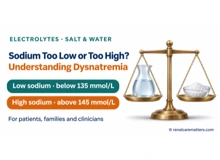
Emergency care comes before this tool
Seizures, coma, marked drowsiness, or breathing difficulty with suspected hypotonic hyponatremia need emergency treatment from a named protocol now. Do not delay for urine tests or for this tracker. Nothing on this page orders a fluid, a drug, or a dialysis setting, and no result here means a patient is safe.
- Choose the direction you are monitoring: a rising sodium during hyponatremia treatment, or a falling sodium during hypernatremia treatment.
- Record the onset. Unknown onset is handled as chronic.
- Select the named protocol whose ceilings you are following (or enter your institution’s values). The tracker never chooses ceilings for you.
- Enter each sodium with its collection date, time and time zone (not the result time). Add treatment events in the note column (no names or hospital numbers).
All computation runs in your browser. Nothing is stored or sent. Reloading the page clears every entry.
When to Use
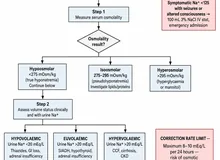
Use it while sodium is being actively corrected — after hypertonic saline, isotonic fluid in hypovolemia, glucocorticoid replacement, stopping a thiazide, refeeding, tolvaptan or urea, and during free-water replacement in hypernatremia. Those are exactly the moments when a water diuresis can accelerate correction between blood draws. See the dysnatremia guide for the clinical pathway.
What this tool does not do
It does not estimate the probability of osmotic demyelination syndrome (ODS), predict a future sodium, select a fluid or a desmopressin dose, or label any course “safe.” A short-interval rate is never presented as a 24-hour result. Sparse sampling can hide a peak, so incomplete windows are flagged rather than reassured.
Sodium Trajectory & Correction-Limit Tracker
Risk factors for osmotic demyelination (recorded separately; not a score)
Sodium observations
| Collected (date, time) | Sodium (mmol/L) | Method | Event / treatment note |
|---|
⚕ Interval rate = (Naj − Nai) ÷ elapsed hours. Window maximum = the largest change between any two measured values collected within W hours of each other (W = 24 or 48), with its actual elapsed time. Equal to a ceiling = “at limit”; greater = “exceeded”; both compared before rounding. Formula version DYSNA-K 1.0.
Formulae & Evidence
Formulae
| Quantity | Definition |
|---|---|
| Baseline-to-current change | Latest sodium − first sodium entered (the first entry is your episode reference) |
| Interval rate | (Naj − Nai) ÷ hours between consecutive collections |
| Observed 24/48-hour maximum | max over all pairs i < j with 0 < tj − ti ≤ W of (Naj − Nai) for a rise, or (Nai − Naj) for a fall |
| Coverage | “Incomplete” when the entries span less than 24 hours; “sparse” when two consecutive samples are more than 6 hours apart |
Protocol ceilings offered (quoted, not merged)
- Conservative default for chronic or unknown onset: ≤8 mmol/L in any 24 h with a lower working target — an editorial safety choice for this site, not a claim that every guideline uses 8.
- US/Irish expert recommendations, usual risk: limits of 10–12 mmol/L in 24 h and 18 mmol/L in 48 h, aiming below the limit; high ODS risk: aim 4–6 mmol/L/day and avoid more than 8 in any 24 h (Verbalis et al., 2013; Sterns et al., 2024).
- European guideline (2014): ≤10 mmol/L in the first 24 h and ≤8 mmol/L in each subsequent 24 h (Spasovski et al., 2014).
- Hypernatremia, chronic or unknown: conventional practice limits the fall to about 0.5 mmol/L/h and 10–12 mmol/L per day; adult evidence is observational and conflicting (Yun et al., 2023; You et al., 2026).
Key numbers
- Osmotic demyelination: 0.23% overall in 11 cohorts (26,710 patients); 0.73% after rapid versus 0.10% after non-rapid correction (odds ratio 3.16, 95% confidence interval 1.54–6.49). Group incidences, not an individual risk (Suppadungsuk et al., 2025).
- SALSA: overcorrection occurred in 17.2% with intermittent boluses and 24.2% with continuous infusion of 3% saline, with 6-hourly sampling (Baek et al., 2021).