- Residual kidney function: enter the measured 24-hour urine volume (mL) and press Check for an interpretation band and protective advice. A formal residual GFR still requires a timed urine collection.
- spKt/V, URR & eKt/V: enter pre- and post-dialysis BUN, session duration (hours), ultrafiltration volume (L), and post-dialysis weight (kg). Calculate returns URR, single-pool Kt/V (Daugirdas), and equilibrated Kt/V, each with a target badge.
- UFR limit: enter pre-dialysis weight, dry/target weight, and session hours to get the ultrafiltration rate and the maximum UF volumes that keep UFR ≤ 10 and ≤ 13 mL/h/kg.
- nPCR: enter the current pre-BUN, the previous session's post-BUN, post-dialysis weight, sex, interdialytic weight gain, and interdialytic interval (2 or 3 days) for the normalized protein catabolic rate.
- PD weekly Kt/V: enter the 24-hour dialysate volume and BUN, the paired serum BUN, body weight, sex, and residual urea clearance (Kru, 0 if anuric) to get dialysate, renal, and total weekly Kt/V.
All computation runs in your browser; no values are stored or transmitted. Verify against your dialysis software before changing any prescription.
When to Use
This is a grouped toolset for dialysis prescription work. Use it to estimate residual kidney function (RKF) from a 24-hour urine volume, to compute hemodialysis adequacy (single-pool and equilibrated Kt/V plus URR) and the ultrafiltration-rate (UFR) limit, to derive the normalized protein catabolic rate (nPCR) as a marker of protein intake, and to calculate peritoneal dialysis weekly Kt/V. Together they cover the core numbers reviewed when writing or adjusting an HD or PD prescription.
Appropriate use
Clinicians (and informed patients) prescribing or reviewing maintenance hemodialysis or peritoneal dialysis. The HD tools need correctly timed pre- and post-dialysis BUN values and session details; nPCR needs the post-BUN from the preceding session; the PD tool needs a 24-hour dialysate collection with a paired serum BUN; the RKF tool needs a measured 24-hour urine volume.
When NOT to rely on it
Single-pool Kt/V overestimates the equilibrated dose; the nPCR two-session method assumes a steady metabolic state and accurate BUN sampling. The RKF urine-volume bands are an educational guide — a formal residual GFR requires a timed urine collection with serum/urine urea and creatinine. Verify every result against your dialysis software before changing a prescription, and interpret in the full clinical context (fluid status, nutrition, comorbidity).
Pearls & Pitfalls
Time is the most powerful lever
When Kt/V is below target, extending session time is usually the most reliable fix and simultaneously lowers the ultrafiltration rate. Each additional 30 minutes meaningfully improves clearance and reduces UFR by roughly 10–15% — often a better first move than chasing higher blood-flow rates alone.
Protect residual kidney function
Even a few hundred milliliters of urine per day adds clearance, eases fluid and potassium control, and can justify incremental dialysis. Preserve it by avoiding NSAIDs, aminoglycosides, and iodinated contrast, by controlling blood pressure, and by avoiding repeated intradialytic hypotension from aggressive ultrafiltration.
Pitfalls
(1) Single-pool Kt/V overestimates the true equilibrated dose because of urea rebound — use eKt/V when judging borderline adequacy. (2) nPCR is invalid if the previous session's post-BUN is mistimed or the patient is not in a steady metabolic state. (3) The PD calculation requires a complete 24-hour dialysate collection paired with a same-day serum BUN; an incomplete drain underestimates Kt/V. (4) These tools assume accurate, correctly timed BUN sampling — always verify results against your dialysis software before changing a prescription.
Why Use It
Dialysis dose, ultrafiltration rate, protein nutrition, and residual kidney function each independently influence how a dialysis patient feels and survives. Under-dosing (low Kt/V) raises mortality; an excessive ultrafiltration rate (> 13 mL/h/kg) is linked to intradialytic hypotension and cardiovascular death; a low nPCR signals inadequate protein intake or hypercatabolism; and preserved residual kidney function contributes meaningful clearance that can justify incremental dialysis. Quantifying all of these from routine labs turns a prescription review into a series of explicit, target-anchored decisions rather than guesswork.
Dialysis Prescription Calculators
Five interactive tools for HD and PD prescription work — residual kidney function, spKt/V & URR & eKt/V, ultrafiltration rate limit, nPCR, and PD weekly Kt/V. All formulae per Daugirdas / KDOQI 2015 / ISPD 2014. Results support clinical decision-making — verify with your dialysis software before adjusting prescriptions.
Residual Kidney Function — Does My Remaining Urine Still Count?
If the patient still produces urine, the native kidneys are still contributing to waste removal — and this can be credited in the dialysis dose. Enter the 24-hour urine volume to see what it means.
1 — spKt/V, URR & eKt/V
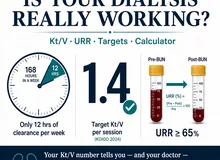
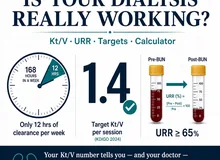
Daugirdas 2nd-generation formula for spKt/V; KDOQI conversion for eKt/V. Targets: spKt/V ≥1.4, eKt/V ≥1.2, URR ≥65%.
2 — Ultrafiltration Rate (UFR) Limit
UFR >13 mL/hr/kg is independently associated with increased cardiovascular mortality (KDOQI). Target <10 mL/hr/kg; maximum 13 mL/hr/kg.
3 — Normalized Protein Catabolic Rate (nPCR)
Two-session method (Depner-Daugirdas): requires post-BUN from the preceding session. Target nPCR ≥1.0 g/kg/day (KDOQI); 1.0–1.2 optimal.
Formula: UNA = [(Cpre2 − Cpost1) × V + Cpre2 × ΔW] ÷ (tid × 100) g N/day → PCR = 6.25 × UNA + 0.031 × W → nPCR = PCR ÷ W
4 — PD Weekly Kt/V (Adequacy)
Collects 24-hour dialysate effluent simultaneously with a mid-collection blood draw. Combines dialysate + residual clearance. Target total weekly Kt/V ≥1.7 (ISPD 2014).
Next Steps
Use the result to support — not replace — clinical judgment.
- Interpret the value against the targets shown in the calculator and the Evidence section below, in the context of the full clinical picture.
- Trend serial measurements rather than acting on a single result; confirm abnormal or unexpected values before changing management.
- Apply the relevant KDIGO / specialty-guideline threshold and document the indication.
- Escalate or refer to nephrology when results are out of range, rapidly changing, or discordant with the clinical picture — and discuss the implications with the patient.
Evidence & References
Formula & Equations
| Quantity | Equation |
|---|---|
| Single-pool Kt/V (Daugirdas 2nd generation) | spKt/V = −ln(R − 0.008 × t) + (4 − 3.5 × R) × UF ÷ W, with R = post-BUN/pre-BUN, t = hours, W = post-dialysis weight |
| Equilibrated Kt/V (KDOQI rate equation) | eKt/V = spKt/V − 0.6 × (spKt/V ÷ t) + 0.03 |
| Urea reduction ratio (URR) | URR = (1 − post-BUN/pre-BUN) × 100% |
| Ultrafiltration rate (UFR) | UFR = UF volume (mL) ÷ (session hours × dry weight kg); max UF = 10 (or 13) × t × W ÷ 1000 L |
| Total body water (V) for nPCR/PD | V = 0.58 × W (male) or 0.49 × W (female) |
| Urea nitrogen appearance (UNA) | UNA = [(Cpre − Cpost) × V + Cpre × ΔW] ÷ (tid × 100) g N/day |
| Normalized protein catabolic rate (nPCR) | PCR = 6.25 × UNA + 0.031 × W; nPCR = PCR ÷ W |
| PD daily dialysate Kt/V | (dialysate BUN × dialysate volume) ÷ (serum BUN × V) |
| PD total weekly Kt/V | 7 × daily dialysate Kt/V + (Kru × 10,080 ÷ (V × 1000)) renal Kt/V |
Target reference ranges
| Metric | Target |
|---|---|
| Single-pool Kt/V (thrice-weekly HD) | ≥ 1.4 (minimum delivered ≥ 1.2) — KDOQI 2015 |
| Equilibrated Kt/V | ≥ 1.2 |
| Urea reduction ratio | ≥ 65% |
| Ultrafiltration rate | < 10 mL/h/kg preferred; ≤ 13 mL/h/kg maximum |
| nPCR | ≥ 1.0 g/kg/day (1.0–1.2 optimal) |
| PD total weekly Kt/V | ≥ 1.7 (ISPD 2014) |
The spKt/V equation is the Daugirdas second-generation formula; eKt/V uses the rate-adjustment approximation that accounts for post-dialysis urea rebound. nPCR uses the two-session (Depner–Daugirdas) urea-kinetic approach. PD weekly Kt/V follows the standard dialysate/serum urea-clearance method with a residual renal term.
Evidence & References
The HD adequacy formulae are the Daugirdas second-generation spKt/V and the KDOQI rate equation for eKt/V; dose targets and the UFR ceiling come from the KDOQI 2015 Hemodialysis Adequacy update, with the UFR–mortality association from observational dialysis cohorts. nPCR is derived from urea-kinetic modeling (Depner, Daugirdas). PD weekly Kt/V targets follow the ISPD adequacy guidance.
- Daugirdas JT. Second generation logarithmic estimates of single-pool variable volume Kt/V: an analysis of error. J Am Soc Nephrol. 1993;4(5):1205–1213.
- National Kidney Foundation. KDOQI Clinical Practice Guideline for Hemodialysis Adequacy: 2015 Update. Am J Kidney Dis. 2015;66(5):884–930.
- Depner TA, Daugirdas JT. Equations for normalized protein catabolic rate based on two-point modeling of hemodialysis urea kinetics. J Am Soc Nephrol. 1996;7(5):780–785.
- Lo WK, Bargman JM, Burkart J, et al. (International Society for Peritoneal Dialysis). Guideline on targets for solute and fluid removal in adult patients on chronic peritoneal dialysis. Perit Dial Int. 2006;26(5):520–522.
- Flythe JE, Kimmel SE, Brunelli SM. Rapid fluid removal during dialysis is associated with cardiovascular morbidity and mortality. Kidney Int. 2011;79(2):250–257.
- Watson PE, Watson ID, Batt RD. Total body water volumes for adult males and females estimated from simple anthropometric measurements. Am J Clin Nutr. 1980;33(1):27–39.