After this module you should be able to
- Describe how infection risk changes over the first year and why rejection treatment raises it again.
- Explain cytomegalovirus (CMV) risk by donor and recipient serostatus, and the difference between prophylaxis and preemptive monitoring.
- Describe the BK polyomavirus screening schedule and why an asymptomatic result matters.
- Teach prevention: prophylaxis adherence, vaccines, food and water safety, and tropical exposures.
- Triage a fever or illness call, route unstable patients to emergency care, and close the loop on results.
A calendar of risk
Picture the first year after transplant as a calendar with three seasons. In the first month, the threats are the ones any surgical patient faces: the wound, the bladder catheter, intravenous lines, hospital-acquired pneumonia, and occasionally an infection carried in the donor organ. From roughly the second to the sixth month, when immunosuppression is at its peak and prophylaxis is ending, opportunistic infections appear: cytomegalovirus (CMV), BK polyomavirus (BKPyV), Pneumocystis, fungi, and reactivated tuberculosis. After that, most recipients face ordinary community infections, but each one can be more severe, and the calendar resets whenever immunosuppression is intensified to treat rejection.
The calendar is a guide, not a guarantee. A recipient with a heavily treated rejection at month 10 may be back in the high-risk season. And immunosuppression blunts the body's alarm system: fever may be low or absent, white cell counts may not rise, and a serious infection can look like mild fatigue.

Infection threats change month by month after transplant, and intensified immunosuppression for rejection puts the patient back in the high-risk season.
- CMV
- Cytomegalovirus
- UTI
- Urinary tract infection
Cytomegalovirus: risk, prevention and monitoring
CMV is a herpesvirus most adults carry silently. After transplant it can reactivate in a seropositive recipient (R+) or be transmitted from a seropositive donor (D+). Without prevention, it causes fever, low white cells, hepatitis, colitis, pneumonitis, and it is linked to rejection and poorer graft survival. Risk depends on serostatus and on the intensity of immunosuppression: donor-positive, recipient-negative (D+/R−) recipients are at highest risk; R+ recipients are intermediate; D−/R− recipients are at low risk.
The Fourth International Consensus Guidelines on CMV in solid-organ transplantation (2025) support two prevention strategies.1
Letermovir. In a randomized trial of 601 high-risk (D+/R−) kidney recipients, letermovir prophylaxis was noninferior to valganciclovir for preventing CMV disease through week 52 (10.4 versus 11.8 percent), with fewer cases of low white cell counts, an important advantage because valganciclovir and mycophenolate both suppress the bone marrow.2 Access and cost determine its use locally.
The nurse's part. Know which strategy your center uses for each patient, the stop date of any prophylaxis, and the monitoring schedule. Make sure prophylaxis doses are adjusted to kidney function as ordered, that each viral load result has an owner, and that patients know the symptoms to report, particularly after prophylaxis ends.
Mrs. Aquino received a kidney from a CMV-positive donor; she was CMV-negative. She finished six months of valganciclovir three weeks ago. Today she says she has felt "tired and feverish in the afternoons" for a week, and her white cell count is lower than at her last visit.
You recognize the pattern: a high-risk recipient, soon after prophylaxis stopped, with fever and falling white cells. You ask the team whether a CMV viral load should be drawn today rather than at her next visit, and you make sure the result has an owner before she leaves.
What this shows. Late-onset CMV appears after prophylaxis ends. Knowing the stop date tells you when to be most alert.
BK polyomavirus: the silent graft infection
Most people acquire BKPyV in childhood; it lies dormant in the urinary tract. Under immunosuppression, particularly with tacrolimus, higher steroid exposure and after rejection treatment, it can replicate in the graft's tubular cells, causing BKPyV nephropathy and graft loss. It produces no symptoms until creatinine rises, which is why it must be screened for.
The Second International Consensus Guidelines (2024) recommend screening all kidney recipients for BKPyV DNA in plasma monthly until month 9, then every 3 months until 2 years after transplant (3 years in children). Where plasma testing is not available, urine cytology for "decoy cells" at similar intervals can help exclude nephropathy, with plasma testing when decoy cells appear. For DNA loads persisting above 1,000 copies/mL, or exceeding 10,000 copies/mL, or biopsy-proven nephropathy, immunosuppression should be reduced in predefined steps. The consensus does not support leflunomide, cidofovir, quinolones or intravenous immunoglobulin (IVIG) for treatment.3
On Friday afternoon you find a plasma BK result in the inbox: 18,000 copies/mL, collected eight days ago. The patient, Mr. Fernandez, has a normal creatinine and "feels fine." The result has not been opened by anyone.
You flag it to the transplant nephrologist that afternoon instead of leaving it for Monday rounds. The team plans a stepwise reduction of immunosuppression. You call Mr. Fernandez, explain the plan, have him repeat the new dose instructions, and book his repeat test.
What this shows. BK nephropathy is silent until creatinine rises. An unopened result is the most common way it is missed.
Prophylaxis, vaccines, food and the tropics
Pneumocystis. Pneumocystis jirovecii pneumonia (PJP) should not occur while a patient takes trimethoprim-sulfamethoxazole (TMP-SMX) prophylaxis. American Society of Transplantation guidance recommends prophylaxis for at least 6 to 12 months after transplant, preferably with TMP-SMX, and notes higher risk with low lymphocyte counts, CMV infection, treated rejection, corticosteroids and age over 65.4 TMP-SMX can raise potassium and creatinine slightly; report these as ordered rather than stopping the drug.
Vaccines. Live vaccines are generally avoided after transplant. Inactivated vaccines, including annual influenza, can be given after transplant once the team judges immunosuppression has stabilized, typically a few months after surgery. Household contacts should also be vaccinated.5 Coordinate every vaccine with the transplant team.
Food and water. Teach safe water (boiled or treated), thorough cooking of meat, eggs and seafood, washing produce, and avoiding raw kinilaw, unpasteurized dairy and street food of uncertain hygiene, especially in the early months.
Infections that matter more in the Philippines
- Tuberculosis. Recipients have a much higher risk than the general population, and disease is often extrapulmonary or atypical. Treatment with rifampicin requires major immunosuppression adjustment (Module 6).6
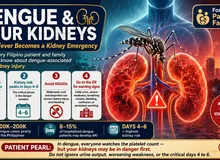
- Dengue. Fever in the rainy season may be dengue; watch platelet counts, fluid balance and warning signs, and do not give nonsteroidal anti-inflammatory drugs (NSAIDs).
- Leptospirosis. Wading in floodwater carries risk of leptospirosis and acute kidney injury; ask about exposure after typhoons and floods.
- Strongyloides. A gut parasite that can cause overwhelming hyperinfection when corticosteroids are given; candidates from endemic areas are screened or treated before transplant.
Three days after floodwater rose through his barangay in Malabon, Mr. Ramos calls. He waded through knee-deep water to rescue his neighbor's children. Now he has fever, severe calf pain and red eyes, and he is passing less urine.
You recognize a possible leptospirosis exposure in an immunosuppressed recipient with falling urine. You do not suggest waiting to see. You direct him to the emergency department now, call ahead to the transplant team, and record his exposure history so the emergency staff hear it from the start.
What this shows. Local exposures change the differential. Ask about floodwater, mosquitoes and sick contacts on every fever call.
The fever or illness call
Use a structured approach so that nothing important is missed and the disposition is clear.
- Where and how to reachConfirm identity, current location and a callback number before anything else, in case the call drops.
- ContextMonths since transplant, recent rejection treatment, current immunosuppression and prophylaxis, recent procedures or stent.
- AcuityBreathing difficulty, confusion, fainting, chest pain, very low urine output, rigors, inability to keep medicines down, severe abdominal pain; temperature and blood pressure if a device is available.
- Focus and exposuresCough, urinary symptoms, diarrhea, rash, wounds; sick contacts, floodwater, mosquito exposure, travel.
- DispositionEmergency care now; same-day assessment; or advice and a defined callback, according to protocol and the transplant physician's direction.
- Close the loopNotify the transplant team, document advice and read-back, and track any tests ordered until they are reviewed.
A woman calls about her husband, who had a transplant five months ago. He has fever and "is talking strangely." Then the line drops.
Because you asked for her location and a callback number in the first 20 seconds, you can call back. You reach her on the second try and direct her to the nearest emergency department immediately. You notify the transplant team and the receiving hospital, and you document the advice and her read-back.
What this shows. Location and callback number come first. In an emergency call, they are the only details you cannot get later.
Vomiting and diarrhea deserve special mention: they cause dehydration and acute kidney injury (AKI), may prevent absorption of immunosuppressants, and diarrhea can paradoxically raise tacrolimus levels. These patients often need same-day assessment.
Case: Chills, weakness and less urine
Saturday, 4:00 p.m., transplant hotline. Mrs. Garcia, 57, calls. She is five months after a deceased-donor transplant and stopped valganciclovir prophylaxis three weeks ago, as planned.
She has had chills since morning and feels "too weak to stand for long." She has passed "only a little urine" today. Her husband measured a temperature of 37.9 °C. She vomited her morning medicines, including tacrolimus, about an hour after taking them.
She lives 40 minutes from the nearest hospital. Her husband can drive. Halfway through the call she says she feels dizzy and needs to sit down.
Before reading on, decide what you would assess, whom you would contact and what you would say, what you would teach, and what would make you escalate. Then compare with the debrief below.
Assess
Communicate
Teach
Escalate
The nurse in the story had already taken her address and her husband's number in the first minute. When Mrs. Garcia said she felt dizzy, the nurse did not continue the full questionnaire. She told her to lie down, asked her husband to take her to the emergency department now, and had him repeat the name of the hospital.
She called the on-call transplant physician, then the emergency department, so they knew a recipient with fever, low urine output and lost immunosuppressant doses was on the way. She documented the time of each call and the read-back.
In the emergency department, Mrs. Garcia's blood pressure was low and her creatinine had doubled. She was admitted for intravenous fluids, cultures and a cytomegalovirus test. The test came back positive on Monday, which is where the second round begins.
Submit: A triage and routing record showing the backup reviewer, acknowledgment, and patient communication.
Check your understanding
Each visit draws 5 questions at random from this module’s 15-question bank, in a shuffled order. Choose the single best answer for each, then select Check answers; a rationale appears under every option. Select New set of questions for a different mix. Nothing you select is sent anywhere; scoring happens in your browser and records self-study only.
What this module builds
| Code | The learner can | Course evidence |
|---|---|---|
| K5 | Recognize graft dysfunction and infection, and close the loop on triage and test results. | Fever triage note and trend-based Situation, Background, Assessment, Recommendation (SBAR) |
Performance evidence for this module: Fever triage and abnormal-result follow-through.
With your preceptor
In clinic and on the hotline, supervised. These are prompts for supervised learning, not a procedure. Use your center’s own protocols, contacts and forms; your preceptor observes and signs off each item on the facility’s competency record.
- Map each of your current recipients to a CMV strategy, prophylaxis stop date and BK screening schedule.
- Complete a simulated fever triage call using the structured form.
- Teach food and water safety and tropical exposure precautions using teach-back.
- Review a recipient's vaccine plan with the transplant team.
- Track a viral load result from collection to documented review and patient communication.
Read next on this site
- Viral Infections and Vaccinations in Kidney DiseaseViral infections and vaccines in kidney disease.
- Dengue & Your Kidneys — When Fever Becomes a Kidney EmergencyDengue and the kidney.
- Fever and Kidney Injury in the TropicsTropical infections that injure the kidney, including leptospirosis.
Back to the Transplant Nurse subtrack home · the Nephrology Nursing course · the entry lesson, Nephrology Nursing Module 11.