After this module you should be able to
- Build a discharge plan covering medicines, sampling, warning signs, contacts and follow-up that the patient can explain back.
- Use teach-back and demonstration to confirm understanding, and correct gaps.
- Close the loop on outpatient laboratory results, from receipt to patient communication.
- Explain the long-term risks of cardiovascular disease, post-transplantation diabetes, cancer and bone disease, and the nursing role in each.
- Plan adolescent transition by readiness, and support patients when a graft begins to fail.
Handing over the controls
In hospital, the team flies the plane: nurses give medicines on time, blood is drawn at the right moment, and abnormal results reach a physician within hours. At discharge the controls pass to the patient and family, who must now do all of that themselves, at home, often far from the center, while recovering from surgery. A discharge plan is a flight manual. It works only if the new pilot can read it, has the instruments, and knows whom to radio when something goes wrong.
Where the analogy falls short: pilots train for months before flying alone. Recipients get a few days. That is why every element of the plan must be tested, not just told, and why the first weeks of follow-up are so frequent.
A discharge plan the family can carry out
Before the patient leaves, confirm access, not just understanding. Reconcile the medicines (Module 6) and verify that the exact formulations are in hand or reliably obtainable, with a refill date and a supply plan. Confirm transport to the first visit and to the laboratory, how results will reach the team, and the after-hours route.
Teach-back. Ask the patient to explain or show, in their own words: "Tell me how you will take your tacrolimus on the morning of your blood test." "Show me how you check your blood pressure." "If you have a fever on Sunday night, what will you do?" Correct gaps and ask again. A systematic review in kidney disease found teach-back improved knowledge, self-efficacy and self-management in most studies, although trials were small and heterogeneous.1 It costs minutes and catches errors that a signature on a form never will.
Mr. Cabrera, 52, signed his discharge teaching form yesterday. This morning you ask him to show you his medicines for tomorrow. He picks up the tacrolimus box and the mycophenolate box and says, "These are the same, the antirejection ones, I take them together at eight." He is right about the time. He does not know which is which, and his blood test is tomorrow morning.
You lay the boxes on the table with his daughter. You put a colored sticker on the tacrolimus box and write "bring this to the laboratory, take after the blood is drawn." Then you ask him to walk you through tomorrow morning from the moment he wakes up. On the second try he gets it right.
What this shows. A signed form shows that teaching happened. Teach-back shows whether it worked.

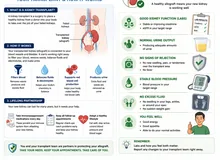
The five parts of a discharge plan, each confirmed by teach-back and by checking that the family can actually obtain what it needs.
The first months and closed-loop results
Follow-up is frequent at first and tapers over the first year. The Kidney Disease: Improving Global Outcomes (KDIGO) recipient guideline suggests visits several times weekly in the first month, tapering to every few months after the first year, because rejection, drug toxicity and infection are most likely early.2 Each visit typically includes creatinine, electrolytes, blood count, glucose, tacrolimus trough, urine protein, and the scheduled viral tests (Module 8).
A result is complete only when the loop is closed. The steps are: the result is received; an authorized clinician reviews it; an action or disposition is documented (dose change, repeat test, no change); and the patient is told when indicated. Results that arrive after hours, on weekends, or from an outside laboratory are the ones most often lost. Every abnormal result needs a named owner, with a backup when that person is away (Module 11 turns this into a measurable process).
Mrs. Javier's potassium was 6.4 mmol/L on a Saturday sample sent from a provincial laboratory. The fax arrived at the clinic on Saturday afternoon. Nobody saw it until Monday.
She was fine, by luck. At the next team meeting, you and Carla map how weekend and outside results arrive. You propose a named weekend reviewer and an after-hours number for laboratories to call with critical values. The team adopts it.
What this shows. Results that arrive after hours or from outside laboratories are the ones most often lost. Close the loop by design, not by luck.
From rejection to heart, sugar, cancer and bone
After the first year, most recipients who lose their kidney either die with a functioning graft or lose it to chronic injury. The leading cause of death with a functioning graft is cardiovascular disease, driven by pre-existing vascular damage from years of kidney disease, plus the hypertension, diabetes and lipid effects of immunosuppression.2
Post-transplantation diabetes mellitus (PTDM). Tacrolimus impairs insulin secretion by pancreatic beta cells; corticosteroids increase insulin resistance; weight gain after transplant adds to both. The 2024 international consensus emphasizes that early post-operative hyperglycemia is common and should not be labeled PTDM; the diagnosis is made once the patient is stable on maintenance immunosuppression.3 glycated hemoglobin (HbA1c) can be misleading in the first months because of anemia and recent transfusion. Nurses screen glucose as ordered, teach diet and activity, and recognize hypoglycemia once treatment starts.
Eight months after transplant, Lorna, 45, has gained 9 kilograms. Her fasting glucose has been 128 to 140 mg/dL on her last three visits. She says, "The doctor said high sugar right after surgery was normal, so I'm not worried."
You explain the difference: high sugar in the first weeks after surgery is common, but she is now stable on her maintenance medicines, and these readings need a doctor's review. You record the trend and her weight and route them to the transplant nephrologist. You also start a conversation about the food she eats at work, and refer her to the dietitian.
What this shows. Early hyperglycemia and diabetes after transplant are not the same thing. The timing of the reading matters.
Cancer. In a linkage of more than 175,000 US solid-organ transplants, overall cancer risk was about twice that of the general population, with the largest excess for non-Hodgkin lymphoma (about 7.5 times) and increases in many virus-related and some non-viral cancers.4 Skin cancers, not captured in that registry analysis, are the most common malignancy in recipients in many countries. Teach sun protection (shade, clothing, sunscreen), self-examination of skin, and keep age-appropriate screening up to date. Report new lumps, nonhealing skin lesions, night sweats or weight loss.
Mang Isko, a fisherman from Batangas, shows you a scaly sore on his ear that has not healed in two months. He thought it was sunburn.
You record its size and location, take a photo with consent for the chart, and route it to the transplant team for dermatology referral. Then you talk about a wide-brimmed hat and long sleeves on the boat, and ask him to check his skin each month.
What this shows. Recipients who work outdoors carry a high skin cancer risk. A sore that does not heal is reported, not watched.
Bone and other risks. Steroids and pre-existing mineral and bone disorder raise fracture risk; follow the ordered calcium, vitamin D and bone assessments. Hypertension and lipid targets follow the team's plan. Mood, sleep, work, sexuality and reproductive plans belong in follow-up conversations, because they drive adherence and quality of life.
Teenagers, graft failure and living donors
Adolescent transition. Adolescence and young adulthood are the highest-risk years for graft loss, largely through nonadherence and the disruption of moving from pediatric to adult care. In a US registry analysis, recipients transferred to adult care before age 21 had 58 percent higher graft failure rates than those of the same age who transferred later.5 This is observational, but it supports transition based on readiness (self-management skills, understanding of medicines, ability to book appointments) and an agreed clinical handover, not age alone.
Bea had her transplant at 12. She is now 19, a college student in Manila, and her mother, who managed every dose, has stayed in the province. Her last two tacrolimus levels were very low.
You see Bea alone for part of the visit. She admits that she forgets the evening dose when she studies late. You set up a phone alarm with her, give her the clinic number to save under her own name, and agree that she will book her next laboratory visit herself, with you checking that it happened.
What this shows. Transition is a set of skills to build and check, not a date on the calendar.
When a graft begins to fail. Kidney function may decline slowly over years. Support honest conversations about the options: dialysis access planning, retransplant evaluation (Module 1 applies again), or supportive care. Immunosuppression is usually continued and adjusted by the team during this period; do not let a patient stop medicines because "the kidney is failing anyway."
Living donors have their own follow-up plan (Module 3), separate from the recipient's, with at least annual blood pressure, kidney function and albuminuria checks.6
Case: Medicines named, refills unknown
Day 7, 10:00 a.m., discharge planning. Mr. Ocampo, 63, is ready for discharge after a living-related transplant. His wife, his main caregiver, can name every medicine and its time without looking at the list. You are impressed.
Then you ask how they will get next month's tacrolimus. She looks surprised. "We will look for it when it runs out." They live in Tarlac. The nearest pharmacy they know is in town, and they have never asked whether it stocks his formulation.
They share one mobile phone with their son, who works night shifts in Manila and keeps the phone during the day. The first clinic and laboratory visit is in four days.
Before reading on, decide what you would assess, whom you would contact and what you would say, what you would teach, and what would make you escalate. Then compare with the debrief below.
Assess
Communicate
Teach
Escalate
The nurse in the story did not sign the discharge until a supply route was confirmed. She called the transplant pharmacist, who confirmed that the hospital pharmacy could dispense a month's supply, and asked benefits staff to check coverage under the adult post-transplant package.
She recorded the son's number with his consent and agreed a calling window with the family: after 6 p.m., when the son is home. She then asked Mrs. Ocampo to explain the refill plan back: where, when, and what to do if the pharmacy has none. On the first try, she forgot the last part; on the second, she had it.
Mr. Ocampo went home that afternoon with 30 days of tacrolimus, a written plan for the next refill, and a reminder in the clinic tracker for the nurse to check his supply at the four-day visit.
Submit: A follow-up plan with contact consent, transport and refill contingencies, and named backup contacts.
Check your understanding
Each visit draws 5 questions at random from this module’s 15-question bank, in a shuffled order. Choose the single best answer for each, then select Check answers; a rationale appears under every option. Select New set of questions for a different mix. Nothing you select is sent anywhere; scoring happens in your browser and records self-study only.
What this module builds
| Code | The learner can | Course evidence |
|---|---|---|
| K4 | Reconcile immunosuppression and manage monitoring and supply gaps within nursing scope. | Two-source medication reconciliation and teach-back |
| K6 | Plan longitudinal follow-up, including transition, equity and self-management. | One-page discharge plan and care adaptation |
Performance evidence for this module: One-page discharge plan and teach-back.
With your preceptor
On the ward at discharge and in clinic. These are prompts for supervised learning, not a procedure. Use your center’s own protocols, contacts and forms; your preceptor observes and signs off each item on the facility’s competency record.
- Write a one-page discharge plan for a synthetic recipient and test it with teach-back on a peer.
- Observe a patient demonstrating home blood pressure and temperature measurement.
- Trace one outpatient result from receipt to documented review and patient communication.
- Teach sun protection and skin self-examination.
- Review your center's adolescent transition process and readiness checklist.
Read next on this site
- When a Kidney Transplant FailsPlanning when a transplant begins to fail.
- Diabetes & Your KidneysDiabetes and the kidney, including management principles.
- Understanding Kidney TransplantPatient overview of life after transplant.
Back to the Transplant Nurse subtrack home · the Nephrology Nursing course · the entry lesson, Nephrology Nursing Module 11.